Going Whole Hog

Go Ahead, Pig Out!

Go Ahead, Pig Out!

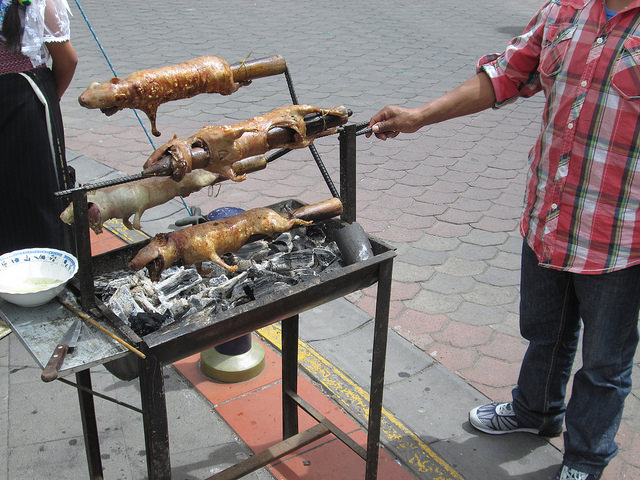
Dan and I were in Otavalo, two hours north of Quito. Famous for its textile and other handicrafts, the town of some 90,000 inhabitants is also famous for fiestas. In addition to the Ecuadoran equivalent of carnitas (shown above), there are other local meat specialties, such as cuy, or guinea pigs (shown below). In both Peru and Ecuador, I have seen paintings in cathedrals of the Last Supper in which Christ and his apostles were dining on cuy. (I’ll try to post one of them at some point in the future.)

Cooking Cuy, or Guinea Pigs

Cooking Cuy, or Guinea Pigs

Dan resolved to try some cuy, but I guess he didn’t have the heart for it. I guess it reminded him too much of the hamster named Mutzi that we had as a pet when we were kids. Also, they are famous for their paucity of meat combined with a plethora of tiny bones.

Latin American Churches

Altar of Quito’s La Compañía de Jesús Church

Altar of Quito’s La Compañía de Jesús Church

In my posting the other day on Why Did I Go to Ecuador?, I seem to have left out one of the main reasons. This applies equally to Peru and probably Colombia, but not so much to Argentina, Chile, and Uruguay.

I am referring to the Catholic cathedrals, basilicas, and other old churches of the Andes. Until age 17, I received a Catholic education at St. Henry School in Cleveland and Chanel High School in Bedford, Ohio. Then, while I was at Dartmouth, although a nominally Congregationalist school, I was very active with the Catholic Students’ Newman Club.

Coming to California has been disastrous to my faith—but yet something remains. It comes out when I visit the Andean churches, the most beautiful of which is La Compañía de Jesús church (shown above) near Quito’s Plaza de la Independencia.

In both Peru and Ecuador, I frequently stopped in at the local churches; and, not infrequently, I stayed for the services. In the Andes, I felt like a Catholic again. Even the smaller churches in places like Otávalo, Alausi, and Mindo drew me in.

The Small Church in the Village of Mindo

The Small Church in the Village of Mindo

In my life’s journey, I can see my returning to the Catholic Church. I continue to take exceptions to many points of dogma, such as the prohibitions on married priests, women in the priesthood, abortion, and divorce and some doctrines such as the relatively recent ones of the Immaculate Conception and what I call Papal Inflammability. On he other hand, there is much to admire. At this point, I am not sure which route I will take.

It’s OK To Be a Fool!

When in Doubt, Use All Means To Communicate—Even If It Makes You Look Like a Fool

When in Doubt, Use All Means To Communicate—Even If It Makes You Look Like a Fool

I never took Spanish in school, so most of my knowledge of the language comes from an old Berlits Latin American Spanish phrase book. I’m pretty good at getting a place to stay, and even better at ordering a meal. What I cannot do is engage in a conversation. I will try gamely, but my Rule #1 is never ever get flustered.

Once you get flustered, the person who is talking to you will think that you are being a rude dickhead for no earthly reason. It is far better to look stupid and try patiently with your limited repertoire, including hand gestures and even written notes.

At the bus station in Cuenca, I tried hard to buy a ticket for a ride to Alausi. Although the signs on the booth indicated that Patria buses stopped there, the lady refused to sell me a ticket there. Instead she went into a long explanation which I didn’t understand. Finally, I bought a ticket instead to Riobamba, which was a major stop on the line, albeit past Alausi. I figured I could get off the bus near enough to Alausi to get there by other means—at worst walking a kilometer or two down the hill. (I knew that the buses would not stop in Alausi itself, as it was in a valley below the Pan-American Highway.)

In the end, not only did I have no trouble getting off at the Alausi bus station on the Pan-American Highway (a place called La Estación), but the conductor called a cab for me.

I think what the woman’s long explanation at the Cuenca terminal was all about was that the bus did not go into the town of Cuenca, a fact which I already knew. Although I was out about fifty cents by buying a ticket to Riobamba, everybody was a winner in this transaction.


Why Did I Go to Ecuador?

Plaza Independencia in Quito

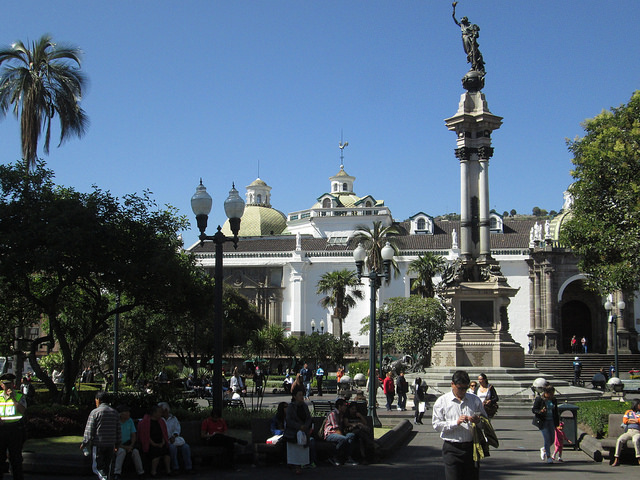
Plaza de la Independencia in Quito

A reasonable question, one that I have been asked frequently by people who know me. My answers will probably tell you a whole lot more about me than about Ecuador:

  1. I am drawn to South America because it is at one and the same time strangely different, yet not to the extent that I would feel totally at sea. And it has been so neglected by North Americans.
  2. The Andes are incredible. When my brother and I were lost on a road that was not on our map, we suddenly came upon the volcano Chimborazo, which was not only striking in its own right, but surrounded by herds of wild vicuñas. It was a magical moment of the type I keep having in Latin America.
  3. You can always find a bench at a beautiful tree-shaded plaza, get a shoe-shine, and do some world class people watching.
  4. It’s so nice to leave Los Angeles during a heat wave and find oneself in the mountains.
  5. South Americans feel so out of the way of “mainstream civilization” that they tend to be friendly and curious. I keep having interesting conversations with locals who know a little English; when they don’t speak English, I just try to carry on with my poor Spanish.
  6. I have a positive loathing of mosquitoes, so I tend to avoid jungles.
  7. It’s fun to spend the months before vacation time reading up on a culture with which one isn’t familiar.
  8. After standing on the zero meridian at Greenwich Observatory in London, I always wanted to stand on the Equator.
  9. Nobody I know knows anything about Ecuador.
  10. Ever since my visits to Mexico in the 1970s and 1980s, I fell in love with Pre-Columbian art in all its variety.

There’s probably half a dozen more reasons I could come up with, but this’ll do for starters.

The Approach to J. L. Borges

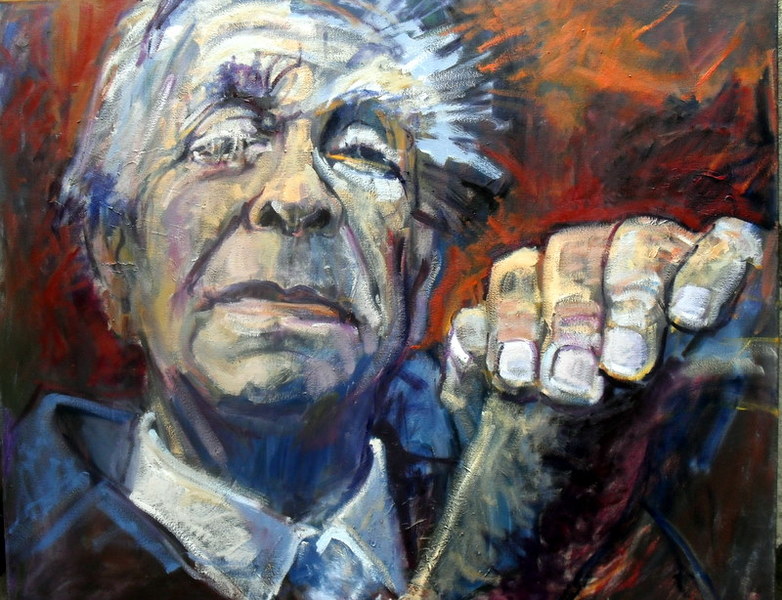
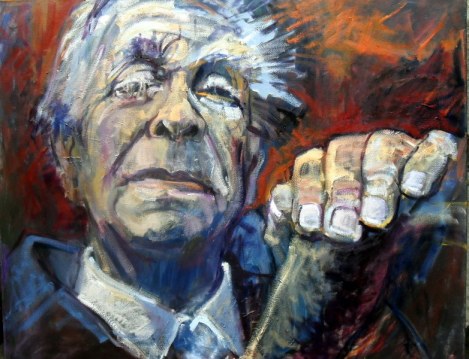
Argentinian Author and Poet Jorge Luis Borges

Argentinian Author and Poet Jorge Luis Borges

In 1935, Jorge Luis Borges wrote a story entitled “The Approach to al-Mu’tasim.” In it, he writes of a man who, after a religious riot between Hindus and Muslims, “becomes aware of a brief and sudden change in that world of ruthlessness—a certain tenderness, a moment of happiness, a forgiving silence in one of his loathsome companions.” He concludes that “somewhere on the face of the earth is a man from whom this light has emanated; somewhere on the face of the earth there exists a man who is equal to this light.”

For me, the source of that light—at least in the world of 20th Century literature—is Jorge Luis Borges himself. I have read all his works that have been translated into English, and even the many interviews he conducted toward the end of his life. I am now on the lookout for ever more obscure works … and I think I have found a good candidate.

The book is by Argentinian author and filmmaker Edgardo Cozarinsky, and its title is Borges In/And/On Film (New York: Lumen Books, 1988). Its three parts consist of:

  1. Reviews of films written by Borges before his blindness became total in the 1950s.
  2. The influence of Borges on film critics and filmmakers (mostly French).
  3. A survey of films based on Borges’s stories or scripts.

The parts become decreasingly interesting from one part to the next. He had a curious liking for the films of Josef von Sternberg—before that director had discovered Marlene Dietrich. Afterwards he regards him as “a devotee of the inexorable Muse of Bric-à-Brac.” Reviewing an Argentinian film, Borges writes it “is unquestionably one of the best Argentine films I have seen, which is to say, one of the worst films in the world.”

Of Citizen Kane, he writes that it “suffers from gigantism, from pedantry, from tediousness. It is not intelligent, it is a work of genius—in the most nocturnal and Germanic sense of that bad word.”

Of Victor Fleming’s version of Doctor Jekyll and Mr. Hyde, Borges complains that he “avoids all surprise and mystery; in the early scenes of the film, Spencer Tracy fearlessly drinks the versatile potion and transforms himself into Spencer Tracy, with a different wig and Negroid features.”

Although Borges did no write many film reviews, many of his observations are interesting. He also has made one notable howler: Recalling Sergei Eisenstein’s Battleship Potemkin (1925), he writes:

Thus, in one of the noblest Soviet films, a battleship bombards the overloaded port of Odessa at close range, with no casualties except for some marble lions. The markmanship is harmless because it comes from a virtuous, maximalist battleship.

It is not the Potemkin that bombards Odessa, but the Czarist Black Sea Fleet, whose shooting results in a massacre.

The above painting is the work of Beti Alonso.

“Ernesto Cardenal and I”

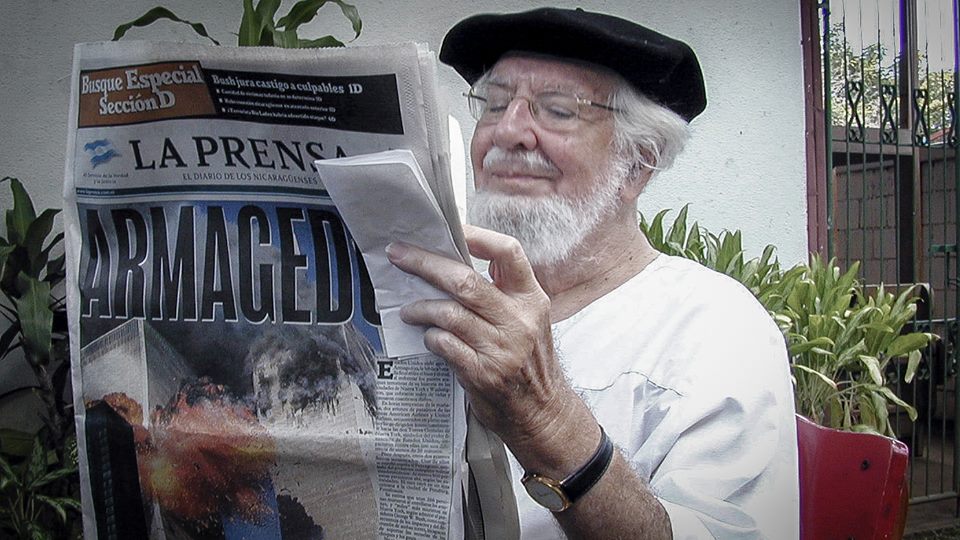
Poet, Priest, and Sandinista Politician: Ernesto Cardenal

Poet, Catholic Priest, and Sandinista Politician: Ernesto Cardenal

It suddenly struck me that i haven’t done a poetry posting on this blog for some time. Keeping it all in a Latin American vein, here is Roberto Bolaño’s “Ernesto Cardenal and I.” Ernesto Cardenal was the Sandinista minister of culture from 1979 to 1987 under Daniel Ortega’s government.

Ernesto Cardenal and I

I was out walking, sweaty and with hair plastered
to my face
when I saw Ernesto Cardenal approaching
from the opposite direction
and by way of greeting I said:
Father, in the Kingdom of Heaven
that is communism,
is there a place for homosexuals?
Yes, he said.
And for impenitent masturbators?
For sex slaves?
For sex fools?
For sadomasochists, for whores, for those obsessed
with enemas,
for those who can’t take it anymore, those who really truly
can’t take it anymore?
And Cardenal said yes.
And I raised my eyes
and the clouds looked like
the pale pink smiles of cats
and the trees cross-stitched on the hill
(the hill we’ve got to climb)
shook their branches.
Savage trees, as if saying
some day, sooner rather than later, you’ll have to come
into my rubbery arms, into my scraggly arms,
into my cold arms. A botanical frigidity
that’ll stand your hair on end.

The Journalist

Svetlana Alexievich, Winner of the 2015 Nobel Prize for Literature

Svetlana Alexievich, Winner of the 2015 Nobel Prize for Literature

I have only read two of her books so far, but they were both knockouts. First, there was Zinky Boys (1991), about the Soviet experience in Afghanistan. Now, added to that is Voices from Chernobyl: The Oral History of a Nuclear Disaster (1997). Both books are descriptions of incredible suffering, and they are both powerful disincentives from enlisting in the Soviet military.

Svetlana Alexievich (b. 1948) is usually described as a Belorussian journalist, though she herself rejects the title: She has been known to edit the first person testimonials from one edition to the next, which is a big no-no for oral historians, but the mark of an imaginative writer. I do not mind, because I will accept 99-44/100% accuracy if it involves stylistic or other improvements.

Both Afghanistan and Chernobyl were unspeakable disasters that seemed to go on forever (the latter is still claiming victims), and you cannot hope for a better introduction to both than read Alexievich’s books.

In Voices from Chernobyl, the wife of one Soviet soldier who was involved in the cleanup says:

They say, “Chernobyl,” and they write, “Chernobyl.” But no one knows what it is. Something frightening opened up before us. Everything is different for us: we aren’t born the same, we don’t die the same. If you ask me, How do people die after Chernobyl? The person I loved more than anything, loved him so much that I couldn’t possibly have loved him more if I’d given birth to him myself—turned—before my eyes—into a monster. They’d taken out his lymph nodes, so they were gone and his circulation was disrupted, and then his nose kind of shifted, it grew three times bigger, and his eyes became different—they sort of drifted away, in different directions, there was a different light in them now, and I saw expressions in them I hadn’t seen, as if he was no longer himself but there was still someone in there looking out. Then one of the eyes closed completely.

I do not recommend reading the book on a full stomach. The same with Zinky Boys:

We were combing through a village. You fling open the door and throw in a grenade in case there’s a machine-gun waiting for you. Why take  a risk if a grenade could sort it out for you? I threw the grenade, went in and saw women, two little boys and a baby in some kind of box making do for a cot.

You have to find some kind of justification to stop yourself going mad. Suppose it’s true that the souls of the dead look down on us from above?

I know that we considered the Soviets to be our enemies, but these books describe scenes that one wouldn’t wish upon one’s worst enemy.


Pre-Columbian, Then and Now

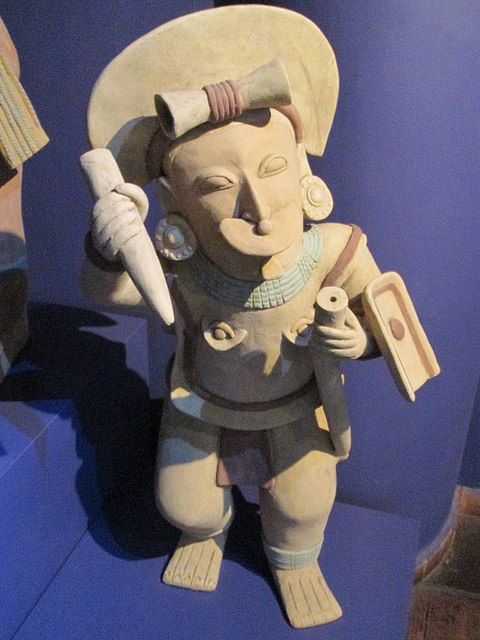
A Unique Museum Linking Pre-Columbian Art to the Present Day

A Unique Museum Linking Pre-Columbian Art to the Present Day

There it was, a museum just one block from our hotel in the Mariscal district of Quito. I knew that Dan was interested in seeing and buying Ecuadorian handicrafts, so we decided to pay a visit to the Museo Mindalae, which calls itself an ethno-historical museum of Ecuadorian handicrafts.

It turned out to be a good call. Although we are more than half a millennium away from Christopher Columbus, the peoples of the Andes are still very much in touch in touch with their ancestors. Of course, not only the Spanish, but subsequent rulers encouraged them in this. Today, the Fundación Sinchi Sacha, which runs the museum, not only encourages them, but runs a three-story handicraft store featuring the best of their work at fair prices.

Pre-Columbian or Current?

Pre-Columbian or Current?

I wound up liking the Museum so much that I returned to it the day before leaving Ecuador for the U.S. Both Dan and I bought several pieces of art from the store.

When, subsequently, we saw the crafts markets at Otavalo and Cuenca, we had a good idea what we would find and how much it might cost.

Regarding Henry

Henry Miller (1891-1980)

Henry Miller (1891-1980)

Is Henry Miller famous? Or is he just infamous? Or is he both?

I have just finished reading a book of his essays, reviews, and prefaces entitled Stand Still Like the Hummingbird (1962) and find myself alternately idolizing and deploring the man’s work. Of course, he is probably most famous for his novels featuring S-E-X, especially The Tropic of Cancer (1934). And yet, he can write like a Bodhisattva, as in the essays “The Hour of Man” and “The Immorality of Morality.”

In the latter essay, he wrote what I regard as the definitive answer as to how to live in the era of Trump:

Neither would I urge one to run away from the danger zone. The danger is everywhere: there are no safe and secure places in which to start a new life. Stay where you are and make what life you can among the impending ruins. Do not put one thing above another in importance. Do only what has to be done—immediately. Whether the wave is ascending or descending, the ocean is always there. You are a fish in the ocean of time, you are a constant in an ocean of change, you are nothing and everything at one and the same time. Was the dinner good? Was the grass green? Did the water slake your thirst? Are the stars still in the heavens? Does the sun still shine? Can you talk, walk, sing, play? Are you still breathing?

And yet, in another essay entitled “To Read or Not To Read,” Miller brags about reading fewer books “I tried to make it clear that, as a result of indiscriminate reading over a period of sixty years, my desire now is to read less and less.”

One of Miller’s Water Colors

One of Miller’s Water Colors

Is it perhaps because Miller also sees himself as a painter, particularly of water colors? The ones I have seen are pretty good, and I shouldn’t be surprised if the author likes the act of pure creativity involved in coming up with these scenes, which he does not paint from life.

In the end, I see Henry Miller as, at times, gifted by his muses—and at other times merely producing when the muses aren’t present. There is a certain lack of consistency in his work. I will continue to read him for the times I find he is spot on.

“Men of the Red Earth”

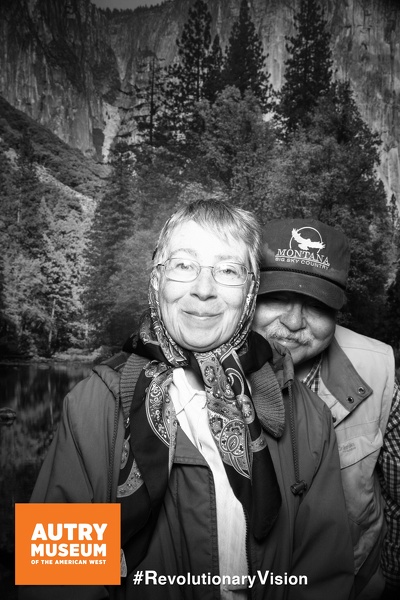
Martine and Me at the Autry Museum

Martine and Me at the Autry Museum

Today, Martine and I stayed as far away from the Black Friday Madness as possible. Instead, we went to the Autry Museum of the American West in Griffith Park. At the #RevolutionaryVision show, we took the above picture, showing a pleasant looking woman and the strange character who photobombed her.

The Autry has been opening some new galleries and updating others. There was a nice exhibit of Mabel McKay’s Pomo Indian basketry, and the usual excellent art of the West. Below is Maynard Dixon’s “Men of the Red Earth”:

“Men of the Red Earth”

“Men of the Red Earth”

Born in Fresno, California, Maynard Dixon (1875-1946) is probably one of the best painters of the American Southwest. Although the museum was founded by Gene Autry, it attempts to present a panoramic picture of the West, including the land, the Western films, the art, the myths, and the environment.

I’ve always thought it an excellent place for travelers from other countries to visit—though I suppose they will continue to troop to Hollywood and be disappointed.