Musashi and the Flies

You Don’t Have to Draw a Sword to Prove Your Swordsmanship

I had forgotten the movie in which this scene took place until I viewed the DVD this morning. The great masterless samurai, Musashi Miyamoto (played by the redoubtable Toshiro Mifune), is holed up in a cheap inn in which a loud group of gamblers was partying. When Musashi’s disciple, Jotaro, goes out and tells them to shut up, they decide to teach Musashi a lesson. They charge up he stairs to his room, where Musashi is calmly eating a dish of noodles with his chopsticks. He is not much bothered by the gamblers, but he is irritated by the flies buzzing around him and his meal. Without sparing a glance elsewhere, he reaches out with his chopsticks and kills several flies, one after the other. The gamblers are awestruck at Musashi’s demonstration of icy control and quietly back out of his room. In fact, their ringleader, Kumogoro, insists on becoming Musashi’s disciple.

The film is Duel at Ganryu Island (1956), the third film in Hiroshi Inagaki’s Samurai trilogy.

Although the Inagaki trilogy is by no means the greatest of samurai films, I have so many happy memories of seeing the films that I have invested them with perhaps more merit than they deserve. They are, in fact, quite good—particularly at influencing a 21-year-old who had just arrived in Los Angeles and found the whole genre congenial to him.

Pioneer Life in the Old West

Figure on Three Hours of Fun

One of our favorite types of museums is the outdoor museum concentrating on life as it was lived in former times. In Bishop, California, there is the Laws Railroad Museum and Historical Village. In Dearborn, Michigan, there is the Henry Ford Museum and Greenfield Village, which I saw as a kid with my parents. And it’s not just an American phenomenon: Martine and I loved Enkhuizen in the Netherlands, and in Iceland I enjoyed visiting Reykjavík’s Arbær Open Air Museum. Finally, last month, Martine and I spent an enjoyable afternoon touring the Aztec Museum and Pioneer Village in Aztec, New Mexico.

After visiting the Anasazi ruins at Aztec Ruins National Monument, we drove down the street and checked out the Aztec Museum. The more we looked, the more we were drawn into the vortex of pioneer life in northwestern New Mexico. There were toys, costumes, minerals, three barber chairs, agricultural implements, and, in the back, a whole pioneer village consisting of small-sized schools, stores, doctor’s office, pharmacy, blacksmith—you name it.

One of the strangest exhibits was the Pecos West Cyclorama, a labor of love by Valenty Zaharek which “features over 100 hand carved woodcarvings of people, animals, plants, buildings, vehicles and the high mesas and mountains of the desert Southwest. The cyclorama measures eighteen feet in diameter and slowly rotates as old west cowboy music plays in the background.” I spent over half an hour admiring the attempt to summarize the Old West in a rotating wooden display, with music no less.

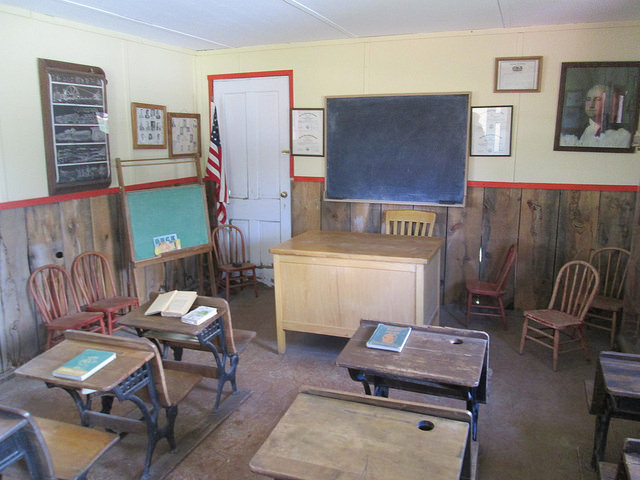
Aztec Pioneer Schoolhouse

Martine and I also went into the Pioneer Village outbuiildings, which are built to approximately half scale. Above is a photo of the little one-room schoolhouse, complete with teacher’s and students’ desks, blackboard, and typical textbooks and wall displays. The same attention to detail appears in all the other buildings as well.

Originally we didn’t plan on coming to Aztec. Instead, we were going to go on to Durango, Colorado. When we were in Chama taking the Cumbres & Toltec Narrow Gauge Railroad, however, Martine was showing signs of discomfort from the altitude, so we changed our plans and went to Aztec instead. We had no reason to regret our decision.


You Know What You Can Do With That Giant Zucchini?

Only Hungarians Know The Answer to This One….

Hungarians use their giant zucchinis to make tökfőzelék. (Don’t swallow your tongue while attempting to pronounce this word, or for sure you won’t enjoy your tökfőzelék!)

This is one of those Hungarian poor people’s dishes which are so delicious. My mouth still waters at the squash dishes my Mom used to make. I’ve made it myself, and it’s really tasty. Here’s what you’ll need:

2 zucchini, about 8-10 inches long
1 yellow summer squash, about 8-10 inches long
(You can use all zucchini or all summer squash if you prefer.)
3/4 tsp. salt (fine-grind salt is best)
2 T red wine vinegar
1 T finely chopped fresh dill
2 T finely chopped onion
2 T butter (or use a slightly smaller amount of olive oil if you prefer, but the butter adds a lot of flavor here.)
2 tsp. paprika, plus more for garnish (preferably Hungarian Szegedi sweet paprika: Don’t mess with the tasteless Spanish variety)
1/3 cup sour cream
1 T flour
1-2 tablespoons dill pickle juice, as needed
dried dill weed, for garnish
additional sour cream, for garnish

Follow the instructions at Kalyn’s Kitchen, complete with photographs to help you come up with a perfect tökfőzelék. Even if you can’t pronounce it, you’ll have no trouble eating it.

I Have a Preposition for You

Yeah, Some of These …

Here’s a poem for you by Morris Bishop entitled “To and Fro”:

I lately lost a preposition;
It hid, I thought, beneath my chair
And angrily I cried, “Perdition!
Up from out of under there.”

Correctness is my vade mecum,
And straggling phrases I abhor,
And yet I wondered, “What should he come
Up from out of under for?”

Wow, six prepositions in a row! That has to be something of a record.

Serendipity: Raven Brings Death to the World

Tlingit Myth: Raven Swallowing the Sun

Now that I have resolved to explore the Inside Passage of Alaska and British Columbia, I have become interested in the many native peoples along the route. And also that means I have a renewed interest in Franz Boas, who spent so much of his career studying the Kwakiutl, the Tlingit, the Bella Coola, the Salish, and others. From Boas’s (edited) Folk-Tales of Salishan and Sahaptin Tribes (1917) comes this tale, from the Nicola Valley, of how death came into this world:

Coyote was travelling, and came to Raven, a bad, selfish chief, who wanted to make everything difficult for other people, and easy for himself. He wanted the game for himself, wanted long winters, and he did not want man to be immortal. Coyote questioned him as to why he wanted people to die. He said, “If people were immortal, there would be too many. Let them become sick and die.” Coyote said, “Why should they die? Death will introduce sorrow into the world, and sorrow is very hard. If they die, what will become of them? Where will they go? Let them be sick, but not die.” Raven said, “No, they must die. I do not wish our enemies to live forever. If the people should become too numerous, there would be no food, and they would be hungry. It is better for them to die.” Raven’s people supported their chief, and clamored for the people to die. Raven, Crow, Fly, Maggot, and many others wanted people to die, so that they might feed on corpses. Coyote said, “Let people die for a while, and then come back to life again. Let death be like sleep.” Raven said, “No, if they die, let them die for good, and let their bodies rot.” At last Coyote agreed, and said, “Well, it is ordained that people shall die when their time has come. Their bodies shall be buried, and their souls shall go to spirit-land; but this will only be until the world changes again, when they will die no more.”

Shortly after that, Raven’s daughter became sick and died. She was the first to die. Raven tried to restore her to life, but failed. Then he wept because of his daughter. He went to Coyote, and said, “Let us change what we said before. Do not let people die and remain dead forever. Let us change it!” Coyote answered, “No, it is settled now, and cannot be altered.” Thus it happens that people die and are buried.

Killing Batteries

Leif Pettersen, Travel Writer Extraordinaire

Travel writers tend to be a bloodless crew these days, which is why I find Lonely Planet writer Leif Pettersen such a delight. He is a specialist in travel to Romania and Moldova (you’ve always wanted to go there, haven’t you?). He is the author of a blog called Killing Batteries, which sends you to some of the more interesting pieces he’s written. My favorite posting is entitled “The 10 Best Lonely Planet Articles of All Time (That I Wrote),” which is a good place to start. It will tell you why Florence is not always the best place to go in Italy, delicious local foods that look ugly, rain and other travel buzz-kills, how to travel with friends (and not want to kill them), stuff you should never take on a trip (includes: children and pets), and best places to stage a cathartic breakdown.

One could read travel articles for information, but if Leif is the author, you will also enjoy them, because the man has a great sense of humor.

Pettersen has recently come out with a book entitled Backpacking with Dracula. Remember, he is an expert on travel in Romania. And he thinks one of the safest places in the world to have a cathartic breakdown is Bulgaria. So you can feel comfortable with Pettersen behind the Slivovitz Curtain.

That Stupid Wall

Will There Be Any Guard Towers Manned by Machine-Gunners?

Last night I was reading author Ursula LeGuin’s blog, and I came upon this poem about Trumpf’s infamous wall written by a poet who is part Mexican Yaqui Indian and part European ancestry.  I am referring to Anita Endrezze. Her poem is called, appropriately, “The Wall.”

The Wall

Build a wall of saguaros,
Butterflies, and bones
of those who perished
in the desert. A wall of worn shoes,
dry water bottles, poinsettias.
Construct it of gilded or crazy house
mirrors so some could see their true faces.
Build a wall of revolving doors
or revolutionary abuelas.
Make it high as the sun, strong as tequila.
Builders of sugar skulls. Adobe or ghosts.
A Lego wall or bubble wrap. A wall of hands
holding hands, hair braided from one woman
to another, one country to another.
A wall made of Berlin. A wall made for tunneling.
A beautiful wall of taco trucks.
A wall of silent stars and migratory songs.
This wall of solar panels and holy light,
panels of compressed Cheetos,
topped not by barbed wire but sprouting
avocado seeds, those Aztec testicles.
A wall to keep Us in and Them out.
It will have faces and heartbeats.
Dreams will be terrorists. The Wall will divide
towns, homes, mountains,
the sky that airplanes fly through,
with their potential illegals.
Our wallets will be on life support
to pay for it. Let it be built
of guacamole so we can have a bigly block party.
Mortar it with xocoatl, chocolate. Build it with coyote howls
and wild horses drumming across the plains of Texas,
from the memories
of hummingbird warriors and healers.
Stack it thick as blood, which has mingled
for centuries, la vida. Dig the foundation deep.
Create a 2,000 mile altar, lit with votive candles
for those who have crossed over
defending freedom under spangled stars
and drape it with rebozos,
and sweet grass.
Make it from two-way windows:
the wind will interrogate us,
the rivers will judge us, for they know how to separate
and divide to become whole.
Pink Floyd will inaugurate it.
Ex-Presidente Fox will give it the middle finger salute.
Wiley Coyote will run headlong into it,
and survive long after history forgets us.
Bees will find sand-scoured holes and fill it
with honey. Heroin will cover it in blood.
But it will be a beautiful wall. A huge wall.
Remember to put a rose-strewn doorway in Nogales
where my grandmother crossed over.
pistols on her hips. Make it a gallery of graffiti art,
a refuge for tumbleweeds,
a border of stories we already know by heart.

Anita Endrezze

I love the heart behind this poem. Maybe it’s not perfect, but it adequately chides the Cheeto-headed mofo for his stupid ideas, none of which he is capable of putting into action as yet. And never, I hope.


Samurai Swords

Toshiro Mifune as Musashi Miyamoto

The above scene is an evocative moment in Musashi Miyamoto (1954), the first film in Hiroshi Inagaki’s Samurai trilogy. Musashi, heretofore called Takezo, has been imprisoned in Himeji Castle by the wily (and wise) Buddhist priest Takuan for three years. He has just stepped out of the castle for the first time and takes a look back at the walls that held him while he learned to tame his wild impulses.

I first saw Inagaki’s trilogy at a seminal point in my life. I had just moved to Los Angeles to start studying film history and criticism at UCLA. Before my classes  began in January 1967, the Toho La Brea theater began screening Musashi Miyamoto. In the following months, Duel at Ichijoji Temple (1955) and Duel on Ganryu Island (1956)—the remaining films of the trilogy—were to be shown. Although I had seen many films at Dartmouth College, I was just starting to get into the whole jidai-geki genre.

Also, I fell in love with Kaoru Yachigusa, the perennially frustrated love interest in the trilogy.

In fact, I got so much into it that, in June, I moved to an apartment on Mississippi Avenue, right in the heart of the Sawtelle Japanese-American neighborhood. At that time, there were two Japanese restaurants around the corner, the O-Sho and the Futaba Grill, where I frequently dined, learning how to tame those unruly chopsticks. My ignorance was still pretty much in evidence: I took the squares of tofu in my miso shiru soup to be shark’s fin.

Kaoru Yachigusa as Otsu, the Love Interest in the Trilogy

Before long, I was going with my film friends to all five Japanese movie theaters in Los Angeles: Not only he Toho LaBrea, but the Kabuki (Shochiku Studio) and Kokusai (Daiei Studio) near Adams and Crenshaw, and the Sho Tokyo (Daiei Studio) and Linda Lea (Tohei Studio). Now all five theaters are gone, but back then, I collaborated with two of my friends (Alain Silver and Jim Ursini) in a column for The UCLA Daily Bruin entitled “The Exotic Filmgoer,” which commemorated not only the Japanese theaters, but some of he others. We wrote under the collective pseudonym of Tarnmoor.

The Criterion Collection has released DVD and Blue-Ray editions of the Samurai trilogy, which are well worth your while.

Serendipity: My Hovercraft Is Full of Eells

The Eells in Question Was the Reverend Myron Eells

In preparation for a projected trip along the Inside Passage to Alaska, I am reading Jonathan Raban’s Passage to Juneau: A Sea and Its Meanings (New York: Pantheon Books, 1999). The book is full of delightful historical anecdotes about Captain Vancouver and other early explorers and settlers. Some got along well with the Indians: Others didn’t. One in the latter category was the Reverend Myron Eells, known for his “garrulous moralism.” More than fifty years after he passed on, he was still remembered by old people who, as children, been on canoes with him. In 1934, William M. Elmendorf interviewed a Skokomish elder who spoke of Eells as “that awful man.” The elder went on to say:

People didn’t like him very well. He was collecting Klallam words from some Klallam Indians who were visiting here one time. I had to translate for him. So he would ask them for words like father, mother, house, dog, and so on. And those people didn’t think much of Eells, so they would give him all sorts of dirty, nasty words, and he would write them down in a book. Then he would try to use some of these words. thinking he was talking Indian, and people would just about bust trying to keep from laughing.

If you have any interest in primitive languages, it would help first to see whether one is on the same wavelength as one’s interviewees. (Oh, and my apologies to Monty Python’s Flying Circus!)

Reckless Driving—With Impunity—At Least, So Far!

A Crazy Man Is Behind the Wheel. When Will We Apprehend Him?

After some six months in office, President Trumpf is turning out to be the cray man I thought he would be. I still remember the worst night of my life, watching the election returns coming in while I was twisting and turning in a hotel in Quito, Ecuador. (Note: Although I was not in the U.S. at that time, I had voted before I left on my vacation.)

It is time to bring the Trumpf to account for his many crimes—and his “you can’t catch me” attitude. What are we waiting for? Child pornography on his computer? Goosing Brigitte Macron in front of her French President husband? An executive order to have Liberals castrated?  Sodomizing Hillary and Chelsea Clinton in front of Congress? Banishing Barack Obama to Kenya? Regardless what he does, he can continue to rely on his core supporters, consisting of the 40% of eligible voters who don’t give a sh*t what happens to our country, especially to the city slickers on the East and West Coasts.

I think we have to be created. Perhaps we should pass out free Oxycontin and other opioids in those states that voted most heavily for him. Those voters should not be immune from sharing in their President’s horrible fate, whatever it might be. Since Trumpf hates Iran so much, perhaps the ancient Persian form of execution known as “The Boat,” or Scaphism, would be appropriate:

The intended victim was stripped naked and then firmly fastened within the interior space of two narrow rowing boats (or hollowed-out tree trunks) joined together one on top of the other with the head, hands and feet protruding. The condemned was forced to ingest milk and honey, and more honey would be poured on the victim to attract insects, with special attention devoted to the eyes, ears, mouth, face, genitals, and anus. In some cases, the executioner would mix milk and honey and pour that mixture all over the victim. The victim would then be left to float on a stagnant pond or be exposed to the sun. The defenseless individual’s feces accumulated within the container, attracting more insects which would eat and breed within the victim’s exposed flesh, which—pursuant to interruption of the blood supply by burrowing insects—became increasingly gangrenous. The individual would lie naked, covered from head to toe in milk, honey, and his own feces. The feeding would be repeated each day in some cases to prolong the torture, so that fatal dehydration or starvation did not occur. Death, when it eventually occurred, was probably due to a combination of dehydration, starvation, and septic shock. Delirium would typically set in after a few days.

In case you didn’t know, I really don’t like the man.