Serendipity: Exile on Exile

Writer W. G. Sebald (1944-2001)

If there is a poster boy for exiles, it is W. G. Sebald, who was born in Germany, but spent most of his life in self-exile. In his collection of essays, Campo Santo, he is curiously unable to come to life talking about the ruins of the Second World War. The farther his subject is from Germany, the better his essays are. One of the very best is “Dream Textures: A Brief Note on Nabokov.” Himself an exile from Red Russia, Nabokov became one of the leading lights of American literature. It is from this essay that these selections are taken:

At any rate, the most brilliant passages in his prose often give the impression that our worldly doings are being observed by some other species, not yet known to any system of taxonomy, whose emissaries sometimes assume a guest role in the plays performed by the living. Just as they appear to us, Nabokov conjectures, so we appear to them: fleeting, transparent beings of uncertain provenance and purpose. They are most commonly encountered in dreams, “in surroundings they never visited during their earthly existence,” and are “silent, bothered, strangely depressed,” obviously suffering from their exclusion from society, and for that reason, says Nabokov, “they sit apart, staring at the floor, as if death were a dark taint, a shameful family secret.”

Vladimir Nabokov With His Butterflies

.   .   .   .   .   .

In the fifth chapter of Pnin he speaks at length and in different voices of the price you must pay on going into exile: not least, besides the material goods of life, the certainty of your own reality…. Unexpectedly finding themselves on the wrong side of the frontier, [Nabokov’s young emigrant heroes] are airy beings living a quasi-extraterritorial, somehow unlawful afterlife in rented rooms and boardinghouses, just as their author lived at one remove from the reality of Berlin in the twenties.


 

My Rudeness Backfires

The Santa Monica Pier at Sunset

I was waiting for the Number 1 Santa Monica bus on 4th Street, near the Expo Line Terminus, when two young women suddenly hove into view as my bus was approaching. When I don’t want to talk to strangers—and I almost never do—I answer them … in Hungarian. Well, these two girls went away thinking I was some kind of a genius instead of a rude bastard manqué.

In English, they asked me which way was the ocean.

In Hungarian, I answered, “You mean the beach?” Their eyes widened. How did I know they were Hungarian? I gestured toward the beach and said, “That way!” in my best Magyar. They thanked me profusely as I boarded my bus.

Actually, they were rather cute.


Martine Is Back!

Martine at the Automobile Driving Museum in El Segundo

This morning, as I was watching the movie Odds Against Tomorrow (1959), the doorbell rang. I thought, “Who could that be? Is it the Jehovah’s Witnesses? LDS Missionaries?” I opened the door to find Martine with her suitcase. She had taken buses from South Central LA to Union Station, and from there the 704 bus, which drops her off two short blocks from home.

Martine had stayed at a women’s shelter run of Volunteers of America near Broadway and West 88th Street, in the heart of South Central. The facility contained some forty bunk beds on each of two floors, sleeping some one hundred sixty women. Martine, who is by no means a sound sleeper, had three nights of no sleep on a mattress that was too soft for her bad back. She had no complaints about the way she was treated or the food that was served, but she could not tolerate another sleepless night. Fortunately, I had purchased for her a senior TAP card with a few dollars of stored value which enabled her to take buses at a discount without having to worry about exact change, so she could take a bus virtually anywhere in the county at will.

During her absence, I was less worried about her because I knew she was being well cared for. Plus she called me three times during her three day sojourn at the center, though I was not able to call her. I suspect that most of the women at the shelter were there because they had been abused by husbands and boyfriends. How were the receptionists to know that I was not an abuser?

Martine’s “escapes” are a symptom of her depression. All I can do is demonstrate to her that I continue to love her and that she can trust me. In all her actions, there is no sign of enmity or exasperation with me. As she stood at my doorstep with her luggage, there was a big smile on her face. I can accept that.


Favorite Films: The Thing from Another World (1951)

The Scene That Scared Me Most as a Kid

My favorite science fiction film of the 1950s was The Thing from Another World, an RKO cheapie that was superbly written and, for me as a boy who grew up in that strange era, utterly frightening. The whole film takes place in a research camp in the remote arctic north of Alaska. An army officer (Captain Hendry) receives orders to investigate the landing of an unknown object weighing some 20,000 tons (18 million kilograms)—far above the weight of known aircraft of the period. Also, it could not be a giant meteor because it went up before ultimately landing.

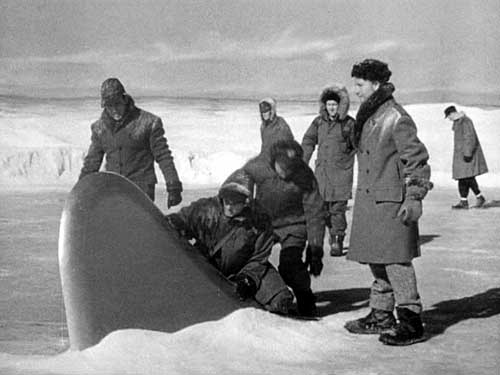
He flies up to the research station and, the next day, scouts out the landing site, in which the entire craft with the exception of a protruding fin is under ice. Hendry’s men line up above the visible edges of the vessel to determine its shape (it is circular, of course) and test the fin for its composition (an unknown alloy of some sort). To study the vessel more carefully, Tobey employs thermite bombs to melt the ice around it. Unfortunately, it also blows up the space ship. In doing so, a large (8 feet or 2.5 meters) figure is thrown from the ship. Still encased in ice, the figure is flown back to the research station.

Tobey orders the windows of the supply room in which it is stored to be broken to keep the figure frozen in ice. One of the guards on a later shift puts an electric blanket over the space alien—for such it turns out to be. The ice melt, the creature awakens, and it immediately goes on the attack.

Flying Saucer Fin Sticking Up Through the Ice

The scientists at the station, led by the venerable Nobelist Dr. Carrington, immediately deduce that the priority must be to communicate with the “obviously” superior creature, even if it turns out to be suicidal in the end. Captain Hendry, on the other hand, is more concerned for the safety of the military and scientific staff. During the beast’s rampages, there is an almost total radio silence with the civilized world because of severe storms.

This 87-minute black and white film was produced in the same year that saw The Day the Earth Stood Still and When Worlds Collide, and it was more successful than either film. My only reaction to that is, to use an expression from the film, “Holy Cat!” By the way, the beast was played by James Arness in his first role.

The film was signed by Christian Nyby as director, though it clearly shows signs of having been heavily influenced by producer Howard Hawks.


Very Old Water

Lower Emerald Pool at Zion National Park

This is a re-post from the visit Martine and I made to the National Parks of Utah in 2007. Minor changes have been made to this post originally dated October 4, 2007.

We were on a walk and ride with one of Zion’s park rangers when we learned an interesting fact. As we stood at a viewpoint looking at little-visited Menu Falls, the ranger explained that the water seeping from the sandstone cliffs had taken a long journey from the top of the cliff down to where it descended to the Virgin River. In fact, it took 2,000 years.

When the water that poured out of the cliffs along their base appeared as rain on the Colorado Plateau, Caesar Augustus was Emperor of Rome and Jesus Christ still walked the earth.

The sandstone that formed the cliffs of Zion National Park was formed from massive dunes that once covered the area. Then the area was under water some 260 million years ago, part of prehistoric Lake Claron. Calcium carbonate from the water seeped down to the sand and helped cement it into sandstone, along with the massive weight of the lake itself, so that millions of years later, it served as a slow and massive sponge that soaked up rainfall and sent it on a long, slow journey until it reached the base of the cliff two millenia later.

Illustrated above is another one of those falls, at Lower Emerald Pool. In the extreme heat of Zion, Martine and I rested on a boulder with the deep shade and stray drops of cool (and very old) water helping us keep comfortable. The ranger had also mentioned that the sandstone purified the water in the process, but Martine and I had cool water in our canteens. I always take the precaution of leaving our canteens in the freezer so that we can be refreshed later in the day during our hikes.


Another Getaway

Martine at the Automobile Driving Museum

Today Martine left me for the fifth time. It wasn’t really a break-up. We wished each other well, and Martine managed to get a space in a women’s shelter in South Central Los Angeles where she could wallow in her depression. She will lie on her back all day and stare at the wall. This evening, at least, she called me and told me where she was staying and how I could get in contact with her. I can’t see how she would be able to tolerate such a minimalist life, though I’ve seen her go through stretches like that here in the apartment. I still love her and hope she herself will come out of her dudgeon long enough to see that the life she has chosen for herself is too unspeakably grim even in the short term.

In her previous getaways, Martine made it to Sacramento, Truckee, Salt Lake City, and some unspecified point in the California desert. She doesn’t want me to interfere with these getaways, yet she always wants to keep at least a minimal line of communication open. That at least is a good thing.

I have gone through these episodes before and have become slightly inured to them. Still, my thoughts are always with her; and I regard my life alone as being incomplete, as if several vital organs were missing. The two things that keep me on an even keel are my old friends and my books. I hope she comes back and decides that maybe the old man is no longer a sexy beast, but he does love her after his own fashion.


How Dare You Interfere With My Manly Pleasures?

That’s a Heavy-Duty Snarl, Brett!

I think both sides have covered all the substantive issues, according to their various points of view. One thing I have not seen is how Brett Kavanaugh seems to have screwed the pooch as far as his nomination to the Supremes is concerned. (That won’t matter to Mitch McConnell, who at this point would gladly accept in nomination Jack the Ripper, Benedict Arnold, or even Judge John Hathorne of the Salem witch trials.)

Admittedly, the Democrats are enraged that are being requested to swallow the bolus of Kavaugh’s sexual and other moral misdeeds and his lies under oath. Somehow, I think he would still have gotten by if only he were nicer. That snarl, though, is such a clear sign of villainy that he is rapidly losing adherents. I mean, who wants to be associated with a guy whose main legal qualifications are his love of beer and pussy.


Optimates and Populares

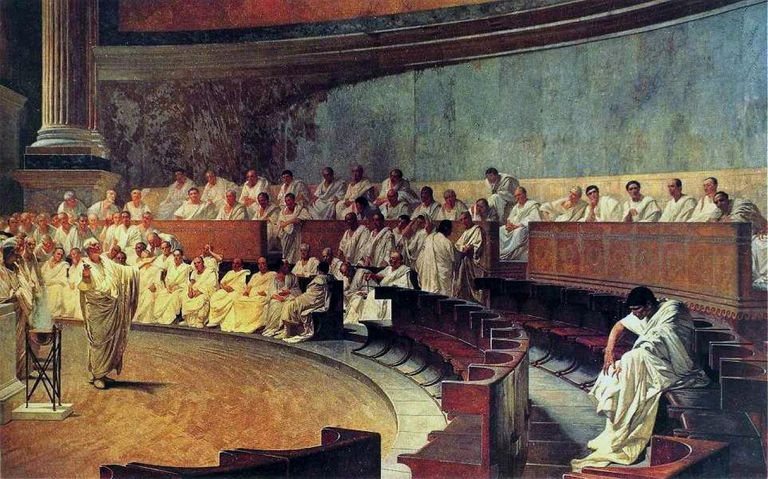
The Roman Senate with Cicero Accusing Catiline (Seated by Himself at Right)

Over the last couple of days, I have been reading Mary Beard’s SPQR: A History of Ancient Rome. We think of the Roman Republic in very decorous terms, with all those dignified men in togas. We don’t see many representations of Roman plebeians, who were not permitted to wear the toga—let alone the thousands of slaves living in the city.

It was actually a far from decorous time, with over a hundred years of violent conflict between the optimates (wealthy upper classes) and the populares (common people). This century included the Brothers Gracchi, who were murdered; the brutal dictator Sulla; the victorious general Marius; and ended with the war between Julius Caesar and Pompey the Great. In many ways, it was reminiscent of our own times—a time when we are envisioning the end of our own Republic from the repeated assaults of the Dictator Trump.

Among the optimates, there were the senate, the consuls, the priesthood, all the Republican offices (Quaestor, Praetor, Aedile, etc.), as well as the class of equites, or knights. For most of its existence, these are the people who ruled the Republic. The populares, or plebeians, were everyone else (always excepting the slaves, who had no one to speak for them). The optimates did everything in their power to aggrandize their power at the expense of the populares. In fact, one of the reasons Julius Caesar was assassinated in the Senate in 44 BC was his policy of sharing power with the populares. The men who stabbed him were all Senators.

I am tempted to equate the optimates with Republicans, and the populares with Democrats. In fact, the situation was complicated by the inhabitants of the various provinces of the Republic—and these provinces began right outside the Rome city limits.


The Death of Boris Vian

CD Cover of Boris Vian Song Collection

There is a myth that the French are contemptuous of everything that the United States stands for. They might be now, seeing how how our country has sunk to Stygian depths since November 2016. But there have been many exceptions, consisting of key figures in the arts who have paid homage to American art forms. In the case of Boris Vian (1920-1959), the contributions have been in the form of music (he was a jazz trumpeter who knew Duke Ellington, Hoagie Carmichael, and and Miles Davis), literature (detective and Oulipo), and translation (Raymond Chandler and A. E. Van Vogt).

I have just finished reading Vian’s Mood Indigo, the English title of L’Écume des jours. It is an inventive work of the Oulipo school of literature. It starts out as a manic love story and becomes ever more somber and even tragic as the characters come to sad ends. It is reminiscent of works by Raymond Queneau and Georges Perec.

Vian died at the age of thirty-nine of a heart attack while watching the credits of a French film adaptation of his novel I Spit On Your Graves. You can see the credit sequence by clicking here. Reportedly, Vian cried out “These guys are supposed to be American? My ass!” and collapsed in his seat. He died en route to the hospital.

He had a point, it looks a lot more French than American. It’s a pity we lost him, because he was a real friend to American literature and jazz.


American Car Culture

1934 Ford Model 40 Deluxe Roadster

One of the reasons I enjoy visiting automobile museums—of which there are five that I know of in Southern California—is that classic American cars represent a culture that is so uniquely different from that of our European cousins. That 1934 Ford Roadster from the Nethercutt Collection in Sylmar is brash, yet built along classical lines. Compare it with a Rolls Royce, Voisin, Maybach, Talbot Lago, or Bugatti and you will see it different from American cars in pretty much the same way that American literature is different from European literature.

There are some classic American car designs that are characterized by some restraint, but for the most part Detroit says, “Here! This is what you want! It’s you!” One feels one has to grow into a Bentley or a Hispano-Suiza: It is something to which to attain. The American model is much closer to the Id, whereas the European model is closer to the Superego.

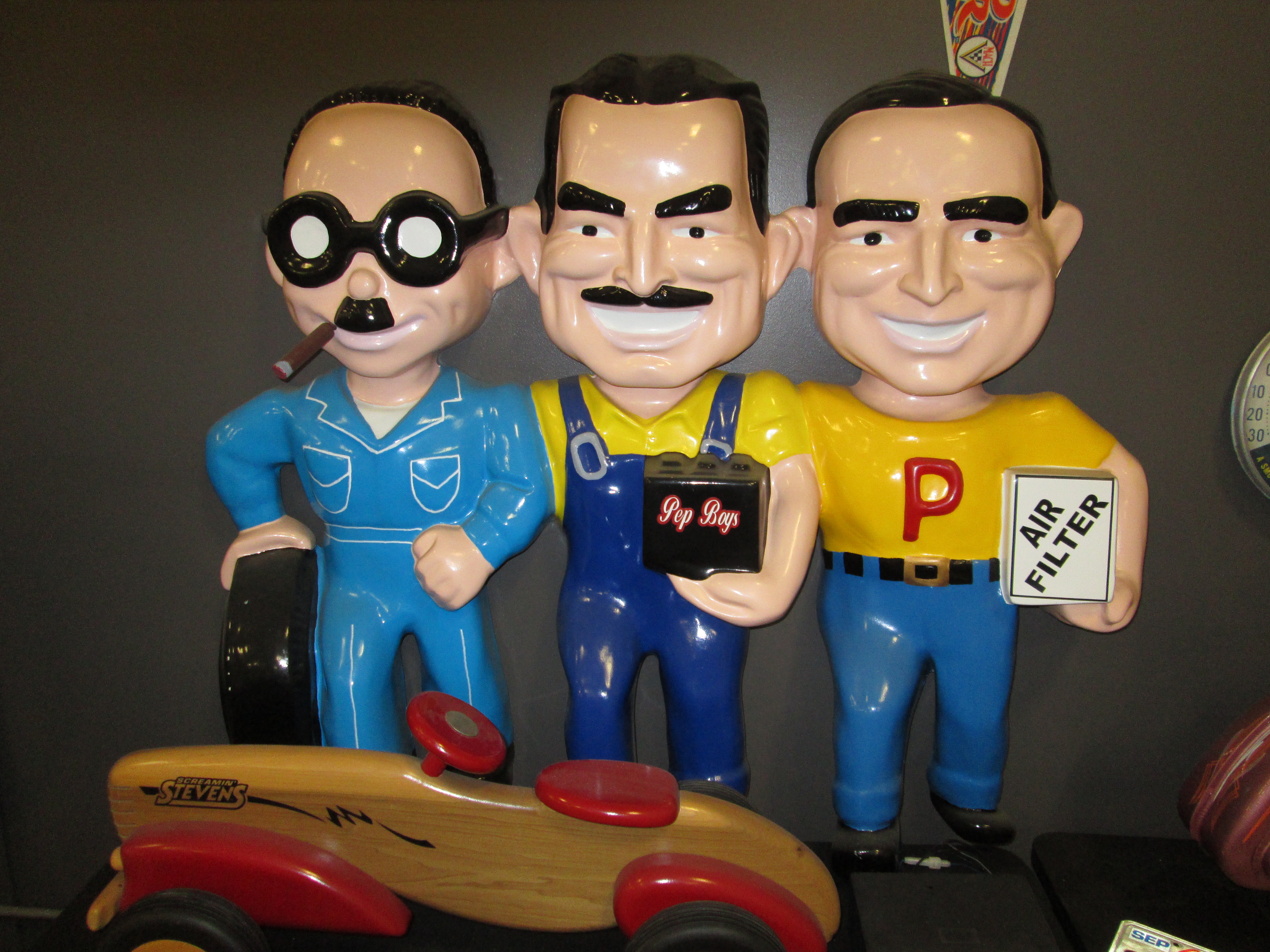
The Pep Boys: Manny, Moe, and Jack

I was enthralled yesterday by this Pep Boys plastic logo at Oxnard’s Murphy Automotive Museum. I compare Manny, Moe, and Jack to the automobile repairman in Patrick Modiano’s novel Villa Triste: cool, detached, intellectual.

It is possible, perhaps, to carry this McLuhanesque comparison too far, but it does seem to make sense. Look, for example at the logos.

Plymouth Barracuda Logo

Can you imagine Rolls Royce calling one of its Silver Phantoms a Phan’? Or Talbot Lago, a ’Bot? Even though Rolls Royces are affectionately referred to as Rolls, the company would never abbreviate the name on one of their automobiles. Yet, Plymouth gladly adopted an abbreviated name to put on the rear bumpers of their later model Barracudas.

Now then, is the American approach any worse? It appears to sit well with the American automobile-buying public. Of course, it would be far better if the American automobiles themselves have not declined so precipitately. I have owned nothing but Japanese cars since I began to drive. Yet, looking back at Detroit products of the Golden Age, I would have had no trouble with Packard or Pierce Arrow or Duesenberg. They were beautiful cars that compared favorably with the best that Europe could manufacture.