
The Only Language the Devil Respects

Hungarian Poet Borbély Szilárd (1963-2014)

This post is a tribute to my strange native language, Hungarian, which is one of only four non-Indo-European languages in Europe. (The others are Basque, Estonian, and Finnish.) It is also a tribute to one of the great Hungarian poets of our time: Borbély Szilard. Get the pronunciation right: It’s BOHRR-bay SEE-lard.

I have decided to print the following poem first in English translation, and then in the original Magyar language. My intent is to show you what a strange language Hungarian is, so alien from any other language you may know. In his novel Budapest, the Brazilian novelist Chico Buarque writes that Hungarian “is rumoured to be the only tongue in the world the devil respects.”

Computer, Evening

There are certain moments in the evening when
one is too tired to do more.
Just to sit quietly. Not tired enough for sleep,
but not really energetic either. You read a few lines

from Kosztolányi about autumn and the soul, mysterious
way stations, the passing of time. For time is like life
itself: it leaves its imprint on the body alone.
In consciousness, on the soul, or the relational

structures of language. I don’t really know. Someone looks
out from the window, to see the stars growing distant
or whatever else they are doing. And thinks about

this: between the stars and the earth, he lived. Afraid
to sleep. Like a child in the evening, always seeking
a pretext. While the computer’s screen saver swirls.

Now for the original Magyar:

A Számítógép Este

Vannak azok a pillanatok este, amikor
az ember fáradt már bármit csinálni.
Csak ül csendben. Még nem álmos, de
nem is friss. Olvas néhány Kosztolányi

sort lélekről, őszről, titokzatos megállókról,
elmúlódő időről. Mert az idő is olyan, mint
az élet: csupán a testen hagy nyomot.
A tudatban, a lélekben vagy a nyelv

viszonyrendszerébden. Nem is tudom. Valaki
kinéz az ablakon, hogy távol a csillagok
vajon mit is csinálnak. Elgondolkodik azon,

hogy a föld és a csillagok közt élt ő. Fél
elaludni. Mint a gyerek este, kifogást
keres. Amíg táncol a képernyőkímélő.

I don’t expect you to understand a word of the Hungarian. It is one of the most difficult languages in the world to learn. But it was the first language I learned, and it has had a lasting effect on my life. First of all, it is an agglutinative language, like Turkish, Korean, and Swahili. It puts together elements into long words such as viszonyrendszerébden (relational structures of language) and képernyőkímélő (screen saver). Note also the double acute accent in words such as őszről (about autumn). It represents a lengthening of the umlauted vowel sound.

The reference to Kosztolányi is to Hungarian poet and prose writer Dezső Kosztolányi (1885-1936).


Favorite Films: Popeye with Robin Williams

Robin Williams and Shelley Duvall Star in the 1980 Film

On Wednesday, i was delighted to find a cheap DVD of one of my favorite films from the 1980s: Robert Altman’s Popeye (1980) from Paramount. I don’t really think it’s a great film, but I find it to be a lovable one, especially for the first hour. (It kind of goes off the rails at the end.) Filming in Malta, Altman creates a whole world in the rackety port of Sweethaven. From the first scene, when Popeye arrives at the port in a wild thunderstorm in a tiny rowboat, we are precipitated into an invented world that is different from but not incompatible with the Max and Richard Fleischer cartoons of past decades. At the same time, it is a musical with strange tunes and a dance film with strange moves.

The Set of Sweethaven Which Forms the World of Altman’s Popeye

At first, Popeye is viewed by the village as an unwanted stranger. He manages to get a room in a boarding house run by the Oyl family, where he meets the daughter Olive. Shelley Duvall as Olive Oyl is perfect casting, even better (but not by much) than Robin Williams as Popeye the Sailor man. Interestingly, the story is about not only the growing relationship between Popeye and Olive, but also about how Popeye learns the benefits of swallowing large amounts of canned spinach.

Bluto is, as expected, the villain of the piece, along with the shadowy figure known as the Commodore (who turns out to be Ray Walston as Popeye’s pappy). Popeye romances Olive away from Bluto, about whom she could only say that he’s “large.”

I love to lose myself in the rich multitextured goofiness of this film. By now I have easily seen it more than ten times.


How to Fight a Playground Bully

We Don’t Have to Name Names, Do We?

The Democrats have a daunting task in front of them—especially if they go about business as usual. That is guaranteed to fail. The rules are different now. The times have changed. So here are my suggestions for victory. Warning: They’re not pretty.

Victory is Possible

Just remember one thing: Playground bullies are punks. They can be defeated, but not with the usual political weapons. Really strong people don’t need to be such devious liars. Bone spurs, indeed!

How About a Nickname for Him?

I say, fat-shame the SOB! How about using an uncomplimentary nickname like Tubbo or Lard Ass? Use photographs of him at the golf course, where he looks his worst. I know it’s juvenile, but it will work against him.

Names That Have Lost Their Magic

The names I am referring to are words like Democrat or Liberal, or even Socialist. Yes, there is no reason one can’t change the name of a political party. And while you’re at it, get rid of the Hillary Clinton people like Tom Perez. As I said earlier, business as usual will notwork in 2020.

Ideological Purity vs. Power

Another way to word this is: Stop being stupid about small points of ideological purity. It’s all about power, and you can’t get power if you’re part of a circular firing squad. Don’t get stuck on a single issue like abortion, police brutality, LGBTQ and other identity groupings, or guns. You have to reach for that ring on the merry-go-round, and not hand devastating weapons to your enemies.

Distribute Opioids to the Red States

This is my nastiest suggestion. Let’s face it: These people hate city dwellers. They’ll hate whatever you do because they just think you hate Jesus or want to kill babies or encourage Arab terrorists or freaking whatever.

“A Toast to Inyo”

The House at Laws Railroad Museum Where I Found the Poem Framed on the Wall

Hitherto, whenever I have presented a poem, it had a certain literary quality which justified the effort to puzzle it out. This time, I am reprinting a poem which I saw framed on a wall in one of the houses at the Laws Railroad Museum near Bishop, California. So at one and the same time, it is a poem and an artifact of a particular time and place which are increasingly remote to us.

Toast to Inyo

Here’s to Inyo, well beloved,
With her smiling skies so fair,
Here’s to her Sierras tall,
With their grand and stately air.

Here’s to the pioneers, old and gray,
Many of whom have passed away,
And solved the mystery, which all
Of us must solve some day.

Few there are who now remain
To remind us of the past;
Foremost in our hearts are they,
And as our “nobles” they are classed.

Here’s to the wives and mothers true
Who did their very best
To make this lovely vale of ours
A home of peace and rest.

Here’s to the noble sons and brave
Who hallow the colors three;
Smiling at the foeman’s frown,
Ready to fight for liberty.

Here’s to the daughters, fair and good;
With laughing eyes so sparkling bright,
With rosy cheeks and golden hair,
The world they hold within their might.

Remember then, whe’er you go,
There’s no place like “home sweet home;”
And think of dear old Inyo,
As o’er the wide world you roam.

I rather suspect that the poem was written around the time of the First World War based on the “foeman” in the fifth stanza.

Western Town

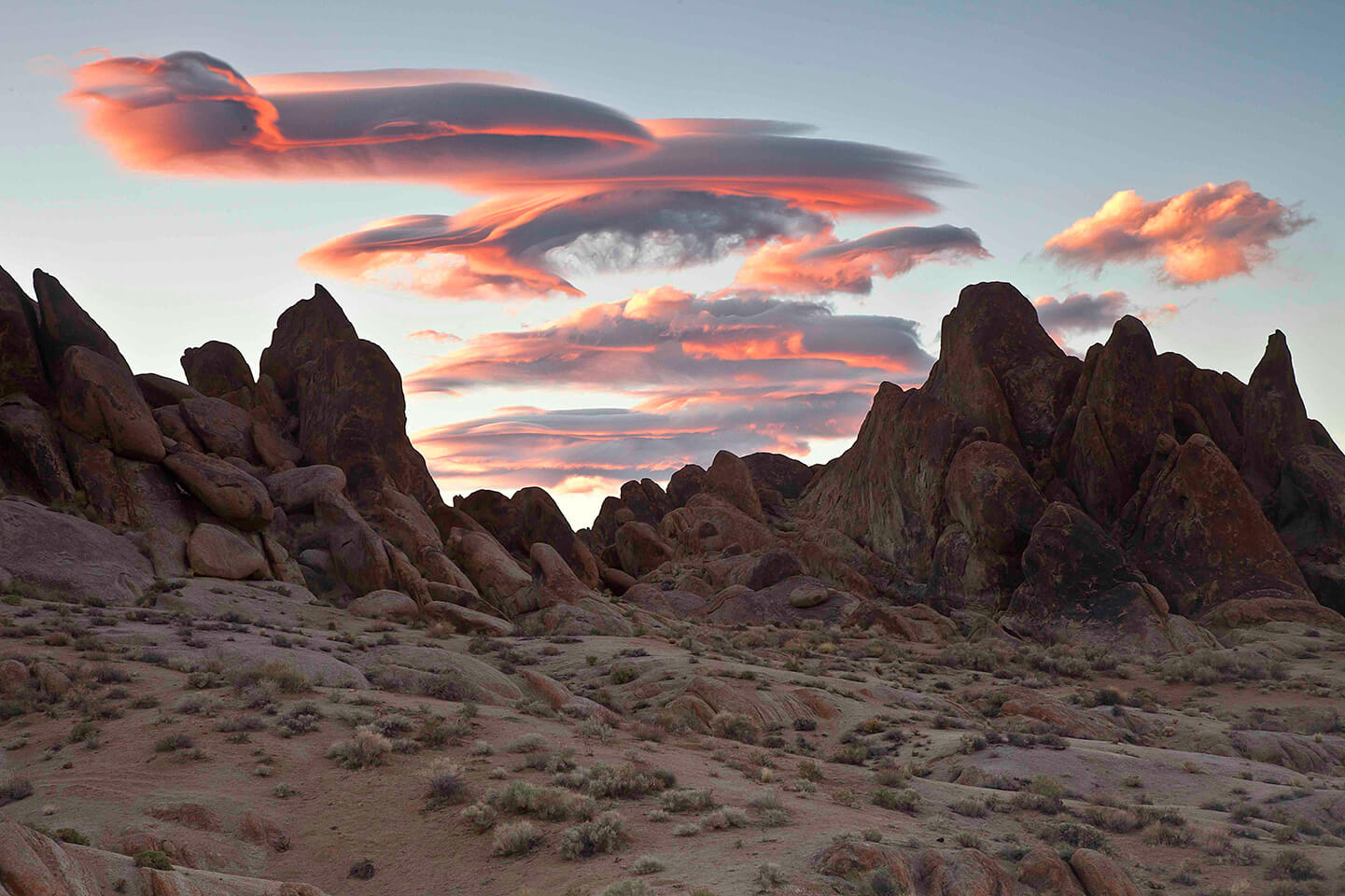
Sunset in the Alabama Hills

Martine and I were in agreement: Our two favorite towns on our recent trip to the Eastern Sierras were Bishop and Lone Pine. More about Bishop later. If it weren’t for the fact that Lone Pine is a little too close to the Mojave Desert, way too close to Owens Dry Lake which, on windy days, is the largest source of dust pollution in the United States, and if it weren’t such a small town, I wouldn’t mind living there.

Oh, yes, there is one other thing: Not only is Lone Pine only 71 miles (114 kilometers) by air from the recent earthquakes at Ridgecrest, but, back in 1872, there was a major earthquake that destroyed a good part of the town and killed twenty-seven people. When you consider that the tallest peak in the contiguous forty-eight states—Mount Whitney—is just a few miles to the west, I suspect that some more disasters are in the cards for this sweet little town.

So much for the negatives. Lone Pine holds an honored place in film history for being situated close to the Alabama Hills, which for almost a hundred years have been one of the major shooting locations for movie Westerns. From the days of Jack Hoxie, Tom Mix, and Ken Maynard to the TV Westerns of the 1950s and 1960s, the Alabama Hills were seen in hundreds of film and TV productions. For this reason, the town is the site of the Museum of Western Film History, which is worth two or three hours of your time if you have any love for the genre (as I do).

Just Beyond the Alabama Hills Are the Snowcapped Sierras

Although we spent almost two hours riding the washboarded dirt roads that wind through the hills, I would gladly have allocated more time. Unfortunately, the heat was beginning to build, so I didn’t get out to take the many little hikes to particularly interesting rock formations and filming locations. Instead, we headed north to Independence to take another look at those coyote dentures I wrote about yesterday.


Indian Baskets and Coyote Dentures

Panamint Shoshone Indian Baskets

Inyo County’s county seat is the small town of Independence, CA. To me, it will always be associated with the Eastern California Museum and the writings of Mary Hunter Austin (1868-1934). Curiously, the museum and Mary Austin’s house are just across the street from one another. I have always thought that Austins The Land of Little Rain and The Basket Woman are two of the best books written about life in the Eastern Sierras over a century ago. The Austin house is not open to visitors, but you can always cross the street to the museum to buy her books and learn about this incredible writer.

In fact, there is little about the Eastern Sierras that you can’t learn about from the museum. If the Owens Valley and its continuation northward to the Nevada state line is of any interest to you, you owe it to yourself to spend at least half a day at the museum. There you will learn about the miners, the Indians, the Japanese interned at Manzanar, the pioneer men and women, the mountain climbers, the water wars, the geology, the railroads, and the farmers.

One of the most incredible displays is a set of dentures using coyote teeth for a dentally distressed resident by the name of George Washington Hancock. While we visited the museum, we heard two visitors walk in the door and immediately ask about the “coyote teeth.”

The Coyote Dentures and the Story Behind Them

The collection of Paiute and Shoshone Indian basketry is world class. I particularly liked the Panamint Shoshone designs on their baskets. I was disappointed to learn that these baskets were made for early tourists to the area, as the Indians were much too pragmatic to bother about designs for something so utilitarian as a food container. Yet the designs came from somewhere and are visually striking.

In many ways, it is recommended to visit the museum at or near the beginning of your trip along Highway 395. Wherever you are going, whatever you are planning to do, you will find answers here in this museum which is owned and run by Inyo County. There are no admission fees, but I strongly recommend you make a donation so that this outstanding institution can continue to highlight one of the most interesting corners of our country.

Back from the Desert

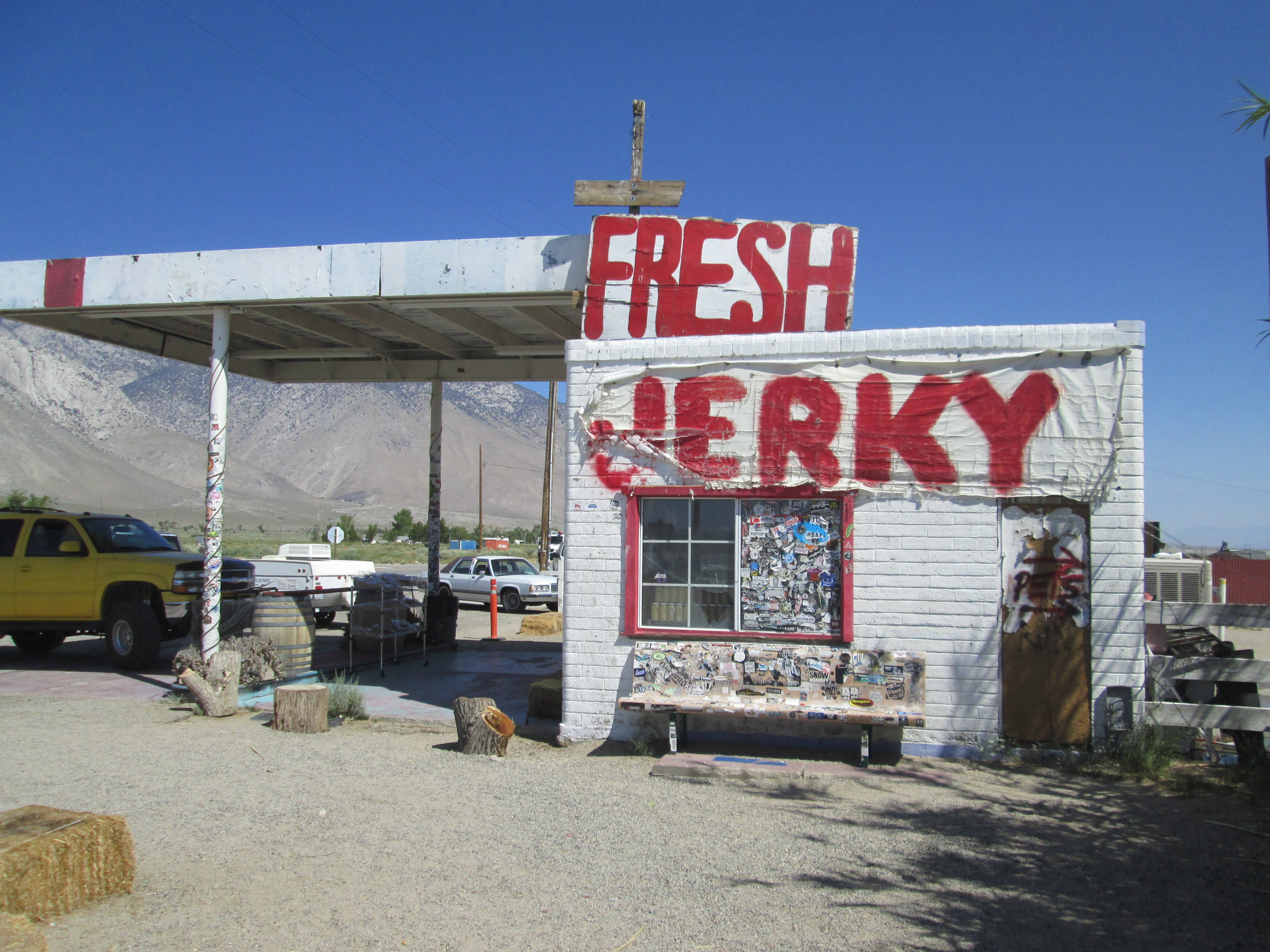
Gus’s Fresh Jerky in Olancha, CA

Today, as a major heat wave was sending the desert temperatures as high as 107° Fahrenheit (42º Celsius), Martine and high sped south from Lone Pine to return to Los Angeles by mid-afternoon today. We had expected hot temperatures on the floor of the valley, so all of our major destinations were at an altitude between 7,500 feet (2,286 meters) and 10,500 feet (3,200 meters). It was not unusual for the temperature at these higher locations to be 20 degrees Fahrenheit cooler than our starting point for the day. In the White Mountains, where we viewed the Ancient Bristlecone Pine Forest, it actually became chilly.

Gus’s Fresh Jerky (shown above) was one of the first stops on our trip. The unpromising building actually had delicious beef jerky and various types of dried fruit, honey, and olives. In fact, we stopped not only on our way up the valley, but also on the return trip.

One of the things one learns while traveling in the California desert is that there is little correspondence between how fancy a building is and the quality of merchandise (or exhibits) within. A store like this in Los Angeles would not be taken seriously. Check out their website, which belies the casual look of their premises.

The Laws Railroad Museum

Gas Station and Jalopy at Laws Railroad Museum

It was January 2010 when Martine and I last drove through the Eastern Sierras. One of our favorite destinations was an outdoor museum of pioneer life in the hamlet of Laws, CA. Four miles northeast of Bishop, Laws was a station on the Carson & Colorado Railroad, which ran from Mound House, NV to Keeler, CA, site of the Cerro Gordo (“Fat Hill”) mines, which produced high grade silver, lead, and zinc. In 1900, the Carson & Colorado was sold to the Southern Pacific where it operated in various forms until around 1960.

Today, the Laws Museum is one of those outdoor museums to which various old local structures were moved, from railroad buildings and residences to various types of businesses. Martine and I plan to pay another visit next week.

One of the Original 19th Century Boxcars of the Old Carson & Colorado Railway

We love the strange desert landscapes of the areas flanked on one side by the steep eastern flank of the Sierra Nevadas on the left and the Inyo and White Mountains on the right. We expect that the Sierras will still be covered with snow because of the record precipitation this last winter.


Shake Rattle & Roll

Little Lake Just Off Highway 395

After a twenty-year period of calm, we are once again in the throes of a series of earthquakes. Now these quakes are not quite so dangerous in Los Angeles as they are at the epicenter in Ridgecrest, CA, which is 120 miles (193 kms) as the crow flies. With yesterday’s Richter 6.4 temblor, the quake hit us as a rolling motion that lasted about a minute. Today’s Richter 7.1 temblor was a few miles northwest of yesterday’s epicenter, but it came to us as a stronger, more long-lasting rolling motion.

The funny thing is that next Monday, we will be driving by Little Lake (shown above), which is approximately ten miles west of the epicenter. We will continue until we get to Lone Pine, where we will spend the night. At Lone Pine, we will be about 71 air miles north and slightly west of the epicenter.

Today’s quake was the first one that threw a scare into Martine, because of its strength and duration, but even more because she felt two quakes in as many days.


The Living Desert

Mountain Lion at the Living Desert Zoo in Palm Desert

Not to worry: There was a thick layer of glass between me and that mountain lion. I took this picture ten years ago when I went with Martine to one of my favorite zoos in Southern California, the Living Desert in Palm Desert. (The other one is the small but otherwise perfect Santa Barbara Zoo in the city of the same name.)

This was before my brother and sister-in-law moved to Palm Desert. Martine and I had just done an overnighter, staying at the local Motel 6. J know it wasn’t exactly ten years ago because I can’t see myself visiting the lower desert in the Coachella Valley in the heat of July.

Martine and I will be taking something of a risk visiting the Owens Valley next week, as the daily temperatures are expected to range between 60º and 98º Fahrenheit (16º to 37º Celsius) with the humidity hovering around 20%. The only thing that will make that bearable is that, if it gets too hot, we can always drive to higher latitudes and relax. There are only a few things we want to see in the floor of the valley, but those are all things we’ve seen before.

We will have a large cooler with us filled with block ice and plenty of water, along with a few goodies in case we feel like roughing it at high altitude. After all, for most of our trip, we will be in the shadow of the highest mountain range in the contiguous forty-eight states.