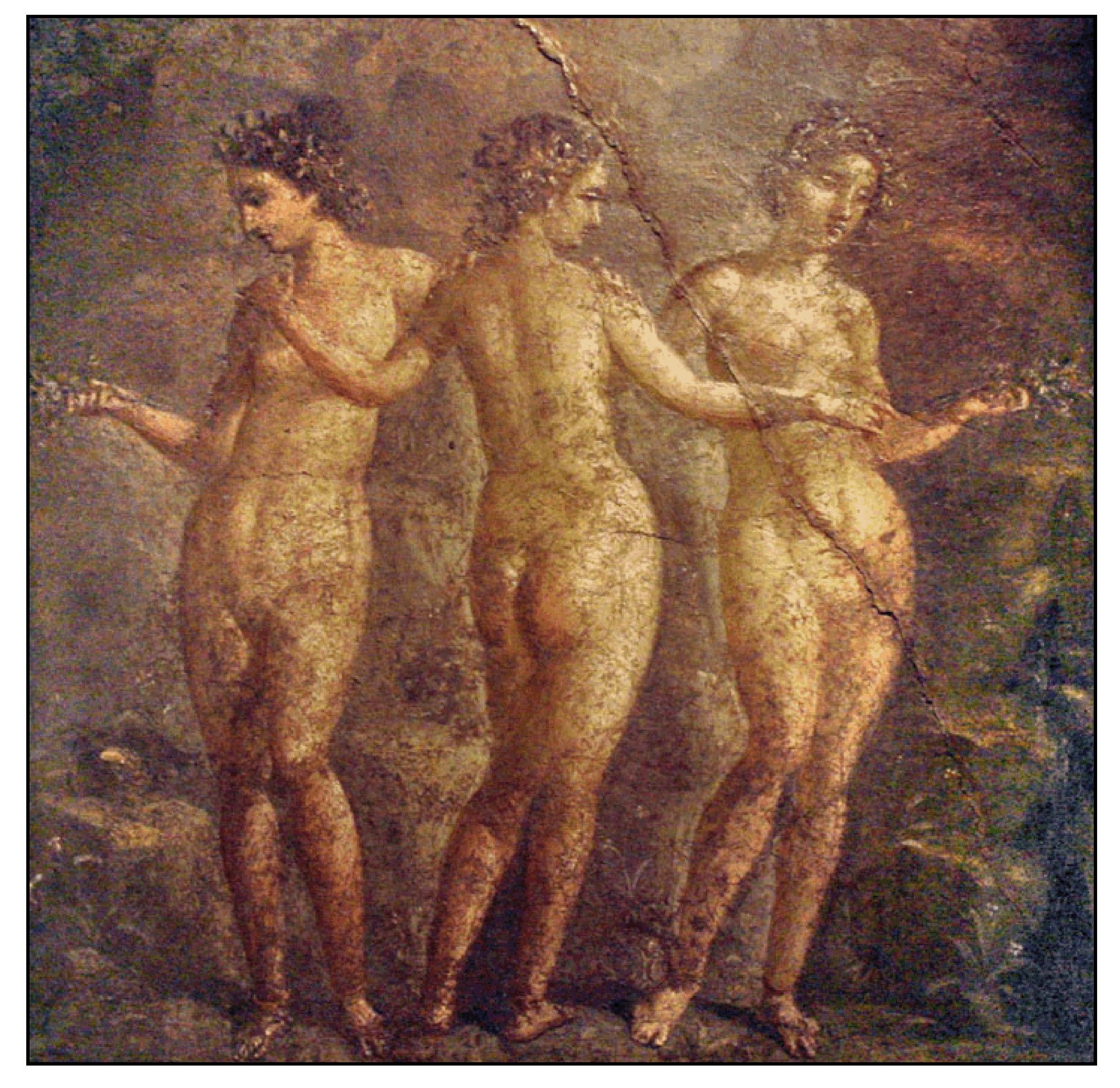
Three Graces

Roman Fresco from Pompeii of the Three Graces

In many ways, our culture has descended from the Greeks and the Romans. And yet, I think that we are so far removed from them that we no longer react the way that ancient audiences did.

According to the Greeks, the Graces were the daughters of Zeus and Eurynome. They were Aglaea (“Splendor”), Euphrosyne (“Good Cheer”), and Thalia (“Festivity”), though there were many name variations.

What surprises me most of the above depiction from first century Pompeii is its matter-of-factness. Three young unclothed women, realistically painted, who do not inspire lust but merely exist on their own terms. If you look at Renaissance or later images of the Graces, you will notice they are more beautiful and appealing. I do not think the Roman artist failed in his depiction, but that he rendered them on a different plane altogether.

It is as if they are saying, “It does not matter to us whether or not you find us appealing. We are immortal goddesses, and you are mortal men.”
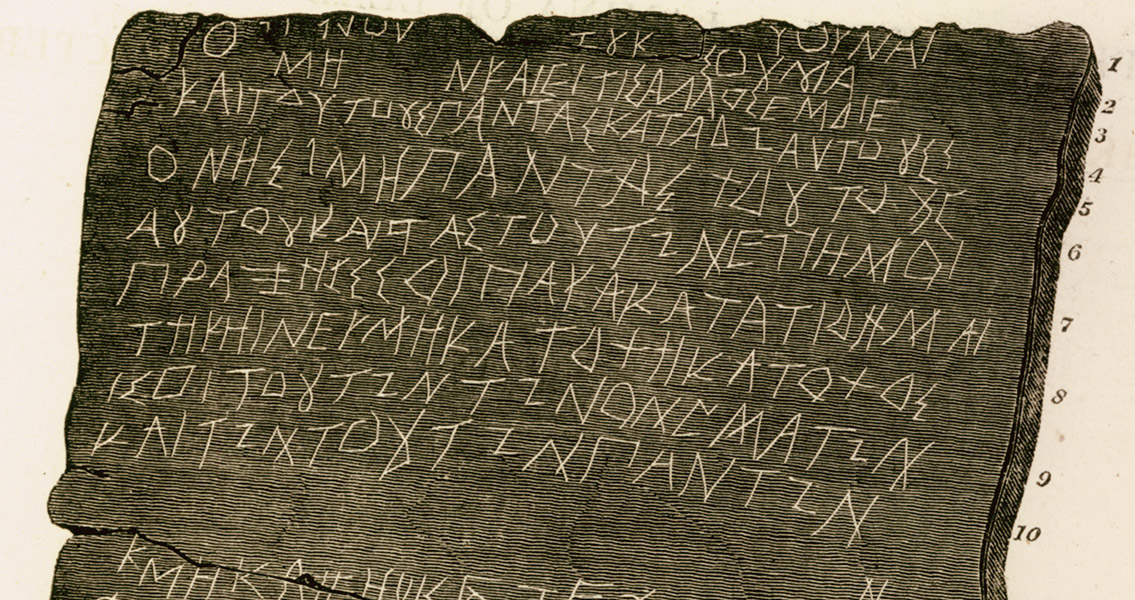
 

Curse Tablets

The Ancients Had Some Interesting Practices

According to a Dutch scholar named H. S. Versnel, the ancient Greeks had a practice involving the creation of “curse tablets.” In Memphis in the fourth century BC, the following curse was left etched into a tablet at the Temple of Oserapis:

O Lord Oserapis and you gods who sit enthroned together with Oserapis, to you I direct a prayer, I, Artemisia … against the father of my daughter, who robbed her of her death gifts (?) and of her coffin … Exactly in the way that he did injustice to me and my children, in that way Oserapis and the gods should bring it about that he be not buried by his children and that he himself not be able to bury his parents. As long as my accusation against him lies here, may he perish miserably, on land or sea….

Now these curse tablets were typically made of lead with the curse scratched onto their surface. Although I cannot wish death to the man I most ardently hate (whose visage is caricatured below) there are certain things I can say without bringing the Secret Service to my doorstep.

The Object of My Own Curse Tablet

May his bucket of chicken contain gristle that rots his fundament. May his fingers that would fly over his cellphone in a Twitter fury come out as utterly incomprehensible covfefe—at all times. May his followers discard their red MAGA hats out of shame, and may he be buried with a large streamer of toilet paper adhering to his shoes. May his real estate investments come to naught and his billions all turn out to have been illusory. May he be laughingly turned down by women he does not regard as beautiful and forget what his original urge was all about.


“To a Cat”

Panther in the Wild

If you look hard at my life, you will see that it is like a marginal gloss to the poems, essays, and stories of the Argentinian Jorge Luis Borges. Ever since I first came across his work around 1970, I have returned to it again and again as to an ineffable guide. Here is one of his poems, called “To a Cat.” I have visited the zoo in the Palermo district of Buenos Aires where Borges probably got the inspiration for this poem.

Jungle Waterfalls at Buenos Aires Zoo (2011)

To a Cat

Mirrors are not more silent
nor the creeping dawn more secretive;
in the moonlight, you are that panther
we catch sight of from afar.
By the inexplicable workings of a divine law,
we look for you in vain;
More remote, even, than the Ganges or the setting sun,
yours is the solitude, yours the secret.
Your haunch allows the lingering
caress of my hand. You have accepted,
since that long forgotten past,
the love of the distrustful hand.
You belong to another time. You are lord
of a place bounded like a dream.