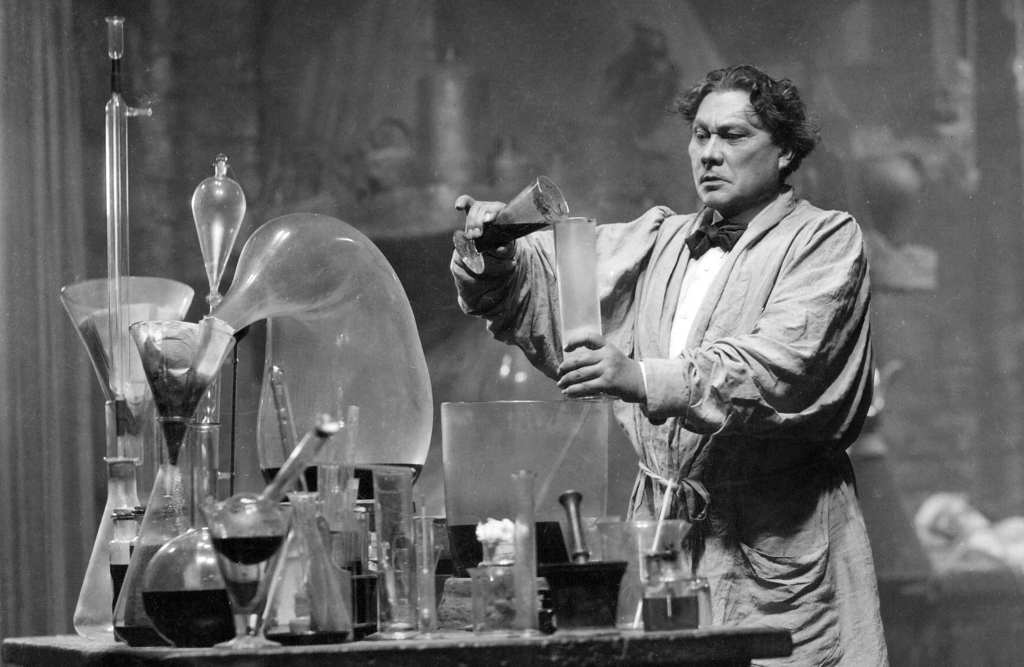
It’s always interesting to see a famous film director acting in a movie made by others. I am thinking of John Huston in Roman Polanski’s Chinatown (1974), Erich Von Stroheim in Jean Renoir’s Grand Illusion (1937), Victor Sjöström in Ingmar Bergman’s Wild Strawberries (1959), and Paul Wegener in Rex Ingram’s The Magician (1926).
Who’s Paul Wegener, you ask? He directed (and acted in) The Golem: How He Came Into the World (1920), which was a surprisingly good film considering its early production date.
Here’s Paul Wegener as the Golem, a monster created by a rabbi to protect the Jewish residents of Prague from oppression. He actually directed two other films about the Golem going back to 1915, but those films have been lost.
In The Magician, Wegener plays the magician Oliver Haddo, who is obsessed in hypnotizing Margaret Dauncey (played by Alice Terry, Rex Ingram’s wife) and creating life by killing her and taking the blood directly from her heart. Fortunately, her fiancé and guardian arrive at Haddo’s mad doctor’s castle and put the kibosh on him.
Rex Ingram made a number of classic silent films. The most famous is The Four Horsemen of the Apocalypse (1921), which catapulted Rudolph Valentino to stardom. After sparring with studio bosses, he repaired to Southern France with his wife Alice Terry and made a number of beautiful films such as Mare Nostrum and The Magician, both filmed in 1926.
He is not to be confused with the black actor known by the same name.
It is without a doubt one of the most incredible shots in the history of the cinema. And yet it was the work of a director, Hideo Gosha, on his first motion picture, Three Outlaw Samurai (1964). Picture to yourself a peasant who with two of his friends kidnapped the daughter of a corrupt local magistrate as part of a protest against his cruel administration. Instead of keeping his promises, this magistrate sends thugs to kill him. As he lies bleeding with his back slashed by a sword, we cut to a closeup up the peasant, dying, looking with wide-eyed wonder at a lone wildflower growing in front of his face.
In the 1950s and 1960s, the Japanese cinema was at its height, one of the most fascinating in the world. The best of their films were in a genre known as jidaigeki, historical pictures set mostly during the Tokugawa Shogunate between 1603 and 1868. Starring most prominently were samurai, particularly masterless or outlaw samurai called ronin. Other films in the genre portrayed gangsters (yakuza), merchants, even peasants.
I had seen Three Outlaw Samurai at least twice before, but this time the film’s pessimism struck home. Aiding the peasants in their protest are three ronin who, one by one, come together. They are unable, however, to help the peasants win. After the three who kidnapped the magistrate’s daughter are killed, the other peasants in the surrounding villages are afraid to present their protest to a wondering clan chief who is due to visit in a few days. It is because of this visit that the magistrate hires waves of goons to attack not only the protestors, but previous goons who are asking for too much money.
The bloodshed is considerable. The three ronin kill at least a hundred of the magistrate’s men, who in turn kill large numbers of peasants. At the end, the three ronin decide to travel together in a direction selected by chance.
Ever since I first fell in love with movies as a student at Dartmouth, I have loved the fast action of chambara (“sword fight”) films. But, like the best Westerns, these “Easterns” can attain the status of high art. In a future post, I will list my favorite samurai films.
When I went to Yucatán in 2020, I had not been to Mexico for many years. I was pleasantly surprised that even the second class buses were air-conditioned and relatively new. Back in the early 1980s, I remember the old Unión de Camioneros de Yucatán buses with their broken windows and busted seats. Now there were a whole spate of new companies, such as Oriente (shown above). This was the bus I took from Izamal to Mérida.
In all, I took six trips using second class buses:
Izamal to Mérida
Mérida to Uxmal
Uxmal to Campeche
Chichén Itzá to Valladolid
Mérida to Progreso
Progreso to Merida
The first four were on comfortable new Oriente buses. The last two were on a shabbier line that just ran every few minutes between Mérida’s Autoprogreso Station some twenty miles to the port of Progreso.
Above is the first class bus ticket I used to get from Campeche to Merida. The second class route took some 5-6 hours stopping at numerous small inland towns. The ADO (Autobuses de Oriente) line pretty much owns first class routes in Yucatán. From Campeche to Mérida, it took the coastal toll road, which took only about 2 hours.
What’s the difference between first class and second class buses in Mexico? The first class routes are theoretically point to point, not making any pickups or drop-offs along the way. I say “theoretically” because drivers are not above going out of their way for friends. On a second class route, anyone can stop a bus anywhere. When I was going from Chichén Itzá to Valladolid. I stood in the bushes across the street from the Dolores Alba motel and waved down the Valladolid bus. Piece of cake.
I have always had my suspicions about the first Thanksgiving feast in 1621. There is no record of what was on the menu, only a few words by Governor William Bradford about the preparations for the feast:
Our harvest being gotten in, our governor sent four men on fowling, that so we might after a special manner rejoice together, after we had gathered the fruits of our labors; they four in one day killed as much fowl, as with a little help beside, served the Company almost a week.
Were potatoes served at the first Thanksgiving? Not likely, as potatoes were a South American tuber originating either in Peru or Chiloe Island in Chile. And it is highly unlikely that the Spanish conquistadores made any contribution to the Pilgrims’ harvest feast. Were green beans available to the colonists in Massachusetts during November? I doubt it.
Cranberries and pumpkins might very well have been at the feast, along with various types of squash and beans.
Turkey may well have been among the fowl served, though there probably were a number of other types, not only of fowl but other types of meat as well, including, perhaps, venison.
Whatever you choose to have at your family’s gathering tomorrow, I hope you all have a good time. Just remember one thing: Do not, under any circumstances, discuss politics, even if everyone is likely to be more or less in agreement. As with religion, everyone has his own bête noire where governing is concerned.
Politics in America is one thing for which we have scant reason to be thankful.
I have just enjoyed reading Rosemary Mahoney’s Down the Nile: Alone in a Fisherman’s Skiff about her trip—solo—in a rowboat between Aswan and Qena. I loved her description of what it’s like to drive in Egypt. Following is a selection from her chapter on Luxor.
Egyptians drive in a fashion that could only be described as chaotic. They seemed compelled to position their car in front of the one ahead of them at any cost. At night they drove with their headlights off until an oncoming car approached, at which time they helpfully blinded the opposing driver with a sudden flash of the high beams. And Egyptian highways were minefields of disaster. There were always skinny figures leaping across them at just the wrong moment, entire families sitting down to picnics in the middle of them, cars speeding along them in the wrong direction, men stopping their cars to pee in the fast lane, sudden pointless barriers stretched across the road, or wayward oil barrels, or boulders, or a huge herd of hobbled goats. Every ten miles or so the hideously crushed hull of a truck or car would appear at the edge of the road, the rusting, twisted remains of past accidents, and yet these gruesome and shockingly numerous reminders never seemed to chasten Egyptian drivers. They raced and careered and honked their way along with the heedless abandon of people who believe either that they are invincible or that life has no value whatever.
By no means is Clark Ashton Smith (1893-1961) considered as a mainstream American writer. Yet his poems and stories have a certain quality, reinforced by his association with H. P. Lovecraft and Robert E Howard. Of him, Lovecraft said, “in sheer daemonic strangeness and fertility of conception, Clark Ashton Smith is perhaps unexcelled.” And Ray Bradbury said that Smith “filled my mind with incredible worlds, impossibly beautiful cities, and still more fantastic creatures.”
Below is a poem of his entitled “Beyond the Great Wall”:
Beyond the Great Wall
Beyond the far Cathayan wall,
A thousand leagues athwart the sky,
The scarlet stars and mornings die,
The gilded moons and sunsets fall.

Across the sulphur-colored sands
With bales of silk the camels fare,
Harnessed with vermeil and with vair,
Into the blue and burning lands.

And ah, the song the drivers sing
To while the desert leagues away—
A song they sang in old Cathay
Ere youth had left the eldest king,

Ere love and beauty both grew old
And wonder and romance were flown
On irised wings to worlds unknown,
To stars of undiscovered gold.

And I their alien words would know,
And follow past the lonely wall
Where gilded moons and sunsets fall,
As in a song of long ago.
I think that Smith deserves a long second look, both for his poems and his eldritch short stories.
Not all my cooking creations are successful. The first time I tried cooking Hungarian stuffed cabbage rolls—a dish I was brought up on by my mother and great-grandmother—the rolls all fell apart. I didn’t know the trick of trimming the thick “veins” in the cabbage leaves, and I don’t remember parboiling and coring the cabbage.
This week, I got it right. First of all, I consulted with my brother, who is by far the best cook in the family. Then he sent me the recipe he uses. Here it is.
It took me five hours to cook the cabbage rolls from start to finish, though much of that time was waiting for the rolls to boil for 1½ to 2 hours. I used four different kind of meats in my recipe: smoked Hungarian gyulai kolbasz, Hickory smoked bacon, ground pork, and ground beef. Fortunately, there’s a great butcher shop at Alpine Village in Torrance which has several different types of kolbasz.
Once you make stuffed cabbage rolls, it’s easy to cook enough to feed a family for several days. Our lasted five days, with some left over that we had to discard because i have a rule that no cooked dish I make can be eaten for more than five days.
If you should try the recipe, be sure to get some fresh dill and some marjoram and—most important of all—real Hungarian paprika from Szeged, Hungary. The Spanish stuff has the color, but not the flavor.
PARIS – JUNE 07: (FILE PHOTO) Bohumil Hrabal poses while in Paris,France on a promotional visit on the 7th of June 1995. (Photo by Ulf Andersen/Getty Images)
England and Western Europe do not have a monopoly on great literature. I love prospecting for interesting writers from Eastern Europe. Perhaps that has something to do with the fact that I am Hungarian (and Czech and Slovak), and that I feel that the writers of the East have gotten short shrift from the American literary establishment.
I have just finished reading Bohumil Hrabal’s Why I Write? and Other Early Prose Pieces, which consists of his early work, much of which was circulated via samizdat, or underground typescript distribution to bypass strict censorship. There is a freshness to most of the stories within and a sharp attention to dialog as it is actually spoken by common people. Several whole stories consist of stream of consciousness ramblings of Hrabal’s Uncle Pepin, who goes on for pages shifting from one topic to another. Footnotes explain many of the obscure local references to Bars in Prague and people unknown outside of the Czech Republic.
From Ukraine, there is Andrey Kurkov, whose Death and the Penguin fills us in on the absurdity of life in Kiev. His Ukraine Diaries bring us up to date on the tensions with Putin’s Russia.
The former Soviet Union is another good source, such as the literary journalism from Svetlana Alexievich of Belarus, who won the Nobel Prize for Literature in 2015. I was appalled by her book of interviews on the Russian War in Afghanistan, called (in English) Zinky Boys. I also read Voices from Chernobyl, which gives a Russian perspective on that disaster.
Anna Politkovskaya’s criticisms of Putin cost her her life. She was murdered at her block of flats upon returning from grocery shopping. Her books on Chechnya (especially A Small Corner of Hell: Dispatches from Chechnya) and Putin’s Russia earned her the enmity of Putin, who cynically staged a show trial of several stooges who probably didn’t have anything to do with her killing.
Every month I try to read at least one Eastern European book. Often, they are the best things I’ve read that month.
Puerto Rican poet Martin Espada has recently won the National Book Award for his collection of poems entitled Floaters, named after the famous photograph of a father and daughter who drowned in the Rio Grande swimming to supposed safety in Trump’s United States. One of the poems in that collection is the following prose poem:
Letter to My Father
You once said: My reward for this life will be a thousand pounds of dirt shoveled in my face. You were wrong. You are seven pounds of ashes in a box, a Puerto Rican flag wrapped around you, next to a red brick from the house in Utuado where you were born, all crammed together on my bookshelf. You taught me there is no God, no life after this life, so I know you are not watching me type this letter over my shoulder.
When I was a boy, you were God. I watched from the seventh floor of the projects as you walked down into the street to stop a public execution. A big man caught a small man stealing his car, and everyone in Brooklyn heard the car alarm wail of the condemned: He’s killing me. At a word from you, the executioner’s hand slipped from the hair of the thief. The kid was high, was all you said when you came back to us.
When I was a boy, and you were God, we flew to Puerto Rico. You said: My grandfather was the mayor of Utuado. His name was Buenaventura. That means good fortune. I believed in your grandfather’s name. I heard the tree frogs chanting to each other all night. I saw banana leaf and elephant palm sprouting from the mountain’s belly. I gnawed the mango’s pit, and the sweet yellow hair stuck between my teeth. I said to you: You came from another planet. How did you do it? You said: Every morning, just before I woke up, I saw the mountains.
Every morning, I see the mountains. In Utuado, three sisters, all in their seventies, all bedridden, all Pentecostales who only left the house for church, lay sleeping on mattresses spread across the floor when the hurricane gutted the mountain the way a butcher slices open a dangled pig, and a rolling wall of mud buried them, leaving the fourth sister to stagger into the street, screaming like an unheeded prophet about the end of the world. In Utuado, a man who cultivated a garden of aguacate and carambola, feeding the avocado and star fruit to his nieces from New York, saw the trees in his garden beheaded all at once like the soldiers of a beaten army, and so hanged himself. In Utuado, a welder and a handyman rigged a pulley with a shopping cart to ferry rice and beans across the river where the bridge collapsed, witnessed the cart swaying above so many hands, then raised a sign that told the helicopters: Campamento los Olvidados: Camp of the Forgotten.
Los olvidados wait seven hours in line for a government meal of Skittles and Vienna sausage, or a tarp to cover the bones of a house with no roof, as the fungus grows on their skin from sleeping on mattresses drenched with the spit of the hurricane. They drink the brown water, waiting for microscopic monsters in their bellies to visit plagues upon them. A nurse says: These people are going to have an epidemic. These people are going to die. The president flips rolls of paper towels to a crowd at a church in Guaynabo, Zeus lobbing thunderbolts on the locked ward of his delusions. Down the block, cousin Ricardo, Bernice’s boy, says that somebody stole his can of diesel. I heard somebody ask you once what Puerto Rico needed to be free. And you said: Tres pulgadas de sangre en la calle: Three inches of blood in the street. Now, three inches of mud flow through the streets of Utuado, and troops patrol the town, as if guarding the vein of copper in the ground, as if a shovel digging graves in the backyard might strike the ore below, as if la brigada swinging machetes to clear the road might remember the last uprising.
I know you are not God. I have the proof: seven pounds of ashes in a box on my bookshelf. Gods do not die, and yet I want you to be God again. Stride from the crowd to seize the president’s arm before another roll of paper towels sails away. Thunder Spanish obscenities in his face. Banish him to a roofless rainstorm in Utuado, so he unravels, one soaked sheet after another, till there is nothing left but his cardboard heart.
I promised myself I would stop talking to you, white box of gray grit. You were deaf even before you died. Hear my promise now: I will take you to the mountains, where houses lost like ships at sea rise blue and yellow from the mud. I will open my hands. I will scatter your ashes in Utuado.
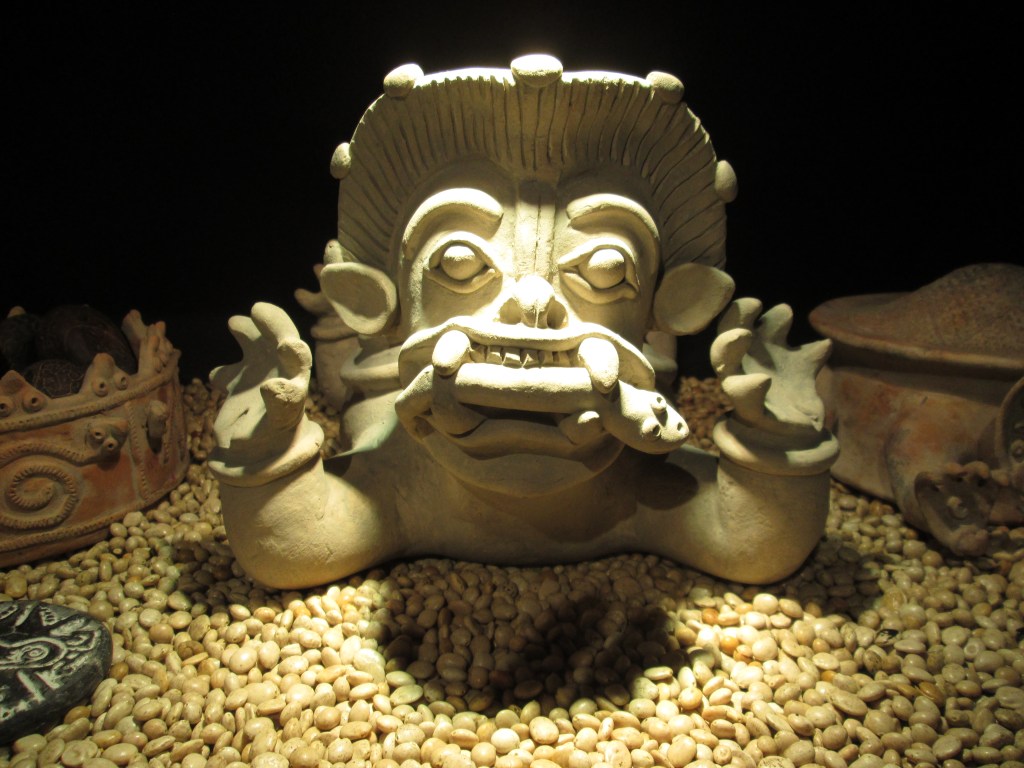
ancient The photo above is of a contemporary figurine of a Pre-Columbian idol on display in Quito’s Museo Mindalae. Although I doubt there was much trade between the ancient peoples of Ecuador and the Olmecs, Maya, and Aztecs of Mexico, there are clearly similarities in their religious iconography.
Before I began my travels to Latin America in 1975, I was puzzled by the images I saw of deities and demons from the more civilized portions of Meso-America. There were many similarities. But once one crossed the Rio Grande and visited where the Anasazi lived, the imagery is altogether different. And when I traveled in Argentina, Uruguay, and Chile, I saw precious little suggesting an advanced ancient civilization (though, in all honesty, I never visited the Northwest of Argentina, which was part of the Inca empire).
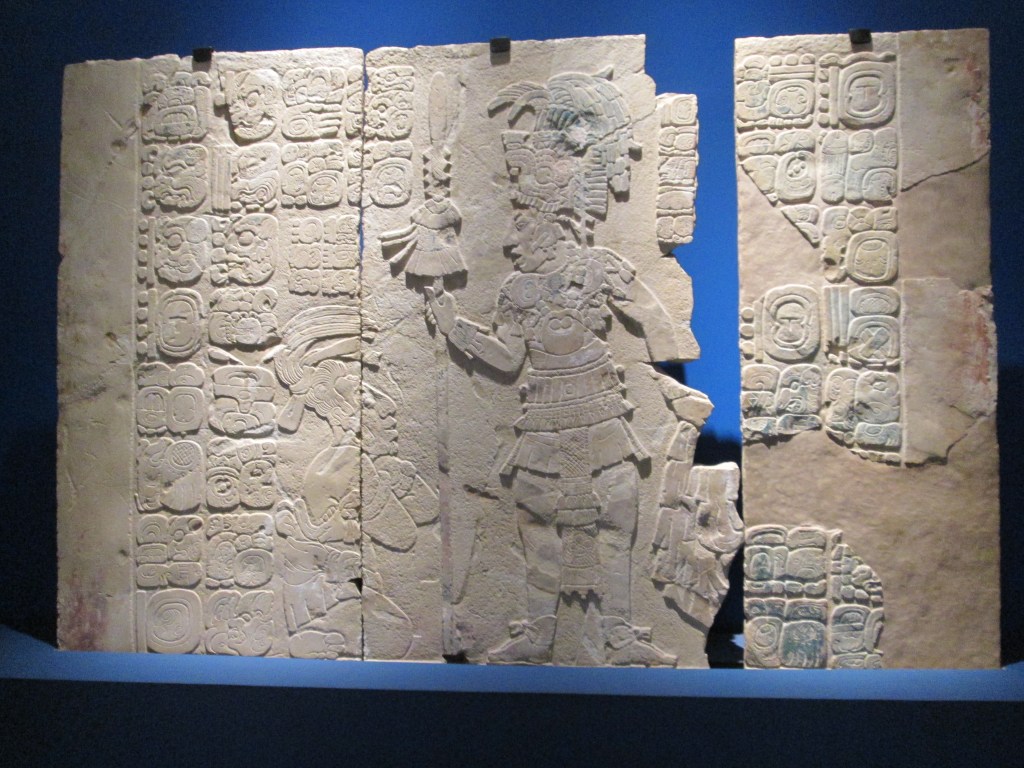
Now look at the depiction of one of the Mayan Priest Kings of Yucatán from the Mérida Museum of Anthropology:
Note the elaborate headdress and the warlike demeanor. Do not expect mercy from either of these rigidly powerful figures. I remember a conversation that took place at a symposium at UCLA decades ago between two archeologists, Michael Coe and Nigel Davies, about whether they would prefer to be in captivity to the Mayans or the Aztecs. Both agreed that, although the Aztecs were an empire and the Mayans were a group of city states, they both feared being prisoners of the Maya.
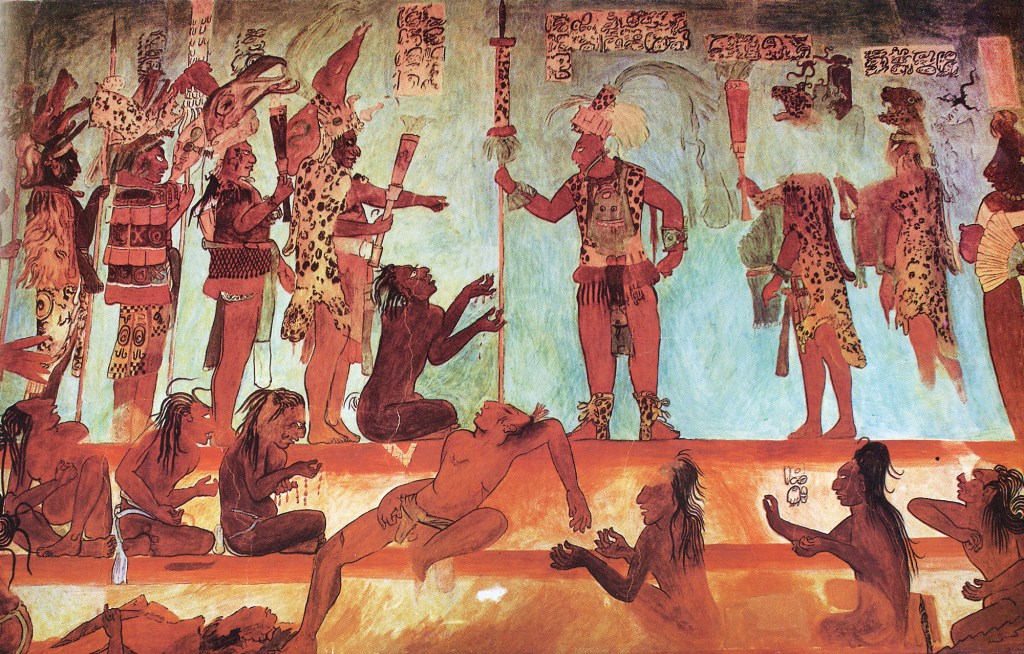
Why? Take a look at this fresco from the ruins at Bonampak in Chiapas:
Here you see the victorious Maya of Bonampak with their prisoners captured in a war with another city state. The scene is described in the Sixth Edition of Robert J. Sharer’s The Ancient Maya:
The aftermath is presented on the north wall. Here the full-frontal figure holding his jaguar-pelted spear, again probably Chan Muwan, accompanied by his warrior allies and entourage, along with two women at the far right, stands on the summit of a platform to preside over the captives taken in the battle. The chief captive sits at Chan Muwan’s feet, while the rest of the unfortunate prisoners are displayed on the six steps of the platform, where they are tortured and bled from their fingernails, held and guarded by more victorious warriors. These are the captives that will be sacrificed; one sprawled figure may already be dead, and the severed head of another has already been placed on the steps.
What all these Meso-American peoples had in common was highly organized and ritualistic warfare. Reading the history of many of these city states based on commemorative stelae, paintings, and other media, one clearly gets the feeling that life for the common people was anything but fun.









You must be logged in to post a comment.