For a couple months now, I have had a savage attack of blepharitis. My eyelids continue to itch like crazy, inviting me to rub them, while discharging what looks like endless tears. Last night, all night long, I had to wipe the tears from my eyes, which woke me as they ran down my face.
Finally, today I contacted my ophthalmologist, who prescribed eyedrops and a salve that worked well a few weeks ago until they ran out. They should be ready for pickup on Friday or Saturday.
The worst thing about this condition is that I am tempted to drive with only one eye open, which is not great for depth perception. Also, reading becomes a much more tiresome activity. (For me, that’s serious.)
I have no doubt that this condition is somehow connected with climate change. The summers have been growing progressively hotter, and large-scale wildfires have packed the air with various toxins.
In the absence of prescribed medications, the only thing that helps for an hour or two are hot or warm compresses. Over-the-counter preparations like Pataday are not even that good.
Production Still of Michael Caine Killing the Man Responsible for His Brother’s Death
I am rather new to Get Carter, which I saw for the first time last year. It is a tale of revenge by a London mobster on the Newcastle hoods who killed his brother and cast his teenage niece in a pornographic film. Once Caine has seen the film, he goes on a killing spree of unabated fury and brutality against the Newcastle mob. There was a remake shot in 2000, but the Michael Caine film directed by Mike Hodges is the version to see.
Interestingly, the role of Newcastle mob boss, Cyril Kinnear, is acted by playwright John Osborne of Angry Young Men fame (Look Back in Anger, The Entertainer, the screenplay for Tom Jones).
Particularly gruesome were the murders of two women who worked with Kinnear. Caine sleeps with one of them, locks her in the trunk of a sports car, and essentially shrugs his shoulders when his adversaries push the car into the harbor. Another one, who recruited the niece for the porno film, was told to strip, injected with drugs, and pushed into a pond. Caine left a trail of her clothes for police to follow to point to the location of her body.
This is a fairly violent picture, but it is well made and definitely worth seeing.
As I sit here sweltering in Los Angeles, I am conscious of the scenes of my past being erased from view, almost as if they had never existed.
But they did. Chanel High School in Bedford, Ohio was the scene of my triumphs. I was not only the valedictorian of my class, but also the recipient of the Mr. Chanel award for my contributions to the school. Because of budgetary constraints felt by the Catholic Diocese of Cleveland, Chanel was shut down in 2013. Today, I discovered in an email from my brother Dan that the school is now being wrecked by the City of Bedford.
Chanel High, which ended its life as St. Peter Chanel High, was opened in 1957. I was in the second graduating class of the school (1962), having started out as a freshman when there was only a sophomore class ahead of me.
old St. Henry Elementary School on Harvard Road, which I attended between 1951 and 1958. has been closed down for some time. No longer are the devoted Dominican Sisters who taught me walking the halls rustling the large wooden rosaries they wore, and Father John Hreha has no one to yell at. I believe it now exists as the Harvard Community Services Center.
My very first school, Harvey Rice Elementary at 2730 East 116th Street in Cleveland, still exists. I went there for Kindergarten and half of First Grade. I didn’t do well because I didn’t speak English at that time, only Hungarian. When we moved to the Harvard-Lee area in the summer of 1951, I was signed up for Second Grade at the new St. Henry School, never having completed First Grade. (Sometimes, I still fear that knock at the door in the middle of the night reminding me that I have to go back to Cleveland to finish First Grade.)
Dites-moi où, dans quel pays,
Est Flora la belle Romaine,
Archipiades, et Thaïs,
Qui fut sa cousine germaine,
Echo, parlant quant bruit on mène
Dessus rivière ou sur étang,
Qui beauté eut surhumaine ?
Mais où sont les neiges d’antan ?
Sometimes, I feel as if my life were one of the novels of the Argentinian César Aira, whose stories progress like one of those Roomba vacuums—always going forward, and never back.
Even though much of my past has been erased, Dartmouth College in Hanover, New Hampshire is still around. But since most of the stately elm trees died of Dutch Elm Disease, and the school decided to fill every open space with new buildings, I don’t recognize the place any more.
We Created a Situation in Which the States Are at War with One Another
The words of the Tenth Amendment of the U.S. Constitution seem innocuous enough:
The powers not delegated to the United States by the Constitution, nor prohibited by it to the States, are reserved to the States respectively, or to the people.
The United States of America didn’t suddenly come into being as a harmonious united country. Before there was a constitution, there was a document referred to as the Articles of Confederation, which were in force from 1781 until replaced by the Constitution in 1789. That initial document didn’t work out all that well because of some serious problems, such as:
Congress could not regulate trade
There was no uniform system of currency
The Federal Government (such as it was) had no power to tax
There was no independent judiciary, foreign affairs head, and no ability to deal with internal or external threats
In other words, the various states had all the power, and the Federal Government, virtually none. It seems to me that, even with the Constitution ratified by all the states, that some states still think they are in charge. That’s one of the major causes for the Civil War of 1861-1865—a conflict whose resolution has been partial at best.
Although I am a Citizen of the United States, there are some states which I would think twice before visiting; as I doubt but that my rights would be abridged.
When it comes to issues such as abortion, one can see clear cultural fault lines:
Foreigners visiting the United States are often surprised that, in some states, there is a different set of laws. If one is traveling from ocean to ocean, one could find oneself in a different legal situation not only from state to state, but sometimes from county to county—especially if you are trying to buy alcoholic beverages or marijuana products.
When traveling in Europe or Latin America, I faced no such situation, even in areas where there were strong cultural differences, such as in some of the islands off the coast of Scotland where the Wee Frees form a large part of the population.
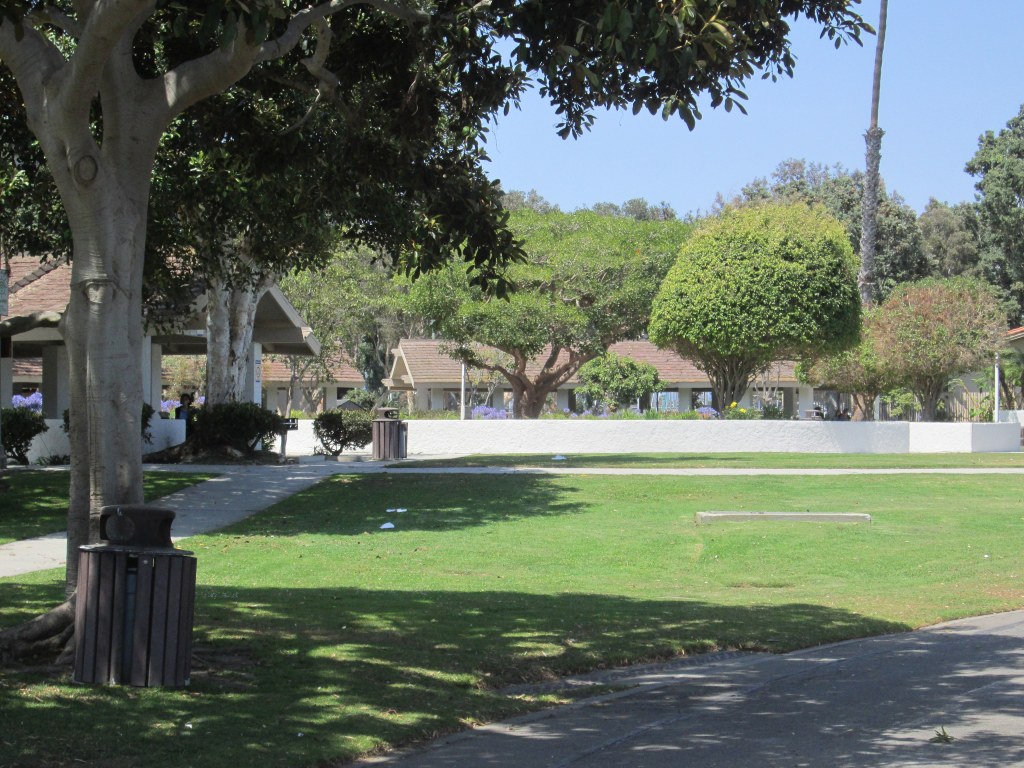
delightful It was another warm day, though nowhere near as blistering as those inland areas euphemistically referred to as valleys. Whenever I’m feeling too hot, I always know that it will be miraculous cool and breezy in that park at the west end of Mindanao Way.
So I stopped in at Trader Joe’s for a picnic lunch of a Mexican chicken salad, watermelon chunks, and watermelon juice and found myself a picnic table in one of the three covered picnic pavilions in the park (shown above). Then I moved closer to Stone Point, at the tip of the peninsula, and took out a copy of Roberto Bolaño’s short story collection entitled Last Evenings on Earth and began reading.
Wouldn’t you know it? There are in big cities three things that militate against enjoying a book (or even a good night’s rest): motorcycles, rap music, and helicopters; and I got a 30-minute dose of the latter as it lazily and raucously circled the park without any clear end in mind. I kept thinking to myself how opportune a shoulder-mounted Stinger missile would have been.
But then, one of the drawbacks to big city life is that your neighbor gets all het up and doesn’t give a damn about your need for a modicum of silence. One fantasizes about a gruesome conclusion to each incident, but that never seems to happen. Tant pis!
If I had to pick the worst decade of my life, I would have to pick my twenties, between 1966 and 1975. I had miraculously survived brain surgery in September 1966. For my entire adolescence, I did not have a functioning pituitary gland: Instead, I had a benign tumor that not only destroyed my pituitary, but was staging an incursion on my optic nerve. Oh, and by the way, due to the malfunction of my pituitary, I had, for all intents and purposes, no adrenaline, thyroid, sex hormones, or human growth hormone. At the age of twenty-one, I looked like a high school freshman. When I bought alcoholic beverages, I was always being carded by store employees who did not believe my true age.
As I have described my condition before, I felt like a Martian mixed among human beings. I had fallen in love with a young woman, but it was not reciprocated. Several times, I awoke in the middle of the night, walked several blocks to Zucky’s Deli and had breakfast, then walked a few more blocks to the beach at Santa Monica. In the pre-dawn hours, I stared at the waves wondering if I had the courage to take a walk to Japan.
In time, I weathered my depression. I signed up for group therapy, where I discovered that my problems were all part of the human condition, namely, that we were all Martians.
In his book of interviews with Osvaldo Ferrari, Jorge Luis Borges found an interesting way of describing my condition:
Yes, I am sure I am happier now than when I was young. When I was young, I sought to be unhappy for aesthetic and dramatic reasons. I wanted to be Prince Hamlet or Raskolnikov or Byron or Poe or Beaudelaire, but not now. Today, I am resigned to being who I am. And to summarize: I do not know if I have attained happiness—no one does—but I have sometimes attained a kind of serenity and that’s a lot. Also, seeking serenity seems to me to be a more reasonable ambition than seeking happiness. Perhaps serenity is a kind of happiness.
For Borges, that’s saying a lot, as he had lost the sight of his eyes some thirty years before the interview. After my surgery, I was sterile—which is, as I see it now, a highly survivable condition.
It was the last poem Cowper (which he pronounced “Cooper”) ever wrote, shortly after he read the tale of Commodore George Anson’s circumnavigation of the globe, as described in his A Voyage Round the World in 1740-4. Cowper’s 1799 poem tells of one of Anson’s crewmen washed overboard and drowning within full view of his shipmates during an awful storm.\
Curiously, I discovered the poem as a resulting of reading Charlotte Bronte’s Shirley, which discusses the poem at some length. Here it is in its entirety:
The Castaway
Obscurest night involv’d the sky,
         Th’ Atlantic billows roar’d,
When such a destin’d wretch as I,
         Wash’d headlong from on board,
Of friends, of hope, of all bereft,
His floating home for ever left.

No braver chief could Albion boast
         Than he with whom he went,
Nor ever ship left Albion’s coast,
         With warmer wishes sent.
He lov’d them both, but both in vain,
Nor him beheld, nor her again.

Not long beneath the whelming brine,
         Expert to swim, he lay;
Nor soon he felt his strength decline,
         Or courage die away;
But wag’d with death a lasting strife,
Supported by despair of life.

He shouted: nor his friends had fail’d
         To check the vessel’s course,
But so the furious blast prevail’d,
         That, pitiless perforce,
They left their outcast mate behind,
And scudded still before the wind.

Some succour yet they could afford;
         And, such as storms allow,
The cask, the coop, the floated cord,
         Delay’d not to bestow.
But he (they knew) nor ship, nor shore,
Whate’er they gave, should visit more.

Nor, cruel as it seem’d, could he
         Their haste himself condemn,
Aware that flight, in such a sea,
         Alone could rescue them;
Yet bitter felt it still to die
Deserted, and his friends so nigh.

He long survives, who lives an hour
         In ocean, self-upheld;
And so long he, with unspent pow’r,
         His destiny repell’d;
And ever, as the minutes flew,
Entreated help, or cried—Adieu!

At length, his transient respite past,
         His comrades, who before
Had heard his voice in ev’ry blast,
         Could catch the sound no more.
For then, by toil subdued, he drank
The stifling wave, and then he sank.

No poet wept him: but the page
         Of narrative sincere;
That tells his name, his worth, his age,
         Is wet with Anson’s tear.
And tears by bards or heroes shed
Alike immortalize the dead.

I therefore purpose not, or dream,
         Descanting on his fate,
To give the melancholy theme
         A more enduring date:
But misery still delights to trace
   Its semblance in another’s case.

No voice divine the storm allay’d,
         No light propitious shone;
When, snatch’d from all effectual aid,
         We perish’d, each alone:
But I beneath a rougher sea,
And whelm’d in deeper gulfs than he.
Another Show at El Segundo’s Automobile Driving Museum
On Saturday morning, Martine and I drove down to the Automobile Driving Museum for their Air-Cooled Volkswagen Car Show. I was frankly surprised that so many entries and visitors showed up. It reminded me that around 1969 I consider buying a VW Beetle—and that was even before I learned to drive. Because of medical reasons, I was not to get my driver’s license until age 40. I never did get a VW. My first car was a 4-cylinder Mitsubishi Montero, followed by a Nissan Pathfinder, and now a 2018 Subaru Forester.
The Poster for the V Dub Show
In the late 1960s through the 1970s, I knew a lot of people who had Beetles, VW Microbuses (which I always thought looked cool), and Karmann-Ghias.
From the museum, we drove down to Captain Kidd’s Fish Market and Restaurant in Redondo Beach and had a great seafood lunch.
Most people’s idea of summer reading is of some cheap paperback to be consumed on a beach towel or on a long plane, train, or bus ride. There are a large number of trashy novels written each year to satisfy this undemanding audience. My taste in reading material, however, is more of what you would describe as deep-dish.
When the temperature rises into the 80s F (30s Celsius), there are certain books that appeal to me. Looking back over July and August in the last several years, here is what appeals most to me during temperature spikes:
Books about India, such as those written by William Dalrymple, author of City of Djinns
The novels of William Faulkner set in Mississippi
The novels of Brazilian author Jorge Amado set in his native State of Bahia
The novels and short stories of Chilean author Roberto Bolaño
American and French noir novels
The Travis McGee novels of John D. MacDonald set in South Florida
Travel books such as those written by Freya Stark, who traveled extensively by herself in the Middle East
Sometimes, I go in the opposite direction: I recently read Chauncey C. Loomis’s Weird and Tragic Shores: The Story of Charles Francis Hall, about a failed trip to discover the North Pole.
I am currently rereading William Faulkner’s Go Down Moses and have Jorge Amado’s Home Is the Sailor in my TBR pile.
Jack Nicholson and Faye Dunaway in Roman Polanski’s Chinatown
Eddie Muller of the Turner Classic Movies (TCM) series Noir Alley thinks that Chinatown is the greatest film ever made about Los Angeles. I am inclined to agree with him. Last night, I saw it for the nth time and newly appreciated it for its dark beauty.
How is it that the ultimate film about L.A. was directed by a Pole? You might remember that five years earlier, Charlie Manson and his gang brutally murdered Polanski’s wife, Sharon Tate, who at the time was 8½ months pregnant. She was stabbed 16 times, killing herself and her unborn child. Polanski was away in Europe at the time working on a film project.
Roman Polanski Playing a Bit Part in His Film
So, yes, I think Polanski had an understanding of the dark side of Los Angeles, which came out in his film. In fact, it was Polanski who insisted that Faye Dunaway gets shot in the head at the end of the movie while attempting to escape her father and incestuous lover played by John Huston. Both the producer and scriptwriter wanted to have Dunaway shoot Huston at the end. Polanski disagreed, saying that his film was not an adventure for children.
Film is a collaborative art form. In consequence, there are so many ways a film can go wrong. This film didn’t. Even after decades, it comes across as fresh, interesting, and somber as it did 48 years ago when it premiered.
I even like the sequel, The Two Jakes (1990) directed by and starring Jack Nicholson.
An interesting side note: I knew the next-door neighbor to the Tate murder house on Cielo Drive. It was inhabited by Richard Anderson, a Hollywood actor who had a long and illustrious career and was also a delightful person.











You must be logged in to post a comment.