
You Can, But You Won’t

E-Readers Are OK, but Smart Phones Are Not

E-Readers Are OK, but Smart Phones Are Not

Once I saw a website somewhere about all the devices that smart phones will render obsolete. On the list were e-readers, such as Kindle and Nook. I do not believe, however, that people with smart phones will be reading Proust’s In Search of Lost Time (in seven volumes) anytime soon. I do not even think that they will be reading many shorter books, such as 10 Haikus for the Next Millennium.

Just because you can read books on a smart phone does not mean that you will ever want to. There are four reasons for this:

  • You can only see so many words on a page. Excessive page-turning will render the reading experience too clumsy.
  • If your device is backlit, it will bother your eyes to read for any length of time. E-book readers like Nook and Kindles use a technology that does not glare at you.
  • People past a certain age (and I am already there) have trouble reading words on small screens.
  • Smart phones are so small that the reading experience is psychologically different from cradling a physical book in your hands.

I remember when Gutenberg and other websites put the complete texts of thousands of books online. In the last ten years, I have succeeded in reading only one book online: Sir Richard F. Burton’s Falconry in the Valley of the Indus. It is a relatively short book, and I can tell you it was a real chore, what with the glareback from my monitor. I believe this may also be a problem on iPads and other pad devices.

Over the years, I have long suspected that those people staring at their cellphone screens while walking are probably not reading Moby Dick.

 

L.A. Writer: John Fante

John Fante, L.A. Novelist, Short Story Writer, and Scriptwriter

John Fante, L.A. Novelist, Short Story Writer, and Scriptwriter

This is a series about writers whose work is predominantly set in Los Angeles.Last Month, I wrote about Eve Babitz (who is still alive).  I am wondering whether to open this series up to people who came from other countries, such as Aldous Huxley or Raymond Chandler, who have written works that have added to the Southern California scene. Omitted will be writers like Nathanael West (The Day of the Locust) who are primarily oddities or one-shots.

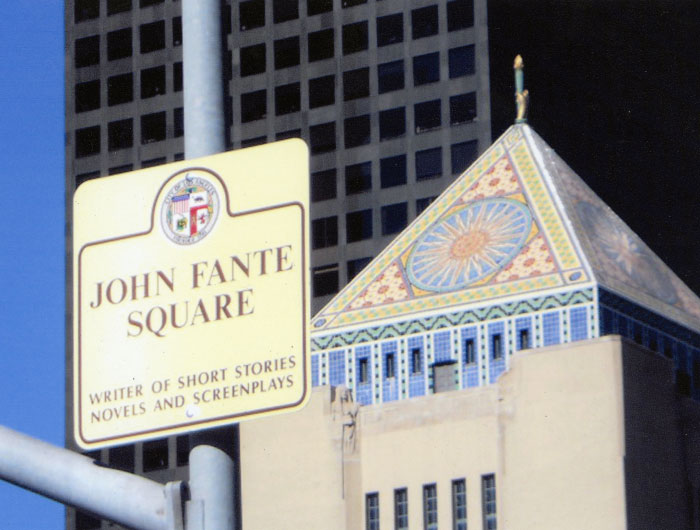
At the corner of West 5th Street and South Grand Avenue, hard by the Los Angeles Central Library, is a sign commemorating John Fante Square (see below), just on the edge of the old Bunker Hill neighborhood made famous by the writer’s Arturo Bandini novels. These include:

  • Wait Until Spring, Bandini (1938)
  • The Road to Los Angeles (1936, Published 1985)
  • Ask the Dust (1939)
  • Dreams from Bunker Hill (1982)

The best of them that I have read is Ask the Dust, which I finished reading this morning in the Central Library just outside the foot of Bunker Hill, where Fante and his hero Bandini lived.

Sign Commemorating John Fante Square with the Tower of the Central Library

Sign Commemorating John Fante Square with the Tower of the Central Library

Arturo Bandini wanted more than anything else to be a great writer, but we see him on the edge of poverty and trying unsuccessfully to find a love interest—in the worst possible way. His choice in Ask the Dust is a hophead Mexican waitress named Camilla Lopez with whom he has a love/hate relationship that ends badly. He is torn between his Italian Catholic upbringing and the glitzy Hollywood life of famous writers and film people.

It is in no way a Hollywood novel. In fact, Bandini and Lopez don’t even drive through Hollywood or have any interest in seeing films together.

Today, Bunker Hill is no longer a ghetto of cheap boarding houses; rather, it is full of high rise banks and corporate headquarters that tower over the lowlands of Downtown L.A. The old funicular, Angel’s Flight, which rises to the top of Bunker Hill from Hill Street across from the Grand Central Market is still in existence, though it is not presently in operation.

The life of John Fante has a particular interest for me because the end of his life was characterized by severe diabetes. In 1978, he went blind. Subsequently, he lost both of his legs to the disease. He died in 1983 at the age of 74.


My Japanese Years

Mifune Toshiro in Hiroshi Inagaki’s Duel at Ichijoji Temple

Toshiro Mifune in Hiroshi Inagaki’s Duel at Ichijoji Temple

It all came back to me while I had a Japanese meal with Martine at the Aki Restaurant in West Los Angeles. When I first came to Los Angeles in late 1966 I quickly became a Nipponophile. I lived for a while on Mississippi Avenue in the middle of the Sawtelle neighborhood, the old Japanese plant nursery district. Even before I started my explorations of Mexican food, I started becoming a Japanese foodie. I even thought the little tofu cubes in my miso soup were shark’s fin. (I marveled at my sophistication in eating “shark’s fin” soup.)

Since i was a graduate student in film at UCLA, I made a point of seeing as many Japanese films as I could. I remember taking the MTA #81 bus down Wilshire Boulevard to La Brea and walking a couple blocks south to the old Toho La Brea theater. The first films I saw there were Hiroshi Inagaki’s Miyamato Musashi (based on Eiji Yoshikawa’s novel) trilogy: Samurai (1954), Duel at Ichijoji Temple (1955), and Duel at Ganryu Island (1956). I fancied myself falling love with the sweet Kaoru Yachigusa, who played the part of Otsu; and of course I hero-worshipped Toshiro Mifune as the hero of he saga.

The Toho La Brea theater had a clock over the left emergency exit that was illuminated with the words Sumitomo Bank. All features were preceded by an Asahi Shimbun newsreel in Japanese without subtitles. Although I couldn’t understand a word, I looked forward to the newsreels.

A few years later, I joined with my film freak friends in visiting the other Japanese theaters in town: the Kokusai and Sho Tokyo (both Daiei studio), Kabuki (Shochiku), and the Linda Lea (Tohei). Today all five Japanese theaters are gone.

By the way, ever wonder why I call this website Tarnmoor? That was a pseudonym I used along with two of my friends in a UCLA Daily Bruin column entitled “The Exotic Filmgoer,” which was mostly about these Japanese theaters.

Santa Monica and Saint Monica

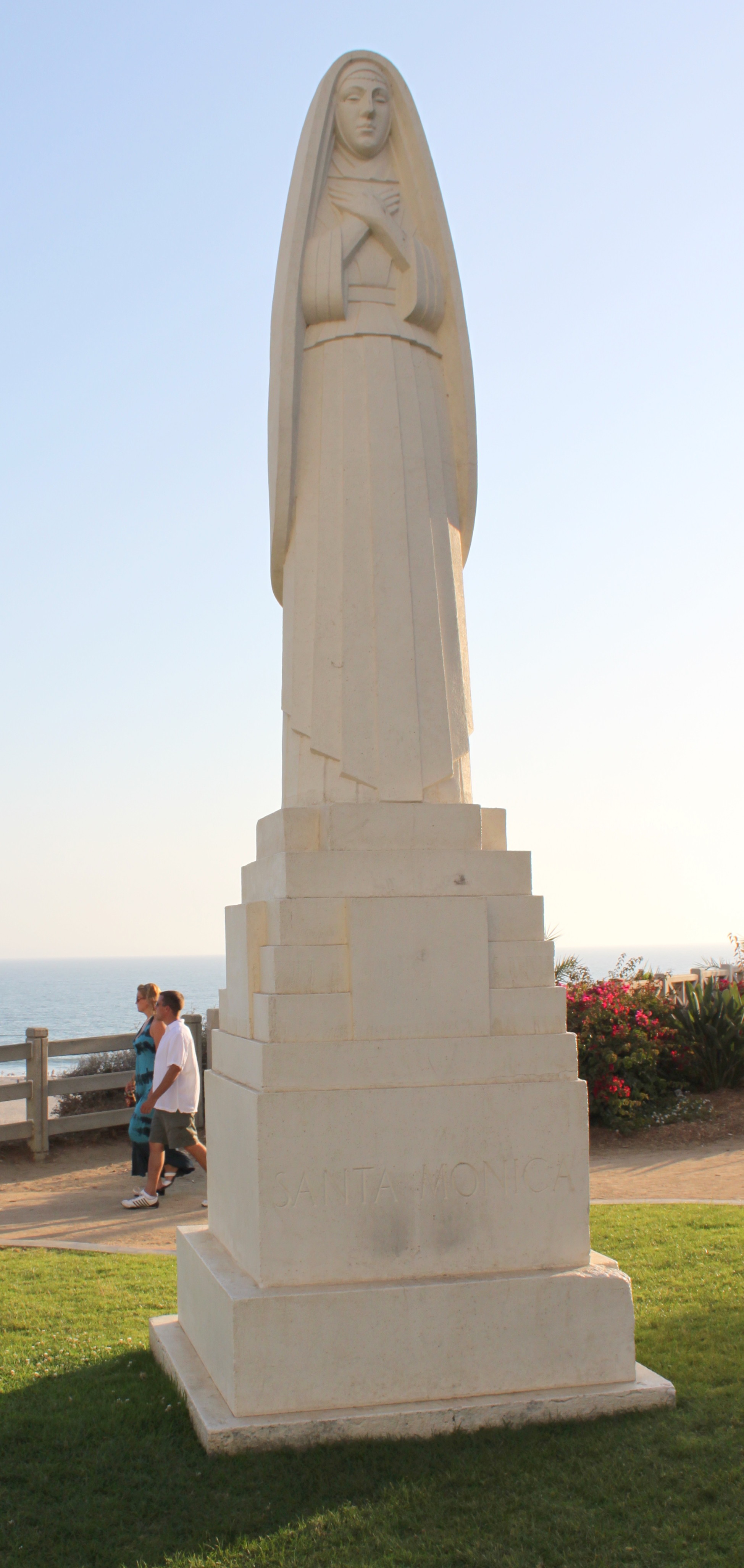
Statue of St. Monica in Santa Monica’s Palisades Park

Statue of St. Monica in Santa Monica’s Palisades Park

I’ve walked past this statue hundreds of times in the last half century. I always wound up shaking my head because St. Monica is made to look so Nordic. It’s like all those blonde blue-eyed Jesuses favored by Evangelicals. Protestant America doesn’t like to admit that, in certain countries surrounding the Mediterranean, people come with dark hair, brown eyes, and various skin shades of a darker hue.

Saint Augustine was born in present day Algeria, where, presumably, his mother Saint Monica, lived. Here is a painting of Saint Monica by artist John Nava which more closely corresponds to how she may have looked:

Painting of St. Monica by John Nava

Painting of St. Monica by John Nava

This painting is from a Saint Monica’s Church in Trenton, New Jersey. Too bad the people in Santa Monica are afraid of ’fessing up that their eponymous saint could be … shudder! … colored. And also likely to be banned from the local country club.


The Crusade Against the Christians

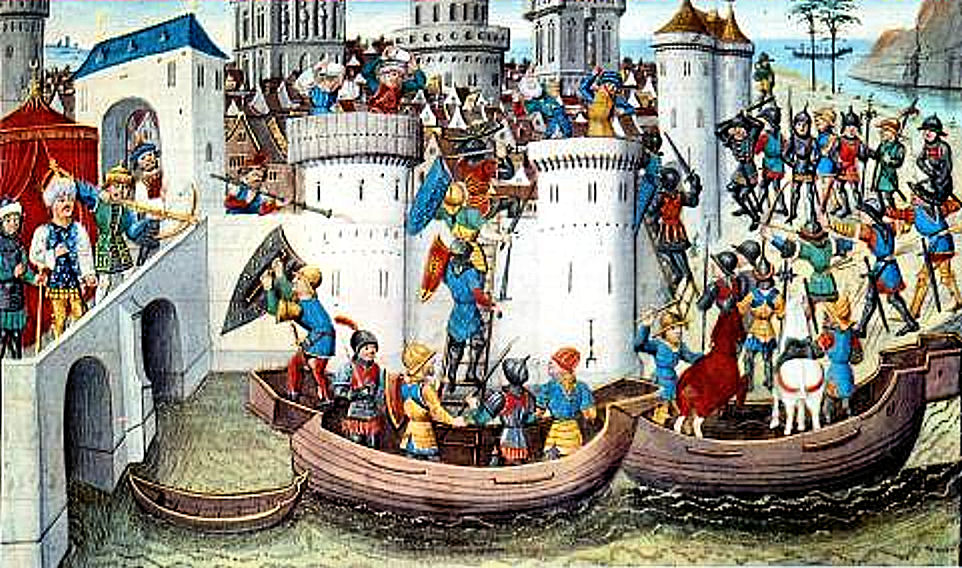
The 4th Crusade Was Christians vs. Christians

The 4th Crusade Was Christians Against Christians

Pope Innocent III didn’t plan it that way, but the 4th Crusade (1202-1204) was mostly Christians fighting Christians.When the knights involved in that crusade decided to go to the Holy Land by sea, they contracted with the Venetians to carry 30,000 bodies and associated horses and supplies to retake Jerusalem.

There was only one little problem. Although the Venetians spent a year building a fleet to carry the 30,000 crusaders, only about a third of that number showed up. Oops! That didn’t sit well with Enrico Dandolo, the 90-year-old blind Doge of Venice—but no pushover when it came to negotiations.

Venice was upset that the Adriatic port of Zara (now called Zadar) now belonged to Hungary. The Doge negotiated with the leaders of the crusade to stop and capture Zara “on the way” to the East. Unfortunately, Zara was not only Christian: It was Roman Catholic. And King Emico of Hungary wore the crusaders’ cross himself. A deal was a deal, and the crusade did not want to start on in debt to the Venetians. So, they attacked and took Zara, returning it to the Venetians.

That was only the beginning of their problems. A Byzantine prince named Alexius Angelos offered to pay a fortune to the crusade and to their Venetian transport … if only they would see fit to returning him to the throne of Constantinople. His father, Isaac II Angelos, has been the emperor; but his elder brother Alexius III Angelos, had him blinded and deposed him.

It looked like a good deal. Although Prince Alexius had been drumming up support for his cause among the crowned heads of Europe, he was pretty much ignored. Too flighty, it seems. But the crusaders were committed, and the idea of all that loot turned their heads.

So off to Constantinople they sailed. They besieged the city from the Golden Horn side, and after a number of attacks finally prevailed. Prince Alexius was set up as Alexius IV Angelos. And now it was time for payback. Except, Alexius IV was unable or unwilling to pay what he had promised. So the crusaders not only took the city, but looted and burned it, raping and killing at will. And, um, they never did get to the Holy Land.

Pope Innocent III was furious. If you can’t trust 10,000 crusaders wearing crosses over their armor to do what they promised, whom can you trust?

The story is well told in Jonathan Phillips’s The Fourth Crusade and the Sack of Constantinople, complete with extensive notes, a large bibliography, and an alphabetical index.


Pilgrims

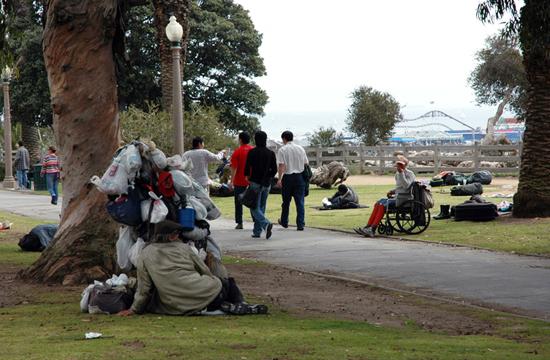
Homeless in Santa Monica’s Palisades Park

Homeless in Santa Monica’s Palisades Park

The title of this post comes from Joseph Conrad’s The Heart of Darkness:

I went to work the next day, turning, so to speak, my back on that station. In that way only it seemed to me I could keep my hold on the redeeming facts of life. Still, one must look about sometimes; and then I saw this station, these men strolling aimlessly about in the sunshine of the yard. I asked myself sometimes what it all meant. They wandered here and there with their absurd long staves in their hands, like a lot of faithless pilgrims bewitched inside a rotten fence.

Except, the pilgrims of whom I speak are not European ivory traders in the Congo, but either the homeless or people who do not wish to be labelled “homeless,” so they merely appear to be “in transit” with multiple bags.

Now that I work only two days a week, I like to spend more time in libraries, specifically downtown L.A.’s Central Library or Santa Monica’s Main Library. Curiously I see more pilgrims in Santa Monica, which comic Harry Shearer has dubbed “the Home of the Homeless.” Most are young, approximately half are black, and they travel with a lot of “stuff.” Usually, they just drop into a chair and doze off. Some use the Internet to try to find a way out of their present circumstances.

The library discourages homeless that smell very bad or have too many bags with them, as they inhibit families and students from using the books and computers. That tends to discriminate against elderly bums who have lived on the streets for years and and who have accumulated a vast store of “stuff.” (I have seen some with regular choo-choo trains of multiple supermarket carts.)

At night, Palisades Park along the bluffs overlooking the Coast Highway turns into a large encampment full of tents, shopping carts, plastic bags full of rags and food scraps, and whatnot.

There are Salvation Army and other accommodations in Santa Monica for the homeless, but I suspect not enough. And many of the homeless, as I hinted, are “in transit” and do not consider themselves to be homeless. A goodly number are stark raving mad, and a couple are probably homicides or arsons waiting to happen.


Cold War Nostalgia

The Spy Vs. Spy Characters from Mad magazine

The Spy Vs. Spy Characters from Mad Magazine

Looking back, the Communists were a worthy enemy. There were no suicide vests or improvised explosive devices aimed at innocent civilians. (Religious wars are always the most brutal.) Mind you, the Russians weren’t Boy Scouts, either. But after the ugliness and indiscriminate savagery of the current Sunni Muslim jihad against the West, I grow downright nostalgic about the 1960s.

Lately, I have been reading the three great spy novelists of that time—with great pleasure. I just finished Funeral in Berlin by one of them, the great Len Deighton. The other two were Ian Fleming of James Bond fame, and John Le Carré, author of Tinker, Tailor, Soldier, Spy and The Spy Who Came In from the Cold.

Funeral in Berlin is typical of the period. The hero, who is called Harry Palmer in the movies but is unnamed in the books, arranges to transfer a Russian scientist to West Berlin by means of a coffin. No one seems to be trustworthy. In fact, the character one would think would be the most villainous, Colonel Stok of the KGB, is actually the most sympathetic character that “Harry” encounters. The people who are supposedly his allies are an untrustworthy lot: two of them try to kill him, others just want to sell him down river.

In comparison, James Bond is almost never surprised by villains who are supposed to be on the same side as him. There are all those lovely girls, and Felix Leiter of the CIA appears as a supporting hero in several of the novels.

Only Le Carré comes close to Deighton in creating a murky world of spies and supposed friends. My favorite of his books is Tinker, Tailor, Soldier, Spy, which has been made into an excellent film and a great British TV series starring Sir Alez Guinness as George Smiley.


The Monster That Almost Devoured Cleveland

Le Bron James of the Cleveland Cavaliers

LeBron James of the Cleveland Cavaliers

I never write about sports, and yet here is my second consecutive posting about sports. The day before yesterday, the subject was Muhammad Ali. Today, it is the comeback of my native city, Cleveland, Ohio, in winning the NBA championship after being down 3 games to 1. No, I didn’t watch the game—Martine controls the TV remote in our household—but I followed the sports news on the net and in the Los Angeles Times.

The last time Cleveland won any sports championship was the 1964 NFL championship, in which the Browns slammed the Baltimore Colts 24-0. And that was 2 or 3 years before the first Super Bowl. That was the great team that featured Dr. Frank Ryan at QB and Jim Brown at FB. I remember listening to the game on radio because it was blacked out in the Cleveland TV market.

It took 52 years before Cleveland won another championship … in anything. In the meantime, it became the butt of jokes, such as from Maynard G. Krebs (played by Bob Denver) of “The Dobie Gillis” show always going to see a movie called The Monster That Devoured Cleveland.

Well, the monster did not devour Cleveland this time. Although I would have to have my head examined before I ever went back to live in what we called The Mistake on the Lake, I retain a strong affection for the people who live in my old home town.

When I was in grade school, Cleveland was the 7th largest city in the United States. No more. After much of its industry went to Asia to stay, it is now 31st and still falling. Although they have been uniformly miserable in sports rankings over the years, I hope they start a new tradition of winning, so that the devoted sports fans of Northeastern Ohio have something to look forward to.


Boxing Day

Muhammad Ali Takes Joe Frazier in 14 Rounds (1975)

Muhammad Ali Takes Joe Frazier in 14 Rounds (1975)

No, it’s not December 26. At 100 degrees Fahrenheit (37 degrees Celsius), I wish it were.

Martine and I reacted to the heat by going to the air-conditioned Paley Center for Media. While Martine watched 1950s sitcoms, I saw Muhammad Ali’s three bouts with Smokin’ Joe Frazier over a three-hour period:

  • The so-called Fight of the Century took place on March 8, 1971 at Madison Square Garden in New York. Frazier beat Ali in 15 rounds on a unanimous decision. Ali lost his world championship title as a result.
  • On January 24, 1974, Ali beat Frazier in 12 rounds on a unanimous decision. Neither were world champions at the time.
  • The “Thrilla in Manila” took place on October 1, 1975 in Quezon City in the Philippines. After 14 rounds, Ali, who was world heavyweight champion, hurt Frazier so badly that he was temporarily blinded, leading his trainer Eddie Futch to call the fight for Ali.

It was a grueling experience to see three fights between the same competitors one after the other, all with commentary by the grating Howard Cosell. At least, the Paley’s John H. Mitchell theater was well air conditioned, and the alternative would be to endure an altogether different sort of hell.

It was interesting to see Ali improve between the fights, starting from his clay-footed rope-seeking fighting style in the 1971 bout. Frazier stayed the same—always aggressive, bobbing, weaving, and left-hooking—but Ali developed new ways of meeting his challenge. Between the two of them, I was impressed by Frazier for his indomitable courage, and Ali for his intelligence and ability to adapt to different circumstances.


The Big Irish Fair

The Merry Wives of Windsor

The Merry Wives of Windsor

It was time for the Big Irish Fair and Musicfest in Long Beach. So Martine and I headed down to El Dorado Park and sat down for a day of extreme heat and delightful Irish music.

We concentrated on the more traditional groups at the Royal Tara Stage, which included harpists, fiddlers, and the fun girl band who called themselves the Merry Wives of Windsor. Although their website concentrates on their Renaissance Faire appearances, here they were clad in mufti. Conveniently, the stage was in the comfortable shade of several large pines.

I was particularly taken with their fiddler, Darien DeVries with her dancing eyes (right, above). They played a mixture of Irish, English, and original music with toasts and jokes between numbers.

Also notable was the harp playing of Dennis Doyle, who sang several tunes in Gaelic. Included in his act was (strangely) the best re-telling of James Joyce’s story, “The Dead,” from his Dubliners.