Mexican Heartbeat

¡Muy Delicioso!

¡Muy Delicioso!

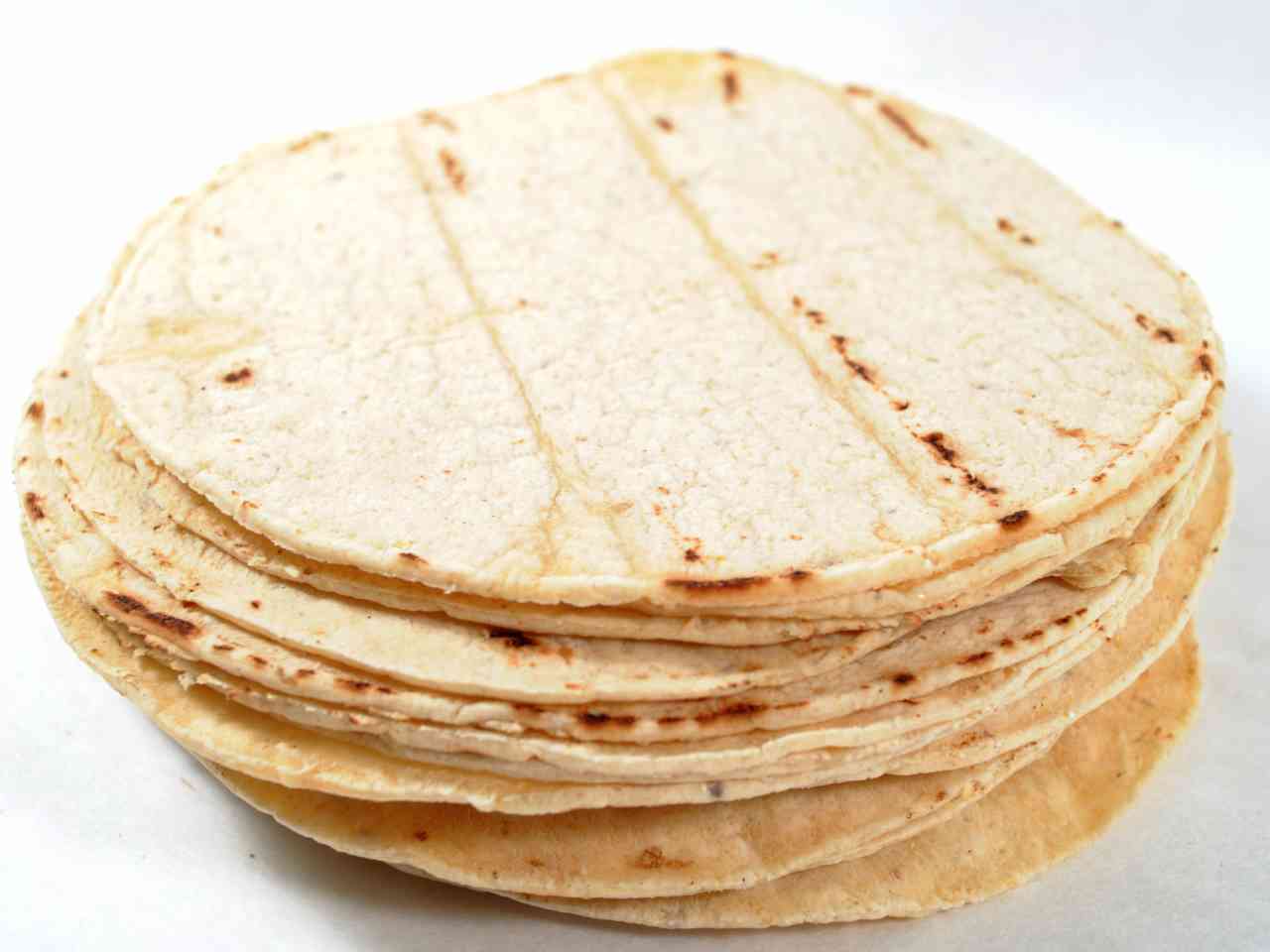
Fifty years in Los Angeles, and I’m turning into a Mexican! So many of the foods I used to like before—like rice, potatoes, bread, and gooey pastries—are now part of my pre-diabetic past. Lately, I’ve been eating a couple of tacos for lunch, preferably nopalitos (marinated prickly pear cactus) or fish with raw cabbage slaw. And for breakfast, I like to warm up some corn tortillas over a flame, roll them up in aluminum foil, and pop them in the oven. Warm them for a few minutes, and they taste great with sweet butter and a dash of salt.

I have heard it said that the sound of women’s hands rhythmically slapping the masa de maíz into little round cakes the heartbeat of Mexico. Perhaps I am developing a Mexican heart. There are far worse things in this world—though at least one presidential candidate would demur.

Apparently, the tortillas are helping my glucose readings stay lower. They satisfy my appetite without sending my sugar into the stratosphere.

A Red, Red Rose

Difficult, but Super Great!

Difficult, but Super Great!

Robert Burns is not popular with American readers. I suspect that is because he wrote in a broad Lowland Scots dialect that sends most Americans packing to a glossary. Fortunately, his poems are not all that way; and he is one of the few poets in the English language who were farmers before they were litterateurs. Below is his poem entitled “A Red, Red Rose”:

O my Luve is like a red, red rose
   That’s newly sprung in June;
O my Luve is like the melody
   That’s sweetly played in tune.

So fair art thou, my bonnie lass,
   So deep in luve am I;
And I will luve thee still, my dear,
   Till a’ the seas gang dry.

Till a’ the seas gang dry, my dear,
   And the rocks melt wi’ the sun;
I will love thee still, my dear,
   While the sands o’ life shall run.

And fare thee weel, my only luve!
   And fare thee weel awhile!
And I will come again, my luve,
   Though it were ten thousand mile.

The Reluctant Saxophonist

Not One of My Happier Memories

Not One of My Happier Memories

There are three things that I absolutely cannot do—and they are all connected to music:

  1. I cannot play music well.
  2. I cannot move in time to music.
  3. I cannot sing or carry a tune.

It took me ten years to discover these things, ten long years. It all started at a music store in downtown Cleveland (very near Prospect and Ontario). I was a little boy who was moderately interested in playing a musical instrument, say a trombone, for example. My parents and the sales clerk both agreed that a trombone would not suit me because I did not have buck teeth. Are buck teeth a requirement for trombonists? I wondered.

My parents talked me into choosing the alto saxophone. I was snookered into it, not even knowing what a saxophone looked like or sounded like.

I was soon to find out. The first thing I found out was that reed instruments like the saxophone are very mucky. All the gook in the mouth congeals around the reed, adding occasional squeaks from hell.

Then I found out I had to take lessons (with Jack Upson on East 4th Street) and practice half hour a day. And to make matters worse, my parents’ favorite piece of music was “The Londonderry Air,” which they called “Danny Boy” after the first line of the lyrics. My brother Danny was sure to add to my pleasure by smirking through the piece.

At Chanel High School, I was in the marching band. A marching band with only about 25 participants is pretty sure not to make a big impression, especially when the only thing anyone could hear was the drums. Because I memorized the scales, I was appointed First Saxophone, even though Chuck Matousek, who got Second Sax, was far better than me. He always played “Night Train” on the bus on the way to the football games. Me, I couldn’t play without the music in front of me. I had zero improvisational skills.

My big chance was in college. I was 600 miles from home, so I didn’t practice. I made a desultory attempt to join the Dartmouth Marching Band, but then said to myself, “Who’s going to know if I just quit?” And so I did. It turned out to be a good decision, though my parents were cheesed off when they discovered the truth.

At the Café of Lost Youth

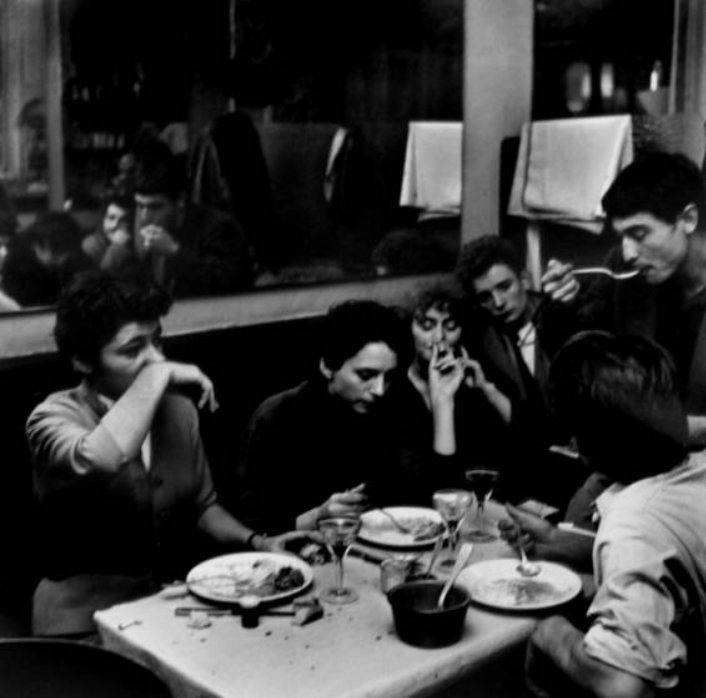
Paris Café Scene, 1950s

Paris Café Scene, 1950s (Ed van der Elsken)

On the back cover of my New York Review edition of Patrick Modiano’s In the Café of Lost Youth was an intriguing blurb:

In the Café of Lost Youth is vintage Patrick Modiano, an absorbing evocation of a particular Paris of the 1950s, shadowy and shady, a secret world of writers, criminals, drinkers, and drifters. The novel, inspired in part by the circle (depicted in the photographs of Ed van der Elsken) of the notorious and charismatic Guy Debord, centers on the enigmatic, waiflike figure of Louki, who captures everyone’s attention even as she eludes possession or comprehension.

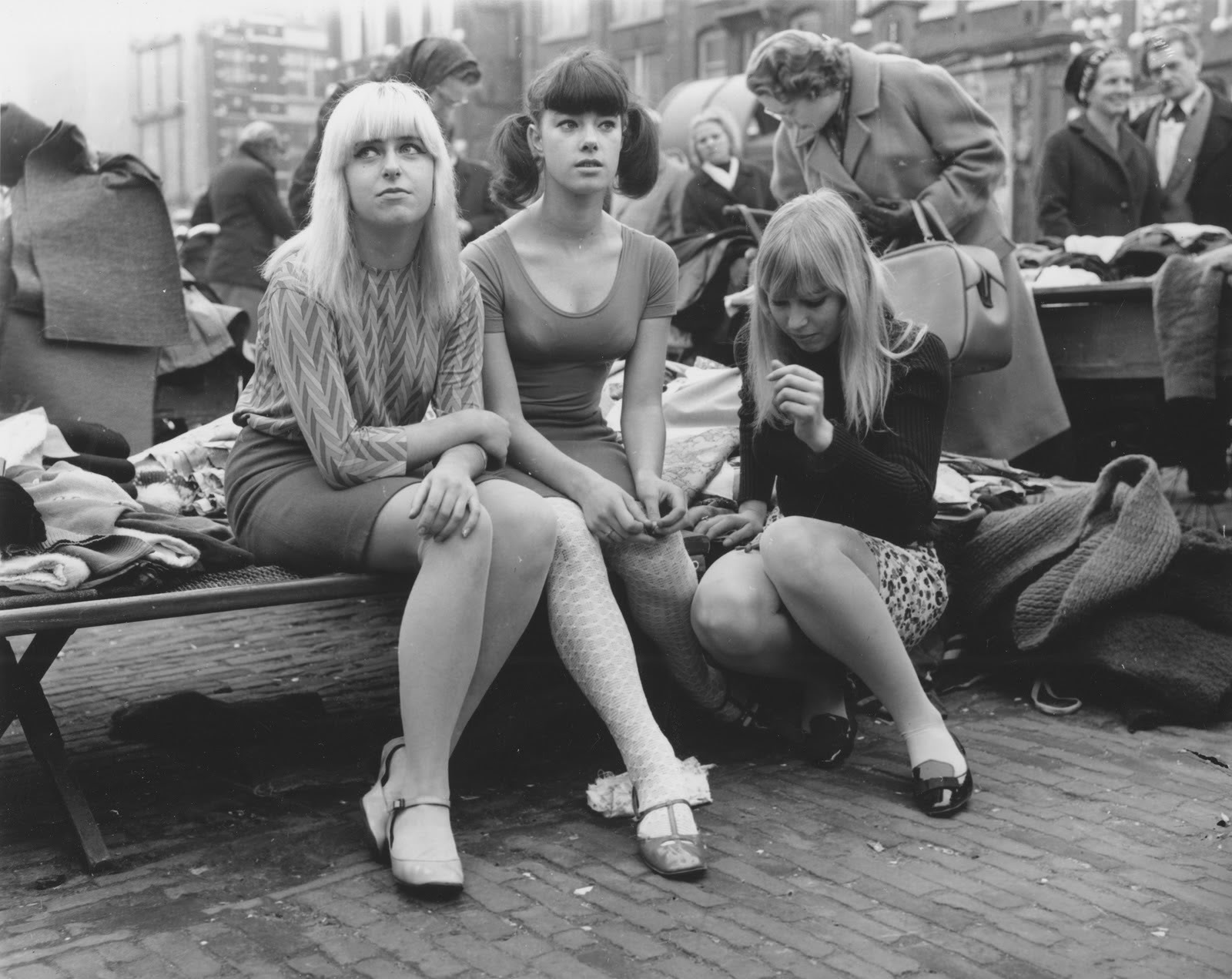
Naturally, I was intrigued and looked up the photos of Ed van der Elsken, of which I present two samples here. The above café scene is strongly suggestive of the Modiano book. The Parisian girls shown below are appealing images from a time long past:

Parisian Girls 1950s (Ed van der Elsken)

Parisian Girls 1950s (Ed van der Elsken)

One of the reasons I am drawn to Modiano’s work is that I am in love with Paris of the 1950s. I love the films (Melville, Chabrol, early Godard), the philosophy (Sartre, Camus), and now, with Modiano, the writers—even though he is writing retrospectively about the period over the last decade.

For more photos by Ed van der Elsken, click here.


The Raisin in the Oatmeal

Sam: Johnson’s Bookstore in Culver City

Sam: Johnson’s Bookshop in Culver City

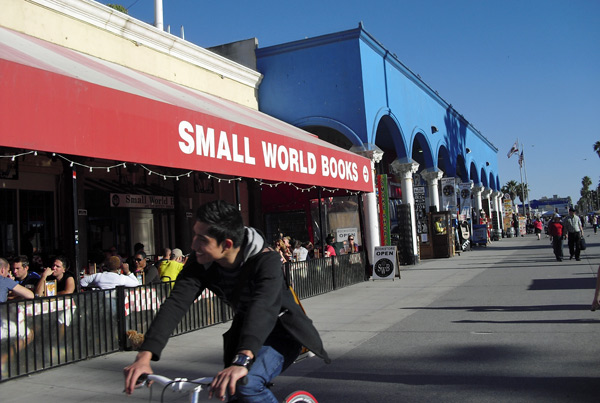
My doctor prescribed that I take long walks four days a week. Now that I am working only two days a week, it is much easier to comply. This morning, for example, I walked from Pico and Pacific down to where Windward meets the ocean—along two miles of “boardwalk” including parts of Santa Monica and Venice. My destination was Small World Books, one of the few remaining independent bookstores in West Los Angeles.

When I walk south, I go along Bundy to Venice Boulevard, where (not coincidentally) Sam: Johnson’s Bookshop is located. It is easily the best used bookshop for miles around.

Do I head west? Then my turnaround point is the three-story Barnes & Noble on the Promenade in Santa Monica.

Small World Books on the Venice Boardwalk

Small World Books on the Venice Boardwalk

Even with bookstores disappearing at an alarming rate, I have this book-buying habit that I have to somehow keep within reasonable limits. On my long walks, bookstores are like the raisin in the oatmeal. They give me a tangible reward for all that exercise.

When the temperature begins to heat up, I may have to join an air-conditioned health club that has treadmills and exercise bicycles. Hot weather is a powerful disincentive to outdoor exercise.

Road Trip

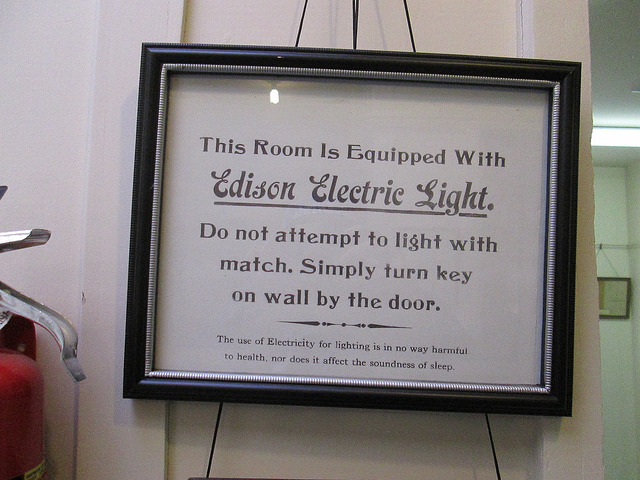
Sign in Fillmore Historical Society’s Museum

Sign in Fillmore Historical Society’s Museum

State Highway 126 runs roughly from Six Flags Magic Mountain in Santa Clarita to the Pacific Ocean around Ventura. During much of its length, it is prime agricultural country and contains miles of fruit orchards, especially in the old Spanish Sespe Rancho.

Ostensibly, we went to take the Fillmore & Western Railroad from Fillmore to Bennett’s Honey Farm in nearby Piru. There I sampled several types of honey and bought a big 3-pound jar of their Topanga Quality Wildflower honey, my favorite. Today was the 5th Annual California Honey Harvest Festival and BBQ Championship. We didn’t try any of the barbecue, mostly because neither Martine nor I really care for barbecued meat—too much sugar! Instead we ate at a little Mexican Restaurant called La Fondita on Central.

The train ride to the honey farm took half an hour in each direction. The train ran forward to get there, and backed up all 6-7 miles to return to the station.

While in Fillmore, we visited the Fillmore Historical Museum, where we saw the amusing sign above and had an interesting discussion with some of the volunteers. Then, on the way back home, we stopped at the Cornejo Produce Stand just outside of Fillmore for some really delicious looking apricots and strawberries.

It was a fun road trip and gave me ideas for several more in the area. Keep tuned to this space for further details.

The Perils of Clicktivism

Yes, Let’s Put a Stop to Internet Petitions!

Yes, By All Means Let’s Put a Stop to Internet Petitions!

Let me begin by saying that, in Britain, “barking” is short for “barking mad.” There are thousands of petitions on the Internet. Even the ones that are well intentioned could have repercussions far different from your goals in signing them.

For one thing, the creator of the petition has your name and e-mail address to sell to whatever nefarious operators are in the spamming business. If you absolutely must sign an Internet petition, give them a throwaway e-mail address that you don’t care to check on a regular basis. Don’t expect your signature to have any effect at all.

Online petitions are in the news today because of the San Jose judge who sentenced a rapist to only six months in prison, with time off for good behavior. Some one million Internet users have signed petitions to remove Judge Aaron Persky. It’s a waste of time, unfortunately, because that’s not how one influences a judge.

Even more interesting—and much more effective in my opinion—was a protest by ten members of the San Jose jury pool who refuse to serve on any case in which Judge Persky is involved. That could be devastating to a jurist and force him to resign.

Clicktivism, also referred to as slacktivism, is the lazy man’s way to try to effect social change.

In the meantime, I suggest you send a tub of lubricant preferably mixed with gravel to Brock Turner’s cellmate. That’ll work, too.

Serendipity: Vikings in Black and White

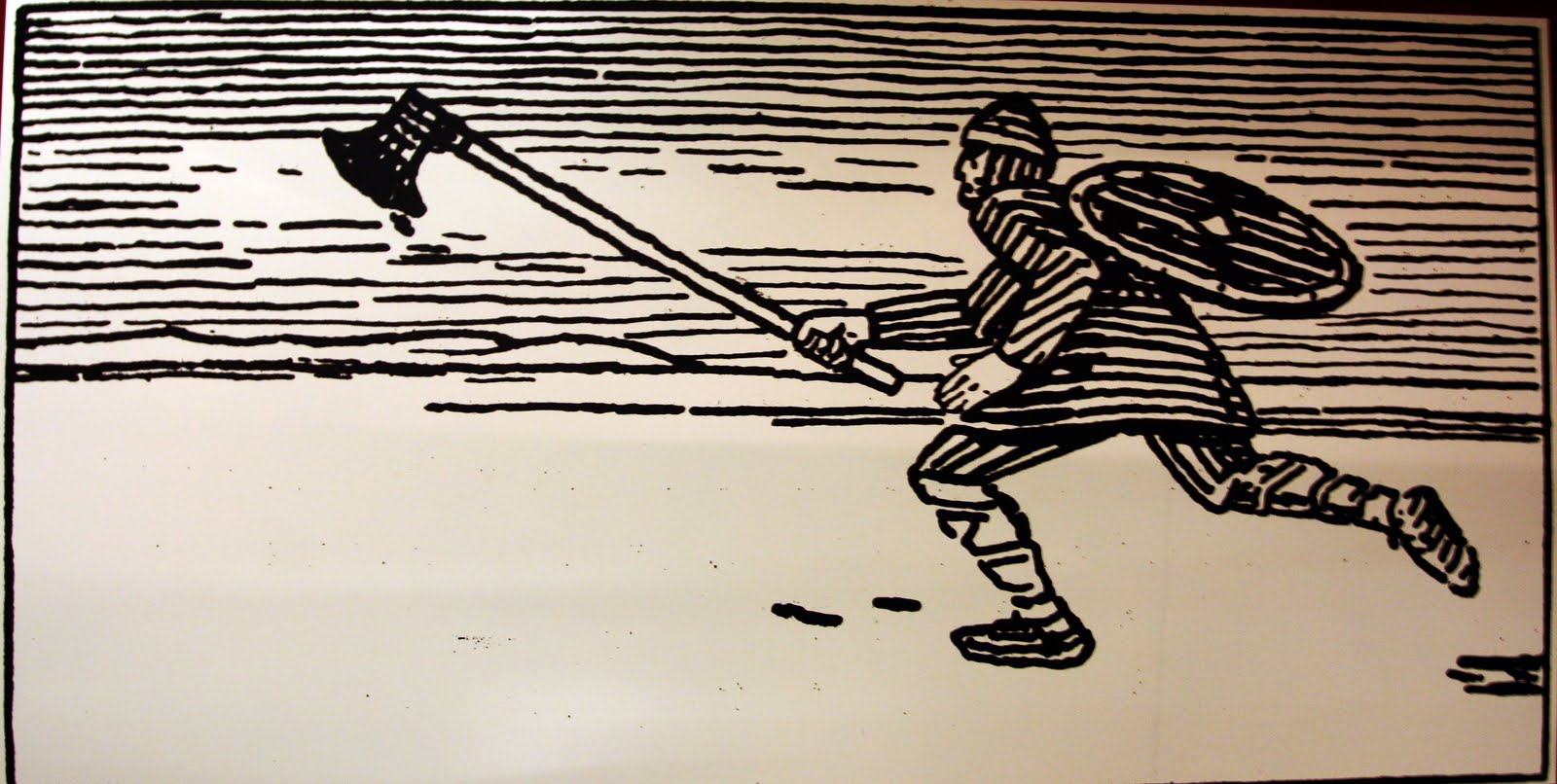
Skarphedinn the Viking Warrior from Njal’s Saga

Skarphedinn the Viking Warrior from Njal’s Saga

It took a blind poet to note something very interesting about Nordic literature at the time of the Vikings. On October 21, 1966, the Argentinian poet Jorge Luis Borges gave a class on Anglo-Saxon literature at the University of Buenos Aires. The book consists of notes recorded by the lecturer’s students and translated and published by New Directions in a volume entitled Professor Borges: A Course on English Literature. When the I read the following this morning at Los Angeles’s Central Library, I had chills up and down my spine:

And further south is what the Norse historians called Blaland, “blue land,” “land of blue men,” or rather Negroes, because they mixed the colors up a little. Besides one word, sölr, which means “yellowed” and is used to describe fallow fields and the sea, they have no colors. The snow is often spoken of, but they never say the snow is white. Blood is spoken of, but they never say it is red. They talk about the fields, but they never say they are green. We don’t know if this is the result of some kind of colorblindness or if it was simply a poetic convention. The Homeric Greeks said “the color of wine.” But we don’t know what color wine was for the Greeks; they don’t talk about colors, either. On the other hand, Celtic poetry that is contemporaneous or prior to Germanic poetry, contains an abundance of colors—it’s full of colors. There, every time a women is mentioned, they speak about her white body, her hair the color of gold or fire, her red lips. They also talk about green fields, and specify the colors of fruits, etcetera. In other words, the Celts lived in a visual world; the Norse did not.

At the time Borges gave this literature, his blindness was almost complete, though he was able to detect the color yellow.

Nothing If Not Messy

That Guy Stepping Off the Seesaw Has Just As Much Power As the Politician

That Guy Stepping Off the Seesaw Has Just As Much Power As the Politician

On this election day (for me, the California Primary), I am reminded of one of the things that Donald Rumsfeld said in which I actually believed: Democracy is messy, sometimes incredibly so. This horrible election year of 2016 brings us a contest between two politicians that many Americans would readily damn to the infernal regions.

But we seem to have bought this whole two-party system thing. But what happens when people start to lose faith in both parties? Just because I donated to Barack Obama’s 2008 and 2012 campaigns, my mailbox is full of solicitations from Debbie Wasserman Schultz and her minions. Although I tend to vote Democratic, I still consign those solicitations to the circular file with as much alacrity as an ad from Herr Trumpf.

Why would I donate money to a political party? I vote for candidates, not parties. And if the party cannot produce a good candidate, why then, bugger the party!

Yet I still vote. There I was at the Stoner Recreation Center at 7:15 this morning to vote for Bernie Sanders, despite knowing that Hillary Clinton would clean his clock. That doesn’t matter: If she gets in, then she has to listen to the forces behind Sanders or go down to defeat to the candidate that Jon Stewart would refer to as Fuckface von Clownstick. That would be … very … bad.

Nopalitos

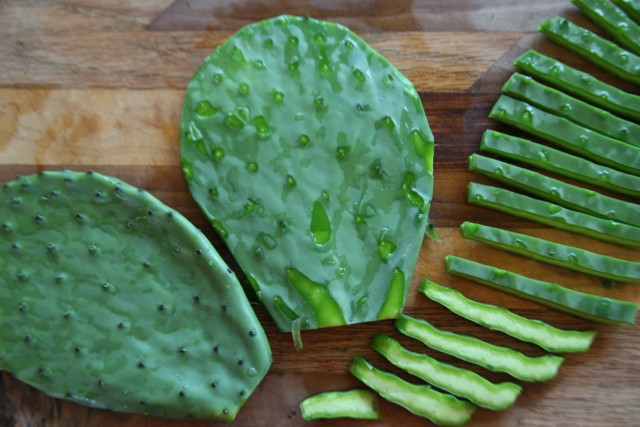
You Wouldn’t Think These Cacti Would Be Good Eating, Would You?

You Wouldn’t Think These Cacti Would Be Good Eating, Would You?

The first time I ran into the pads of prickly pear cactus (Opuntia) in a supermarket, I received a nasty shock. Out of curiosity, I handled them and found that the spines were still in them. My first impulse was to think, “Now why would anyone eat this stuff?”

But curiosity won out in the end. I think I first saw nopalitos on the menu at Paco’s Tacos in Culver City and decided to order them. First of all, it looked very different from the fresh cactus pads:

Hmmm, The Spines Are All Gone!

Hmmm, The Spines Are All Gone!

For one thing, the texture was all different, kind of like pickled okra—and the spines were all gone. Gingerly, I ate some with a fresh corn tortilla and loved the flavor.

Later, when my Type 2 Diabetes required some changes to my diet, I was delighted to find that nopalitos retard the absorption of sugars by the digestive system and thus have a low glycemic index. In Southern Calfornia, one could buy bottled nopalitos in virtually any supermarket and eat them as a salad, in the form of tacos, or cooked with scrambled eggs and chiles.

I don’t know whether it’s possible to find nopalitos outside of the American Southwest, but I think it’s worth making an effort. They’re delicious!