The Lion Dance

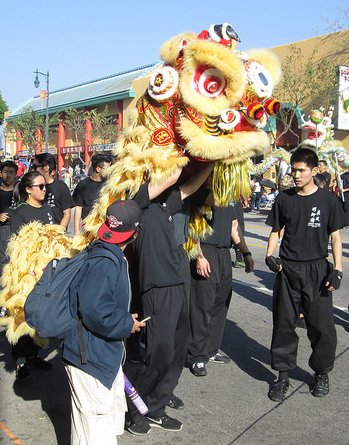
Lion Dancer at Chinese New Year Parade

Lion Dancer at Chinese New Year Parade

I have seen perhaps a dozen Chinese New Year parades, and I am quite used to seeing dragons and lion dancers. What I find interesting, however, is that there are no lions in China, nor have there been for about two thousand years. According to an article in China Highlights:

In traditional Chinese culture, the lion, like the Chinese dragon, was only an animal which existed in myth, and there were no actual lions in China. Before the Han Dynasty (202 BC – 220 AD), only a few lions had reached the Central Plains from the western area of ancient China (now Xinjiang), due to Silk Road trade.

Stone lions can be seen, however, acting as guardians to Beijing’s Forbidden City (see below). And Chinese images and beliefs relating to the mythical strength of the lion have spread around the world with the Chinese diaspora.

Stone Lion at the Forbidden City in Beijing

Stone Lion at the Forbidden City in Beijing

There are two styles of lion dance, the Northern and the Southern. Although most Chinese-Americans originated in South China, all the lion dancers I have seen at New Years parades were of the Northern type, which is associated with Chinese martial arts organizations. In the Northern style, only one person manipulates the lion costume. According to the China Highlights website, “Northern lion dances are more gymnastic, involving rolling, wrestling, leaping, jumping, climbing, or kowtowing.” It’s quite entertaining to see the feats of gymnastics performed by Kung Fu practitioners.

 

Watch It! He’s After Your Brain!

Doctor Daniel Amen

Doctor Daniel Amen

Is he a zombie? Not exactly, but close enough.

Watch public television at certain times, and you are likely to see various health practitioners standing in front of an audience of middle-aged and retired persons who are afraid of (1) getting cancer, (2) losing their memory, (3) blowing up like a dirigible, or (4) outright dying.   All you have to do is listen to the good doctor, buy his DVD, and read his book—and you will be on your way to becoming one of the immortals.

There are inevitably a number of do’s and don’t’s, connected with diet, exercise, sleep habits, etc. It’s like New Years Resolutions all over again—and you know how well those work! Basically, like resolutions, it’s a self-directed program with no snarky degreed individual looking over your shoulder to tell you shape up fast.

I usually associate these medical salesmen with Doctor Daniel Gregory Amen, whose audience is frightened of getting Alzheimer’s Disease and dementia. So, there they sit, clapping on cue at all the good doctor’s talking points.

Perhaps his program is good: I am in no position to judge. But I am dismayed that so much of the Public Television audience has reached a point where health has merged with self-help. As for myself, I will continue to consult with my physician about any worrisome indicators. As for brain health, my readers are aware that I am past help. You might just pronounce the final Amen.

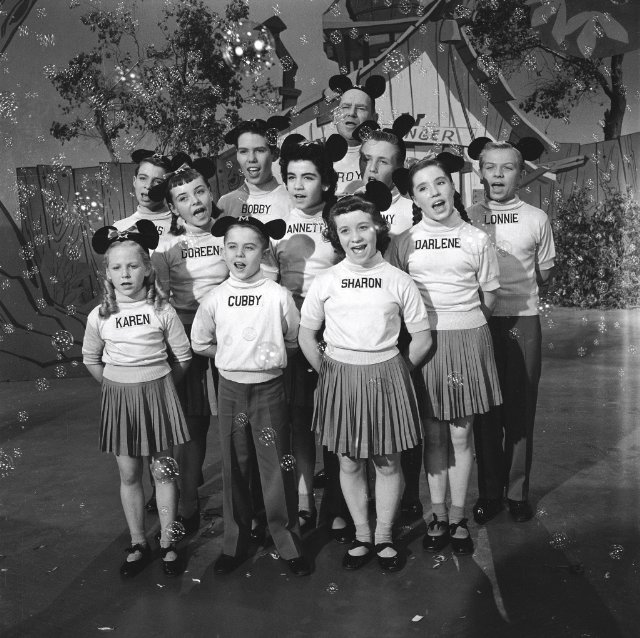
M-I-C-K-E-Y M-O-U-S-E!

Mousketeers with Jimmie Dodd

Mousketeers Around the 1950s

It all started in 1955. Not that it was the first TV show for kids—the Howdy Doodie Show beat it by eight years—but it was the first kids show featuring kids. I am referring, of course, to the Mousketeers of the Mickey Mouse Club.

After a morning doing tax returns at work, I acceded to Martine’s request to drop in at the Paley Center for Media in Beverly Hills. While Martine was watching some of her faves, I decided to see two episodes of the Mickey Mouse Club show, one from 1956 and one from 1957.

I saw at once why the show was a success. Not because I was entertained the way when I was a kid, but because Walt Disney had so much material lying around in film cans that there wasn’t as much of a burden to come up with new material for every show. Every show ended with a quarter hour cartoon segment from the vaults, and there were regularly repeating cartoon intros for the opening and many of the segment categories.

The live portions included the talents of the Mousketeers, including singing and dancing, and visiting a training center for firemen. They also featured local talent such as an archery champion and two yo-yo experts, all of whom were in their teens.

Of course, I watched the show religiously until I deemed myself too old and sophisticated and no longer in love with Annette Funicello with her dark hair and flashing eyes.

A 20-Year-Old Fan Letter


Harper Lee (1926-2016)

Harper Lee (1926-2016)

The author of everybody’s favorite book, To Kill a Mockingbird (1960), died today at the age of 89. Most literate Americans revere her memory, even after the recent publication of Go Set a Watchman (2015), in which Atticus Finch is revealed to be a (gasp!) bigot. I take no position on it, however, as I have not read the book; and I find the first reaction to anything by the media is usually wrong.

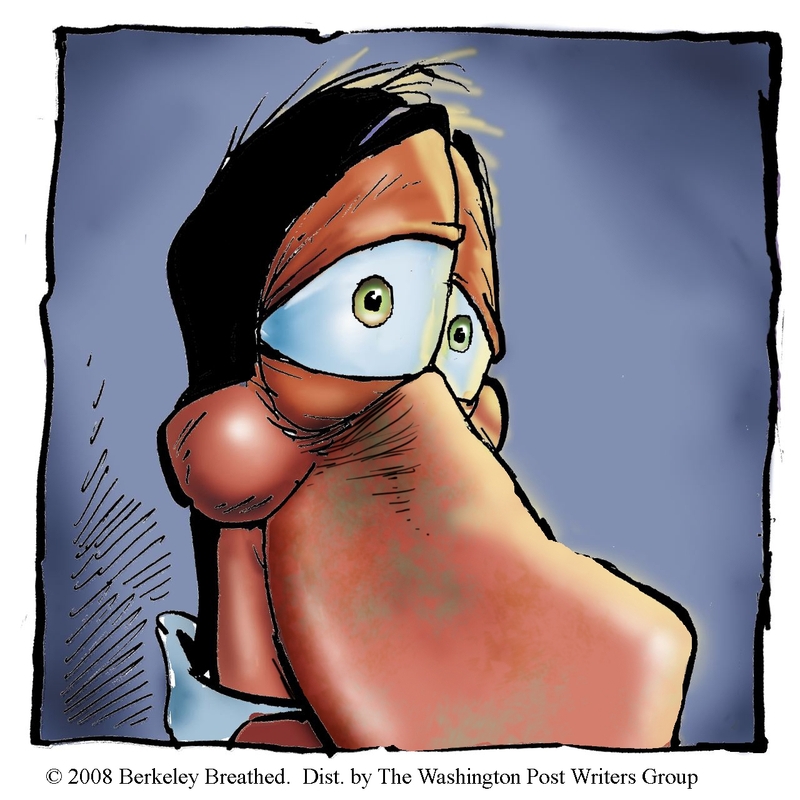
But what I want to write about is a letter Ms. Lee wrote to cartoonist Berkeley Breathed twenty years ago, when he decided to voluntarily stop publishing “Bloom County,” “Outland,” and “Opus.” It was the character of Opus the Penguin that she would miss the most. Here is the text of the letter as it appeared in Breathed’s Facebook posting today:

Dear Mr. Breathed,

This is a plea from a dotty old lady, and from others not dotty at all: Please don’t shut down OPUS. Can’t you at least give him a reprieve? OPUS is simply the best comic strip there is….

The letter goes on, but that’s all that Breathed shares with us. Fortunately, Opus is back, along with his Bloom County buddies, on Facebook, where I religiously check it each day.

Opus the Penguin

Opus the Penguin

Commenting on her letter, the cartoonist writes:

Bloomers: Many, but not all of you, know that in the way that creative life can often surprise, Harper Lee was one of you. One of us. You might be as surprised as I am that she played a large role in my recent return to the streets of Bloom County—streets inspired by those of Maycomb. When I retired Opus from the Sunday comics some years ago, Harper let me know her displeasure, with all the southern, gracious elegance we knew her for. See the letter below. I’ve waited until her passing to show it. We came to exchange many similar notes… including one in which she grudgingly forgives me for my retirement (irony alert). Imagine my 14 year-old self—freshly savoring the first reading of Mockingbird and sending Miss Lee a fan letter in 1970—being told about another fan letter returning my way almost 40 years distant. Life is wonderful and strange and wistful and happy at the same time. And I’m happy to share this with all of you today.

To follow Opus and his buddies, click here.


Serendipity: Byron—Pessimism or Optimism?

Thunderstorm Spectator at Tofino on Vancouver Island

Thunderstorm Spectator at Tofino on Vancouver Island

I have been reading G. K. Chesterton’s early book, Twelve Types (1902), and found this fascinating discussion of Byron’s curious joy in … pessimism?

Now Byron had a sensational popularity, and that popularity was, as far as words and explanations go, founded upon his pessimism. He was adored by an overwhelming majority, almost every individual of which despised the majority of mankind. But when we come to regard the matter a little more deeply we tend in some degree to cease to believe in this popularity of the pessimist. The popularity of pure and unadulterated pessimism is an oddity; it is almost a contradiction in terms. Men would no more receive the news of the failure of existence or of the harmonious hostility of the stars with ardour or popular rejoicing than they would light bonfires for the arrival of cholera or dance a breakdown when they were condemned to be hanged. When the pessimist is popular it must always be not because he shows all things to be bad, but because he shows some things to be good. Men can only join in a chorus of praise even if it is the praise of denunciation. The man who is popular must be optimistic about something even if he is only optimistic about pessimism. And this was emphatically the case with Byron and the Byronists. Their real popularity was founded not upon the fact that they blamed everything, but upon the fact that they praised something. They heaped curses upon man, but they used man merely as a foil. The things they wished to praise by comparison were the energies of Nature. Man was to them what talk and fashion were to Carlyle, what philosophical and religious quarrels were to Omar, what the whole race after practical happiness was to Schopenhauer, the thing which must be censured in order that somebody else may be exalted. It was merely a recognition of the fact that one cannot write in white chalk except on a blackboard.

Surely it is ridiculous to maintain seriously that Byron’s love of the desolate and inhuman in nature was the mark of vital scepticism and depression. When a young man can elect deliberately to walk alone in winter by the side of the shattering sea, when he takes pleasure in storms and stricken peaks, and the lawless melancholy of the older earth, we may deduce with the certainty of logic that he is very young and very happy. There is a certain darkness which we see in wine when seen in shadow; we see it again in the night that has just buried a gorgeous sunset. The wine seems black, and yet at the same time powerfully and almost impossibly red; the sky seems black, and yet at the same time to be only too dense a blend of purple and green. Such was the darkness which lay around the Byronic school. Darkness with them was only too dense a purple. They would prefer the sullen hostility of the earth because amid all the cold and darkness their own hearts were flaming like their own firesides.

I am reminded of a curious form of tourism in Canada: winter storm watching, which reaches its peak at the Vancouver Island resort of Tofino.  When I am finished spending my winters working on tax preparation, I am tempted to take a room at Wickanninish Inn on Chesterman Beach some five miles south of Tofino and watch the storm and waves hurl themselves at me.

Chesterton got it right. I feel the same way.

The Six Lost Tribes of the Confederacy

Robert Reich, Dartmouth Class of 1966

Robert Reich, Dartmouth Class of 1966

I knew Robert Reich when we were in the same graduating class at Dartmouth College. I was the film critic for the school newspaper, and Robert was a cheerleader for the football team. He probably doesn’t remember me (there were 800 of us in that class), but I remember him. The important thing is that he has become a powerful voice for the direction that American politics should take.

What, exactly, does that mean as far as the GOP is concerned? According to Robert’s website, the Republican party has splintered into six not altogether compatible factions:

  1. “Evangelicals opposed to abortion, gay marriage, and science.” That would include Ted Cruz, Mike Huckabee, and Rick Santorum.
  2. “Libertarians opposed to any government constraint on private behavior.” That would be Rand Paul.
  3. “Market fundamentalists convinced the ‘free market’ can do no wrong.” Most of them pay lip service to this statement, though if Mike Bloomberg decided to run, this would be his mantra.
  4. “Corporate and Wall Street titans seeking bailouts, subsidies, special tax loopholes, and other forms of crony capitalism.” Enter Donald Trump.
  5. “Billionaires craving even more of the nation’s wealth than they already own.” Trump again, plus other candidates feeding from the billionaire-funded PACs.
  6. “And white working-class Trumpoids who love Donald. and are becoming convinced the greatest threats to their wellbeing are Muslims, blacks, and Mexicans.” Well, now, this one is pretty obvious.
This is Just One of the Faces of Today’s GOP

This is Just One of the Faces of Today’s GOP

You could take all the remaining candidates and map them by their emphasis on one of these six strains. What makes their races so difficult is that many of the candidates tend to lose their focus when they are split so many different ways.


Rat Number 42


Sometimes, You Just Can’t Win

Sometimes, You Just Can’t Win

The following comes from AboveAverage.Com. I thought you might find it amusing:

Researchers at Harvard are incredibly annoyed with a lab rat they describe as “a real asshole.”

“We’re trying to research how obesity impacts brain function,” explained Dr. Stu Macho. “To do that, we got all these normal rats and started observing them. Then this little fucker, we call him #42, starts eating a ton. He got super fat and starts walking into his cage walls like a moron when we try to observe him. But then, at night, he’s completely normal. It’s totally throwing off our data. He’s being a real shithead.”

shutterstock_365565182

I mean, look at this little shithead.

This isn’t the first time #42 has ruined an experiment. Dr. Macho explains, “I once ran an experiment to test whether the scent of cats was frightening to rats. We gave them a treat every time they pushed a big red button. Then we sprayed it with cat scent. Literally every single rat was too scared to push the red button, except #42. He pushed it, winked, and then held his little paws out for his treat. He’s such an asshole, his data screwed my entire thesis.”

Dr. Macho believes #42’s behavior is intentional and aimed specifically at him. “I caught him laughing at me once while I was trying to sort data he’d fucked up. I know what you’re thinking, ‘Can rats even laugh? And what would it look like?’ Trust me, when a rat laughs at you, you’ll know.”

When asked why he doesn’t simply exchange #42 for a less malicious rat, Dr. Macho explained, “You can’t just use an infinite number of lab rats. They start to think you’re a psycho if you keep asking for more.” Dr. Macho sighed. “I feel like I’m living in an annoying Pixar movie where I’m the bad guy – oh, wait….I’m the bad guy. I’m the evil scientist performing experiments on a sassy, smart rat. And my name is Dr. Stu Macho? Oof, yeah, I’m the wrong one here.”

Just behind Dr. Macho, #42 winked and walked directly into his food bowl.

What Have Billionaires Done for Us Lately?

Trump with His Plane

Trump with His Plane

There is a certain category of voter who thinks we need a businessman at the helm of this country. Do we? What have businessmen done for us lately?

Perhaps their biggest contribution has been to send American jobs overseas. My father used to be a machine tool builder in Cleveland. Now there is an ever-dwindling number of machine tool builders in the United States. Plenty of them in Southeast Asia, however!

If a hypothetical President Trump were in charge, what might he do? For starters, he could send less desirable (i.e. Democrat) voters to Syria, Libya, and Somalia—countries which are in the process of being rapidly depopulated.

He can raise his salary and create new perks for his office. (Isn’t that what billionaire businessmen do best?)

He could find sneaky ways of making his investments worth more (and those of his competitors worth less).

Really, in the end, all American CEOs care about is me, Me, ME, ME! After all, they didn’t get rich by helping losers. And we are all losers, aren’t we?


Hijacking The Presidential Race

Antonin Scalia (1936-2016)

Antonin Scalia (1936-2016)

The 2016 election has quite suddenly morphed into a struggle for control of the U.S. Supreme Court. If the Republicans refuse to fill Scalia’s seat with a new Obama nominee until the inauguration of a new president next January, then they will be openly guilty of sabotaging the Constitution so that their minority party can control the country. As you may recall, that has been tried before in 2013 when John Boehner and Mitch McConnell staged a shutdown of Congress.

Republicans like to think that most Americans are conservatives. That is true to some extent, especially where fiscal issues are concerned, but untrue when it comes to cultural issues. And that divergence can only be expected to grow as the aging angry white population of the U.S. dies off.

The Dragon and the Monkey

Dragon

Dragon

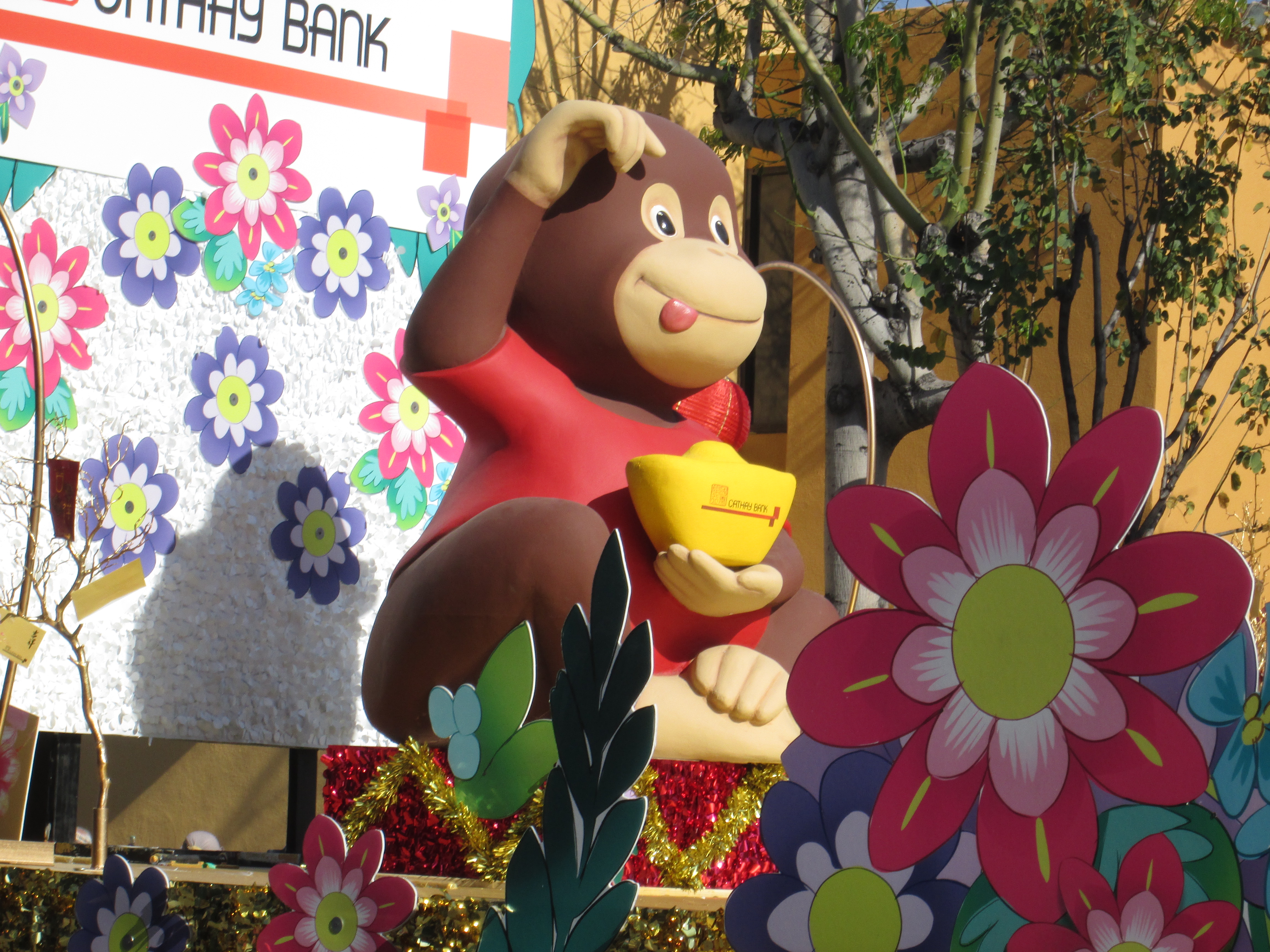
Today, for the first time in two or three years, Martine and I attended the Golden Dragon Parade in Chinatown to celebrate the new Year of the Monkey. It turns out that I was born in the Year of the Monkey, but according to Chinese astrology, this may not be a lucky year for me. Fortunately, I do not believe in any kind of astrology.

Martine, on the other hand, was born in the Year of the Dragon, which means that we are complementary. But I am convinced that we are complementary for other reasons than those picked by astrologers.

Monkey

Monkey on Cathay Bank Float

To avoid various construction and marathon race snarls, we took the bus downtown and went to our usual Chinatown restaurant, the Sala Thai on Alpine Street. I had a spicy fish filet with basil and peppers, and Martine had her usual pad see ew with chicken and broccoli.

Even though the parade was fraught with symbolism which we didn’t altogether understand, we had a great time.