Flea-Bitten Empire

With the Legions Came Another Invader ....

With the Legions Came Other Invaders ….

According to an article in The Guardian, we tend to give a lot of credit to the Romans for cleanliness and hygiene. What is not commonly associated with them are “lice, fleas, bed bugs, bacterial infections from contamination with human feces, and 25ft-long tapeworms, a misery spread across the empire by the Roman passion for fermented fish sauce.”

But what about all those Roman baths? Well, how often was the water changed? Or did the bathers regale themselves in a bacteriological soup until the bucket brigade of slaves renewed the water? Unchanged water “left the bathers swimming in a warm soup of bacteria and the eggs of parasites such as roundworm and whipworm.” Then, too, many simply bathed themselves in olive oil, which was cleaned off with a strigil, an kind of scraper with a curved blade used to scrape sweat and dirt from the skin in a hot-air bath or after exercise.

Roman Baths

Roman Baths

And what about those tapeworms? Here the culprit was the Romans’ use of a fermented raw fish sauce called garum. According to Piers Mitchell, from whose article in The Journal of Parasitology this information is derived: “Wrapped around the Romans’ intestines …, the parasites could remove nutrients from food before it could be digested, which could cause severe or even fatal anaemia. Evidence from some Roman sites in Italy revealed that up to 80% of the child skeletons had evidence of severe anaemia.”

Another common source of ill health was the use of human feces to fertilize vegetable gardens. If the human wastes were allowed to compost for a year or more, there would be no danger from bacteriological infections; but there is no proof that the Romans knew of this.

Archaeologists found that the Romans with their baths were no freer from infection and worms and such like than the supposedly more primitive Vikings.

Sic transit gloria Imperii!

Tannu Tuva or Bust!

Very Nice, But There Were No Railroads in Tuva

Very Nice, But There Were No Railroads in Tuva

One of the things I remember most vividly from my stamp collecting days was the availability of postage stamps for non-countries. These were for real places on the map, but not for entities that had their own postal services. The one I remember most vividly is Tannu Tuva (formerly in the Soviet Union).

According to Wikipedia:

Tuva was a region in central Asia between Russia and Mongolia, which in 1921, under Russian instigation, became the Tuvan People’s Republic. A treaty between the Soviet Union and the Mongolian People’s Republic in 1926 affirmed the country’s independence, although no other countries formally recognized it. In 1944, it was annexed to the Soviet Union as part of the Tuvan Autonomous Oblast and in 1961 became the Tuva Autonomous Soviet Socialist Republic. Its successor since 1992, the Tuvan Republic, is a member of the Russian Federation.

I remember reading a book in the 1990s about American physicist Richard Feynman’s failed attempts to visit Tuva, which were detailed in a book by Ralph Leighton entitled Tuva or Bust!: Richard Feynman’s Last Journey. Apparently he never got a visa approval before his final illness.

Some early Tuvan stamps may actually have been used postally, at least in the early days. Most, however, were issued in Moscow with picturesque settings to hard currency from capitalist collectors for Mother Russia. The stamp pictured above of a camel racing a railroad train was a bit fanciful, as there are no railroads in Tuva. Also, why wasn’t the text on the stamp in Cyrillic or even Mongolian letters?

I remember confronting an old family friend about his extensive collection of Tuvan postage stamps. A former postal employee, he became red in the face when told by a little boy that his Tuvan stamps were merely pretty paper.


Ocean Park

In His Case, I’ll Make an Exception

In His Case, I’ll Make an Exception

It was my friend Lynette who opened my eyes to the “Ocean Park” series of abstract paintings by Richard Diebenkorn (1922-1993). Ordinarily, I dislike nonrepresentational art; but in Diebenkorn’s case, I’ll make an exception. He moved in Los Angeles around the same time I did, and I found his choice of colors reminded me of the Santa Monica neighborhood after which this series is named.

Usually, colors alone do not mean much to me. In the case of Mark Rothko, for example, they mean less than nothing. In “Ocean Park #40” above, I could probably find something like that particular pattern somewhere along Ocean Park Boulevard.


Ocean Park #105

Ocean Park #105

The same goes for “Ocean Park #105” above.

I wonder, if the color scheme of an abstract painting suggests something to me, can it really be said to be abstract at all?

Adventures in Stamp Collecting

20 Fillér Stamp Honoring Hungarian Radio Manufacturing

20 Fillér CTO Stamp Honoring Hungarian Radio Manufacturing

One would think that nothing can be so staid and stolid a pastime as stamp collecting. Mind you, it’s getting increasingly difficult since most stamps—in the U.S. anyway—are of the peel and stick variety. As a child, I remember soaking stamps still attached to pieces of envelope and postcard in lukewarm water to remove the gum. Then I carefully dried the stamps under a blotter weighted down with a book so the stamps wouldn’t curl. The end result was pretty presentable.

But then the Soviet block discovered CTO—short for canceled to order—with perfect cancellations that were printed right on the stamp which came without gum. In effect they were mint ungummed stamps.

Of course, mint never used stamps were more expensive. Putting them in albums caused a certain amount of existential angst. One could use a stamp hinge, but (horrors!) it left a mark on the gum. The option was to buy expensive mounts in which the mint stamps were wholly encased.

My guess is that there are relatively few stamp collectors left, and that they are mostly aging rapidly. What with smart phones and their ilk, kids are not interested in anything that requires patience, knowledge, and care. Too bad! I learned a lot from my old hobby and had lots of fun.

This is the first of several posts under the general heading of “Adventures in Stamp Collecting,” consisting of stories I remember from my collecting days.

Some of these stories are more interesting than they seem at first glance.

Serendipity: A Snark-y Response

The Snark at the Dock

The Snark at the Dock

The following comes from the Foreword of Jack London’s The Cruise of the Snark:

Our friends cannot understand why we make this voyage.  They shudder, and moan, and raise their hands.  No amount of explanation can make them comprehend that we are moving along the line of least resistance; that it is easier for us to go down to the sea in a small ship than to remain on dry land, just as it is easier for them to remain on dry land than to go down to the sea in the small ship.  This state of mind comes of an undue prominence of the ego.  They cannot get away from themselves.  They cannot come out of themselves long enough to see that their line of least resistance is not necessarily everybody else’s line of least resistance.  They make of their own bundle of desires, likes, and dislikes a yardstick wherewith to measure the desires, likes, and dislikes of all creatures.  This is unfair.  I tell them so.  But they cannot get away from their own miserable egos long enough to hear me.  They think I am crazy.  In return, I am sympathetic.  It is a state of mind familiar to me.  We are all prone to think there is something wrong with the mental processes of the man who disagrees with us.

The ultimate word is I LIKE.  It lies beneath philosophy, and is twined about the heart of life.  When philosophy has maundered ponderously for a month, telling the individual what he must do, the individual says, in an instant, “I LIKE,” and does something else, and philosophy goes glimmering.  It is I LIKE that makes the drunkard drink and the martyr wear a hair shirt; that makes one man a reveller and another man an anchorite; that makes one man pursue fame, another gold, another love, and another God.  Philosophy is very often a man’s way of explaining his own I LIKE.

The Man With The Shredded Ear


Speaking of Raymond Chandler

Speaking of Raymond Chandler

While I was scanning the Futility Closet website (it’s on my link list to the left), I found the following alternative titles that Raymond Chandler had listed for possible future works:

The Man with the Shredded Ear
All Guns Are Loaded
The Man Who Loved the Rain
The Corpse Came in Person
The Porter Rose at Dawn
We All Liked Al
Too Late for Smiling
They Only Murdered Him Once
The Diary of a Loud Check Suit
Stop Screaming — It’s Me
Return from Ruin
Between Two Liars
The Lady with the Truck
They Still Come Honest
My Best to the Bride
Law Is Where You Buy It
Deceased When Last Seen
The Black-Eyed Blonde

In addition, there was this delightful little excerpt:

In a 1954 letter to Hamish Hamilton, he invented a “neglected author” named Aaron Klopstein who “committed suicide at the age of 33 in Greenwich Village by shooting himself with an Amazonian blow gun, having published two novels entitled Once More the Cicatrice and The Sea Gull Has No Friends, two volumes of poetry, The Hydraulic Face Lift and Cat Hairs in the Custard, one book of short stories called Twenty Inches of Monkey, and a book of critical essays entitled Shakespeare in Baby Talk.”

How does one shoot oneself with an Amazonian blow gun? I thought those were fairly long. Maybe he got his own toes, or set up some sort of fancy ricochet.


The Long Goodbye


The First Time I Read This Edition

The First Time I Read This Edition

The following is based on my review of Raymond Chandler’s The Long Goodbye for Goodreads.Com:

I had read The Long Goodbye many years ago, and liked it. In the meantime, I have aged—not exactly like a fine wine, but aged nonetheless—and found myself loving Raymond Chandler’s penultimate work. I might even go so far as to say it is his masterpiece, though back then I liked The Big Sleep and Farewell My Lovely more.

This time I detected the raggedness. Chandler’s wife, Cissy, was dying and he felt more vulnerable. This is no tight Agatha Christie thriller than runs like a Swiss clockwork. Not by a long shot. It’s about a nasty, persistent evil that, once you poke it with a stick, keeps coming back to snare you and hurt you. Somehow, Chandler’s detective Marlowe walks the straight and narrow path and comes out alive at the end:

I was as hollow and empty as the spaces between the stars. When I got home I mixed a stiff one and stood by the open window in the living room and sipped it and listened to the groundswell of the traffic on Laurel Canyon Boulevard and looked at the glare of the big angry city hanging over the shoulder of the hills through which the boulevard had been cut. Far off the banshee wail of police or fire sirens rose and fell, never for very long completely silent. Twenty-four hours a day somebody is running, somebody else is trying to catch him. Out there in the night of a thousand crimes people were dying, being maimed, cut by flying glass, crushed against steering wheels or under heavy tires. People were being beaten, robbed, strangled, rape, and murdered. People were hungry, sick, bored, desperate with loneliness or remorse or fear, angry, cruel, feverish, shaken by sobs. A city no worse than others, a city rich and vigorous and full of pride, a city lost and beaten and full of emptiness.

A French Edition of The Long Goodbye

A French Edition of The Long Goodbye

And mind you, this is just the background in which a series of murders and/or suicides take place that call Marlowe’s actions into question and put him in personal peril, such as the time four toughs waylay him in his own house. They included the following:

A man was sitting across the room with his legs crossed and a gun resting sideways on his thigh. He looked rangy and tough and his skin had that dried-out look of people who live in sun-bleached climates. He was wearing a dark brown gabardine-type windbreaker and the zipper was open almost to his waist. He was looking at me and neither his eyes nor the gun moved. He was as calm as an adobe wall in the moonlight.

That last short sentence inspired writer Walter Mosley to begin writing his own series of detective novels featuring Easy Rawlins.

I feel I have not rendered justice to this great novel—probably because it is still working its way through my bloodstream and opening channels in my body that I did not know existed.

“Iron In The Blood Of The People”

Poet Langston Hughes (1902-1967)

Poet Langston Hughes (1902-1967)

I like this poem by Langston Hughes, which is entitled “Kids Who Die.” Unfortunately, it’s as relevant today as when it was first written.

Kids Who Die

This is for the kids who die,
Black and white,
For kids will die certainly.
The old and rich will live on awhile,
As always,
Eating blood and gold,
Letting kids die.

Kids will die in the swamps of Mississippi
Organizing sharecroppers
Kids will die in the streets of Chicago
Organizing workers
Kids will die in the orange groves of California
Telling others to get together
Whites and Filipinos,
Negroes and Mexicans,
All kinds of kids will die
Who don’t believe in lies, and bribes, and contentment
And a lousy peace.

Of course, the wise and the learned
Who pen editorials in the papers,
And the gentlemen with Dr. in front of their names
White and black,
Who make surveys and write books
Will live on weaving words to smother the kids who die,
And the sleazy courts,
And the bribe-reaching police,
And the blood-loving generals,
And the money-loving preachers
Will all raise their hands against the kids who die,
Beating them with laws and clubs and bayonets and bullets
To frighten the people—
For the kids who die are like iron in the blood of the people—
And the old and rich don’t want the people
To taste the iron of the kids who die,
Don’t want the people to get wise to their own power,
To believe an Angelo Herndon, or even get together.  \1

Listen, kids who die—
Maybe, now, there will be no monument for you
Except in our hearts
Maybe your bodies’ll be lost in a swamp
Or a prison grave, or the potter’s field,
Or the rivers where you’re drowned like Leibknecht \2
But the day will come—
You are sure yourselves that it is coming—
When the marching feet of the masses
Will raise for you a living monument of love,
And joy, and laughter,
And black hands and white hands clasped as one,
And a song that reaches the sky—
The song of the life triumphant
Through the kids who die.

\1 – Angelo Herndon was an African-American labor organizer arrested in Atlanta for insurrection for attempting to organize industrial workers in 1932.

\2 – Liebknecht – Karl Leibknecht was a German socialist who was murdered by paramilitary forces for his role in the failed Spartacist Uprising of 1919.

A City That Is Set On A Hill

Homeless Man on the Street

Homeless Man on the Street

It all started in the 1980s, during the Presidency of Saint Ronald Reagan. Almost overnight, the homeless began appearing in the streets. Over the last thirty years, their numbers have increased to the point that I cannot step out for lunch without getting at least three solicitations for spare change. When I drive home on Ohio Avenue, the bridge under the I-405 is full of tents and cardboard “forts” covered with tarpaulins.

In Matthew 5:14, Christ says, “You are the light of the world. A city that is set on a hill cannot be hidden.” Reagan and other Republicans have been fond of seeing the United States in this light. Sometimes I wonder what foreign tourists think when they see raggedy men and women sprawled on the sidewalks and living under bridges. In my travels, I did not see such sights, not even in supposedly Third World countries such as Peru, Uruguay, Argentina, and Chile.

For whatever reason, our “city that is set on a hill” has become a festering garbage dump. Even in rural America, crystal meth, opiates, and alcohol have stranded untold thousands wandering the streets in search of a meal or a place to crash. Across the street from where I live, people appearing to be homeless have their own cigarettes and cell phones and are, I suspect, dealing in drugs—especially when they make an appearance at their “corner” only intermittently.

As much as I want to help them, I know that my best bet is to help the Salvation Army and the local rescue missions. They can weed out the clearly unworthy more readily than I can. But what of the mentally ill? It seems that they form more than half of the local homeless population. I get this feeling of hopelessness whenever I think of them.

“The Longing for Impossible Things”

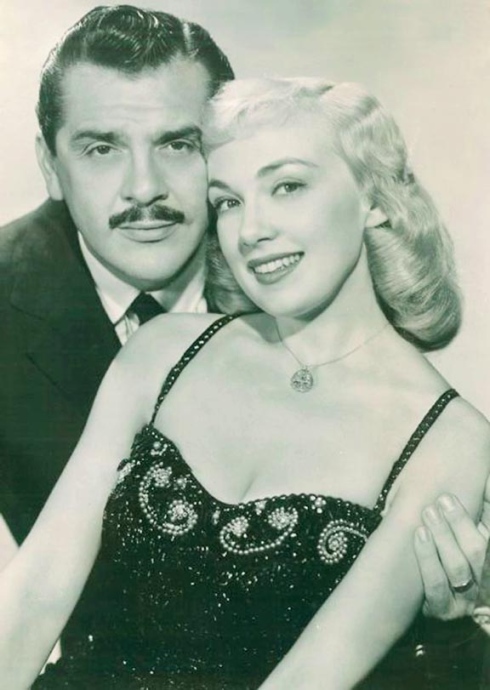
Ernie Kovacs and Edie Adams

Ernie Kovacs and Edie Adams

One of the most poignant things about watching old movies and television programs is that, quite suddenly, the veil of years disintegrates, sometimes leaving an image of inexpressible beauty. That happens when I see films with Louise Brooks, Mabel Normand, Marilyn Monroe, and now Edie Adams.

Sunday was a rare wet day in Los Angeles, so Martine and I spent it at the Paley Center for Media in Beverly Hills. While Martine watched some of her old faves, for three hours I watched nothing but the old Ernie Kovacs show. While she was married to Ernie, until he died in a spectacular car crash in West Los Angeles on my 17th birthday, she was in her late twenties and drop-dead gorgeous. The above picture doesn’t do her justice. In the earlier shows on the Dumont and NBC networks, she was cute and obviously in love with her tall Hungarian madman.

Although she had a long and distinguished career in showbiz after the accident, she is buried at Forest Lawn Hollywood Hills next to her late husband.

As a child, I remember watching Ernie because, well, we were Hungarians; and Ernie was our hero. I recall Edie as being lovely. Years later, she still is in those old kinescopes.

As Portuguese writer and poet Fernando Pessoa wrote, “The feelings that hurt most, the emotions that sting most, are those that are absurd—The longing for impossible things, precisely because they are impossible; nostalgia for what never was; the desire for what could have been; regret over not being someone else; dissatisfaction with the world’s existence. All these half-tones of the soul’s consciousness create in us a painful landscape, an eternal sunset of what we are.”