The Story of Joseph

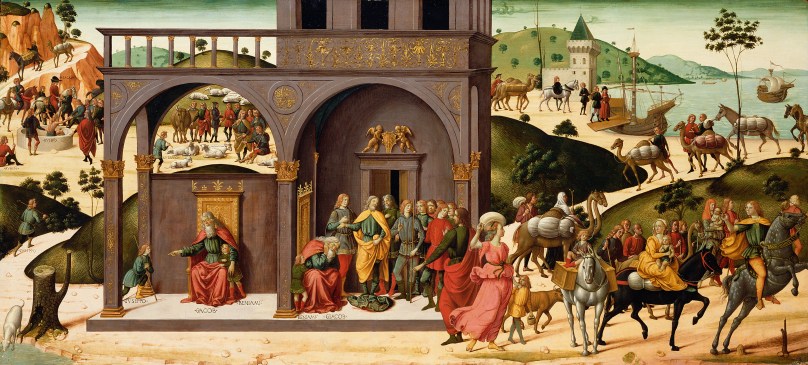
Biagio d’Antonio’s “The Story of Joseph” (ca 1485)

I loved this early Renaissance painting which shows, in the same frame, several incidents in the life of Joseph from the Book of Genesis. What caught my eye was the crowded landscape filled with Old Testament figures. According to the Getty Center website:

In the left-hand loggia, Jacob, seated on a throne, sends Joseph to his half-brothers tending sheep in the field. In the far left corner, the brothers, jealous of their father’s love for Joseph, strip him of his jacket and throw him into a pit. Passing merchants purchase the young boy from his brothers for twenty pieces of silver. In the background to the right, the merchants board the ship that will take them and their cargo to Egypt. In the right-hand loggia, the brothers show a blood-smeared coat to their father as evidence that Joseph is dead. With his head in his hand, Jacob mourns his son, whom he believes to be dead.

A companion panel in the Metropolitan Museum of Art depicts the next sequence of events in Joseph’s life. Originally framed next to one another, these two panels would have been inserted into the paneling of a room in a Tuscan family’s home.

There is always something picturesque and fanciful about the outdoor backgrounds in many Renaissance paintings, most particularly those by Giovanni Bellini (1430-1516). I particularly remember liking one of his paintings I saw in the Frick Collection in New York many years ago. It was called, I believe, “St. Francis in the Desert.”

The Father’s Curse

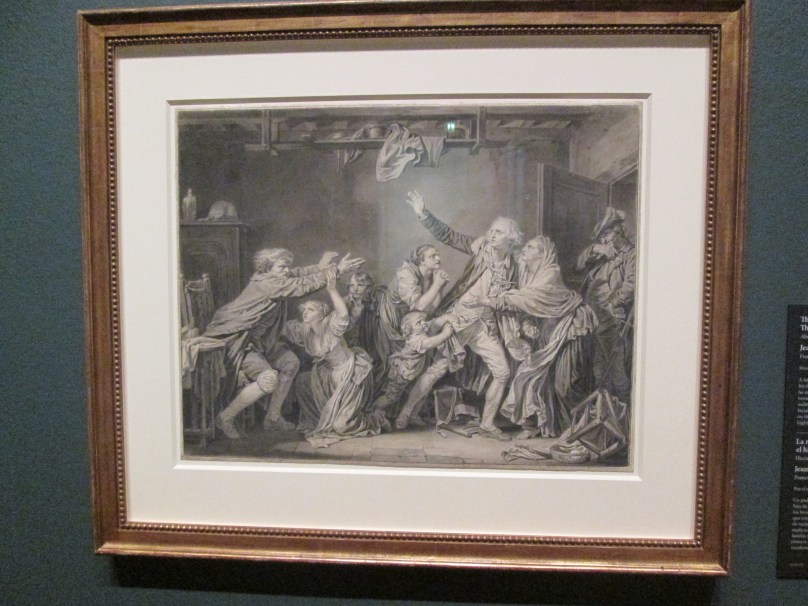
A Drawing by Jean-Baptiste Greuze (1725-1805)

It was the Getty Center that turned me on to the art of Jean-Baptiste Greuze when they had an exhibit in 2002 on “French Drawings in the Age of Greuze.” He may be been something of a moralizer, but his drawings and his paintings are wonderfully dynamic. The above drawing is from a special exhibit at the Getty entitled “Virtue and Vice: Allegory in European Drawing.”

The vice in this case is a son (standing, right) announcing to his family that he has joined the army. He is embraced by his mother while his father (seated, left) curses him for his decision. The full name of the brush and gray wash over graphite drawing is: “The Father’s Curse: The Ungrateful Son.” The museum description of the drawing is as follows:

A father reacts furiously to his son’s decision to leave his family and join the army. With outstretched arms, he releases an angry curse that thrusts the young man toward the door, where a recruiting officer watches with indifference. The family’s pleading gestures and dramatic facial expressions communicate their anguish. Based on the popular painting the artist exhibited in 1777, this highly finished sheet served as the model for a print.

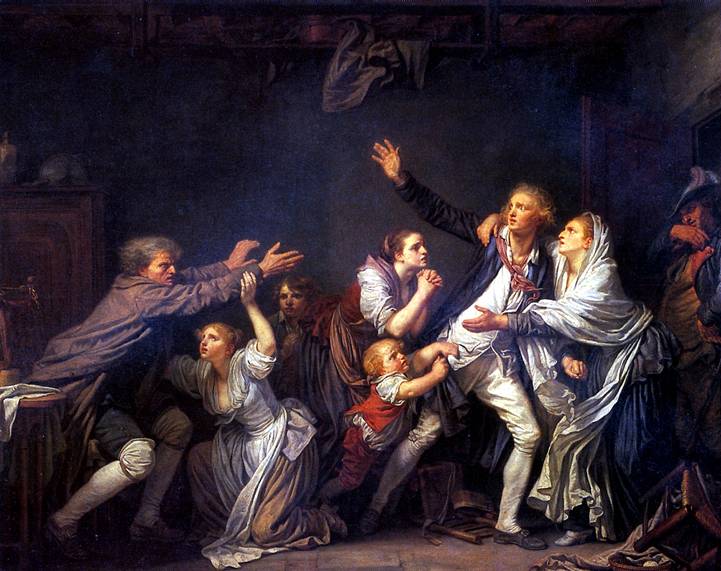
Here is the painting by Greuze that preceded the drawing:

This painting was praised by no less a critic than Denis Diderot, the famous French Encyclopedist. I actually like the drawing that ensued more than the painting because it looks more like a domestic scene rather than a stage proscenium.

I wonder why Greuze found it necessary to do a drawing after he did an oil painting. If, as the Getty description noted, the drawing was turned into a print, I would be very interested in seeing the print or engraving based on it.

The Artist as Martyr

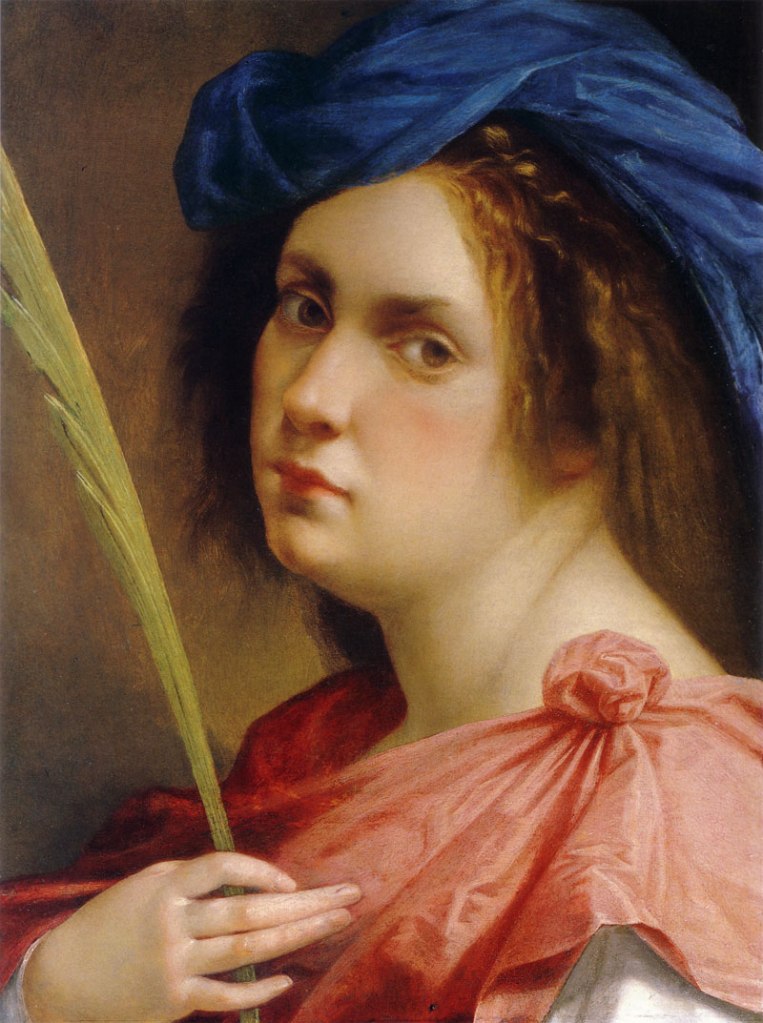
Artemisia Gentileschi’s “Self Portrait as a Female Martyr”

Of all the women artists before the 19th century, perhaps the greatest was Artemisia Gentileschi (1593-1654). Born in Rome, she was the daughter of a noted painter. According to the Getty Center’s website:

Artemesia Gentileschi is known as an ambitious and influential female painter of her time, when female artists were rare. She spread the Caravaggesque style throughout Italy and expanded the narrow possibilities for female artists. Artemesia was taught to paint by her father, Orazio Gentileschi, who painted directly on the canvas and used live models. Her paint-handling in her early works reflects her father’s influence, yet she also departed from him by choosing to paint tense, dramatic narratives with defiant female heroines. In 1612, Artemesia left Rome for Florence, after taking part in a trial against her art teacher, Agostino Tassi, who was convicted of raping her. Shortly after, she painted her interpretation of Caravaggio’s “Judith Beheading Holofernes,” taking a more arresting and gruesome approach to the subject than was common at the time. In the 1620s, Artemesia was living again in Rome, making brief trips to Genoa and Venice and continuing to paint narrative paintings as well as female nudes, a subject avoided by other female artists of the period. In 1630, Artemesia had moved to Naples where her style became less Caravaggesque and her themes turned to more conventional religious subjects. In 1638 Artemesia moved to London to care for ailing father. From then on, her work was less frequent and poorly documented. The last documentation of her was a painting commission dated January of 1654. She may have died in the plague that devastated Naples in 1656.

The self portrait of the painter as a martyr was a testimony to the difficulties she faced as a 17th century painter in what was typically an all-male profession. The painting was done around the year 1615. It was the Getty Center that introduced me to Gentileschi, whom I regard as one of the greatest artists of her time and place.

At the Getty Center

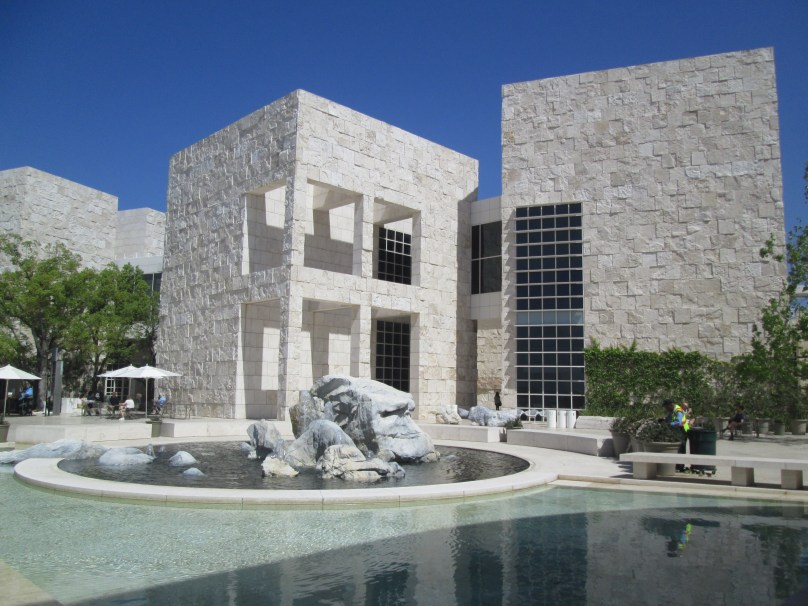
The East Pavilion at the Getty Center (Currently Closed for Remodeling)

Every time I visit the Getty Center in Los Angeles, my imagination is rekindled. And, unlike the Los Angeles County Museum of Art (LACMA), I can visit without spending a small fortune—$26.00 senior admission and almost as much for parking. That comes to almost $50.00 total. I spent a total of seventy cents ($0.70) for the round trip on the MTA 781 bus and the Getty does not charge admission. If you were a senior on a fixed income, which museum would you choose?

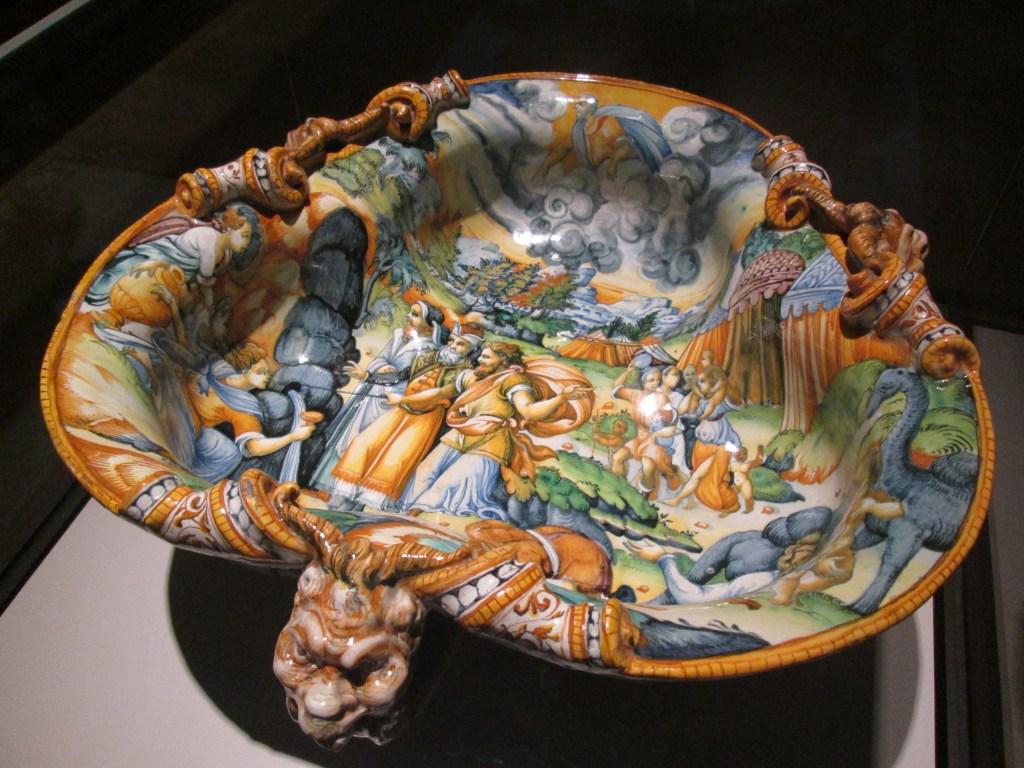
For this visit, there was no obvious special exhibition; but I didn’t care because there was always something interesting to see that piqued my curiosity. For instance, I was amazed by a ceramic basin from Italy dated approximately 1600:

Basin with Moses Striking Water from the Rock

Moses in shown in the bottom left of the interior of the basin. According to the Getty website, “Princess Isabella della Rovere (1552-1619), sister of the Duke of Urbino, commissioned this basin as part of a diplomatic gift for Catalina de Zúñiga y Sandoval (1555-1628), wife of the Viceroy of Naples.”

Note the ogre or monster face jutting out from the bottom of the basin. Or is it Satan planning to turn the Israelites escaping Egypt to worshiping a golden calf?

In any case, it is a lovely piece of work

The Getty website provides more details:

The depiction of narrative scenes, known as istoriato in Italian, along with the vivid color palette of the basin are characteristic of ceramics made in Urbino. The city was a major center for the production of tin-glazed earthenware (maiolica) in central Italy during the 15th and 16th centuries. The workshop of Francesco Patanazzi (d. 1616), a member of a renowned ceramicist family, crafted the vessel. Its elegant shape and sculpted decorations, like the satyr-head handles and the base with lion’s paws, attest to the workshop’s virtuosity.

Winter Scene

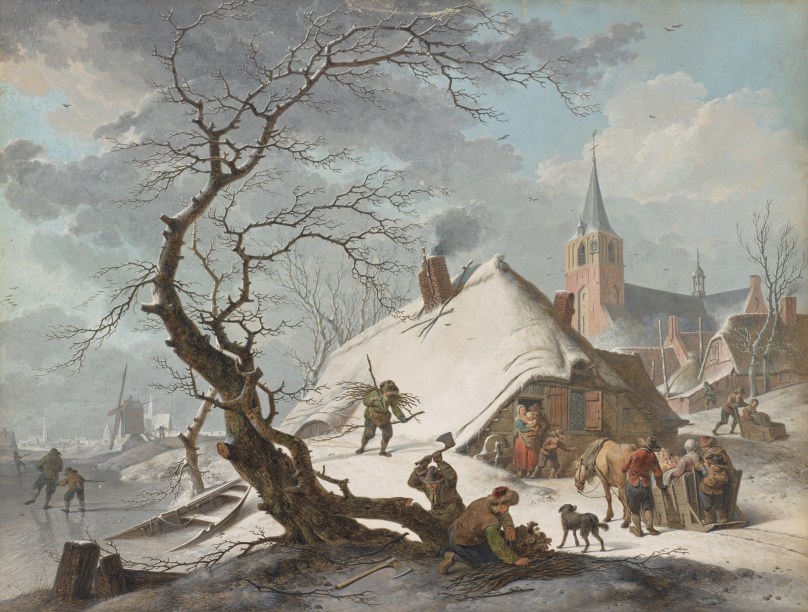
“Winter Scene” by Hendrik Meyer (Dutch, 1744-1793)

Here is one of my favorite paintings in the collection of Los Angeles’s Getty Center. I thought it would be my tribute to the icy winter storms of 2026 (even though I, in Southern California, dis not experience them). According to the Getty website:

Hendrik Meyer illustrated the subject of this watercolor–an idealized version of winter in a Dutch village–in great detail. A barren tree rendered in crisp lines and white highlights, dominates the foreground. The sky is filled with gray clouds, smoke pours from a cottage chimney, and a nearby stream is frozen over. A partially submerged rowboat is covered with snow and ice. Despite the frigid weather, people are outside, keeping warm with activities such as chopping and gathering wood, sledding, and ice-skating. Other elements in the scene also suggest movement: a windmill, chimney smoke, and birds circling or flying in formation. The landscape is filled with delicate textures: grass peeking through snow, a thatched roof, and skaters’ trails on ice.

Meyer’s figured landscapes were produced as finished works for sale. They revived a seventeenth-century tradition of such scenes, hearkening back to Dutch painters such as Pieter Bruegel the Elder, as well as calendar illustrations in medieval books of hours. Artists represented times of the year by showing people engaged in seasonal activities. Winter depictions often featured peasants felling trees, gathering wood, and ice-skating.

I have always loved Dutch painting of the 17th and 18th centuries. Martine and I visited the Rijksmuseum in Amsterdam over twenty years ago featuring Dutch painters of the Golden Age. The exhibit, and the exhibition catalog, has had a major influence on my appreciation of Dutch art.

The Moral of Dutch Still Life Paintings

Jacob van Hulsdonck’s “Still Life with Lemons, Oranges, and a Pomegranate”

I have always found classical Dutch still life paintings to be interesting. In many of them, one can find insects devouring the fruits and flowers depicted. But even if insects are not present, as in Jacob van Hulsdonck’s fruit bowl above, there is an implied message that the fruits depicted will be only around for a while.

According to the Getty Center’s website description of the painting:

The still life attests to the fragile and fleeting properties of the natural world. The dimpled skin of the lemons and oranges; the juicy, glistening insides of the pomegranate held gently together by the thin white tissue of the pulp; the leaves and blooms still attached to fruit; and the shiny droplets of water in the foreground are all brilliant, short-lived effects captured on panel.

Ever since I first noticed this tendency, I have always spent extra time viewing Dutch still life paintings. Even if it’s not a Rembrandt, it is a message to us from four centuries ago that tempus fugit. The message is underlined by the fact that the fruit sits in a Ming dynasty bowl of the sort that could be found in a prosperous merchant’s house.

“The Harmonious Universe of His Soul”

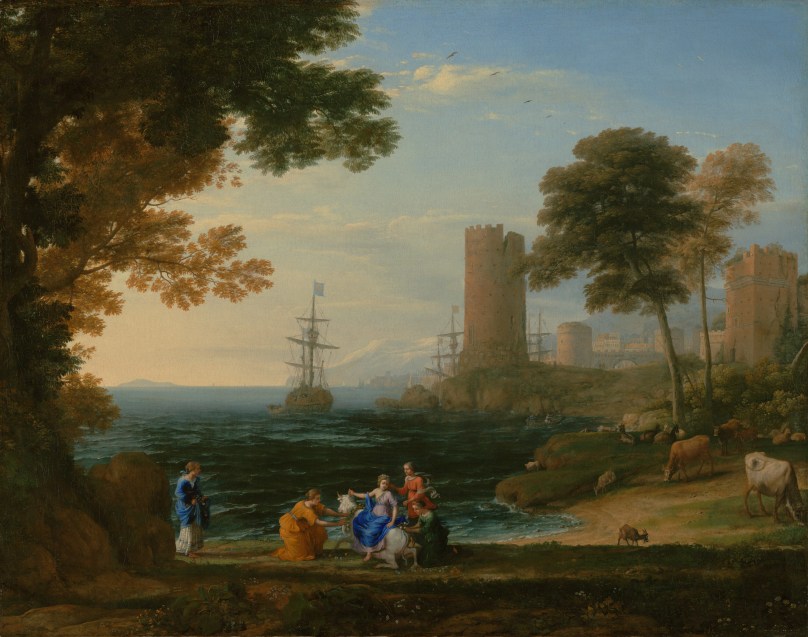
Claude Lorrain’s “Coast View with the Abduction of Europa”

Goethe perhaps said it best: “Claude Lorrain knew the real world by heart, down to the minute details. He used it as a means of expressing the harmonious universe of his soul.”

Both Lorrain (1604-1682) and Nicolas Poussin (1594-1665) made a career of creating peaceful canvases that draw the viewer’s eye in and leave him or her in a meditative state. That is the case even though the subject matter of the above painting is of a violent rape:

The Abduction of Europa is a classical myth from Ovid’s Metamorphoses, in which Zeus transforms himself into a white bull to abduct the Phoenician princess Europa. He lures her onto his back and carries her across the sea to the island of Crete, where they have children, including Minos, who become the first king of Crete and one of the divine judges of the underworld.

Rembrandt also painted the scene in a much more dramatic fashion, but in Lorrain’s painting, it is almost an afterthought—as if it could have been replaced by dancing Naiads or a shepherd with his flock with no loss in overall effect.

Every time I visit the Getty Center in the Santa Monica Mountains, I feel a frisson of excitement as I take a fresh look at the museum’s incredible collection.

The Musicians’ Brawl

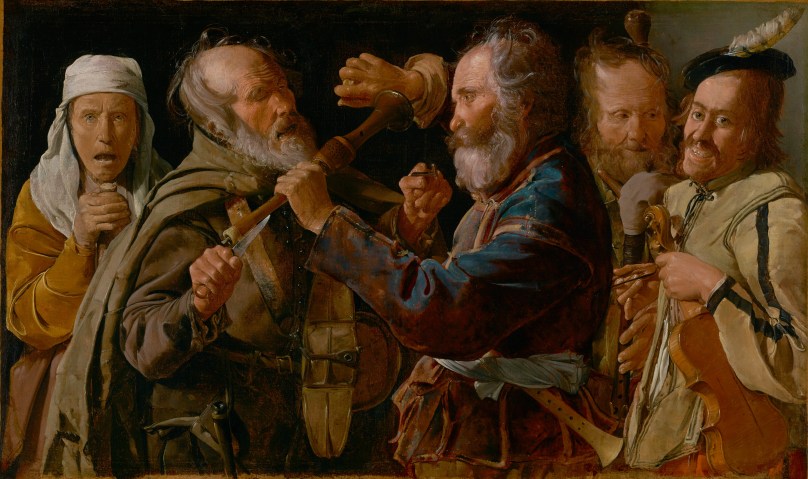
“The Musicians’ Brawl” by Georges de la Tour (1593-1652)

This afternoon, I dropped in to the Getty Center to refresh my store of images. The one that stuck in my mind the most was a 17th century canvas entitled “The Musicians’ Brawl” by French painter Georges de la Tour.

There’s a lot happening in this picture. There are five figures depicted, all very nearly on the same plane. From left to right, we begin with an old woman who is appalled by the fracas. Moving rightward, we have a bearded blind musician with a knife in one hand and a hurdy-gurdy slung on his shoulder. He is being confronted by another bearded musician with a shawm (a predecessor to the oboe) in his left hand and a wedge of lemon in his right, which he is squeezing in the eyes of the hurdy-gurdy player not entirely believing he is blind.

Continuing to the right, we have two musicians who are spectators. The bearded one is barely paying attention, while his mustachioed companion stares drunkenly out at us while clutching his instrument. That rightmost figure is, to me, the most memorable one in the painting. He is clearly chuckling and looking at us with slightly glazed eyes.

I will never forget that drunken facial expression. It is the painterly version of an earworm.

Peele Castle in a Storm

George Howland Beaumont: “Peele Castle in a Storm, Cumbria, 1800”

William Wordsworth is and always has been one of my favorite poets. The Beaumont named in the poem is the painter George Howland Beaumont (1753-1827), creator of the above painting.

Elegiac Stanzas Suggested by a Picture of Peele Castle in a Storm, Painted by Sir George Beaumont

I was thy neighbour once, thou rugged Pile!
Four summer weeks I dwelt in sight of thee:
I saw thee every day; and all the while
Thy Form was sleeping on a glassy sea.

So pure the sky, so quiet was the air!
So like, so very like, was day to day!
Whene’er I looked, thy Image still was there;
It trembled, but it never passed away.

How perfect was the calm! it seemed no sleep;
No mood, which season takes away, or brings:
I could have fancied that the mighty Deep
Was even the gentlest of all gentle things.

Ah! then, if mine had been the Painter’s hand,
To express what then I saw; and add the gleam,
The light that never was, on sea or land,
The consecration, and the Poet’s dream;

I would have planted thee, thou hoary Pile
mid a world how different from this!
Beside a sea that could not cease to smile;
On tranquil land, beneath a sky of bliss.

Thou shouldst have seemed a treasure-house divine
Of peaceful years; a chronicle of heaven;—
Of all the sunbeams that did ever shine
The very sweetest had to thee been given.

A Picture had it been of lasting ease,
Elysian quiet, without toil or strife;
No motion but the moving tide, a breeze,
Or merely silent Nature’s breathing life.

Such, in the fond illusion of my heart,
Such Picture would I at that time have made:
And seen the soul of truth in every part,
A steadfast peace that might not be betrayed.

So once it would have been,—’tis so no more;
I have submitted to a new control:
A power is gone, which nothing can restore;
A deep distress hath humanised my Soul.

Not for a moment could I now behold
A smiling sea, and be what I have been:
The feeling of my loss will ne’er be old;
This, which I know, I speak with mind serene.

Then, Beaumont, Friend! who would have been the Friend,
If he had lived, of Him whom I deplore,
This work of thine I blame not, but commend;
This sea in anger, and that dismal shore.

O ’tis a passionate Work!—yet wise and well,
Well chosen is the spirit that is here;
That Hulk which labours in the deadly swell,
This rueful sky, this pageantry of fear!

And this huge Castle, standing here sublime,
I love to see the look with which it braves,
Cased in the unfeeling armour of old time,
The lightning, the fierce wind, the trampling waves.

Farewell, farewell the heart that lives alone,
Housed in a dream, at distance from the Kind!
Such happiness, wherever it be known,
Is to be pitied; for ’tis surely blind.

But welcome fortitude, and patient cheer,
And frequent sights of what is to be borne!
Such sights, or worse, as are before me here.—
Not without hope we suffer and we mourn.

Orozco at Dartmouth

Panel of Orozco’s Epic of American Civilization

One of the things I most loved about my years at Dartmouth College was studying in the Baker Library’s Reserve Room, as it was then called. The Mexican artist José Clemente Orozco (1883-1949). Between 1932 and 1934, he painted a series of murals entitled “The Epic of American Civilization” in the college’s Baker Library.

There is a detailed discussion of Orozco’s mural put out by Dartmouth’s Hood Museum describing all the panels.

The Reserve Room

Sometimes I think it is those murals which first got me interested in going to Mexico. Nine years after I graduated, I finally made it to Yucatán and visited the ruins at Uxmal, Chichén Itzá, Mayapan, and Kabah during a two-week trip in November 1975.

Until I saw Orozco’s work, Mexico and the Pre-Columbian civilizations of the Americas just weren’t on my radar. Afterwards, they became a major preoccupation.

Quetzalcoatl in a Panel of the Orozco Murals

Little did I know in my college years that my interest in the murals would eventually lead me not only to Mexico, but also Argentina, Guatemala, Honduras, Uruguay, Chile, Peru, and Ecuador.