The Modesty of the Ancients

An Unedited Face from 2,300 Years Ago

An Unedited Face from 2,300 Years Ago

Going to a great art museum always makes me think. Although my two most recent posts regarding my visit to the Getty Center on Saturday are (partly) repeats, there is one thing that hit me between the eyes: In the exhibit entitled “Power and Pathos: Bronze Sculpture of the Hellenistic World ,” I saw that in the ancient world, verisimilitude took precedence over vanity. In the bust of Seuthes III (above), a Thracian monarch, for example, we have a face that does not attempt to prettify its subject. If the face on the statue was not considered to be recognizable to viewers, it was a failure. Unlike today, there was no equivalent to “Photoshopping.”

The same goes for Roman coins. Consider the following examples:

The Emperor Nero

The Emperor Nero

With that massive bull neck, the Emperor Nero was no beauty, yet all representations of him from his day do not hesitate to show his bad features, of which there were many.

The same goes for the Emperor Nerva:

The Emperor Nerva with Massive Schnozz

The Emperor Nerva with Massive Schnozz

Now here is a case of a look that a good plastic surgeon could do something about with a rhinoplasty. Nerva reminds me of that exchange in W.C. Fields’s The Bank Dick (1940):

Boy in Bank: Mommy, doesn’t that man have a funny nose?
Mother in Bank: You mustn’t make fun of the gentleman, Clifford. You’d like to have a nose like that full of nickels, wouldn’t you?


Enjoy It While You Can

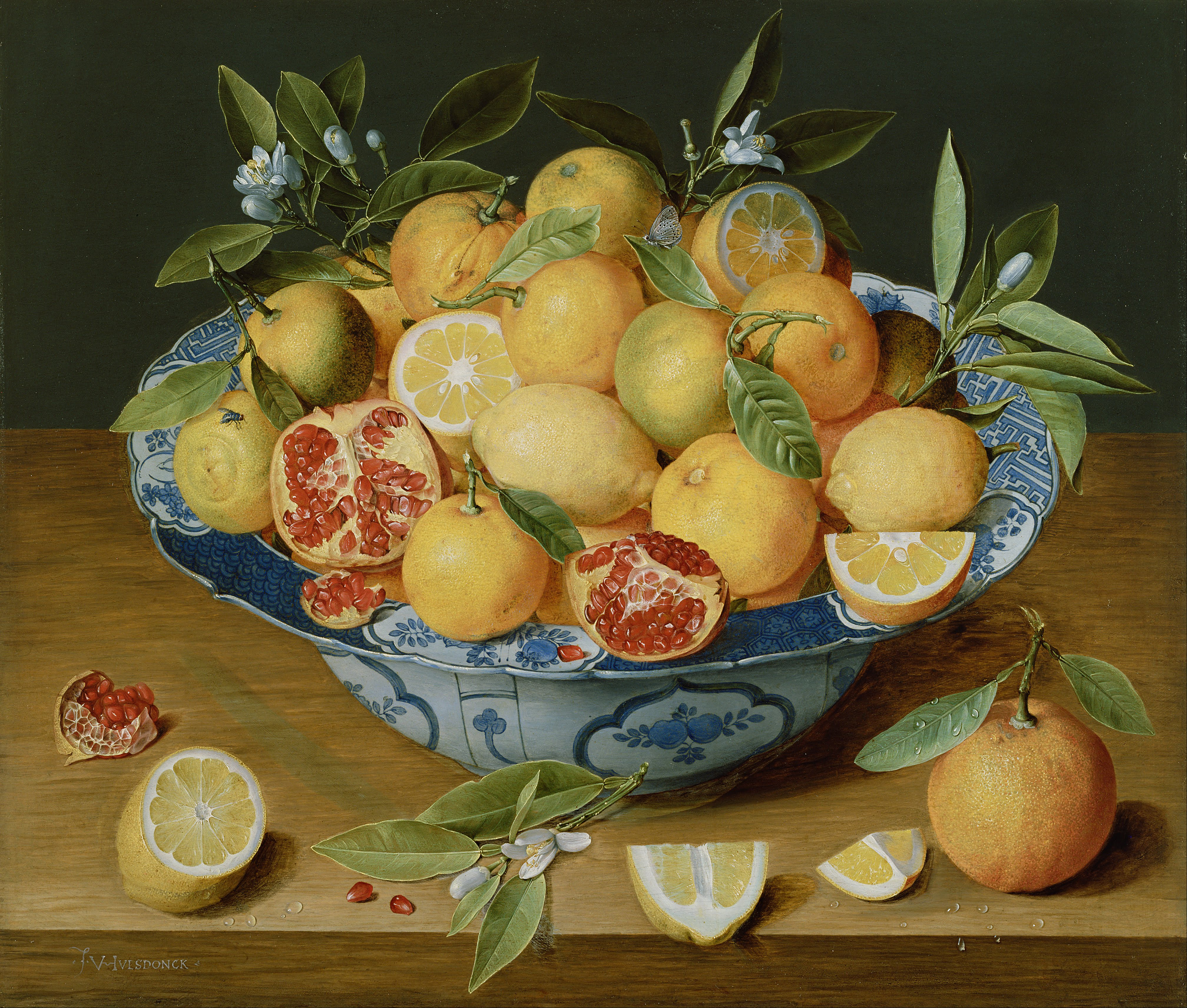
Jacob van Hulsdonck’s “Still Life with Lemons, Oranges and a Pomegranate”

Jacob van Hulsdonck’s “Still Life with Lemons, Oranges and a Pomegranate”

I have always been partial to Flemish still lifes, ever since I first saw “Still LIfe with Oysters and Grapes” (1653) at the Los Angeles County Museum of Art. See below for an image of the still life.

With both of these paintings, and with many Dutch and Flemish still life paintings of the Seventeenth Century, there is a strong moral dimension. According to Wikipedia:

Virtually all still lifes had a moralistic message, usually concerning the brevity of life—this is known as the vanitas theme—implicit even in the absence of an obvious symbol like a skull, or less obvious one such as a half-peeled lemon (like life, sweet in appearance but bitter to taste). Flowers wilt and food decays, and silver is of no use to the soul.

You can see this with the fly on the leftmost lemon in the plate, as well as the aging film showing on the cut pieces of fruit.

Jan Davidszoon de Heem’s “Still Life with Oysters and Grapes”

Jan Davidszoon de Heem’s “Still Life with Oysters and Grapes”


I had always thought of still life paintings are relatively innocuous. And so they are, but they also remind one that time is passing, and the food and flowers on display are the things of a moment.

Not the Epicene Nordic Christ

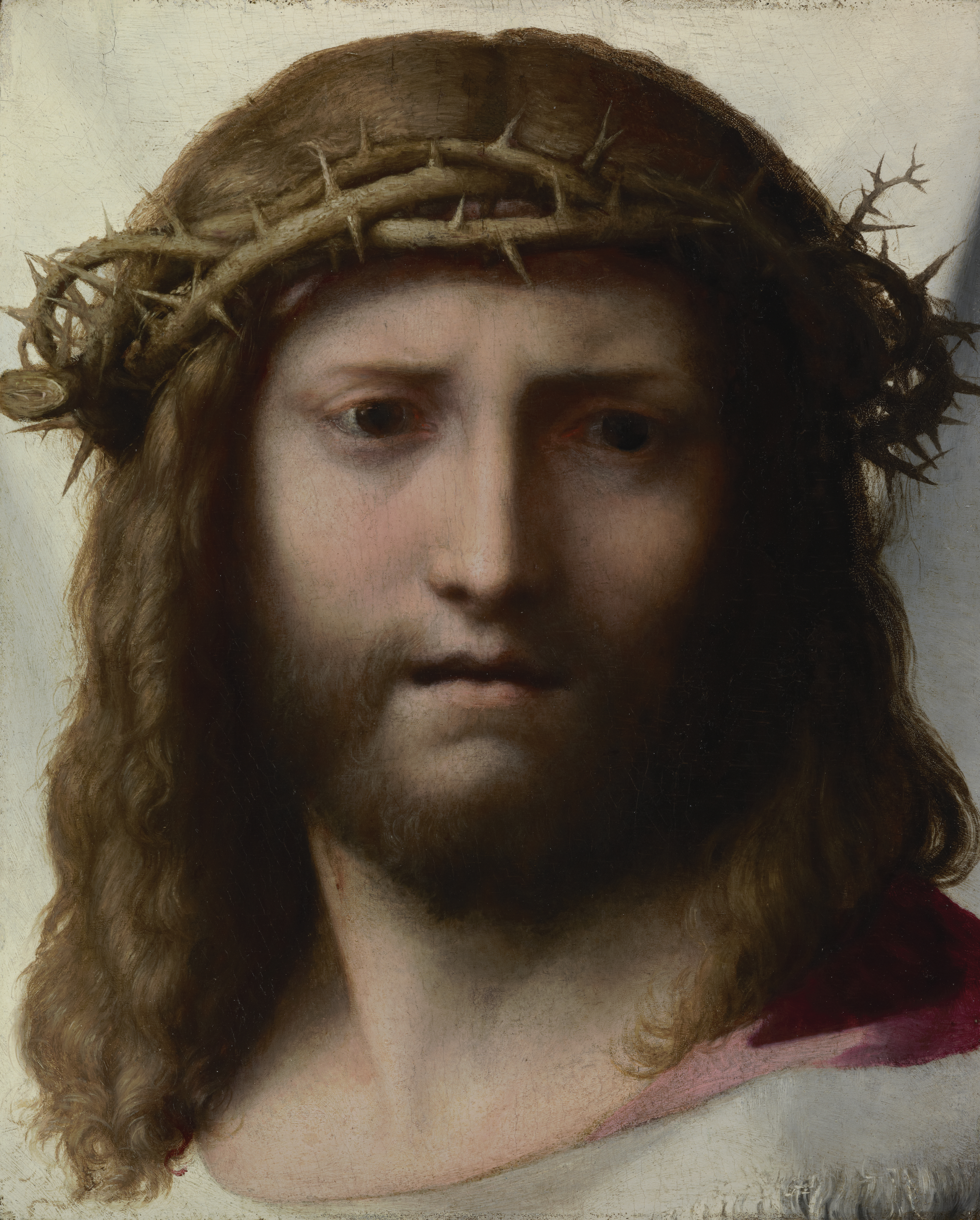
Head of Christ by Antonio Allegri aka Correggio (1489-1534)

Head of Christ by Antonio Allegri aka Correggio (1489-1534)

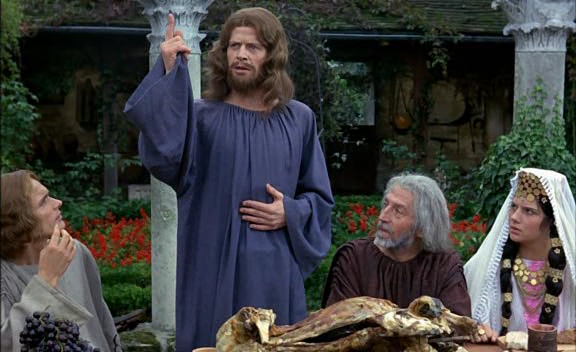
In all of art, there are only two depictions of Christ that I—a notorious renegade Catholic—admire. One is in a Luis Buñuel film called La voie lactée, or The Milky Way (1969). In it, Bernard Verley played the role of the Son of Man (below) as a likable guy who just happens to turn water into wine at the wedding at Cana, because his mother kept insisting, “But they have no more wine!” I could see wanting to become his disciple.

Christ (Bernard Verley) at the Miracle of Cana

Christ (Bernard Verley) at the Miracle of Cana

Today, I visited my favorite painted depiction of Christ at the Getty Center. It was the work of Antonio Allegri, better known as Correggio, sometime between 1525 and 1530. According to the museum’s website, the small (28.6 cm x 23.5 cm) painting represents the face of Christ on the veil offered to Him by St. Veronica on the road to Calvary—though I am not convinced of that. He is wearing the crown of thorns, which looks as if it had just been placed on his head without any sweat or bleeding in evidence.

What there is is an expression on Christ’s face that is a somber acknowledgment of the horrible death to come, the same death that He had asked to be relieved of in the Garden of Gethsemane the night before: “My Father, if it is possible, may this cup be taken from me. Yet not as I will, but as you will.” (Luke 22:39)

Neither of them show us the namby-pamby Evangelical Christ which is fed as pabulum to brainless children (and adults). I can believe in Correggio’s Christ, as I do in Buñuel’s Christ. They both portray the innate tragedy of the Redemption and the strange mismatch between God’s nature and man’s in the same body.

Drifting on the Missouri

“Fur Traders Descending the Missouri”

“Fur Traders Descending the Missouri”

Although his works were not really discovered until the next century, George Caleb Bingham (1811-1879) was perhaps one of the two or three greatest American painters of the Nineteenth Century. His most famous work is “Fur Traders Descending the Missouri” (above) with its idyllic boatmen and a bear cub—no, it’s not a cat—perched in the bow of the boat. There is not a breath of wind, and a mist hovers over the river.

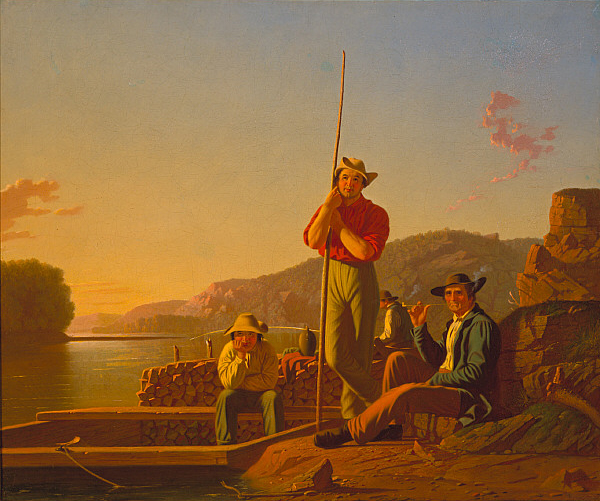
Equally famous is his “Boatmen on the Missouri” (below):

“Boatmen on the Missouri”

“Boatmen on the Missouri”

Most of the best known work by Bingham comes from early in his career. After the Civil War, he went into Missouri politics as a member of the Whig party and held several offices.

Politicians are a dime a dozen, but painters like Bingham are rare. When I think of his time and place, I cannot help but see his art.

“The Wood Boat”

“The Wood Boat”

Under the Bridges

James Doolin’s Painting “Bridges”

James Doolin’s Painting “Bridges”

On past visits to the Autry National Center’s exhibit of paintings of the West, I had always admired James Doolin’s “Bridges” (illustrated above). By  now, I have begun to believe that it is one of the most representative landscapes of Los Angeles, simultaneously showing the present web of freeways and, underneath all the concrete, the desert.

I could almost swear the scenes are of the Pasadena Freeway (I-110), which I drove today on the way back from visiting Bill and Kathy Korn in Altadena. It looks like the stretch as you approach downtown L.A. from the north. You can see the 1930s concrete work (in fact the year 1937 appears on the lower left abutment).


The Man from La Boca

He Was the Painter of the Port of Buenos Aires

He Was the Painter of the Port of Buenos Aires

Benito Quinquela Martín (1890-1977) is a painter not widely known in the art world of New York, London, or Paris. In Argentina, his work is a different story altogether. Martín was known primarily for painting port scenes around La Boca, which, for most of his life, was the port of Buenos Aires. Today, La Boca is primarily known for cheap souvenir shops and dancers who assume tango positions for pesos for the tourists. Near the tour buses at Caminito, however, sits the Escuela Pedro de Mendoza, which happens to contain the Museo de Bellas Artes Benito Quinquela Martín dedicated to his work.

Boca is not the nicest part of the port city, and it is no longer the port, which has been moved east. The polluted Riachuelo, also known as the Matanza, flows past the museum and the brightly colored buildings decorated with leftover marine paints and inspired by Quinquela Martín’s port views.

Unloading Cargo at La Boca

Unloading Cargo at La Boca

Aside from the tourist ghetto around Caminito and the nearby Boca Juniors football stadium known as the Bombonera, or candy box, Boca is a rough neighborhood from which tourists do not stray far. A century ago, however, it was the port of entry for thousands of Italian, Spanish, and other European immigrants who came to South America looking for a better life. And many of them found it. During the First World War, most soldiers on both sides were fed with canned beef from Argentina and Uruguay; and silent movies like The Four Horsemen of the Apocalypse (1921) starring Rudolph Valentino showed the lives of Argentinian millionaires.

Another Port Scene from Martín

Another Port Scene from Martín

Today, Benito Quinquela Martín is considered to be one of the greatest Argentinian painters of the Twentieth Century; and his work in found in museums throughout Buenos Aires.


Tarnmoor’s ABCs: Xul Solar

Surreal Cities ...

Surreal Cities …

All the blog posts in this series are based on Czeslaw Milosz’s book Milosz’s ABC’s. There, in the form of a brief and alphabetically-ordered personal encyclopedia, was the story of the life of a Nobel Prize winning poet, of the people, places, and things that meant the most to him.

My own ABCs consist of places I have loved (Iceland, Patagonia, Quebec, Scotland), things I feared (Earthquakes), writers I have admired (Chesterton, Balzac, Proust, Borges, and Shakespeare); locales associated with my past life (Cleveland, Dartmouth College, and UCLA), people who have influenced me (John F. Kennedy), foods I love (Olives and Tea), and things I love to do (Automobiles and Books). This blog entry is my own humble attempt to imitate a writer whom I have read on and off for thirty years without having sated my curiosity. Consequently, over the next couple of weeks (there are now only two letters left in the alphabet: Y and Z), you will see a number of postings under the heading “Tarnmoor’s ABCs” that will attempt to do for my life what Milosz accomplished for his. To see my other entries under this category, hit the tag below marked “ABCs”. Today is X for—no, not X-Ray—but Xul Solar.

I generally do not like modern art, but I have a strange affinity for many surreal artists like Salvador Dalí, Giorgio di Chirico, and Xul Solar.

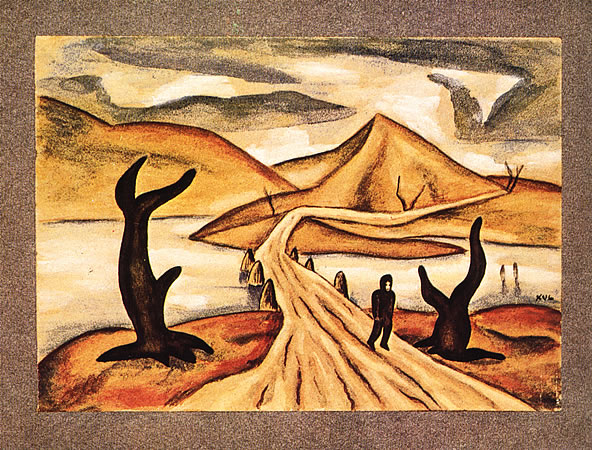
In March of last year, I already wrote a post about the Latvian-Argentinean painter, whose real name is Oscar Agustín Alejandro Schulz Solari, but since that “X” is a difficult letter to account for in any alphabetical scheme such as this one, and because I plan to visit his museum in Buenos Aires in November, I decided to write more about his work, which is filled with strange cities and desolate landscapes populated with strolling characters of a vaguely human appearance.

“Paisaje Bunti”

“Paisaje Bunti”

As I wrote in my previous post, it was Jorge Luis Borges who turned me on to his work. As he wrote on one occasion, “His paintings are documents of the unearthly world, of the metaphysical world in which the gods take the forms of imagination, dreams. Passionate architecture, happy colors, many circumstantial details, labyrinths, homunculi and angels unforgettably define this delicate and monumental art.” Soon after he wrote those words, Borges lost his eyesight and was unable to enjoy any paintings, save what visual fragments remained in his memory.

Below is Xul Solar’s take on a cathedral:

“Cathedral”

“Cathedral”

My hotel in Buenos Aires will be within walking distance of the Xul Solar Museum, which is situated at Laprida 1212, a short walk down Pueyrredón from Recoleta. You can visit the museum’s website and view a nice selection of his paintings done over some fifty years. Never mind that the text is in Spanish.


Dragged Kicking and Screaming into the 21st Century

A Brave New World

A Brave New World

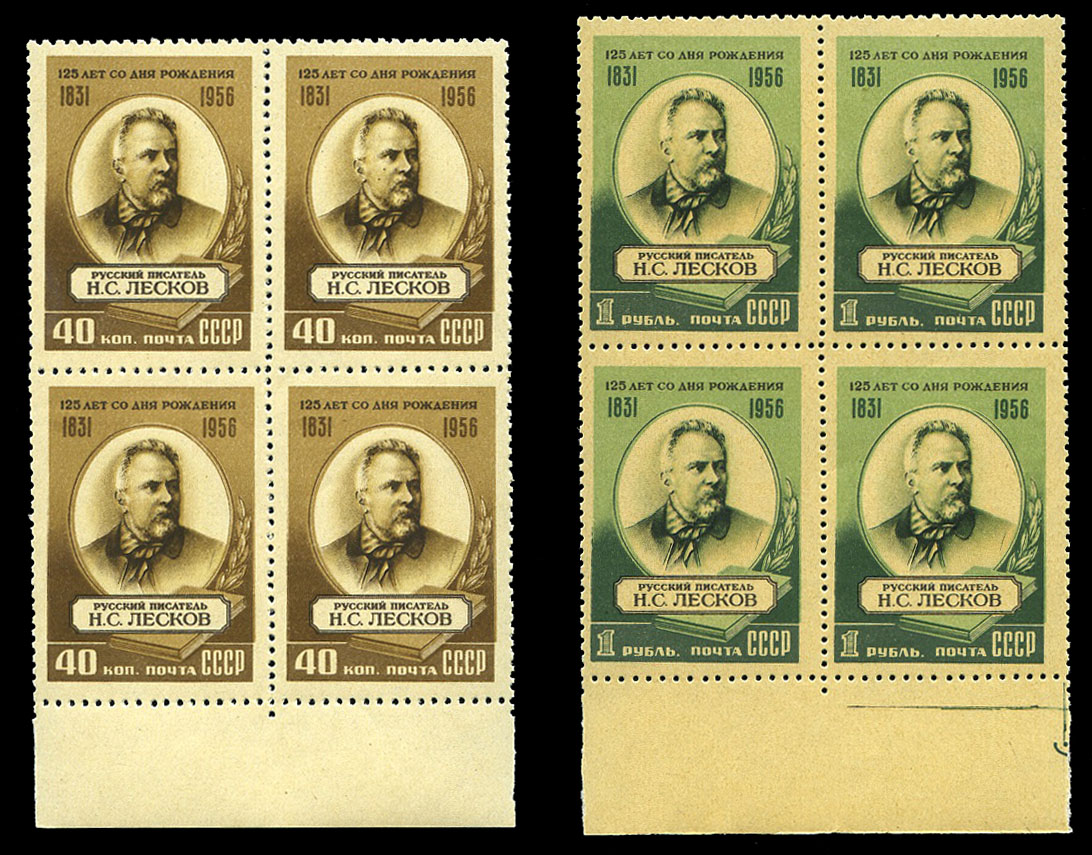
It used to be that, in fiction, the story was king—partly, I think, because God was in His Heaven and all was right with the world. A few things have happened since then: two World Wars, terrorism on a global scale, Charles Darwin, contraception, quantum mechanics, the Internet, and the Atomic Bomb. Mind you, I still love the great storytellers, men like Isaac Bashevis Singer, Nikolai Leskov (see illustration below), Charles Dickens, J.R.R. Tolkien, the authors of the Icelandic sagas, and John Steinbeck. But the world has changed, or at least is in the process of changing, and the only people who still stick with the fundamentalist view of society are the United States (particularly in the Bible Belt) and the Middle East (with the Jihadists).

Slowly, I have been dragged kicking and screaming into the postmodernist 21st century. In 1999, Martine and I walked right by the Picasso Museum in Paris without expressing any interest in its contents. I still actively dislike Mark Rothko, Jackson Pollock, Willem de Kooning, and most abstract expressionists. As for much of current architecture, I curl my lips in disgust. As for music, I tend to be pretty conservative, especially as I listen to most music while reading. Perhaps, for the time being, I am interested only in the literary impact of postmodernism. As for the other art forms, perhaps later….

Russian Stamps Honoring Nikolai Leskov, One of the Great Storytellers

Russian Stamps Honoring Nikolai Leskov, One of the Great Storytellers

What started me down this path is my clear enjoyment at reading such authors as César Aira, Geoff Dyer, Juan José Saer, and Samuel Beckett. Christopher L.C.E. Witcombe has attempted to define the postmodern artist:

The post-modern artist is reflective in that he/she is self-aware and consciously involved in a process of thinking about him/herself and society in a deconstructive manner, “damasking” [i.e., weaving with elaborate design] pretentions [sic], becoming aware of his/her cultural self in history, and accelerating the process of self-consciousness.

In an interesting Chinese blog by Xiaoqing Liu, two characteristics of postmodernism include “a tendency in contemporary culture characterized by the problem of objective truth and inherent suspicion towards global cultural narrative or meta-narrative” and the principle that “the perceiving subject cannot be taken out of the equation.”

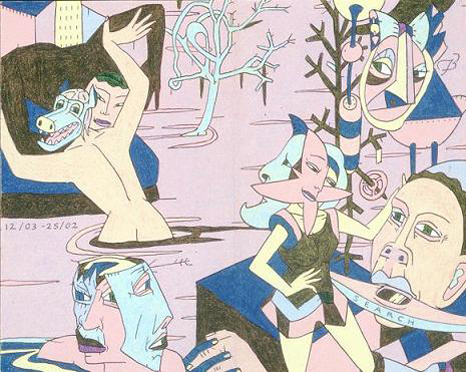
One result is that postmodern literature can be painfully difficult to read. There is little respect for straight chronology. Sometimes, as in Geoff Dyer’s The Search, surrealism suddenly intrudes and plays havoc with the susceptibilities of more traditionally-oriented readers.

Still, there are rewards. The Godlike narrator is gone, and time and place are twisted out of shape. One interesting result is that reading becomes an activity similar to crime detection; and that’s partly why postmodernism has certain affinities with the mystery genre.

The painting at the top is by the British postmodern painter Francis Berry and is entitled “Tonic Moment: Search.”


The Melancholy of Departure (and Arrival)

Giorgio di Chirco’s “Gare Montparnasse: The Melancholy of Departure”

Giorgio di Chirco’s “Gare Montparnasse: The Melancholy of Departure”

I usually do not write about a book until I have finished reading it, but I decided that I had to post this while the ideas were still fresh in my mind. Geoff Dyer’s novel The Search (1993) started out as a genre mystery/detection novel, but has transformed into a Giorgio di Chirico painting.

We are in a non-specific country in an area known as The Bay. A man named Walker (no first name given) winds up at a party with his brother and meets an alluring woman known as Rachel Malory and asks him to track down er ex-husband in order to get some papers signed. Walker finds Rachel seductive, but she does not allow herself to be seduced, which only spurs Walker on. Although he does it ostensibly for money, it is really she who is the goal of his endeavors.

So far, so good. But it is not long before strange things begin to happen. First of all, he meets a man named Carver who wants badly to compare notes with him about Malory. When he refuses, Carver threatens to kill him. So while he is chasing Mallory, he is being chased by Carver. Then even stranger things begin to happen:

There was something strange about the city but he was unable to work out what. Then it came to him. There were no trees or pigeons or gardens. Yet all around were the sounds of leaves rustling and the beating of wings, the cooing of departed birds. He was so shocked that he stood at a street corner, listening.

Then there was a closed bridge that was actually vibrating like a plate of Jello in the wind. Walker goes through a series of tatty cities in this strange nondescript landscape. In one, there are no people; and he is able to get a suit and a car without paying for them. In another, there doesn’t seem to be much of a city, but whatever there is is surrounded by a network of wide freeways on which all the motorists are speeding furiously.

There don’t seem to be any clues about Malory, but Carver or some unknown assailant is still chasing him through a series of random cities.

“Enigma of a Day”

“Enigma of a Day”

That’s when I thought of di Chirico, that painter of mysteriously nonspecific cities. Cities like Meridian, Port Ascension, Eagle City, Usfret, Kingston, Monroe, Durban, Iberia, Friendship—the list stretches on. Each town is different from the other, in a sort of alternate United States with black and Latino ghettos. In one unnamed city, he even finds what looks to be a picture of Malory with Rachel.

As the surrealism grows, I almost want to ration the rest of the book so that I don’t finish it too soon.


The Canadian Op

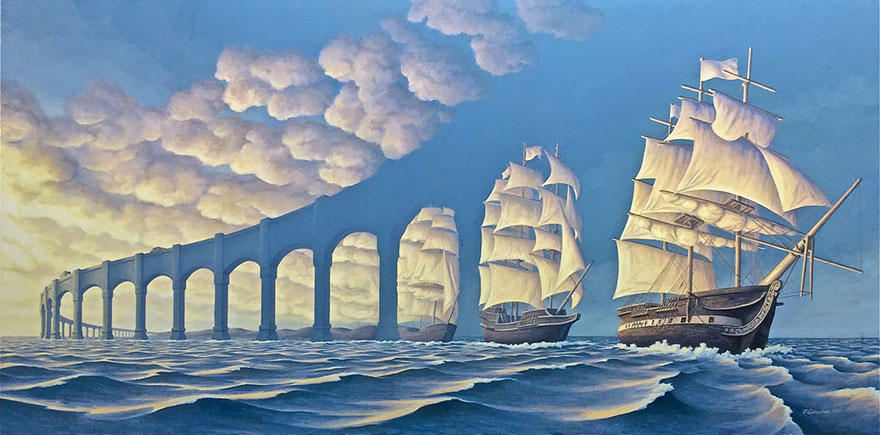
Optical Illusion Art by Canadian Painter Rob Gonsalves

Optical Illusion Art by Canadian Painter Rob Gonsalves

I saw a fascinating selection of Rob Gonsalves mind-stretching optical illusions on BoredPanda.Com. I would say more about them if it weren’t for the fact they speak so well for themselves. Here are two more:

PICmagic-realism-paintings-rob-gonsalves-9__880
PICmagic-realism-paintings-rob-gonsalves-100