Wouldn’t You Know It?

Now My Computer Is Dead

Now My Computer Is Dead, Too

Yesterday, when I got home from work, I noticed that my computer would not turn on. The culprit appeared to be my UPS (uninterruptible power supply) unit, which looks very much like the above, and which just emits a sick squeal when the button is pressed. So I called my friend and system consultant Mike Estrin and asked when he could drop by and replace it. Until then, I will probably not write many blog posts. So it goes….

Stopping Autoplay Videos in I.E.

You Can Also Stop Autoplay Videos in I.E.

You Can Also Stop Autoplay Videos in I.E.

Here, from the February 2015 issue of PC World, are Lincoln Spector’s instructions for suppressing autoplay videos in Internet Explorer:

  1. From the menus at the top of the window, select: Tools>Manage add-ons.
  2. In the resulting Manage Add-ons dialog box, make sure that Toolbars and Extensions is selected on the left. Wait for the list to appear.
  3. Find and double-click Shockwave Flash Object on the right. (It’s listed under Adobe and will likely be near or at the top.)
  4. In the resulting More Information dialog box, click the Remove all sites button. Then close the dialog boxes.

According to Spector, the Flash windows may not appear at all, or they may appear blank. A bar at the bottom of the window will offer options to allow Flash to play. Click the x on the right to indicate No.

How to Stop Autoplay Videos

Yes, You Can Retain Control Over Videos

Yes, You Can Retain Control Over Videos

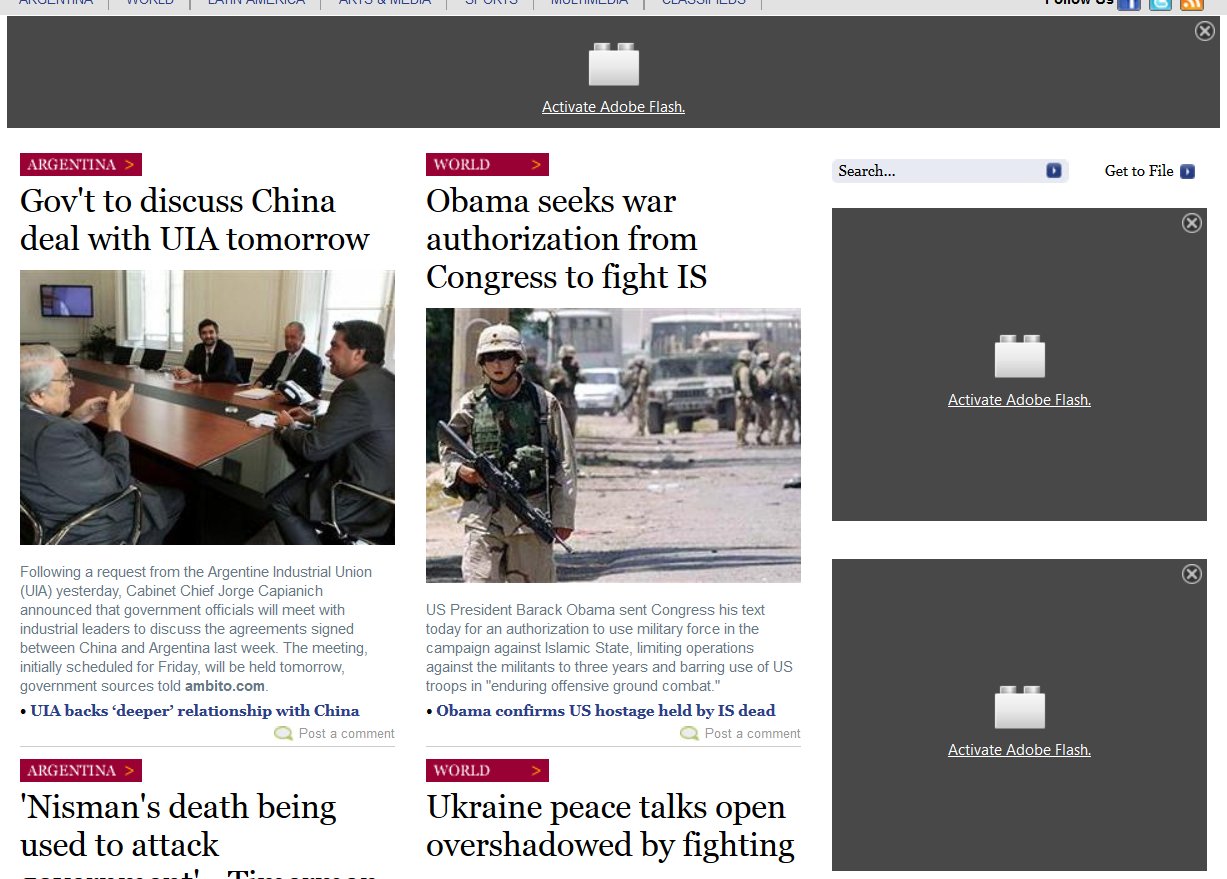
Last summer, I wrote a blog posting entitled Streaming Agony in which I bewailed the tendency of websites to push streaming videos in your face when you open websites—particularly prevalent among news websites. Most of these streaming videos are controlled by Adobe Shockwave. Using your Internet browser, you could request that the video be grayed out, as in the three examples in the above screen shot from the Buenos Aires Herald, and activated only when you specifically request it. By clicking on “Activate Adobe Flash,” you can see the video once, or grant blanket permission to the website.

Because I use Mozilla Firefox as my browser, I will reprint the instructions by Lincoln Spector from the February 2015 issue of PC World on “How to Stop Autoplay Videos” using this browser. If you should be a user of Google Chrome or Internet Explorer, reply at the bottom of this post and I will post the equivalent instructions for your browser. If you use Safari, you are out of luck.

Here are the instructions for suppressing autoplay videos on Firefox:

  1. Press Ctrl-L to go to the address bar and type in the local URL field: about:addons.
  2. Click Plugins in the left pane.
  3. Find Shockwave Flash in the list of plug-ins.
  4. Click the Always Activate pop-up menu on the right, and select Ask to Activate.

The article in PC World continues:

When you visit a page with an embedded Flash video, the video window will be in a box, but this time it will be white with Adobe’s Flash logo (a stylized letter ‘f’ in the center). A gray bar at the top of the page will give you options to continue blocking or allow the flash.

If you click Allow, you’ll get options to Allow Now or Allow and Remember. If you want to allow it at all, I recommend Allow Now.

Hopefully this will protect you from loud NSFW (Not Safe for Work) loud ads and most autoplay videos.


Films: The Imitation Game

Benedict Cumberbatch as Alan Turing

Benedict Cumberbatch as Alan Turing

I knew I would love The Imitation Game even before I saw it. I’ve been working with computers for half a century. Back in the 1960s, they were still often called Turing Machines in honor of the perverse mathematical genius who almost single-handedly invented the first digital computer, code-named Christopher.

Ironically, what brought Turing down were England’s anti-homosexuality laws. Given a choice between prison and a regimen of hormonal drugs to “cure” him, he chose the latter. Within a couple of years, frustrated by the drugs’ effect on his intellect and libido, Turing finally committed suicide in 1956, a scant nine years before I started working on my first computer, a GE 600 series at Dartmouth College, using the world’s first timesharing system and the world’s first higher-order programming language, BASIC.

As you may know, I don’t see too many current films, especially when they are of the self-indulgent “indie” variety. The Imitation Game, on the other hand, is about a man whose way of thinking and feeling is radically different from most of us. And yet he is one of the greatest geniuses of the Twentieth Century, along with Einstein, Von Neumann, Szilard, Teller, Oppenheimer, and a handful of others.

I liked The Imitation Game so much that I intend the read the biography by Andrew Hodges on which it based, Alan Turing: The Enigma. Enigma was the code name of the cryptography machine the Nazis used during World War Two for all their most top secret communications. Turing and his assistants not only cracked the code, but did it in such a way that the Germans could not know that the code was cracked—so they continued using it throughout the war.

Benedict Cumberbatch was superb as the code-breaker, as was Keira Knightley as his talented assistant.


 

Dysinventions

I Wish Touchscreen Keyboards Could Be Uninvented

I Wish Touchscreen Keyboards Could Be Uninvented

There are wonderful inventions that make things easy for people. Then there are what I call dysinventions, or bad inventions, that while seeming to advance technology actually represent a step backward. One prominent example is the touchscreen keyboard. I could see the thought forming in the inventor’s mind: “Why not get rid of the clunky keyboard and just have people hit letters on a keyboard that appears on the screen?”

Well now, that’s just ducky for texting, twittering, and other forms of second-tier communications; but I could not enter this blog on such a quasi-keyboard. Let’s take yesterday’s blog, for example. I would have to type the name of the Icelandic volcano Eyjafjallajökull without the umlaut over the “o”. Eyjafjallajokull would probably look okay to most people, but it is wrong to me; and I insist on absolute correctness. To get the letter, I hit Alt-0246 on my keyboard. To get the em dash in the third paragraph, I type Alt-0151 instead of the double hyphen (“- -”) using the old typewriter convention.

I feel bad enough that there are some Eastern European diacritical marks I can’t use, such as an anacrusis or the Hungarian double-acute-accent over the “o” and “u” to indicate an extended vowel sound. In time, I will figure this out. But not on one of those touchscreen keyboards. I can imagine it would be gruelling just to type an average paragraph shifting between upper and lower case letters and numbers, let alone diacritical marks.

If I can’t make it look as if it were typeset, I would just as soon forget the whole thing. It just wouldn’t be me.

And that is why I don’t travel with an iPad or similar “crippled computer.”

Streaming Agony

This Junk Is Everywhere

Video Is Great—When You Want It!

Over the last year, I’ve noticed that when I visit many websites, I automatically activate videos, usually advertising some sh*t I don’t want. Even if my mouse rolls over some areas of the screen, it is interpreted as a wish to be sold to. In that case, my first reaction is to turn down the sound; and then I hunt for active video screens and hit the stop button.

Webmasters are allowing advertisers to push them around. One instance is the “obliterad” that covers the screen and forces you to hit the X to shut it down. I have complained to several websites, but it was like asking them to empty their cash registers into a bag I am holding. They need the money, but they also need not to annoy their readers. I know I can get many more readers at Tarnmoor.Com if I started running ads, but the intention is not to become the most visited site on the Internet. In fact, greater popularity would force me to spend gobs of time interacting with people with whom I would prefer not to interact.

One easy way to counteract the automatically activated videos is for browsers to ask whether you want to run any videos. That way, I retain the ability to choose. YouTube is great, but I don’t need video when looking at a news story about Syria or our dysfunctional Congress.

Unfortunately, many of the news website stories involve activating a video. CNN, MBCNEWS, and others are trying to ram not only their stories, but their stupid ads down my throat. Do you wonder why I sometimes feeling like spewing back at them?

If, on this website, you see no ads or involuntary streaming video, it’s because I’m trying to apply the Golden Rule.


The Sad Life of Phil Katz

The Inventor of ZIP Files

The Inventor of ZIP Files

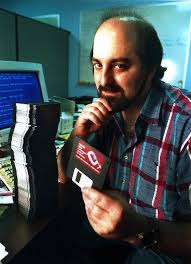
Way back in the early days of Personal Computers, space was at a premium. Very early on, back in the 1980s in fact, I quickly learned to use PKZIP and PKUNZIP to compress and decompress files that I was not using frequently. The PK in the names stood for inventor Phil Katz from Milwaukee, whose company PKWARE pretty much owned the business.

Then the lawsuits came, from a patent troll named System Enhancement Associates (SEA), which tried to establish the similar ARC format. For whatever reason, perhaps even before this happened, Phil turned to drink. He was arrested so many times for drunk driving that he stayed mostly in hotels between Milwaukee and Chicago. It was in one of these hotels in 2000 that Phil was found dead in his room with an empty bottle of peppermint schnapps at his side and two other empty liquor bottles nearby.

He was only 37 when he died.

Not all the innovators in the computer business turned out like Bill Gates or Steve Jobs. Although at one time, PKWARE had twenty employees, Phil was mostly an absentee loner and was not drawn to the business side of his enterprise, though he was not averse to draining the profits whenever he could.

Today I use the ZIP format on an almost daily basis. Although PKWARE is still in existence (at least, their website is), most people use either WinZip or just the ZIP functionality built into the Microsoft operating system (which Phil hated).

So drink a toast to Phil Katz, who didn’t really want to be famous or rich. He just wanted to be left alone.

The Digital Divide

With Every New Technology, There Is a Die-Off

With Every New Technology, There Is a Massive Die-Off

Little by little, I am becoming aware of a tendency in our culture to downplay everything that is before the Internet. Wikipedia and Google are so convenient that we tend to ignore older sources of knowledge. And now that libraries are trashing many of their old books and periodicals and replacing them with computers, there is a real danger that many of the old sources that used to pass for knowledge are slowly disappearing.

For example, I have many books that pre-date the ISBN code. When I read one of them, I have some difficulty describing the book to GoodReads.Com because the likelihood is that there is no reference to the edition I have. And when I try to sell the books on Half.Com (which is owned by eBay), I can’t enter the book because it lacks the ISBN code used to identify the edition. It’s actually keeping me from reading my essays by Sainte-Beuve or many of the hundreds of Oxford World Classics I own in hardbound. Ever since I got in the habit of reviewing everything I read, I tend to hesitate with some of my older editions. Just in front of me, for example,  is a 1926 Alfred A. Knopf edition of Arthur Machen’s The Canning Wonder. I could review the book on Goodreads only if I answer a questionnaire about the edition. If I wanted to sell it on Half.Com, I’d be out of luck.

Most at risk is the history of our civilization based on original archival materials that date back to the Middle Ages. Fortunately, the Europeans are willing to spend the money (in most cases) to protect their history. But what about the Americans? All it would take is for some idiot like Ted Cruz or Rand Paul to sniff at supporting libraries, and millions of words of our country’s history would go by the wayside.

But what about Google Books, you might ask? It is a noble effort, but only a small percentage of old books have been scanned. I collect the works of Sir Richard F. Burton (no relation to the actor). He’s not exactly a popular item, but he is one of the most exciting explorers and travelers of the Nineteenth Century. I can find Burton’s Two Trips to Gorilla Land and the Cataracts of the Congo, but only Volume I has been scanned. The same is true for his Exploration of the Highlands of Brazil. Oh, the books will still be around, but they will be fabulously expensive. (On the other hand, I have been able to find some Burton titles on Gutenberg.Com that I could never afford to buy in print—so the argument cuts both ways.)


The Thirty Plus Years’ Quest

Saverio Mercadante (1795-1870)

Saverio Mercadante (1795-1870)

It was over a third of a century ago. I was preparing to go to work at Urban Decision Systems and listening to a classical music station on the radio, probably KUSC-FM. Suddenly, a piece of music came on called “Variations on a Theme on Stabat Mater by Rossini” by the Neapolitan composer Saverio Mercadante.

I have been looking for that piece of music at record stores (when there used to be such things), eBay, even iTunes—without a shred of luck. Then today I just happened to Google “Mercadante Rossini Stabat Mater” and got two hits on YouTube. Needless to say, I played both clips. One was an Italian recording entitled Sinfonia Sopri i Motivi dello Stabat Mater de Rossini, and the other was a recording conducted by Claudio Scimone with the L’Orchèstre National de l’Opéra de Monte Carlo and entitled Sinfonia sur des thèmes du Stabat Mater du célèbre Rossini (1843).

The musical phrase I loved came in at around the 7:50-minute mark on both recordings and lasted for a little over a minute.

It was nice, but it didn’t impress me as much as it did back in the 1970s or 1980s. Perhaps what I heard on the radio was a better recording. I just don’t know. Or perhaps my taste in music has changed. I am no longer like Swann and Odette de Crécy at the Verdurins oohing and aahing over that little phrase of Vinteuil’s.

What amazed me is that so many things that were impossible to find just twenty years ago can now be Googled and brought up in mere seconds. Technology is wonderful. Sometimes.


The ObliterAd

Corporations Obliterate Your Favorite Websites to Get Their Message Across

Corporations Obliterate Your Favorite Websites to Get Their Message Across

Within the last year or so, there has been a proliferation of what I call ObliterAds, advertisements that shove your website contact down or just cover it with some otiose message which you have to close in order to see your website. I first saw this phenomenon at Salon.Com, and now it’s part of CNN’s news website as well (see above screen capture).

Don’t people in the advertising industry realize that tactics like this irritate Internet users and result in some antagonism. I for one would not buy anything advertised in this way. In fact, I close the ObliterAd as fast as I can so I don’t even get to see the message being promulgated.

Websites, unfortunately, are hungry for ad revenue and don’t seem to mind irritating their loyal visitors. (Please note that this website, tarnmoor.com, has no intention of selling ad space to corporations: They can tattoo their messages on their butts for all I care.)

I may decide to give up on CNN.Com, especially since it seems at any given time that most of the news stories are several days old or send me to videos. (I’d rather just read the story thank you!)