Don’t Cry for Me, Argentina!

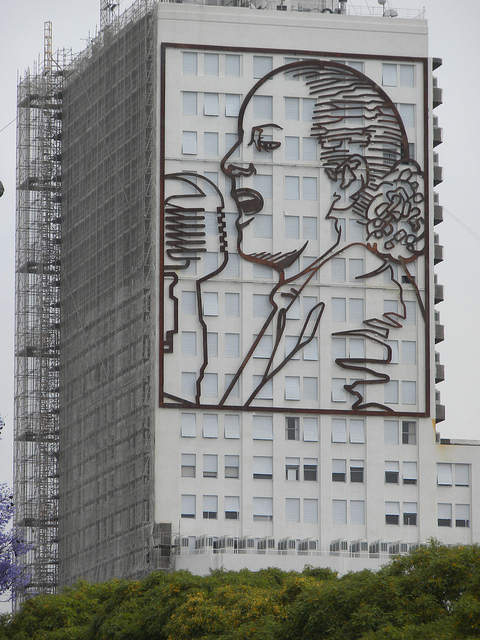
Evita Perón Speaking into a Microphone

Evita Perón Speaking into a Microphone

When I first saw the above building in 2011, I thought it was decorated with Evita’s image while her widowed husband Juan was still alive. I was surprised to find that Cristina Fernández Kirchner, the current president of Argentina, put it up on the side of the Ministry of Health headquarters around the time of my visit. The building is on Avenida 9 de Julio, the giant fourteen-lane highway that runs north/south from Retiro to Constitucion Station.

As President Kirchner said when she unveiled the image: “She was the most hated but the most loved, the most offended, insulted and discounted but the most venerated – the most humiliated but today eternally victorious…. She taught us that to confront the powerful carries a high price.”

By the time I find myself in Argentina next, Kirchner will have been termed out of office. I wonder how she will be seen by future generations. Evita’s reputation is safe: she died of cancer at the age of 33 at the height of her popularity. She was just about to request sharing power with her husband when the illness struck. Cristina, on the other hand, has ruled Argentina alone, and with her late husband Nestor, since 2003.


The King in the Parking Lot

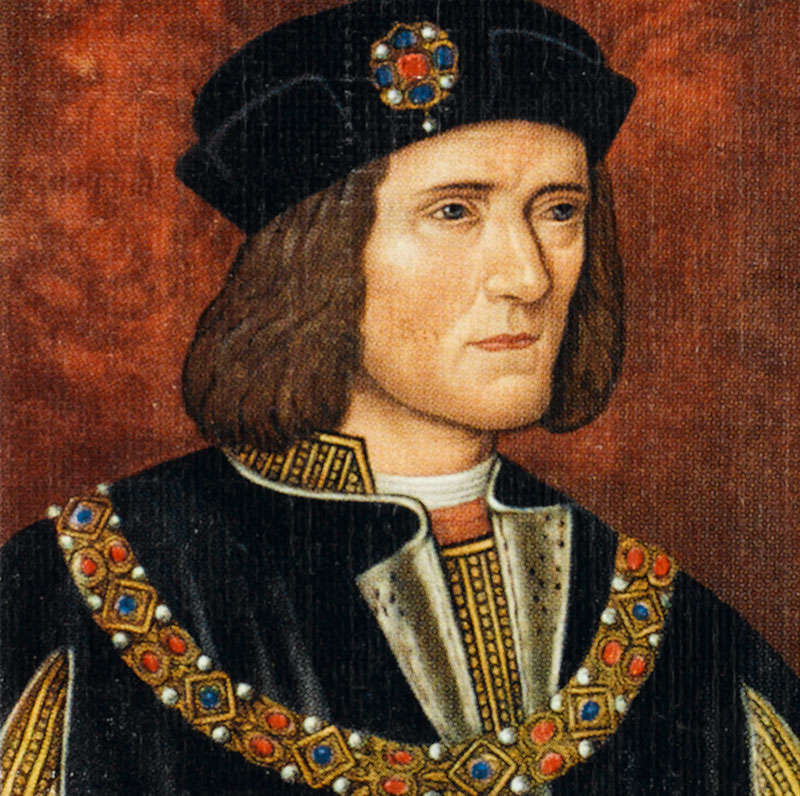
Portrait of Richard III Hanging in he National Portrait Gallery

Portrait of Richard III Hanging in he National Portrait Gallery

In Josephine Tey’s The Daughter of Time, Inspector Alan Grant of Scotland Yard is laid up in the hospital for a stretch, during which time he decides to investigate whether Richard III was really the villain painted by Shakespeare in his play of the same name. After examining the evidence, Grant decides in favor of the monarch killed at Bosworth Field on August 22, 1485. His successor, Henry VII, had Sir Thomas More write a biography blackening his name.

The portrait above also figured in Grant’s reasoning. Although it was painted over a century after Richard’s death, the subject’s face is not that of a vile murderer as described by Queen Margaret (widow of Henry VI) in the play:

From forth the kennel of thy womb hath crept
A hellhound that doth hunt us all to death:
That dog, that had his teeth before his eyes,
To worry lambs and lap their gentle blood,
That foul defacer of God’s handiwork,
That excellent grand tyrant of the earth
That reigns in gallèd eyes of weeping souls,
Thy womb let loose to chase us to our graves.

These lines are addressed to the old Duchess of York, Richard’s mother.

I was interested to hear that the body of Richard has finally been located, under the asphalt of a parking lot in Leicester. If you missed the story, you can find it, with photos, by clicking here.

The Shield Wall

Anglo-Saxon Battle Helmet

Anglo-Saxon Battle Helmet

I am continuing to undergo a period of interest in the Anglo-Saxons. It started with some old poetry, and now I am reading the latest in Bernard Cornwell’s excellent series various called Warrior Chronicles and Saxon Tales. Set in the Tenth Century, we see the half-pagan, half-Christian Uhtred of Bebbanburg and his son of the same name battling internal enemies in the Mercian kingdom as well as Viking raiders.

Warfare among the Anglo-Saxons was a bloody affair. The warriors on each side linked their shields together and proceeded to hack above and below them with swords and axes to bring down their foe. In The Empty Throne, we find the senior Uhtred laid up with battle scars, but pretending to be hurt more than he is.

Reading this description of shield wall battle from Cornwell’s earlier The Pagan Lord, one wonders that he is alive at all:

There is a way of battle. In the end the shield walls must meet and the slaughter will begin and one side will prevail and the other will be beaten down in a welter of butchery, but before the blades clash and before the shields crash, men must summon the nerve to make the charge. The two sides stare at each other, they taunt and insult each other. The young fools of each army will prance ahead of the wall and challenge their enemy to single combat, they will boast of the widows they plan to make and of the orphans who will weep for their fathers’ deaths. And the young fools fight and half of them will die, and the other half strut their bloody victory, but there is still no true victory because the shield walls have not met. And still the waiting goes on. Some men vomit with fear, others sing, some pray, but then at last one side will advance. It is usually a slow advance. Men crouch behind their shields, knowing that spears, axes and arrows will greet them before the shields slam together, and only when they are close, really close, does the attacker charge. Then there is a great bellow of noise, a roar of anger and fear, and the shields meet like thunder and the big blades fall and the swords stab and the shrieks fill the sky as the two shield walls fight to the death. That is the way of battle.

After years of reading Cornwell’s Richard Sharpe novels of the Napoleonic Wars, which I devoured with great pleasure, I find the Warrior Chronicles to be at least as good.

Petroleuses and Communards

Nope, Not the French Revolution—Eighty Years Later

Nope, Not the French Revolution—Eighty Years Later

Most Americans know little about French history, particularly in the years after the French Revolution and Napoleon. I mean, aren’t they “surrender monkeys”?

Not quite. In 1870-1871, Germany invaded France and crushed the French forces at Sedan, as described by Émile Zola in his novel Le Débacle (The Débacle). The Emperor Napoleon III hurriedly decamped; and the Third Republic under Adolphe Thiers, headquartered at Versailles, took over and continued the war. The problem was the city of Paris. The lightly armed National Guard wanted no truck with either Thiers or the Prussians, whereupon the forces of both laid siege to Paris.

This is when the Paris Commune was formed, which ran the besieged city from March to May of 1871. There were stories (probably mythical) of Parisiennes called petroleuses (illustrated above) armed with bottles of inflammable fluids roving the streets, setting fire to buildings. Admittedly, Napoleon III’s Tuileries Palace was torched; but most of the fires were attributable to French and Prussian cannon fire. Still, women found hurrying home with bottles of cooking oil were frequently executed on the spot.

Altogether, the casualties of the siege were about ten times larger than the entire Reign of Terror under Robespierre: The invading forces usually did not take prisoners and instead went in for an early version of ethnic cleansing, targeting mainly the working poor.

It was during this siege that the Parisians first developed a taste for horsemeat, which they were forced into eating along with dogs, cats, and various vermin when food supplies became scarce.

When I was in Paris, I visited the Communards’ Wall at Père Lachaise cemetery, where several hundred men, women, and children were captured, lined up against the wall, shot by firing squads, and buried in a mass grave.

Not too many years later, Vladimir Lenin carefully studied the lessons of the Paris Commune and adopted them in the Bolshevik Revolution, which was much less bloody than the events of Paris in May 1871.

The Phantom Republic

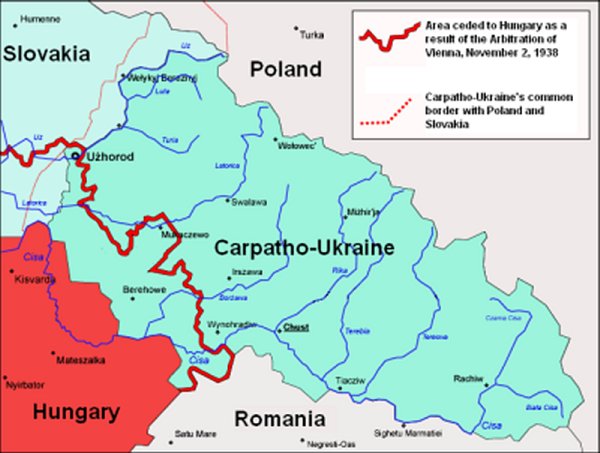
It Lasted for Less Than 24 Hours

It Lasted for Less Than 24 Hours

The darker green area on the above map marked Carpatho-Ukraine declared its independence from Czechoslovakia on March 15, 1939. Within less than 24 hours, it has been absorbed by Hungary with Nazi Germany’s blessing.I guess, from Germany’s point of view, it didn’t matter because it was inhabited by a bunch of Slavs, who were deemed to be of inferior racial stock. And Hungary by this time was an ally of Germany: My people were not only Aryans, they were Hung-Aryans. (In actuality, Hungary’s ruler, Admiral Horthy was intimidated into joining the Axis powers when he saw what happened to leaders of adjoining countries—such as the assassinated Engelbert Döllfuss of Austria—who were not part of Hitler’s program.)

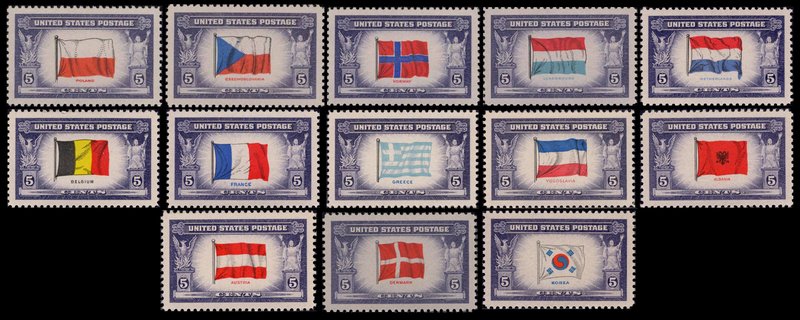
When I was a young stamp collector, I was surprised to find that Hungary was not in the Overrun Countries commemorative series of 1943-1944. It was only later I found out that Hungary was part of the Axis.

The Overrun Countries: I Guess Hungary Was Part of the Bad Guys

The Overrun Countries: I Guess Hungary Was Part of the Bad Guys

Hungary paid dearly for being part of the Axis. Although we “got” the short-lived Republic of Carpatho-Ukraine, we lost thousands at Stalingrad when the Nazi 6th Army was surrounded by the Russians.

And, after World War Two, the Carpatho-Ukraine territories were made part of the Ukrainian Soviet Socialist Republic. And, as they say, that was that!

“This Moldy and Piety-Mouthing Hypocrite”

King Leopold II of Belgium (1839-1909)

King Leopold II of Belgium (1839-1909)

The writer of these lines was none other than Mark Twain, whose dander was up when he learned of the mutilations and massacres in the Congo attributable to Leopold II, the King of Belgium:

In fourteen years Leopold has deliberately destroyed more lives than have suffered death on all the battlefields of this planet for the past thousand years. In this vast statement I am well within the mark, several millions of lives within the mark. It is curious that the most advanced and most enlightened century of all the centuries the sun has looked upon should have the ghastly distinction of having produced this moldy and piety-mouthing hypocrite, this bloody monster whose mate is not findable in human history anywhere, and whose personality will surely shame hell itself when he arrives there—which will be soon, let us hope and trust. [from King Leopold’s Soliloquy (1905)]

Of course, Twain had not yet seen the likes of Adolph Hitler, Josef Stalin, or Pol Pot because that was to come later.

I have just finished reading Adam Hochschild’s King Leopold’s Ghost: A Story of Greed, Terror, and Heroism in Colonial Africa. The Belgian monarch brought something new to colonialism: He designated the Congo as his personal property, making sure that all the wealth that came in went into his personal coffers. No, the Belgians did not enjoy any of that wealth directly. It went into ostentatious palaces, young concubines, and villas on the Mediterranean—all of which were his personal property. He did not even have the saving grace of being a patron of the arts. He was a patron of whatever enriched him. He even made his people “lend” him millions to develop the slave economy of the Congo.

Congolese with Their Hands Cut Off

Congolese with Their Hands Cut Off

At first, the wealth of the Congo came from ivory. It was not long, however, that Leopold realized he could have a corner in rubber. Trees had been planted throughout Asia and Latin America, but would not come to maturity for a number of years. Therefore, Leopold ruthlessly turned the Congolese to harvesting rubber from the rubber trees that grew wild throughout the region. Women and children were held as hostages while their men were sent out to bring in their quota of rubber.

Woe betide any Congolese who didn’t fulfill his quota. They were killed; they hand their hands cut off; or both—and the hostages being held were likewise brutalized.

Eventually, the world caught on to what Leopold was doing—and many other European colonial powers such as France and Germany were also guilty, but not on the same grandiose scale.


Fifth Graders Against Communism

Back in Fifth Grade, We Knew All About the Red Menace

Back in Fifth Grade, We Knew All About the Red Menace

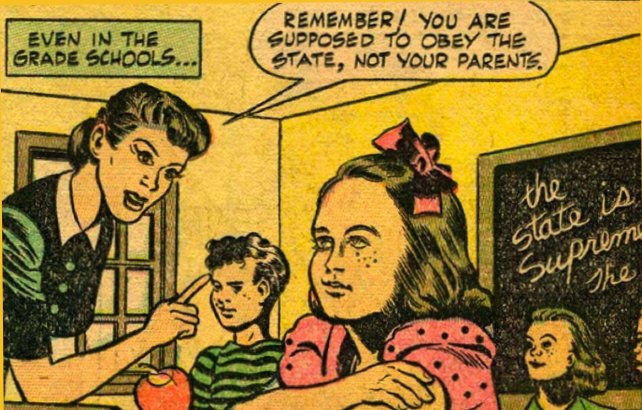
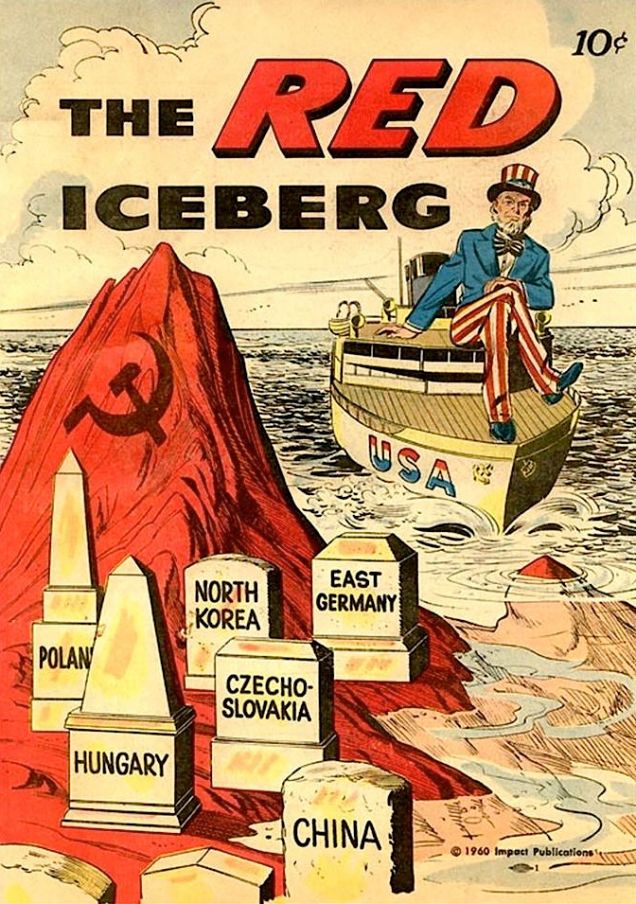
When I was a grade school student at St. Henry’s in Cleveland, we received a weekly newsletter reporting on the news of the world. Most particularly, we learned how the Communists who had recently taken over Eastern Europe were persecuting Catholics and suppressing the God-given rights of the people. At no time were we ever told that Hungary and several other of the Russian satellites fought on the German side in World War Two. And now the communists were threatening us! Several times a year, we had to do drills instructing us what to do in case of a nuclear attack. If you don’t already know, this 1951 video will explain it all to you:
 

(Those school desks were marvelous at protecting students from radiation and falling debris.)

At home, several times a year my mother put together bundles of used clothing she got from church sales to send to our friends and relatives in Hungary. After she’d accumulated about twenty or thirty pounds, she would wrap them in sturdy white cloth and write the address directly on the cloth with indelible ink. Then off it would go. With luck, the jackbooted thugs that worked for the Budapest Post Office would let selected items be delivered to the addressees. The rest, of course, was a perquisite for Communist Party apparatchiks.

Things came to a head during the Hungarian Revolution in 1956. When, after a few days of freedom, the Russian tanks rolled into Hungary and re-established Soviet rule, our family was appalled. Naturally we did what we could to help some of the refugees that made it across the line before the axe fell. (As it turned out, they were not nice people. How could that be? After all, they were Hungarians.)

And Now America Was Threatened, Too

And Now America Was Threatened, Too


Somehow, we made it through those dangerous years. We listened to the Civil Defense alarms that sounded a test on Fridays at noon. And we tuned in to Conelrad at 640 and 1240 on our radio dial. There was so much else, too, bad we licked Communism in the end. Or did we?

The Liberator and the Ombú

I Had to Come All the Way to Peru to See This Argentinian Tree

I Had to Come All the Way to Peru to See This Argentinian Tree

It is a tree from the pampas of Argentina, which, although I have been to that country twice, I have not yet seen at ground level. My first acquaintance with the tree is from W. H. Hudson’s little known (but excellent) Tales of the Pampas:

In all this district, though you should go twenty leagues to this way and that, you will not find a tree as big as this ombú, standing solitary, where there is no house; therefore it is known to all as “the ombú,” as if but one existed; and the name of all this estate, which is now ownerless and ruined, is El Ombú. From one of the higher branches, if you can climb, you will see the lake of Chascomus, two thirds of a league away, from shore to shore, and the village on its banks. Even smaller things will you see on a clear day; perhaps a red line moving across the water—a flock of flamingos flying in their usual way. A great tree standing alone, with no house near it; only the old brick foundations of a house, so overgrown with grass and weeds that you have to look closely to find them. When I am out with my flock in the summer time, I often come here to sit in the shade. It is near the main road; travellers, droves of cattle, the diligence, and bullock-carts pass in sight. Sometimes, at noon, I find a traveller resting in the shade, and if he is not sleeping we talk and he tells me the news of that great world my eyes have never seen.

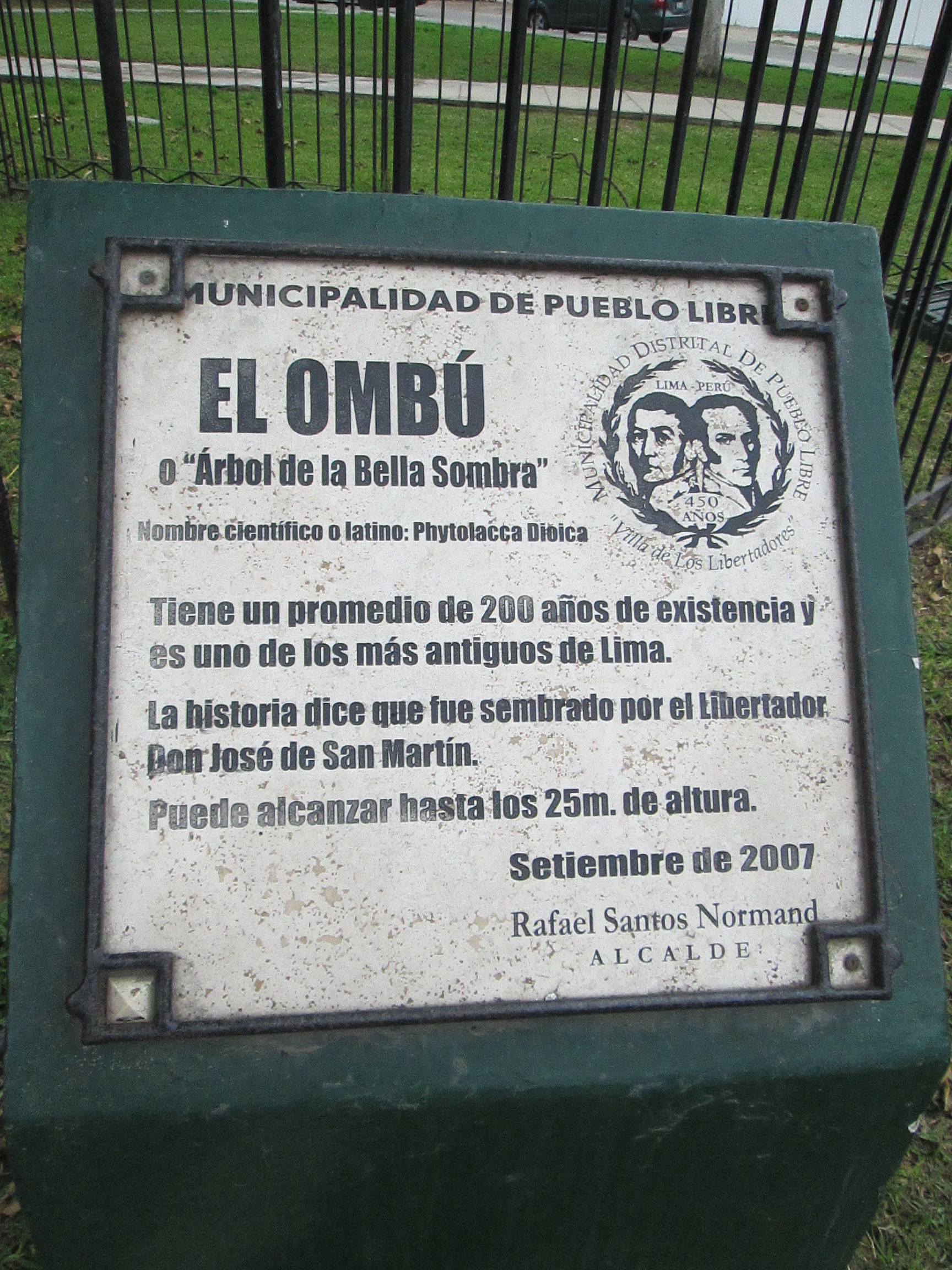
Then, in September, while walking in Lima’s Pueblo Libre between the Museo Larco and the National Museum of Anthropology, I saw my first Ombú, which I photographed.
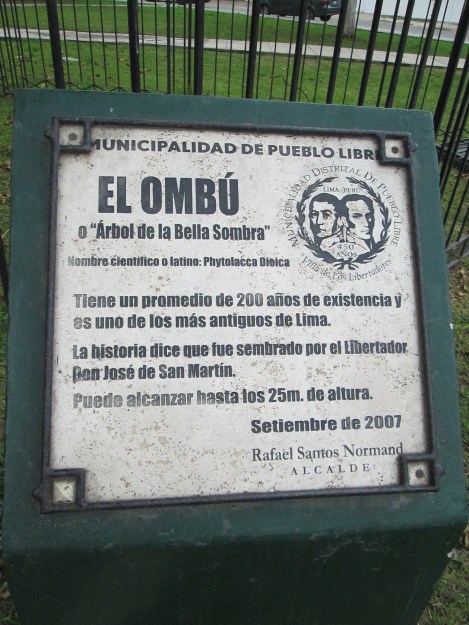
Sign Identifying the Ombú Tree

Sign Identifying the Ombú Tree

What I find interesting about this sign, and this particular tree, is that the seed was purported to have been sowed by José de San Martín, an Argentinian who is considered by the Peruvians as the great liberator of their country. Curiously, Simon Bolivar did more than San Martín to actually free the country from the Spanish yoke, but it was the Argentinian who first declared Peru’s freedom. In the end, it was Bolivar who finally sealed the deal by his military victories.

They would have done it together, if it were not for the fact that they didn’t get along well together. Bolivar felt that San Martín was horning in on his action, and that he was quite capable of actually liberating Peru by himself. The discouraged San Martín returned to Argentina.

In 2011, Martine and I visited his tomb in the Metropolitan Cathedral of Buenos Aires, where a military honor guard protects his remains.

So it was not only my first Ombú, but it was a historically important one at that.


The Guano Economy

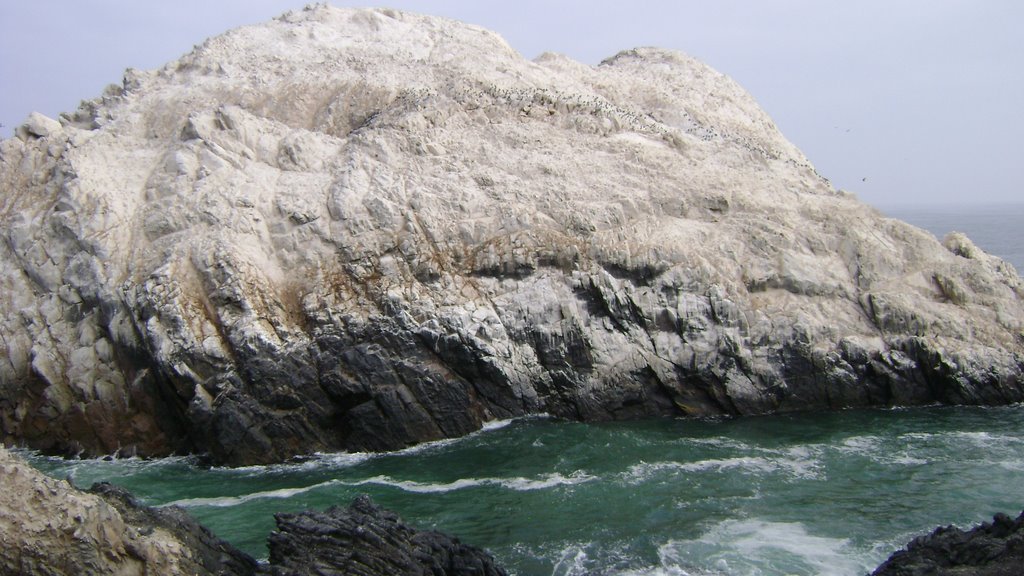
Guano Island Off Peru

Guano Island Off Peru

When Peru finally won its independence from Spain in the 1820s, there was no short quick route to prosperity. Much of South America’s economy was primarily agricultural, based on large haciendas, many of which had just changed hands from Spanish loyalists to officers of the revolution. It took about twenty years before Peru discovered that its primary source of wealth was actually bird sh*t. There were a number of islands off the coast of the Atacama Desert in the south that were covered to a depth of several meters with a centuries’ long accumulation of guano. Europe, which was trying to recover from the ravages of the Napoleonic Wars, needed the fertilizer to insure rich crops.

Mining the guano was no picnic. Peru imported thousands of laborers from China to dig up and bag the guano for shipment to a customer base that was willing to pay top dollar for the … stuff. Native Peruvians did not breathing in the noxious particles, so it was mostly immigrants who worked the islands. For about thirty years, Peru was sh*tting pretty, until it hit the fan. (Had enough of the puns yet?)

After much of the guano was shipped overseas, it was discovered that the Atacama Desert was rich in nitrate fertilizers, which were a good substitute for the organic stuff. At this point, the main actors in the business were Peru, Bolivia (which then had a seacoast), and Chile. Bolivia arbitrarily raised the taxes on mining nitrates. As many of the companies supervising the mines and transporting the fertilizer were Chilean, they demanded tax relief. Bolivia refused, and Peru backed Bolivia.

What Kind of Bird Izzat?

What Kind of Bird Izzat?

In 1879 began the War of the Pacific, with Chile arrayed against both Peru and Bolivia. As Chile had better military leadership and weaponry, it won handily after a number of bloody sea and land battles. The upshot was that Bolivia lost its access to the sea (though they still have admirals for some reason), and Peru lost its State of Tarapacá, including Tacna, Arica, Iquique, and Pisagua. (Eventually Tacna was ceded back to Peru some years later.)

In the end, the British took over the nitrate mining industry, with most of its associated profits. Bolivia suffered the most, as it lost all access to the Atacama Desert. Peru was outraged at having been occupied by Chile, though it fought a fairly successful guerrilla insurgency. Nonetheless, it had suffered a humiliating defeat with repercussions lasting to the present time.

As to the profits from fertilizer mining, they dwindled rapidly; and Peru went from being a wealthy country to being an economic basket case.

For more information, click here for a good illustrated review of the 19th century guano mining industry.


So You Think You Know American History?

Who Was the First U.S. President?

Who Was the First U.S. President?

That doesn’t look a whole lot like George Washington, does it? George became President in 1789, but the United States was already a going concern (to some extent) by 1781. So what did the country do for the intervening eight years? Did it engage in anarchy?

Not quite. Before the Constitution was adopted, the law of the land of the United States consisted of the Articles of Confederation. As students, we didn’t study that eight-year period in depth, except maybe to note that these same Articles of Confederation were a condign failure.

Yet, there were eight U.S. Presidents of the Continental Congress, and therefore of the More-or-Less-United States, serving one-year terms under those same articles. They were, in order:

  1. John Hanson of Maryland (1781-1782, pictured above), who wanted to resign immediately because he had neither any compensation or power, but he manage to stick it out.
  2. Elias Boudinot of New Jersey (1782-1783) was next.
  3. Thomas Mifflin of Pennsylvania (1783-1784)
  4. Richard Henry Lee of Virginia (1784-1785), who wound up disapproving of the Constitution because it concentrated too much power—an early Tea Partier
  5. John Hancock of Massachusetts (1785-1786)—he’s the one with the oversized signature on the Declaration of Independence
  6. Nathaniel Gorham of Massachusetts (1786-1787)
  7. Arthur St. Clair of Ohio (1787-1788), born in Scotland
  8. Cyrus Griffin of Virginia (1788 only)

Only after Griffin’s presidency did the U.S. Constitution become formally ratified and George Washington elected the “first” President under the new rules.

For an interesting discussion of these eight presidents, who have become more or less lost to history, click here.