Et Tu, Brute?!

The Assassination of Julius Caesar by Mariano Rossi (1731-1807)

I have just finished reading an interesting book that sheds light on how rhetoric influenced the way people acted in ancient Rome. J. E. Lendon’s That Tyrant Persuasion: How Rhetoric Shaped the Roman World shows that public speechifying was the dominant mass medium of the time and affected the laws and, in many respects, the way people acted.

Lendon used as his prime example the conspiracy to assassinate Julius Caesar by Brutus, Cassius, and their associates. In Chapter Four, he discusses eight reasons why the whole conspiracy had been a shambles:

  • Decimus Brutus had armed gladiators near the Senate House of Pompey. Why did they not kill Caesar?
  • Why did all the conspirators in the Senate House want to stab Caesar themselves, producing a confused melee?
  • Why did the conspirators do nothing about Mark Antony and Marcus Lepidus, or any other followers of Caesar, not even arrest them for kid-glove treatment if the fastidious Brutus insisted? It was especially leaving Antony alive that Cicero later regarded as “childish.”
  • Why did Brutus think that after the assassination he would be able to address the Senate? Why did he not expect the senators, most of them loyalists of Caesar, to be terrified of the deed?
  • Why were the conspirators apparently surprised by the panic their deed caused in the city?
  • Why did the conspirators go up the Capitoline Hill?
  • Why did the conspirators spend March 16 giving speeches in the Forum?
  • Why, other than descending to give speeches, did the conspirators apparently have no plans for what to do after they ascended the Capitoline Hill, given that the reactions of Lepidus, Antony, their troops, and Caesar’s veterans could have been predicted?

In his book, Lendon deals with each of these questions in great detail. As I read his book, I suddenly saw that public speaking in ancient Rome was the equivalent of our social media, and that the conspirators who, at Donald Trump’s urging, marched on the Capitol on January 6, 2021 were being misled in much the same way that Brutus and his co-conspirators were by the conventions of ancient rhetoric.

“A Certain Apprehension of Darkness”

This is not what one usually hears when talking about the settlers who crossed the continent in wagon trains to settle California. I am currently reading Joan Didion’s Where I Was From, which presents a much-needed corrective to the prevailing boosterism. This is interesting because Joan Didion’s ancestors came to California in the same wagon train that included the Donner Party. Joan’s ancestors split off and settled in Oregon at first.

To read these crossing accounts and diaries is to be struck by the regularity with which a certain apprehension of darkness enters the quest, a shadow of moral ambiguity that steadily becomes more pervasive until that moment when that traveler realizes that the worst of the Sierra [Nevada Mountains] is behind him. “The summit is crossed!” one such diary reads. “We are in California! Far away in the haze the dim outlines of the Sacramento Valley are discernible! We are on the down grade now and our famished animals may pull us through. We are in the midst of huge pines, so large as to challenge belief. Hutton is dead. Others are worse. I am better.” By this point, in every such journey, there would have been the accidents, the broken bones, the infected and even the amputated hands and feet. Sarah Royce remembered staying awake all night after a man in her party died of cholera, and hearing the wind whip his winding sheet like “some vindictive creature struggling restlessly in bonds.” There would have been the hurried burials, in graves often unmarked and sometimes deliberately obliterated. “Before leaving the Humboldt River there was one death, Miss Mary Campbell,” Nancy Hardin Cornwall’s son recalled. “She was buried right in the road and the whole train of wagons was driven over her grave to conceal it from the Indians. Miss Campbell died of mountain fever, and Mother by waiting on her caught the fever and for a long time she lingered between life and death, but at last recovered. Miss Campbell was an orphan, her mother having died at Green River.”

There would have been, darkest of all, the betrayals, the suggestions that the crossing might not after all be a noble odyssey, might instead be a mean scrambling for survival, a blind flight on the part of Josiah Royce’s “blind and stupid and homeless generation of selfish wanderers.”

A Royal Palace on American Soil

Honolulu’s Iolani Palace (Built 1879)

Not far from the Hawaii State Capitol sits the Iolani Palace, home of the monarchs of the Kingdom of Hawai’i from Kamehameha III in 1879 until the overthrow of the monarchy under Queen Lili’uokalani by a group of American merchants in 1893.

As I prepare to go to Hawaii in a week or so, I am conscious once again that the United States ruthlessly stepped on the rights of the Hawaiian people just so that a cabal of American merchants could have their way. On this trip, I plan to read Queen Lili’uokalani’s autobiography. For eight months, the Queen was imprisoned in one of the second floor bedrooms until she was tried by a military tribunal on some trumped-up charge.

It was like the U.S. and the American Indians all over again. Fortunately, there were no massacres by the cavalry in this instance, though the takeover was no less final—and unjust.

Kahuna Lapa’au

In preparation for an upcoming trip to Hawaii in a couple of weeks, I am reading the work of a distinguished novelist and microbiologist: O. A. Bushnell’s The Gifts of Civilization: Germs and Genocide in Hawaii. Never before have I read a book about what happens to public health when a 19th century Western power takes over a primitive aboriginal society.

Bushnell claims that the native Kahuna Lapa’au healers were not inferior to American physicians of the period. When you consider that 19th century medicine was into bloodletting, blistering, and the ingestion of mineral poisons. it is not surprising that aboriginal healers were in now wise inferior.

Unfortunately, they were dealing with a whole new range of illnesses introduced by the white man, diseases such as measles, smallpox, malaria, leprosy, and the various venereal diseases. This led to widespread confusion among native healers as to which treatment to use, at a time when neither American nor native Hawaiian medical practice was effective.

In this book and in his novels—The Return of Lono, Ka’a’awa, Molokai, The Stone of Kannon, and The Water of Kane—Bushnell created an impressive body of work on the interface of the two cultures.

“Accidental to the Truth”

The Flag of Venezuela

I have just finished reading V. S. Naipaul’s A Way in the World. No one can describe the sometimes barely visible gradations that make up racism and colonialism. At one point, his character Francisco Miranda—a fictional precursor to Simón Bolívar, José de San Martín, and the other liberators of South America from Spanish rule—discusses the difficulties inherent in unifying the newly freed peoples of Venezuela:

“In all your years of writing about Venezuela and South America, you simplified it, General. You talked about Incas and white people. You talked about people worthy of Plato’s republic. You always left out two of the colours. You left out the black and you left out the mulatto. Was that because you were far away?”

“No. I did it because it was easier for me intellectually. Most of my ideas about liberty came to me from conversation and reading when I was abroad. So the country I created in my mind became more and more like the countries I read about. There were no Negroes in Tom Paine or Rousseau. And when I tried to be like them I found it hard to fit in the Negroes. Of course, I knew they existed. But I thought of the m as accidental to the truth I was getting at. I felt when I came to write that I had to leave them out. Because of the way I have lived, always in other people’s countries, I have always been able to hold two or more different ideas in my head about the same thing. Two ideas about my country, two or three or four ideas about myself. I have paid a heavy price for this.”

As I read these lines, I suddenly thought about why Spain lost South America. The Spanish monarchy sent out mostly men, accompanied by very few Spanish women. Many of these men married native women, or black women, or mulattoes. Consequently, the thought arouse back on the Iberian peninsula that these Spaniards who “went native” probably did not have the best interests of the Spanish monarchy at heart. Consequently, they were almost never promoted to positions of authority. The rebels who defeated the Spanish armies were mostly these men, referred to as Creoles, who were not quite Spanish.

The Crossing of the Berezina

The low point of Napoleon’s retreat from Moscow was the crossing of the ice-choked Berezina River, after the Russians had destroyed the bridge. Curiously, that crossing was also a choke point in Charles XII of Sweden’s invasion a hundred years earlier—a fact that Napoleon was aware of as he carried with him Voltaire’s Histoire de Charles XII. Here is the scene as described in Patrick Rambaud’s The Retreat:

What Voltaire wrote of the Swedish troops could have been a description of this shadow of the Grande Armée: “The cavalry no longer had boots, the infantry were without shoes, and almost without coats. They were reduced to cobbling shoes together from animal skins, as best they could; they were often short of bread. The artillery had been compelled to dump all the cannon in the marshes and rivers, for lack of horses to pull them….” The Emperor snapped the book shut, as if touching it would put a curse on him. Slipping a hand under his waistcoat, he made sure that Dr Yvan’s pouch of poison [for possible suicide] was safely attached to its string.

And here is the beginning of Victor Hugo’s poem “Expiation,” part of his The Punishments, about the retreat from Russia (as translated by Robert Lowell):

The snow fell, and its power was multiplied.
For the first time the Eagle bowed its head—
Dark days! Slowly the Emperor returned—
Behind him Moscow! Its own domes still burned.
The snow rained down in blizzards—rained and froze.
Past each white waste a further white waste rose.
None recognized the captains or the flags.
Yesterday the Grand Army, today its dregs!
No one could tell the vanguard from the flanks.
The snow! he hurt men struggled from the ranks,
Hid in the bellies of dead horses, in stacks
Of shattered caissons. By the bivouacs
One saw the picket dying at his post,
Still standing in his saddle, white with frost
The stone lips frozen to the bugle’s mouth!
Bullets and grapeshot mingled with the snow
That hailed ... The guard, surprised at shivering, march
In a dream now, ice rimes the gray moustache
The snow falls, always snow! The driving mire
Submerges; men, trapped in that white empire
Have no more bread and march on barefoot.
They were no longer living men and troops,
But a dream drifting in a fog, a mystery,
Mourners parading under the black sky.
The solitude, vast, terrible to the eye,
Was like a mute avenger everywhere,
As snowfall, floating through the quiet air,
Buried the huge army in a huge shroud ...

That was the low point of Napoleon’s reign, unless you include Elba, Waterloo, and captivity under the English at St. Helena.

The Greatest Chart Ever Drawn

Charles Minard’s Chart of Napoleon’s Russian Campaign 1812-1813

Never before has a military campaign been illustrated so completely as Charles Joseph Minard’s 1869 Carte figurative des pertes successives en hommes de l’Armée Française dans la campagne de Russie 1812–1813. It shows the strength of Napoleon’s forces at every point in the campaign.

Compare the red band at the far left of the illustration showing Napoleon’s force of half a million men as they crossed into Russia in June 1812. Notice as the red band narrows until it reaches Moscow, particularly after the casualties of the Battle of Borodino.

The black band illustrates the retreat from Moscow as winter is beginning to set in. That band gets progressively narrower until the crossing of the Berezina River at Studienka, highlighted by a black smudge I made on the above chart. After Berezina, only 25,000 combatants and 30,000 non-combatants survived. You can see the black band narrow after Berezina.

That particular battle was frequently described in Honoré de Balzac’s stories. particularly “Adieu.” It market the catastrophic end to a catastrophic campaign, which led in short order to Napoleon’s first exile, on Elba.

On the lower part of Minard’s graph, the relative temperature at several selected points during the retreat from Moscow is shown. Note that it was it its lowest around the time the Berezina was crossed.

“A Kind of Solution”

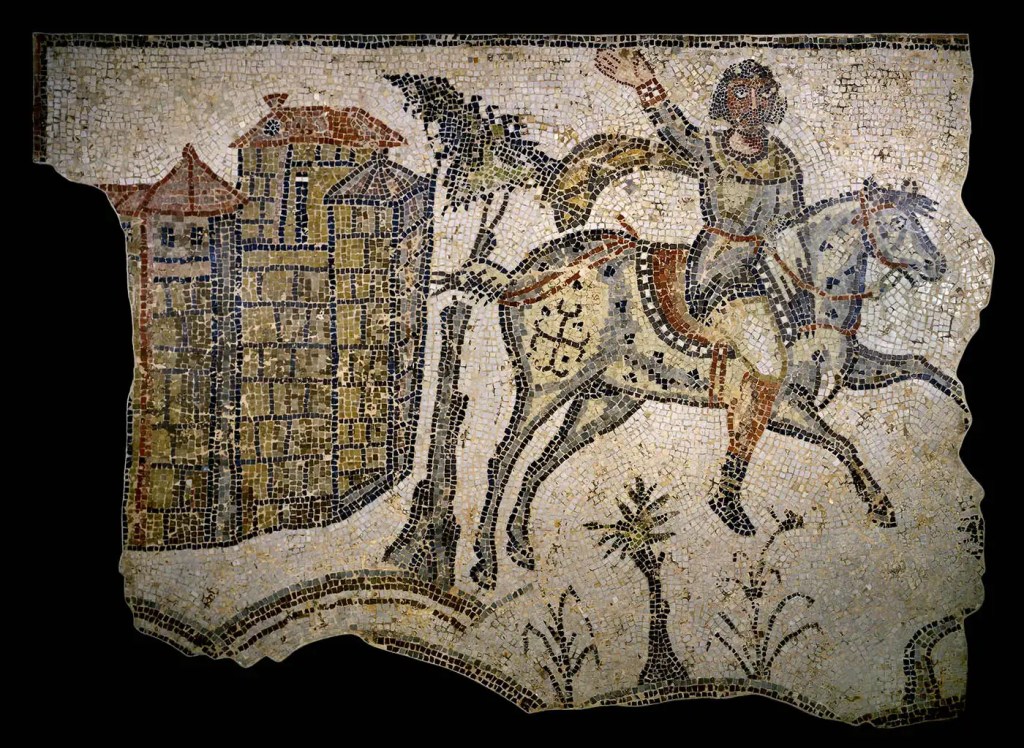
Invading Vandal Horseman

I have just finished reading Volume II of Thomas Hodgkin’s monumental Italy and Her Invaders, which tells of the Hun and Vandal invasions and the Herulian Mutiny that unseated the last of the Western Roman Emperors in CE 476. In essence, it tells of the painful last twenty-five years of the Empire, during which most of the emperors were murdered in a year or two.

There was no benefit to wearing the imperial purple in those last few years. A couple of days ago, I posted a blog in which Apollinaris Sidonius explained why it was no fun in being chosen as emperor.

Those last years of the empire were no fun. Not only were the invading Huns and Vandals brutal, but the empire itself was brutal to its own citizens, taxing them to death to pay for the huge military required to protect the borders.

It makes me think about our own situation. Our problem is not barbarian invasions (unless you don’t particularly like Canadians or Latin Americans), but our seemingly unbridgeable political divisions. The insurrection of January 6, 2021, was, to me, very like Gaiseric and the Vandals’ sack of Rome in CE 455. They may have been barbarians in the end, but they were our very own native-born barbarians. The result, in the end, is no better than the sad end of Rome.

I keep thinking of a poem by the Greek poet Constantine P. Cavafy entitled:

Waiting for the Barbarians

What are we waiting for, assembled in the forum?

      The barbarians are due here today.


Why isn’t anything going on in the senate?
Why are the senators sitting there without legislating?

      Because the barbarians are coming today.
      What’s the point of senators making laws now?
      Once the barbarians are here, they’ll do the legislating.


Why did our emperor get up so early,
and why is he sitting enthroned at the city’s main gate,
in state, wearing the crown?

      Because the barbarians are coming today
      and the emperor’s waiting to receive their leader.
      He’s even got a scroll to give him,
      loaded with titles, with imposing names.


Why have our two consuls and praetors come out today
wearing their embroidered, their scarlet togas?
Why have they put on bracelets with so many amethysts,
rings sparkling with magnificent emeralds?
Why are they carrying elegant canes
beautifully worked in silver and gold?

      Because the barbarians are coming today
      and things like that dazzle the barbarians.


Why don’t our distinguished orators turn up as usual
to make their speeches, say what they have to say?

      Because the barbarians are coming today
      and they’re bored by rhetoric and public speaking.


Why this sudden bewilderment, this confusion?
(How serious people’s faces have become.)
Why are the streets and squares emptying so rapidly,
everyone going home lost in thought?

      Because night has fallen and the barbarians haven't come.
      And some of our men just in from the border say
      there are no barbarians any longer.


Now what’s going to happen to us without barbarians?
Those people were a kind of solution.

Is the Emperor Happy?

Solidus of the Emperor Petronius Maximus (Mar-May455)

I am greatly enjoying the second volume of The Barbarian Invasions of the Roman Empire, written by Thomas Hodgkin (1798-1866). This is the volume that tells of the Huns and the Vandals. More and more, I am fascinated by classic 19th century British and American historians.

The following excerpt is from Apollinaris Sidonius, a fifth century Roman poet, diplomat, and bishop. He is writing about the emperor that followed Valentinian III, who was assassinated for his part in the murder of Aetius, the last great Roman general, who defeated Attila and the Huns at Chalons in CE 451.

I received your letter … dedicated to the praises of your patron the emperor Petronius Maximus. I think, however, that either affection or a determination to support a foregone conclusion has carried you away from the strict truth when you call him most happy because he passed through the highest offices of the state and died an emperor. I can never agree with the opinion that those men should be called happy who cling to the steep and slippery summits of the state. For words cannot describe how many miseries are hourly endured in the lives of men who, like [the Roman dictator] Sulla, claim to be called Felix [fortunate] because they have clambered over the limits of law and right assigned to the rest of their fellow citizens. They think that supreme power must be supreme happiness, and do not perceive that they have, by the very act of grasping dominion, sold themselves to the most wearisome of all servitudes; for, as kings lord it over their fellow men, so the anxiety to retain power lords it over kings.

The Kingdom of Lundy

Block of Four 16-Puffin Stamps from Lundy Island

A small island of the north coast of Devonshire was once owned by a man who called himself a king, issued his own postage stamps, and even—until he was fined for doing so—his own coinage. Martin Coles Harman, who owned the island until his death in 1954, denominated the stamps (and coins) in monetary units of his own devising, which he called Puffins, after the bird which used to congregate on the island. One puffin equaled one British penny.

The stamps were in use to provide postage to Biddeford, Devon, as the Royal Mail had cancelled services to Lundy in 1927. The reason given? There were just two few people resident on the island to justify postal services. So Harman undertook to deliver the mail to Biddeford upon payment of a prescribed number of Puffins. The Lundy stamp appeared on the back of the envelope, so that it would not confuse the Royal Mail employees. On the front of the envelope appeared the appropriate British stamp.

Today, Lundy Island is controlled by the Landmark Trust and still issues its own stamps. And they are still denominated in Puffins. Only now they are good not only for the cross-channel hop to Biddeford, but to whatever destination the sender wishes, with the Royal Mail getting its cut. This is made possible because some 25,000 tourists a year visit the island and send letters and postcards therefrom using the new stamps.

When I used to collect stamps, I had a few Lundy stamps in my possession. At the time, the stamps from the island were considered to be “cinderellas,” that is to say, “anything resembling a postage stamp, but not issued for postal purposes by a government postal administration.” There is a wide variety of cinderella stamps, such as those printed for promotional use by businesses, churches, political or non-profit groups.