Bruce Lee Welcomes You to Chinatown

Statue of Bruce Lee in L.A.’s Chinatown

Statue of Bruce Lee in L.A.’s Chinatown

I’m not sure why it has to be protected by a fence, but there is a statue commemorating Bruce Lee near Chungking Square in L.A.’s Chinatown. When Martine and I celebrated Christmas in Chinatown last month, we noticed Asian family groups taking pictures with the statue. Small wonder: After Bruce’s martial arts films were released in this country, he became a role model for Asian boys who had hitherto been regarded as dorky and innocuous. Even my black friends flocked to see his movies and expressed shock when he died at the age of thirty-two. Needless to say, foul play was suspected.

I myself never went in for what I call “Martian Arts,” but I believe it’s a useful discipline, especially for young men. Once you start on the road to developing yourself into a master of the sport, you learn a lot of good things—including patience. A feisty eight-year-old won’t quickly be able to disarm an opponent the size of, say, Chewbacca; but, as the Chinese say, the journey of a thousand miles begins with a single step.


Shock and Awe

So Easy To Get In ... So Hard To Get Out

So Easy To Get In … So Hard To Get Out

If we weren’t born yesterday, we know by now that it is so much easier to start a war than to end one. Our military talks about going into a war with an “exit strategy,” but what makes us think that we know enough about the situation in the country we are invading to devise an exit strategy that is based on any kind of reality, Take Iraq, for example. We stepped into that tar baby (or was it something equally sticky, but more pungent?) with a display of what George W. Bush called “shock and awe.” It made for good newsreel photography, but don’t you think that once people figured out was happening, they burrowed deep into their warrens and, except for a few unlucky souls, managed to survive.

For a while, things looked pretty good. But then something happened that the Pentagon never imagined: The invasion forced the irreconcilable elements of Iraqi society to splinter apart so quickly that, before we knew what was happening, we found ourselves in a civil war. After the first victories, we bottled ourselves up in the Green Zone. Whenever our boys ventured out, they risked being blown to smithereens by Improvised Explosive Devices (IEDs). Wars tend to accelerate the rapid transformation of societies. Take a look at what happened with all the displaced persons who found themselves stateless at the end of the Second World War.

We are not the only ones to find ourselves in this situation. Take Hitler’s Operation Barbarossa—the invasion of Russia—in 1941. Hitler and his General Staff thought that after some quick one-sided victories, Stalin would sue for peace. After all, the Soviet leader had no idea what was coming. When a Nazi deserter crossed into Russia to warn of an impending mass invasion the day before Barbarossa, Stalin casually had him executed as a spy attempting to sow disinformation. The Germans won their rapid victories and, for two years, came close to taking it all. They had an exit strategy, however, that bore no relation to reality. They thought Stalin would quickly sue for peace. Hitler would then take over Belarus and the Ukraine, send the Slavic riff-raff to death camps, and re-settle the area with prosperous German farmers. So ingrained was this image in the Germans’ minds that they made three slight errors:

  1. They did not plan to repair or replace the tanks, trucks, artillery, and other war machinery that would bog down on muddy Russian roads.
  2. They did not equip their troops with winter clothing.
  3. They did not have enough gasoline and oil to power their working war machinery.

When the Russians began their counter-offensive, they found the roads littered with frozen Wehrmacht corpses. Only 10-20% of the vaunted Nazi tanks were still working. And Paulus’s Sixth Army could not take Stalingrad because they didn’t have the fuel to get a sufficient number of their war machines into battle.

And as for the transformations wrought in Russian society, they were extensive. The war unified the Russians behind Stalin: They called it the Great Patriotic War. They moved their manufacturing capabilities out of range of the German bombers. Unlike Hitler, Stalin actually listened to his generals … in the long run, anyhow. On the negative side, Stalin assumed that every Russian who was ever behind German lines was suspected of collaboration: Hundreds of thousands were sent to the Gulag.

Japan’s exit strategy was to form a Greater East Asian Co-Prosperity Sphere consisting of China, Korea, Indonesia, Burma, the Philippines, and whatever other country they were able to overcome. No one told the Imperial Japanese Army, however, to be nice to the conquered peoples of East Asia. The net result was that no one voluntarily wanted in to Japan’s scheme.

Even Germany’s Schlieffen Plan (see Barbara Tuchman’s book The Guns of August) in the First World War was defective. It was no longer 1870, when Bismarck and von Moltke crushed France in a cakewalk. They forgot to consider that this might turn out to be a long war which they were not sufficiently endowed with the natural wealth to endure.

And so it goes. I am grateful that we did not take the opportunity to invade Syria. I can just see it now: After both sides whine for American help, no sooner would we show up than both sides would say, “Let’s get ’em” and proceed to blow us into kingdom come.

The Ineluctability and Persistence of the Now

Maybe Not So Smart

Maybe Not So Smart After All

I have frequently written about the distractions of modern life, especially with regards to all those convenient little electronic devices created to suck away all your moments of quiet contemplation. Meditation? Hah! It is to laugh!

As one who has ripped out all those little electronic tendrils that seek to ensnare me into an ineluctable and persistent “now” consisting mostly of advertising and various types of cultural noise, I try to be immune. But there are always billboards, loud advertising messages from the TV that Martine is watching across the room when I am on my computer, newspaper ads, and so on. Although I have a cell phone, it is probably one of the last LG models that are non-Internet, non-Smart, and non-Kim-Kardashian-compatible. And I have resolved not to buy a Smart Phone unless there is absolutely no other cellular option available.

According to Malcolm McCullough, a professor of design and architecture at the University of Michigan:

A quiet life takes more notice of the world, and uses technology more for curiosity and less for conquest [though I would ask, Who is conquering whom?]. It finds comfort and restoration in unmediated perceptions. It increases the ability to discern among forms of environmentally encountered information. It values persistence and not just novelty. It stretches and extends the now, beyond the latest tweets, beyond the next business quarter, until the sense of the time period you inhabit exceeds the extent of your lifetime.

I do not think I could write these blogs unless I had a more directed thought process. In fact, I fear that the generation now in school could have done permanent damage to their ability to concentrate. If this tendency is irreversible, welcome to a whole new world of barbarism. Not a pretty thought.

Is all that we are capable of concentrating on is Miley Cyrus’s nude body as she swings on a wrecking ball? If so, we are already a new lost generation. Excuse me while I try to find a nice quiet place in the past to hide and shut out all the noise.

Henceforth Free

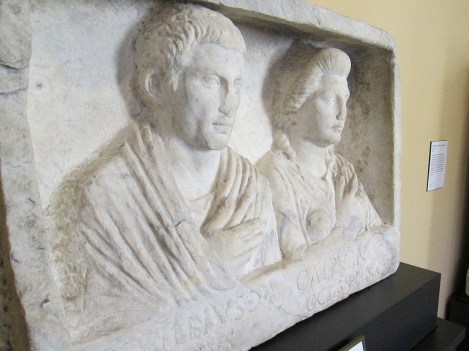
Tomb Monument for Popilius and Calpurnis

Roman Tomb Monument for Popilius and Calpurnia

One of the most touching grave monuments at the Getty Villa in Malibu is of a manumitted couple, Popilius and Calpurnia, who had been slaves before being freed by their master. The design is typical of monuments to freedman. Monuments such as this one lined the roads leading out of Rome. According to the descriptive panel accompanying the monument, “The panels announced the elevated social status of freedmen and their heirs, who were henceforth freeborn.” The monument dates from between A.D. 1 and A.D. 20—right around the time that Christ walked the earth.

I was greatly impressed by this panel, which I felt was made with some feeling for the ex-slaves, as if the artist knew them personally. There is a look of rectitude on their faces, above the hands folded on their breasts.

Works like this make me think that our ancient ancestors were more like us than we think. We would be just as impressed by Marcus Tullius Cicero as his fellow members of the Senate; and we would probably be even more appreciative of him than we are of our own Senators and Congressmen. We didn’t just come into being when personal computers, smart phones, and iPads came into existence. These are all accidentals.

Read yesterday’s post quoting one of Horace’s odes. I wouldn’t change a word of it for our own generation.

HallowThanksMas

Don’t Let Retailers Set Your Agenda

Don’t Let Retailers Set Your Agenda

We are currently on that Snakes & Ladders descent from Halloween through Thanksgiving and Christmas and New Years to Super Bowl Sunday. That’s a goodly chunk of the year being anxious as to whether one has satisfied all one’s loved ones. Because we watch television so many wasted hours each day, we are very conscious of what all the brick-and-mortar retailers want us to do. They endlessly supply us with suggestions as to what to buy for whom. And if the TV isn’t bad enough, there are also the radio, newspapers, e-mail, and FaceBook to remind us.

Because I am in the accounting profession (for the time being), I see this time of year primarily as the run-up to tax season. It means printing and sending out tax organizers, frequent installation of new versions of the tax software, constant re-indexing of the tax database, printing Form 1096 and 1099 for our clients (as needed), and dozens of other tasks. The worst part is the entry and processing of the actual tax returns, which builds up in a slow crescendo to the frantic last weeks before the April 15 deadline. In accounting, one doesn’t look at the Holidays so much as one looks past them.

Enough Already!

Enough Already!

As a result, I don’t go in for holiday decorations. I skip Halloween altogether—there’s never any Trick-or-Treaters who come to our door any more. We get together with our friends for Thanksgiving. We go to a couple of Christmas events, usually a concert of holiday music, and then we visit friends and family. On New Year’s, we stay in to avoid the drunk and drugged motorists. And Super Bowl Sunday? A great time to visit an otherwise crowded museum. Instead of joining the throngs at a shopping center on Black Friday (the day after Thanksgiving), I am thinking of suggesting Martine that we go instead to the Getty Villa to enjoy the serenity of ancient Greek and Roman art.

In fact, serenity is the key. If you don’t feel this serenity during the holiday season, I think you are probably doing something wrong. There’s little that we can do in the way of material goods to show our love. The batteries will run down, the gizmos will fail to work—but the love behind them still runs strong. At least, it should!

Yesterday, I saw my best friends and learned a lesson. Last year, I bought their youngest son a subscription to The New York Review of Books, which wound up being enjoyed primarily by the father. When I asked the son what should I get him, he told me not to worry about it. I don’t have any children of my own, so the children of my friends are particularly important to me. I won’t worry about it, but I will find something nice for him.


We Have Nothing to Fear But …

Someone Needs to Tell This to the Tea Party

Someone Needs to Tell This to the Tea Party

Conservatives are people who are addicted to fear. They fear for the “sanctity” of marriage. They fear what else homosexuals might be planning to discomfit them and their way of life. They fear that liberals are coming to take away their guns. They fear their children will grow up hating their values. They fear that poor people will vote in large numbers to bump them out of office. They fear America will be inundated by immigrants from Third World countries. They fear for the Purity of Essence of their Precious Bodily Fluids.

I take my cue from a great Republican President by the name of Calvin Coolidge. At one point, he said, “If you see ten troubles coming down the road, you can be sure that nine will run into the ditch before they reach you.” I often think of that saying when I am twisting and turning in bed at night because I fear that something will happen.

If you should ever find yourself in Plymouth, Vermont, as I did on one day in 2005. You should visit the Coolidge homestead, which is run by the Calvin Coolidge Memorial Foundation. You will find the former President buried in the local cemetery without an ostentatious monument slathered with grandiose sentiments. You will see the humble home in which he was born and the village where he grew to maturity. And finally, you will see a Republican who could be admired by future generations—as the present crop of Republicans will most certainly not be.

A subsequent President, FDR, told us during his first inaugural address that we had nothing to fear but fear itself:

So, first of all, let me assert my firm belief that the only thing we have to fear is…fear itself — nameless, unreasoning, unjustified terror which paralyzes needed efforts to convert retreat into advance. In every dark hour of our national life a leadership of frankness and of vigor has met with that understanding and support of the people themselves which is essential to victory.

Is the United States going to be paralyzed by the fear of elderly white people who think they are the last generation that supports the values that made this country great? Or will change continue to take place—as it always has and always will—leading to a world that is different, better in some ways and worse in others?

Free Fall

Jumper from World Trade Center on 9/11

Man Falling from World Trade Center on 9/11

Today is the twelfth anniversary of the World Trade Center bombing on 9/11. It occurred exactly one week after I returned from Iceland in 2001. I was on American Airlines Flight 11, the one that crashed into the North Tower of the WTC, seven days before the debacle. For some reason, I turned on the news and saw the whole thing happen—something that I almost never did, and certainly never do any more.

The above image of the man falling from one of the towers has been one of my strongest memories of the event. Two years later, in 2003, Tom Junod wrote an article for Esquire about the picture, in which he wrote:

In the picture, he departs from this earth like an arrow. Although he has not chosen his fate, he appears to have, in his last instants of life, embraced it. If he were not falling, he might very well be flying. He appears relaxed, hurtling through the air. He appears comfortable in the grip of unimaginable motion. He does not appear intimidated by gravity’s divine suction or by what awaits him. His arms are by his side, only slightly outriggered. His left leg is bent at the knee, almost casually. His white shirt, or jacket, or frock, is billowing free of his black pants. His black high-tops are still on his feet. In all the other pictures, the people who did what he did—who jumped—appear to be struggling against horrific discrepancies of scale. They are made puny by the backdrop of the towers, which loom like colossi, and then by the event itself. Some of them are shirtless; their shoes fly off as they flail and fall; they look confused, as though trying to swim down the side of a mountain. The man in the picture, by contrast, is perfectly vertical, and so is in accord with the lines of the buildings behind him. He splits them, bisects them: Everything to the left of him in the picture is the North Tower; everything to the right, the South. Though oblivious to the geometric balance he has achieved, he is the essential element in the creation of a new flag, a banner composed entirely of steel bars shining in the sun.

In the article, Junod attempts to establish the identity of the jumper. The article is well worth reading.

I see 9/11 as a giant punctuation mark for the new millennium. There was before, and now there is after. We seem to be more involved in the Middle East and its hatreds, its fundamentalisms, its generations-long vengeance than we ever wanted to be.


Little Princesses

Possibly the Wrong Paradigm

Possibly the Wrong Paradigm

Today, Martine and I spent the afternoon at the L.A. Greek Fest near downtown. Because the temperature was well into the Nineties, we spent most of our time in the school gym, which was air-conditioned and supplied with large tables. Around the edges of the room were merchants selling various gift items, including tiaras and shiny accessories to make little girls’ dresses resemble the costumes of fairy princesses. One even resembled an Egyptian headdress with a snake like the crown we imagine Cleopatra as sporting. Several little girls were prancing around the room with the sense of entitlement that a princess costume bestows on its wearers.

Really, what is a princess if not a girl who is entitled from birth? What does one do to become a princess? Simple: One is born to royal parents. And when a little girl grows up thinking she is a princess, what are her chances of happiness in a world in which a sense of entitlement will only carry one so far? Really, what is a true-life princess born into except the dynastic pursuit of a [preferably] male heir? In Westwood, near the UCLA campus, there are legions of little princesses who are now in their twenties. In lieu of fairy wands, they carry smart phones , but they still dress fancifully in other ways. Not a pretty sight.

And then I wonder: Am I carrying this too far? After all, little boys are drawn to violent fantasies of battle which are carried forward into the teen years with video games. Even I played cops and robbers and [shudder] cowboys and Indians. But what I really loved more than anything else were my plastic bricks. I would not only use my toy soldiers for going into battle: I actually created little cities for them, with more officers’ titles to go around than I had toy soldiers. Then, too, there was my Lionel O-Gauge electric train, which I played with for over a decade. Again, as with my toy soldiers, I made up series of towns connected by the railroad, complete with schedules. I remember that was a great deal of fun, and constructive, too, in the long run, because it gave play to my imagination.

But thank God I never wanted to be a little princess. Maybe a prince… I had dreams of being visited by people from Hungary who declared I was to be the new monarch of the ex-Communist satellite. That would have been dicey, because my father and my uncle were identical twins.

The Delta of the Paraná

The Delta of the Paraná River near Buenos Aires

The Muddy Delta of the Paraná River near Tigre

Here I am, within a couple of weeks of lifting off for Iceland; and what is going through my mind? Other places I want to visit. I am far from finished with Argentina. Above is the delta of the muddy Paraná River near where it debouches in the Rio de la Plata near Buenos Aires. I was never able to see Bariloche because of the volcanic eruption at Cordon Caulle in Chile. And Martine did not want to visit the Iguazu Falls along the northeast border with Brazil and Paraguay (those pesky mosquitoes!) nor the old Jesuit missions in Paraguay and Misiones Province (again, the bugs).

I don’t know how many years (or months or weeks or days) are left to me—and I don’t want to know. I just know that my sense of wonder is expanding even as my time is contracting. Will my last breath be inhaled near Ulan-Ude on the Trans-Siberian Railroad or at Machu Picchu in the Peruvian Andes or by the Látrabjarg Bird Cliffs in the West Fjords of Iceland or by the ruins of Petra in Jordan or the Széchenyi Baths in Budapest or … wherever?

It doesn’t much matter to me where. I keep thinking of the words from Witter Bynner’s translation of the Tao Teh Ching by Lao Tzu:

From wonder, into wonder
Existence opens.

If I had the money, and if I were no longer committed by my lack of funds to work in accounting, I would be on the road at least half the time.

Then, and only then, I would buy a good notebook computer to take with me. (Otherwise, it’s more of an onus than a bonus to me.)

Note: Since I originally published this, I saw Robert Louis Stevenson’s poem “The Vagabond,” of which this stanza is the refrain:

Let the blow fall soon or late,
Let what will be o’er me;
Give the face of earth around
And the road before me.
Wealth I seek not, hope nor love,
Nor a friend to know me;
All I seek, the heaven above
And the road below me.


Too Much Rugged Individualism?

John Wayne and Jeffrey Hunter in The Searchers (1956)

John Wayne and Jeffrey Hunter in The Searchers (1956)

As a nation, we’ve always prided ourselves on our rugged individualism. And I must say that worked pretty well for us—until the world suddenly grew more complicated after World War Two. Costs began spiraling upwards, at times, such as medical care and housing, beyond belief. Suddenly, we found ourselves in a world where there were 300 million rugged individuals, all competing with one another for scarce resources.

Some of us have learned to walk gingerly through this strange new world. Others have continued on as if it still were the Wild West, and as a result failed spectacularly. No matter: They had their guns. It was just a matter of shooting a bunch of innocent strangers and then turning the gun on themselves. This way they were making a point. What exactly that point was, I cannot even begin to guess. But, by golly, as long as they pretended to be a “Militia” as specified in the Second Amendment (the one part of the Constitution that makes me wonder about our Founding Fathers), they could wreak havoc and go down in flames.

Many Americans of a Conservative bent are scornful of what they call Socialism. In a few weeks, I will be spending some time in Iceland, a Scandinavian country with social guarantees that make it less likely that flagrant failures will shoot up their fellow man in spectacular ways. Medical care is far more affordable than in the U.S., though gasoline costs more. (They have to ship it in from the North Sea and other distant locales.)

Even with only 300,000+ people, Iceland has a number of maladjusted individuals who cause mayhem, but their mayhem is more limited and they are more easily captured because, hey, just about everyone is related to everyone else.

With 300+ million people, the United States has far too many rugged individuals. We need to put an ad on Craig’s List for people who are willing to play well with others.

Not that I have anything against John Wayne! The Searchers is probably my favorite film of all time, though I myself probably resemble John Quayle (the Swedish farmer character) more than the Duke.