Free Fall

Jumper from World Trade Center on 9/11

Man Falling from World Trade Center on 9/11

Today is the twelfth anniversary of the World Trade Center bombing on 9/11. It occurred exactly one week after I returned from Iceland in 2001. I was on American Airlines Flight 11, the one that crashed into the North Tower of the WTC, seven days before the debacle. For some reason, I turned on the news and saw the whole thing happen—something that I almost never did, and certainly never do any more.

The above image of the man falling from one of the towers has been one of my strongest memories of the event. Two years later, in 2003, Tom Junod wrote an article for Esquire about the picture, in which he wrote:

In the picture, he departs from this earth like an arrow. Although he has not chosen his fate, he appears to have, in his last instants of life, embraced it. If he were not falling, he might very well be flying. He appears relaxed, hurtling through the air. He appears comfortable in the grip of unimaginable motion. He does not appear intimidated by gravity’s divine suction or by what awaits him. His arms are by his side, only slightly outriggered. His left leg is bent at the knee, almost casually. His white shirt, or jacket, or frock, is billowing free of his black pants. His black high-tops are still on his feet. In all the other pictures, the people who did what he did—who jumped—appear to be struggling against horrific discrepancies of scale. They are made puny by the backdrop of the towers, which loom like colossi, and then by the event itself. Some of them are shirtless; their shoes fly off as they flail and fall; they look confused, as though trying to swim down the side of a mountain. The man in the picture, by contrast, is perfectly vertical, and so is in accord with the lines of the buildings behind him. He splits them, bisects them: Everything to the left of him in the picture is the North Tower; everything to the right, the South. Though oblivious to the geometric balance he has achieved, he is the essential element in the creation of a new flag, a banner composed entirely of steel bars shining in the sun.

In the article, Junod attempts to establish the identity of the jumper. The article is well worth reading.

I see 9/11 as a giant punctuation mark for the new millennium. There was before, and now there is after. We seem to be more involved in the Middle East and its hatreds, its fundamentalisms, its generations-long vengeance than we ever wanted to be.

 

Little Princesses

Possibly the Wrong Paradigm

Possibly the Wrong Paradigm

Today, Martine and I spent the afternoon at the L.A. Greek Fest near downtown. Because the temperature was well into the Nineties, we spent most of our time in the school gym, which was air-conditioned and supplied with large tables. Around the edges of the room were merchants selling various gift items, including tiaras and shiny accessories to make little girls’ dresses resemble the costumes of fairy princesses. One even resembled an Egyptian headdress with a snake like the crown we imagine Cleopatra as sporting. Several little girls were prancing around the room with the sense of entitlement that a princess costume bestows on its wearers.

Really, what is a princess if not a girl who is entitled from birth? What does one do to become a princess? Simple: One is born to royal parents. And when a little girl grows up thinking she is a princess, what are her chances of happiness in a world in which a sense of entitlement will only carry one so far? Really, what is a true-life princess born into except the dynastic pursuit of a [preferably] male heir? In Westwood, near the UCLA campus, there are legions of little princesses who are now in their twenties. In lieu of fairy wands, they carry smart phones , but they still dress fancifully in other ways. Not a pretty sight.

And then I wonder: Am I carrying this too far? After all, little boys are drawn to violent fantasies of battle which are carried forward into the teen years with video games. Even I played cops and robbers and [shudder] cowboys and Indians. But what I really loved more than anything else were my plastic bricks. I would not only use my toy soldiers for going into battle: I actually created little cities for them, with more officers’ titles to go around than I had toy soldiers. Then, too, there was my Lionel O-Gauge electric train, which I played with for over a decade. Again, as with my toy soldiers, I made up series of towns connected by the railroad, complete with schedules. I remember that was a great deal of fun, and constructive, too, in the long run, because it gave play to my imagination.

But thank God I never wanted to be a little princess. Maybe a prince… I had dreams of being visited by people from Hungary who declared I was to be the new monarch of the ex-Communist satellite. That would have been dicey, because my father and my uncle were identical twins.

The Delta of the Paraná

The Delta of the Paraná River near Buenos Aires

The Muddy Delta of the Paraná River near Tigre

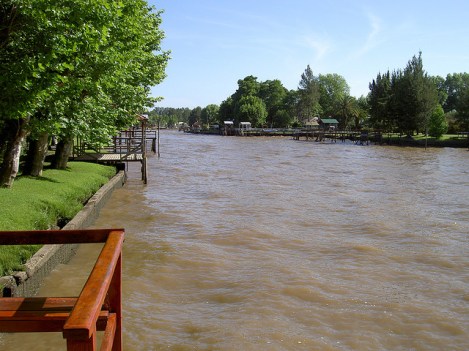
Here I am, within a couple of weeks of lifting off for Iceland; and what is going through my mind? Other places I want to visit. I am far from finished with Argentina. Above is the delta of the muddy Paraná River near where it debouches in the Rio de la Plata near Buenos Aires. I was never able to see Bariloche because of the volcanic eruption at Cordon Caulle in Chile. And Martine did not want to visit the Iguazu Falls along the northeast border with Brazil and Paraguay (those pesky mosquitoes!) nor the old Jesuit missions in Paraguay and Misiones Province (again, the bugs).

I don’t know how many years (or months or weeks or days) are left to me—and I don’t want to know. I just know that my sense of wonder is expanding even as my time is contracting. Will my last breath be inhaled near Ulan-Ude on the Trans-Siberian Railroad or at Machu Picchu in the Peruvian Andes or by the Látrabjarg Bird Cliffs in the West Fjords of Iceland or by the ruins of Petra in Jordan or the Széchenyi Baths in Budapest or … wherever?

It doesn’t much matter to me where. I keep thinking of the words from Witter Bynner’s translation of the Tao Teh Ching by Lao Tzu:

From wonder, into wonder
Existence opens.

If I had the money, and if I were no longer committed by my lack of funds to work in accounting, I would be on the road at least half the time.

Then, and only then, I would buy a good notebook computer to take with me. (Otherwise, it’s more of an onus than a bonus to me.)

Note: Since I originally published this, I saw Robert Louis Stevenson’s poem “The Vagabond,” of which this stanza is the refrain:

Let the blow fall soon or late,
Let what will be o’er me;
Give the face of earth around
And the road before me.
Wealth I seek not, hope nor love,
Nor a friend to know me;
All I seek, the heaven above
And the road below me.


Too Much Rugged Individualism?

John Wayne and Jeffrey Hunter in The Searchers (1956)

John Wayne and Jeffrey Hunter in The Searchers (1956)

As a nation, we’ve always prided ourselves on our rugged individualism. And I must say that worked pretty well for us—until the world suddenly grew more complicated after World War Two. Costs began spiraling upwards, at times, such as medical care and housing, beyond belief. Suddenly, we found ourselves in a world where there were 300 million rugged individuals, all competing with one another for scarce resources.

Some of us have learned to walk gingerly through this strange new world. Others have continued on as if it still were the Wild West, and as a result failed spectacularly. No matter: They had their guns. It was just a matter of shooting a bunch of innocent strangers and then turning the gun on themselves. This way they were making a point. What exactly that point was, I cannot even begin to guess. But, by golly, as long as they pretended to be a “Militia” as specified in the Second Amendment (the one part of the Constitution that makes me wonder about our Founding Fathers), they could wreak havoc and go down in flames.

Many Americans of a Conservative bent are scornful of what they call Socialism. In a few weeks, I will be spending some time in Iceland, a Scandinavian country with social guarantees that make it less likely that flagrant failures will shoot up their fellow man in spectacular ways. Medical care is far more affordable than in the U.S., though gasoline costs more. (They have to ship it in from the North Sea and other distant locales.)

Even with only 300,000+ people, Iceland has a number of maladjusted individuals who cause mayhem, but their mayhem is more limited and they are more easily captured because, hey, just about everyone is related to everyone else.

With 300+ million people, the United States has far too many rugged individuals. We need to put an ad on Craig’s List for people who are willing to play well with others.

Not that I have anything against John Wayne! The Searchers is probably my favorite film of all time, though I myself probably resemble John Quayle (the Swedish farmer character) more than the Duke.

Leaves and Concrete

My Preferred Walking Surface

My Preferred Walking Surface

One of my meditations at Descanso Gardens related to the type of surface we walk on. For us city-dwellers, most of our lives are spent walking on artificial surfaces such as concrete, asphalt, wood, or padded carpets. Yesterday, I cut through the 150-acre wood consisting mostly of oak trees and camellias, roughly from a point just south of the lilac garden to the cactus garden on the other side of the park.

During most of that time, I was treading on a lush carpet of dead leaves and fallen camellia blossoms as pictured above. It was the most resilient surface on which I have ever walked. So much death all around me! But was it really? How much of our skin and hair do we slough off every day of our lives? Yet they are renewed (well, except maybe the hair), as are the leaves and camellia blossoms. It is a little death among so much life. And it made me think that, perhaps, we ourselves are like leaves or blossoms of a much larger living entity.

We hardly ever see ourselves that way, what with our gimme gimme now now lives and somewhat tawdry needs. Going to Descanso always makes me think about our role in the larger life of the planet. We have destroyed so many of the green spaces that make us realize our part in the universe; and, as a result, we have become unhappier and more disconnected.

Eschscholzia californica

Macro Image of a California Poppy

Macro Image of a California Poppy (Eschscholzia californica)

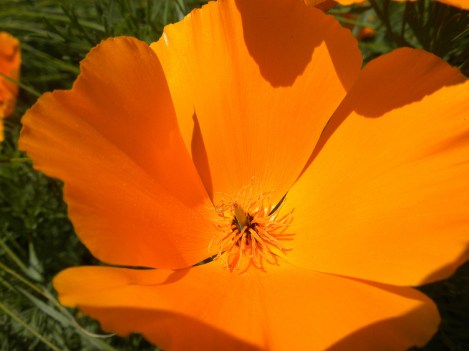
We got an extra day off from work today, so Martine and I drove to Descanso Gardens in La Cañada-Flintridge, perched in the hills above Glendale. We have always associated the gardens with peace of mind, and today was no exception. Martine and I usually split off for a couple of hours and meet at the front gate just before closing time. While she wanders to her favorite sites, I look to get lost on the lesser known trails and perhaps do a bit of meditation.

The plethora of California poppies—the official state flower—kept distracting me. I took a number of close-ups, including the picture above, There is something so simple and yet so splendid about these blossoms that they kept interrupting my meditations. One never knows when one will run into a clump of these.

If it weren’t for tax season, I would have made a point of visiting the Antelope Valley California Poppy Preserve about fifteen miles west of Lancaster. Some 1,745 acres are full of California poppies and other native wildflowers, and there is a small visitor center maintained by the California Department of Parks and Recreation. (Of course, with the state’s current budgetary problems, I don’t even know if the park is still being funded.)


“Grassed Down and Forgotten”

tess

Cover of Tess of the D’Urbervilles

The past was past; whatever it had been it was no more at hand. Whatever its consequences, time would close over them; they would all in a few years be as if they had never been, and she herself grassed down and forgotten. Meanwhile the trees were just as green as before; the birds sang and the sun shone as clearly now as ever. The familiar surroundings had not darkened because of her grief, nor sickened because of her pain.

She might have seen that what had bowed her head so profoundly—the thought of the world’s concern at her situation—was founded on an illusion. She was not an existence, an experience, a passion, a structure of sensations, to anybody but herself. To all humankind besides Tess was only a passing thought. Even to friends she was no more than a frequently passing thought. If she made herself miserable the livelong night and day it was only this much to them—’Ah, she makes herself unhappy.’ If she tried to be cheerful, to dismiss all care, to take pleasure in the daylight, the flowers, the baby, she could only be this idea to them—’Ah, she bears it very well.’ Moreover, alone in a desert island would she have been wretched at what had happened to her? Not greatly. If she could have been but just created, to discover herself as a spouseless mother, with no experience of life except as the parent of a nameless child, would the position have caused her to despair? No, she would have taken it calmly, and found pleasure therein. Most of the misery had been generated by her conventional aspect, and not by her innate sensations.—Thomas Hardy, Tess of the D’Urbervilles

Be Cool, You Fool!

If You’re in College, and You’re Uncool, You’re Nowhere

If You’re in College, and You’re Uncool, You’re Nowhere

When I work Sundays the last five or six weeks of tax season, I always break my workday in two. The high-rise where my accounting firm is located does not run air-conditioning on Sundays, with the result that the oxygen level gets pretty well depleted. So I usually take a four-to-six mile walk around the UCLA area, eat lunch in the UCLA student union, and shop at the UCLA bookstore, returning to work around one in the afternoon.

The Ackerman Union has several chain restaurant outlets and a number of TV monitors that are kept tuned to mtvU, where the programming seems (on Sundays anyhow) to be all music videos.

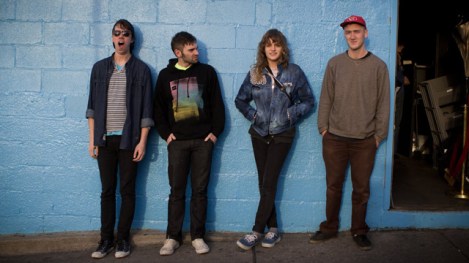
If these music videos have a message, it is: If you’re not cool, you’re nothing—the Twenty Teens’ equivalent of the Beatles’ Nowhere Man. Everyone in a rock music video is always dressed in the just-right casual style, like the group shown above. Nowhere is seen anything as forbidden as a book, an older person, or a work of classical music. (is it because these are all associated with Schoolwork?)

In the world of music videos, all that matters is looking right and making all the cool moves to impress one’s peers. The peer group is everything, to the exclusion of all else. It almost verges on the tribal.

Bad Times Are Gonna Come

Our Lives Are All Subject to Reverses

Our Lives Are All Subject to Reverses

I remember a story that one film industry friend told me several years ago. A family was so solicitous about the health of their son that they raised him on an organic and vegetarian diet. When he grew up, he wanted to go into the movies as a technician like his Dad. That first day on the job, he ate a McDonald’s hamburger and became deathly ill. He had to be hospitalized for weeks.

You can’t stay entirely out of the way of troubles that are sure to come. One of your loved ones could sicken and die, your health could take a turn for the worse, you could be forced out of your home, your investments could disappear as a result of fraud, your best friend could turn on you, your lover could prove unfaithful to you … the list is endless. How are you going to avoid all of those pitfalls, plus the ones not mentioned? Are you going to be like the vegetarian child for whom the world is toxic?

I would like to think that encountering troubles is a powerful inducement for having greater sympathy for your fellow man. It is not easy when your fellow man cuts you off on the street and leaves you with an upraised middle finger and the exhaust from his BMW; but if your response is nothing but rage, you will only hurt yourself.

Look around you. The world is full of people who need a little help. Even when their gratitude is not what you would hope for, you will feel better about yourself.


Cemetery Blues

Holy Cross Cemetery in Culver City

Holy Cross Cemetery in Culver City

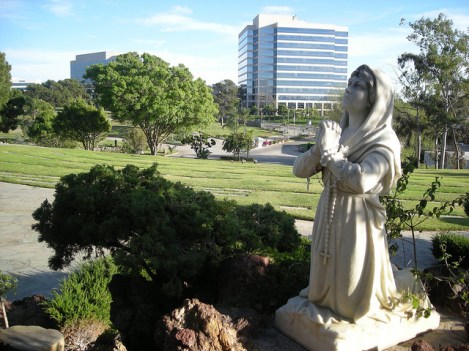
Today, after doing a half day of tax work (on a Saturday!), Martine and I went to Holy Cross Cemetery in Culver City. Today is the first anniversary of the death of our apartment manager, Tony. Not that we liked him very much, but we liked his mother, who died twelve years ago; and believe that, although his son grossly mismanaged his own life, he deserves to be commemorated—not for what he was, but for what he could have been.

Once again, I thought to myself that, when it is my time to go, I do not want to be embalmed and buried—not anywhere. My wish is to have my remains cremated and dispersed, preferably in the ocean. If that’s not possible, on the surface of the earth will be almost as good.

Since we had a little extra time, we did a little Hollywood celebrity grave search. We found out where Bela Lugosi, Jimmy Durante, Rita Hayworth, Zasu Pitts, Bonita Granville, John Candy, and Fred MacMurray are interred.

Then we went to Dinah’s Family Restaurant at Centinela and Sepulveda, one of Martine’s favorite venues for fried chicken.