In Search of Lost Restaurants

The Much Lamented Tung Lai Shun Islamic Chinese Restaurant

The Much Lamented Tung Lai Shun Islamic Chinese Restaurant

If one doesn’t have any children, the easiest way to mark the passage of time is by restaurant closings. For example, my favorite used to be the Tung Lai Shun Islamic Chinese Restaurant at 140 W. Valley Blvd. in San Gabriel. One Hawaiian patron wrote on Yelp:

This was my favorite Chinese restaurant for years and years. I loved it so much, I’d fly over from Hawaii then spend 45 minutes on those dreaded L.A. highways driving over. Before my flight back home, I’d drive over again to pick up green onion pancakes and deep fried shrimp balls (okay, stop laughing, I don’t know what else to call them) dipped in salt and pepper to eat on the plane.

There are hundreds of others: Stelvio’s, Mario’s, Asuka, and Carl Andersen’s Chatham in Westwood; Toi on Wilshire and the Broken Drum in Santa Monica; Gorky’s Cafe and Russian Brewery in downtown L.A.; Marco Polo’s and Pepy’s Chili in Culver City; the Hortobagy Hungarian Restaurant in Studio City; Nichols Restaurant* in Marina Del Rey; and the Chung King in West Los Angeles. I could name hundreds more, but what would be the point?

Today, while I ate lunch at the still robust Westwood Thai Restaurant, I was reading an article amount Walter Benjamin in the July 10 issue of The New York Review of Books. Benjamin was a German Jew who committed suicide when he was unable to cross over into Spain from France during the Second World War. The war not only killed much of what he loved, but he felt hunted by the Nazis and couldn’t take the stress of returning to Vichy France and trying on a better day. As Susan Sontag said about him, “He felt that he was living in a time when everything valuable was the last of its kind.”
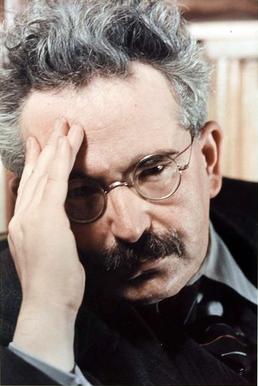
Walter Benjamin

Walter Benjamin

In our crazy 21st Century existence, it’s easy to feel that way. I am thinking now of Robin Williams’s suicide because of … whatever it was really because of: We just don’t know for sure. At some point, Robin, like Walter Benjamin, made the decision that there were not enough valuable things in life left to make a go of it.

It seems quite a jump from a closed restaurant one has loved to a decision about life and death, but is it really? Restaurants open and close quickly. There are other things going on in our lives, however, at a much more glacial pace that could affect how we feel about ourselves and life in general. For instance, do we have a fatal illness? Has everyone we have ever loved died (cf. Mark Twain)? Have we lost the ability to see or hear? Are we facing a future of grinding poverty? Do we feel guilt for an evil that we have committed (most school shooters)?

Life wants us to live as much as we can, or dare. I learned early on from having brain surgery in 1966 that things will change, and I would have to change with them. Just because he became deaf, Beethoven did not quit composing great works. I knew early on I could never have children without a pituitary gland, so I became whatever it is I am today, with which I am all right. I feel relatively good in my aging skin.

* – This is a footnote. Don’t be alarmed. The Nichols Restaurant didn’t die: It became a zombie, now called J. Nichols Restaurant, where it serves TSF (thirty-something food) for millennials and others who want an alternative to Cheerios.
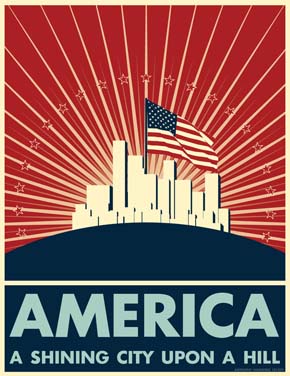
The Way We See Ourselves

Reagan Popularized This Concept

Reagan Popularized This Concept

The text originally comes from the Bible, from the Sermon on the Mount in Matthew 5:14: “You are the light of the world. A city that is set on a hill cannot be hidden.” The phrase had been used by several Americans since to describe the way we as a people wanted to be seen. While still aboard his ship en route to the New World, John Winthrop delivered a sermon in 1630 that contained the following phrase:

For we must consider that we shall be a city upon a hill. The eyes of all people are on us. So that if we shall deal falsely with our God in this work we have undertaken, and so cause Him to withdraw His present help from us, we shall be made a story and a by-word through the world. We shall open the mouths of enemies to speak evil of the ways of God, and all professors for God’s sake. We shall shame the faces of many of God’s worthy servants, and cause their prayers to be turned into curses upon us till we be consumed out of the good land where we are going.

In 1961, John F. Kennedy used the phrase in one of his speeches. More famous, however, was Ronald Reagan in 1984 when he said:

…I’ve spoken of the shining city all my political life, but I don’t know if I ever quite communicated what I saw when I said it. But in my mind it was a tall proud city built on rocks stronger than oceans, wind-swept, God-blessed, and teeming with people of all kinds living in harmony and peace, a city with free ports that hummed with commerce and creativity, and if there had to be city walls, the walls had doors and the doors were open to anyone with the will and the heart to get here. That’s how I saw it and see it still…

In the course of the passing years, after Vietnam, Grenada, Iraq, Afghanistan and various other global hotspots, we have developed another image. In a short story entitled “Absence,” a Peruvian-born writer named Daniel Alarcón painted a very different picture of what the United States had become: “Americans always feel bad. They wander the globe carrying this opulent burden. They take digital photographs and buy folk art, feeling a dull disappointment in themselves, and in the world. They bulldoze forests with tears in their eyes.”

Tenniel’s Walrus and the Carpenter

John Tenniel’s Illustration for Walrus and the Carpenter

Now what this reminds me of are the Walrus and the Carpenter from Lewis Carroll’s Through the Looking Glass. You might remember from the accompanying poem that the Walrus and his Carpenter friend talk some oysters into joining them for dinner. Of course, they eat all the oysters, and begin to cry. The following conversation then takes place between Alice, Tweedledee, and Tweedledum:

‘I like the Walrus best,’ said Alice: ‘because you see he was a LITTLE sorry for the poor oysters.’

’He ate more than the Carpenter, though,’ said Tweedledee. ‘You see he held his handkerchief in front, so that the Carpenter couldn’t count how many he took: contrariwise.’

‘That was mean!’ Alice said indignantly. ‘Then I like the Carpenter best—if he didn’t eat so many as the Walrus.’

‘But he ate as many as he could get,’ said Tweedledum.

This was a puzzler. After a pause, Alice began, ‘Well! They were BOTH very unpleasant characters—’

It’s a long way between the City on a Hill and Lewis Carroll’s the Walrus and the Carpenter, but I do believe that over the centuries, the U.S. seems to have arrived at that point with surpassing ease—while at the same time with all our illusions intact.


Their Hearts Are in the Highlands

Highland Lass with Lore Master

Highland Lass with Lore Master

One of the premier attractions at last week’s Old Fort MacArthur Days was my visit to the encampment of Clan Mac Colin. One of the reasons is that, although many of the performers cooked their own food, the Clan’s food looked the most scrumptious. When I asked some questions to the young lady in the photo above, she referred me to the clan’s Lore Master, who set me straight.

Clan Mac Colin attempts to reproduce a Scottish Highland (and Irish) way of life dating back to the Sixteenth Century, mostly centered around Glenderry, around East Loch Ewe, the Isle of Ewe, and the Gruinard Peninsula in what is now County Ross and Cromarty. I suspect some of the geography might be made up, but the way of life represented attempts to be as authentic as possible. If you are interested in delving into some of the details, you could hardly do better than scanning through the Basic Guide (which loads as an Adobe Acrobat PDF file). Also check out their Tribal Lore website, which is more succinct.

Although I have not an iota of Celtic blood in my veins, if I wanted to escape the cares of a stupid workaday life, I should think that Clan Mac Colin would exercise a powerful lure.

While going to Old Fort MacArthur Days is like walking through history, joining Clan Mac Colin is like living history. I would worship Saint Maolrubha with my fellow clan members. As the Tribal Lore site says, the good saint “continued the work of Saint Columba in Wester Ross and, retiring from that abby, established a cell on the isle of Maree in Loch Maree, the sight of his holy well. He is also the patron saint of the insane, being drug behind a boat around his island three times widdershins and drinking from this well is reputed to be a cure.”

Well, why not?


Red Sunset Mother

It All Goes Back to Aesop

It All Goes Back to Aesop

The three words of the title of this post were separately suppressed by Myanmar’s ruling junta: “red” because of its association with Communism; “sunset” because General Ne Win’s name meant “sunrise”; and “mother” because that was the nickname of Burmese dissident Aung San Suu Kyi.

That brings back to mind another draconian instance of censorship. In Costa-Gavras’s film Z (1969), the rightist Greek colonels in charge forbid the use of the letter Z (Zeta) in the Greek alphabet because of the protestors’ use of the Greek phrase “Ζει,” meaning “He lives.” The pronoun refers to the democratic politician Grigoris Lambrakis, who was assassinated in 1963.

What does one do when the powers that be forbid the use of certain words? Russian and Eastern European writers under Communist rule came up with the solution: use other words in their place. This is referred to as the use of Aesopian, or Aesopic, language. Just as the ancient Greek teller of fables used stories to mask political realities, writers would use metaphorical language to stand in for the proscribed language. In an article entitled “The Rhetoric of Subversion: Strategies of ‘Aesopian Language’ in Romanian Literary Criticism Under Late Communism,” Andrei Terian describes the procedure used:

Since organized dissent was absent, the ‘resistance through culture’ represented in Romania the main form of assertion of the writers’ independence from the Communist regime. Civically, it materialized through the refusal to enroll in the party’s propaganda machine, while artistically, it took place through the defense of the priority of the ‘aesthetic’ criterion in the production and reception of literary works, which generated a literature relatively autonomous from the political sphere. Nevertheless, from the perspective of maximalist ethics, the ‘resistance through culture’ is a deeply duplicitous phenomenon, which fits perfectly in the Ketman paradigm described by Czeslaw Milosz. In the Polish writer’s opinion, ‘Ketman means self-realization against something’ (The Captive Mind ….), which, in the case of totalitarian societies, is translated in a profound divergence between an individual’s private thoughts and their public expression.

I thought Milosz expressed it better in The Captive Mind—a book I urge everyone to read—but I can’t quote it because, alas, I can’t lay my hand on it at the moment.

Terian is a bit abstruse, so let me think of an example. Let us say that the Tea Party rules America as a rightist junta and bans the use of the word “abortion.” A hated Liberal writer can use another term, such as “ablution” in such a way that a censor would let it pass, despite the fact that its meaning would be clear from its context, as in “they were able to limit the size of their family with the discreet use of ablution.” Writers can and did develop an entire language of such circumlocutions under the noses of the Communist censors.

Even words as basic as “red,” “sunset,” and “mother” can find Aesopian equivalents, such as, perhaps, “rubicund,” “gloaming,” or “progenitrix” respectively—though a poet can play with the concept much as Viking poets used kennings such as “wave’s steed” for “ship” or “Freyja’s tears” for “gold.” And the Viking’s did this not because of censorship, but to help the meter of their compositions.

The Missing Link, Going Forward

Man May Prevail, But With What “Modifications”?

Man May Prevail, But With What “Modifications”?

I am always amused about talk of a “missing link” between what was recognizably ape and what is recognizably human. But once we have Homo sapiens down, what about changes to our species that may be as significant—if not more significant—to those which we have traditionally associated with the concept of a missing link?

Today, I had lunch at a local Thai restaurant. In the next booth sat a woman who was part of a larger party that had not yet all met up. No sooner did she get seated than she had a long painful conversation with another member of the party which was supposedly looking for the restaurant but had trouble finding it. At no point did she get the name of the restaurant correct (she kept calling it simply “Thai Café”) and never thought to supply the exact street address. All her instructions were with regard to the identities of nearby retail establishments. If her friend was several blocks away, he would have no more luck finding the “Thai Café” than the stores in its immediate vicinity.

The thought suddenly hit me that the smart phone has introduced new ways of thinking. No longer is any sort of advance preparation required for anything. One can simply make a phone call and use relational markers to home a friend in to the desired location employing fuzzy logic of a sort.

Man has developed increasingly sophisticated tools for tens of thousands of years, but for the first time we are approaching the point where we are using tools to change ourselves and our very thought processes. It is possible, for example, that the smart phone may be as significant for the human race as Gutenberg’s invention of moveable type. If we ever improve robots to the point that we can communicate with them, that may be even more significant. In both cases, man is delegating his own brain powers to a device that parses, stores, and possibly communicates commands.

What do you suppose the effect of that will be on the human brain? Perhaps it will begin to atrophy. Once one has a truly smart phone, one does not have to think for oneself any more.

I’m not sure I would like that development, or should I say retrogression?

Our Heroes Are Developers?

What About Our Artists, Writers, and Scientists?

What About Our Artists, Writers, and Scientists?

I’m sorry to have to say this, but there is something highly suspect in the way we name our cities and streets. In Los Angeles, we have Culver City—named after a real estate developer, one Harry Culver. Van Nuys is named after a developer with the unlikely name of Isaac Newton Van Nuys. World-famous Wilshire Boulevard is named after Henry Gaylord Wilshire. Again and again, we see streets named after developers, their wives, daughters, sons, and I wouldn’t be surprised if some are called after their dogs and cats.

Where in this broad city of ten million people do we see writers like Raymond Chandler, Nathanael West, or Evelyn Waugh commemorated? And what about scientists? Granted, Burbank is named after world-famous botanist Luther Burbank—oops, sorry, it was David Burbank, a dentist and entrepreneur who gave his name to Beautiful Downtown Burbank. In a city crawling with Nobel Prize winners, it seems the names have already been taken by lowlife developers, who splashed out with their developments and skipped town before the inevitable problems began to “develop.”

When I was in Buenos Aires, I stayed on a street named Emiliano Zola. Granted, Zola was a French writer, but at least it wasn’t named after some entrepreneurial skunk. Paris has an Avenue Victor Hugo. Northern California does much better than we do, with numerous streets named after writers, not to mention Jack London Square in Oakland. Well, where is there anything in La-La Land named after Charles Bukowski or John Fante?

Is it some residual puritanism that makes us avoid artists, writers, and scientists when naming places? I am sure that Donald Trump (depicted above) is no model of right behavior.

Perhaps we should rename some of those cities and streets originally named after long-forgotten developers and replace them with people who have mattered to us—not people who have ripped off our forefathers.

And while we’re at it, what about showing someone other than dead presidents and other founding fathers on our currency? I’d like to see Nathaniel Hawthorne, Edgar Allan Poe, Walt Whitman, Emily Dickinson, and William Faulkner on our currency. We can hold our head up high among the peoples of the world with our great writers.


Fútbol

Better Than American Football?

Better Than American Football?

Frankly, I think that most American spectator sports are there strictly for the commercial breaks. There is a brief spurt of intense activity, followed by several interminable ads directed at selling junk to macho males and hip females. The only exception is baseball, which is too much like watching grass grow. There is a pitcher, a batter, a catcher; and, very occasionally, some other players are briefly involved.

While I was in the hospital on Saturday, I watched the Argentina-Iran game in the morning. I was impressed. Despite the fact that the Argentinians won it 1-0 (superstar Lionel Messi finally came alive), it was beautiful to see the ball handling. The Iranian goalkeeper, Alireza Haghighi, frustrated all of Argentina’s many shots at goal until late in the Second Period. It was beautiful to watch the action, from the setup in the backfield to the elegant passing back and forth, along with the numerous interceptions that forced the other side to begin all over again.

The thing I loved was that something was always happening, like waves starting far out in the ocean and crashing on the shore.

Why do I love soccer football so much? For one thing, it was a tie to my father which I remember with great fondness. Elek (Alex) Paris and his brother Emil were identical twins who played the same position in the semi-pro nationality club teams of the 1930s. There were stories from my youth about my father forcing a referee to swallow a whistle (while inhaling to blow it), requiring him to pull it out by the lanyard while choking. Numerous players told me of my father’s powerful kicks that broke other players’ legs.

In the long run, I think that soccer football will replace the mayhem of American armored football. Parents just don’t want their sons to have to deal with concussions leading possibly to death or other serous head injuries. The next generation will be much more receptive to the game—unless they have to play someone like Elek Paris.

There are three reasons why, for the time being, soccer will take second place to the prolate spheroid pigskin, at least for the time being.

The main reason is that games can end in ties. Americans don’t like ties. When the USA-Portugal match ended in a 2-2 tie, newspapers around the country weighed in and harshly criticized the American effort. That was too bad, because the US really outplayed Portugal: Unfortunately, they left a brief opening for Ronaldo to set up a strike at the net. It didn’t matter to me: The Americans played a great game that showed that they deserve their 11th place world ranking. (“What only 11th place?” say the critics.) They’ll be better anon. Whether they ever reach the top spot is a different matter. First they have to pay some dues.

Another thing that drives many American fans crazy is the “expandable clock” of regulation play. A game runs 90 minutes, but referees can add minutes at the end for injuries and whatnot. In the US-Portugal game, there was a time-out at the end of the First Half as a water break. The jungle city of Manaus was hot and sticky, and the players were seriously drenched and dehydrated. In the end, the game ran approximately 95 minutes. It’s not over until the referee whistles the game over.

Finally, many Americans want more bathroom and snack breaks. Well, then, they can watch baseball, which is a lot of nothing—or some other sport with numerous breaks for ads.


The Runaway Trolley Dilemma

What Is the Right Decision?

What Is the Right Decision?

We tend not to discuss ethical dilemmas in the abstract, if for no other reason that they usually tend to be real posers.Take this famous dilemma: There is a runaway trolley headed in your direction, and in its path there are five people tied to the track. You find you are standing right next to a switch which could shunt the trolley off on a siding. You proceed to pull the switch, only to find there is a single person tied to the track on the siding.

The Utilitarians would say that it is a better thing to sacrifice one life rather than five—all other things being equal. But are they really equal? What if the five people tied to the track are all serial child molesters, and the single person tied to the siding is Pope Francis? Also, are there any people on the trolley? If so, wouldn’t they all risk dying in any case?

There is a variant of this dilemma, but without a switch and a siding. Again, we have a runaway trolley, again with five people tied to the track. You are standing on a footbridge over the track with a fat man whom you don’t know. You are between the runaway trolley and the five persons on the track. Should you push the fat man off the footbridge so that he lands in the path of the trolley, leading to a derailment upon impact?

Is This an Easier Decision?

Is This an Easier Decision?

In the first case, most people would throw the switch in the first case, but few would push the fat man to his death in the path of the trolley.

My own preference is to avoid situations where I am anywhere near any runaway trolleys, especially since I could be considered a fat man myself.

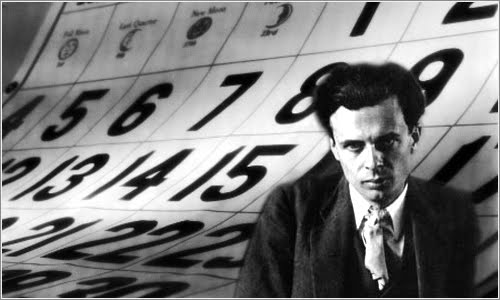
Aldous Huxley Foresees the Future

The Young Aldous Huxley

The Young Aldous Huxley

The Twentieth Century gave us two dystopias to consider: George Orwell’s 1984 and Aldous Huxley’s Brave New World. It is interesting to note, years after the fact, whose vision is closer to the reality. My vote goes to Aldous Huxley, as does the writer of this website, which compares the two point by point using comics to make their point.

In 1949, right after 1984 came out, Huxley wrote a letter to Orwell in which he doubts the latter’s vision would ever come true:

The philosophy of the ruling minority in Nineteen Eighty-Four is a sadism which has been carried to its logical conclusion by going beyond sex and denying it.

Whether in actual fact the policy of the boot-on-the-face can go on indefinitely seems doubtful.

My own belief is that the ruling oligarchy will find less arduous and wasteful ways of governing and of satisfying its lust for power, and these ways will resemble those which I described in Brave New World.

Corybantic Dancers on Reverse of Coin

Corybantic Dancers on Reverse of Greek Coin

Last night, I saw a DVD containing what my friend Lee Sanders claims is the only filmed interview with Huxley, shortly before his death in 1963. Considering the extent to which Huxley has been one of my gurus over the last half century, it is no surprise that I found it fascinating. During the interview, Huxley repeatedly made the point that our own intellectualism was over-rigorous. He brings up the point that the Ancient Greeks needed the frenzied Corybantic Dances to maintain their lives on an even keel.

He also quoted two related poems by William Wordsworth entitled “Expostulation and Reply” and “The Tables Turned.” The the former, a visitor, thought to be Hazlitt, remonstrates with the poet, who appears to be sitting and doing nothing:

‘The eye—it cannot choose but see;
We cannot bid the ear be still;
Our bodies feel, where’er they be,
Against or with our will.

’Nor less I deem that there are Powers
Which of themselves our minds impress;
That we can feed this mind of ours
In a wise passiveness.

’Think you, ’mid all this mighty sum
Of things for ever speaking,
That nothing of itself will come,
But we must still be seeking?

’—Then ask not wherefore, here, alone,
Conversing as I may,
I sit upon this old grey stone,
And dream my time away.’

In “The Tables Turned,” Wordsworth goes on the offensive:

Sweet is the lore which Nature brings;
Our meddling intellect
Mis-shapes the beauteous forms of things:—
We murder to dissect.

Enough of Science and of Art;
Close up those barren leaves;
Come forth, and bring with you a heart
That watches and receives.

Significantly, Huxley wrote a novel entitled Those Barren Leaves (1925), which I have not yet read.

Whether we fling our clothes off and engage in wild corybantic dances, or we sit still and let the world communicate with us in its own time, we are in the process sharpening and shaping our minds using all of our faculties, rather than just a few.


In the Rant Room

Ranting Is Almost Inherent in the Act of Blogging

Ranting Is Almost Inherent in the Act of Blogging

Although I didn’t know it at the time, “Rant Room” is an anagram for “Tarnmoor.” But then, so are “Man Rotor,” “Roman Rot,” “A Mr No Ort,” and “Rat Moron”; so perhaps it’s not worth reading too much into this. Looking back at some of my older postings, particularly during election years (of which this is one), I see that I have frequently indulged in knee-jerk reactions of outrage.

Outrage is so much a part of our national political scene. There is a whole spectrum of the media that feeds on outrage and slings it back magnified and undeodorized. One result is that millions of Americans have lost the ability to communicate with one another, except through the use of buzzwords and loaded talking points. Just look at this partial list of hot buttons (in no particular ordure) that have been used to poison the national debate:

Abortion. Benghazi. Socialism. Prayer. Voter ID. Unwed Mothers. Sharia. Bible. Gay Marriage. Rape. Makers. Takers. One Percent. Tea Party. Cliven Bundy. Racism. Climate Change. Evolution. Ownership. Fox News. Obama. Obamacare. Solar Power. Creationism. Nanny State. Guns. Marijuana. Welfare. Immigration. Terrorists. Hillary. Taxes. Death Panels. Fluoridation. LGBT. Sovereign Citizen.

This is a highly partial list, but it is enough to fuel years of debate and cripple the nation.

I may find myself writing about some of the above, but not, I hope, out of outrage. Please, Lord, let me shed light rather than darkness in the places where I walk.