Ach! Not Again!

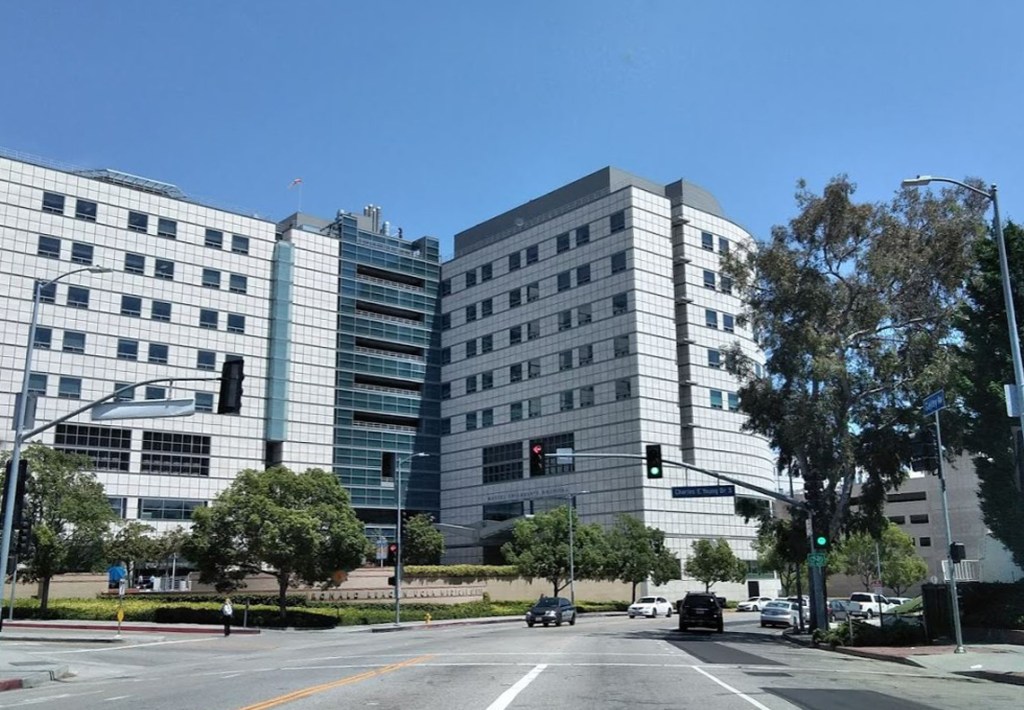
UCLA’s Ronald Reagan Medical Center

Yesterday morning, I found myself being admitted to UCLA Hospital’s emergency room. That morning, I awoke around six in the morning to go to the bathroom. Coming back I found myself bumping into things. When I tried to get back into bed, I slipped and fell on the floor pinning my left shoulder between the bed and my nightstand. I was too weak to make a serious attempt to get up.

Martine heard my fall and frantically tried to help me. But how could she, with her right wrist in a cast from when she broke it the week before. For hours she tried to make me comfortable and gave me water to sip through a straw. Fortunately, she had the presence of mind to give me 30mg of Hydrocortisone, which, as it happened, is the cure for the symptoms I was experiencing.

Time and time again, she asked if I wanted an ambulance. My consciousness was improving from the Hydrocortisone Martine gave me, so I finally said yes. It seemed that the bedroom was crawling with Emergency Medical Technicians from the Fire Department within minutes. They hauled me out of my wedged position and dumped me on the bed. Their strongly recommended I be admitted to the hospital. I tried to resist their suggestion until I had the feeling that it was pretty much de rigeur in their profession.

So, as when I had my last serious Addisonian Crisis on December 30, 2017, I was trundled down the apartment steps, plunked into the ambulance, and driven to the UCLA Hospital emergency room (but without the sirens).

What was wrong with me? The scientific term is panhyopituitarism, which means I no longer have a pituitary gland. It all happened many years ago. To read the gory story of my near-death experience in 1966, click on this post from April 2015.

By the time I got to UCLA, I was feeling pretty good as the Hydrocortisone was doing its job; but I knew I would have to go through the medical profession’s equivalent of the death of a thousand cuts. I was wheeled from one clerk to another and asked for details which were entered into their system. Fortunately, In December 2017, I had roughly the same situation.

Still, it seems that emergency wards assume you have some internal organ problem such as a heart attack or cancer, so I was hooked up with little stickies all over my upper body and probed with needles until the doctors determined that, yes, I would not be likely to die on the spot. My problem was not a disease of an internal organ, but the fact that I was missing the body’s master gland and occasionally needed to have extra amounts of ACTH (adrenocorticotropic hormone) in lieu of natural adrenaline.

On at least two dozen times, I made the point that the problem was that I had no pituitary. I had to talk with an endocrinologist because my ailment was not a common one, certainly not one that a typical emergency room physician would grasp. Not only that, but the cure had been applied hours before when Martine gave me my medications. Back in 2017, the same hospital held me for three days until the resident endocrinologist strolled in with her hands in her pockets and, immediately understanding my situation, had me released.

Fortunately, I was released late that afternoon. Maybe it was the record of my 2017 experience that convinced them to let me go. Maybe it was because they had me walk to the bathroom and saw that I was fully mobile. And apparently, the doctors did talk to the endocrinologist who told them to let me go. I felt bad to be around all those persons who were really suffering. I kept telling the nurses I felt I was occupying space in their emergency room under false pretenses.

So I took a taxi home, and Martine was at the front of the apartment to give me my wallet so I could pay the driver.

The funny thing is, there is little advanced warning when one is about to suffer an Addisonian Crisis. In this case, I didn’t suspect something was wrong until I returned from the bathroom to go to bed. That was approximately a half-minute warning.

No Nurse, He!

I Discover That I Would Not Make a Good Nurse

Last Tuesday, I posted here that Martine broke her wrist in two places. Worse luck, it was her right wrist; and she is right-handed. I suddenly found myself in the position of being on call fifty times a day or more to help dress her, open jars, wash dishes, help with the laundry, and carry out the garbage and recycling, Neither of us has been in a particularly good mood throughout this ordeal, though our eruptions are fortunately short-lived.

Today Martine had her plastered splint removed and replaced with a fiberglass cast. It turned out she replaced one fiercely uncomfortable hard wrap with another. At first, the fiberglass cast was a vast improvement—until it hardened and pinched as bad as the plaster and splint ever did.

Until such time as Martine’s wrist heals, I am the only pair of working hands in this household.

Broken Wrist

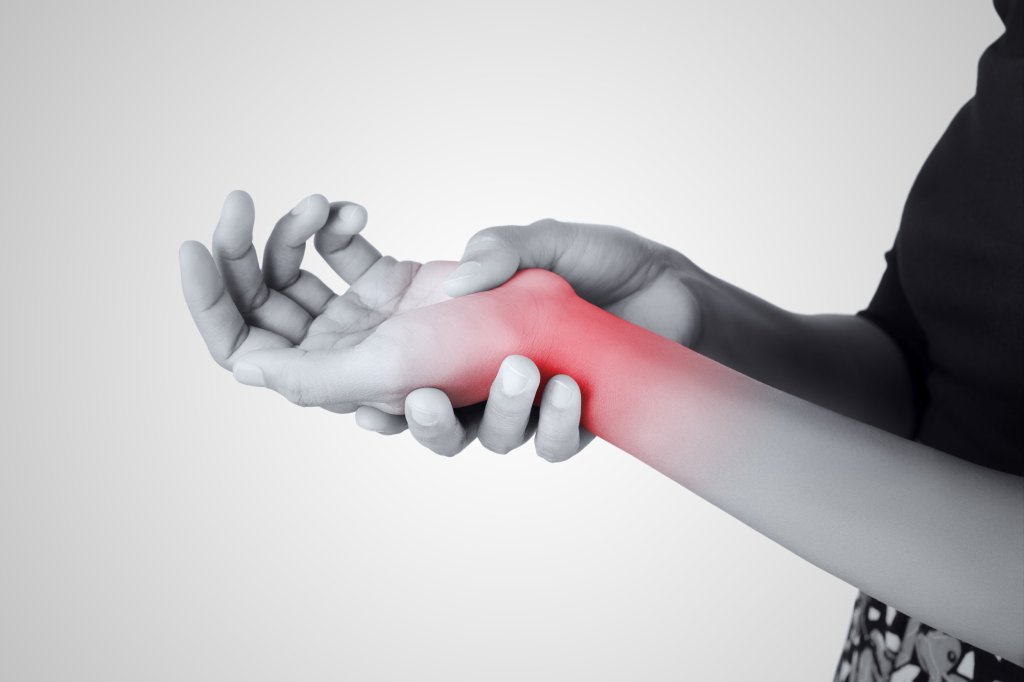
Today, Martine slipped on a rug in the bathroom and, grabbing for the wall, broke her right wrist in two places. She was in such excruciating pain that she was not able to communicate with me for upwards of a half hour. As soon as she was able to move, I drove her to UCLA Santa Monica Hospital’s emergency room. It was only by clutching a largish container of blue ice that she was able to endure the agony.

We were in the ICU for over six hours while she was X-Rayed, injected with Lidocaine, and bandaged with a splint (twice, after her thumb became numb the first time). For the whole time that I was waiting next to Martine’s gurney, a homeless woman tried to use me as her private nurse while she loudly threatened to check herself out of the hospital if she didn’t get her oatmeal instanter.

It looks like there will be some changes to my schedule as Martine is unable to wash dishes or wet her bandaged splint. I had been planning to visit my brother in Palm Desert this weekend, but we’ll have to reschedule.

My goal is to see Martine through this difficult period, just as she helped me through two broken shoulders and three cracked ribs. That kind of support is an effective way of showing love.

Journey to the East

Indian Holy Man

In many ways, most of my life has been a “Journey to the East.” I was raised as a Roman Catholic, going to Catholic schools from the 2nd through the 12th grades. Even at Dartmouth College, I was a worshiper at the Newman Club. In fact, when I fell into a coma in September 1966, it was Father William Nolan, the Catholic chaplain at Dartmouth, who urged the school’s medical insurance program to keep covering me, even though my coverage had officially lapsed at the beginning of the month. So my family and I owe a debt of gratitude to the Catholic Church.

One does not undergo a massive physical trauma without affecting the way one thinks and believes. That September, I was getting ready to take the train to Los Angeles to start graduate school in film history and criticism at UCLA. I had to delay my film classes until the winter quarter to allow me to recuperate.

What was the first book I read when I arrived in Los Angeles? It was Hermann Hesse’s Siddhartha, closely followed by Paul Reps’s Zen Flesh Zen Bones. I had begun my own Journey to the East, mostly in my reading.

Why did I never fly to Asia to experience Hinduism, Taoism, and Buddhism directly? Strangely—especially for someone who was visited so much of Latin America—I was afraid that I wouldn’t survive the experience. Among my fellow Clevelanders who attended Dartmouth College was a student by the name of Noel Yurch. I was shocked to find out from the alumni magazine after I had graduated from college that he had gone to India and died of some gastrointestinal disease.

Curiously, my niece Hilary went to India and studied Yoga at an ashram without suffering any major adverse effects. Today, she is a yoga instructor in the Seattle area. But I was convinced it would be fatal for me. Was it nothing but funk? Perhaps.

Today, I still read many books about the Eastern religions. I consider myself to be a strange combination of Catholic, Hindu, Taoist, and Buddhist. Although I do not go to church on Sundays, I do not consider myself to be an Atheist or even an Agnostic. And when I visit Mexico or South America, I spend hours visiting Catholic churches and even attending Mass. But I no longer buy the whole package.

So in my so-called Journey to the East, I still have one foot in the Catholic Church, or at least one or two toes.

Family Life in America

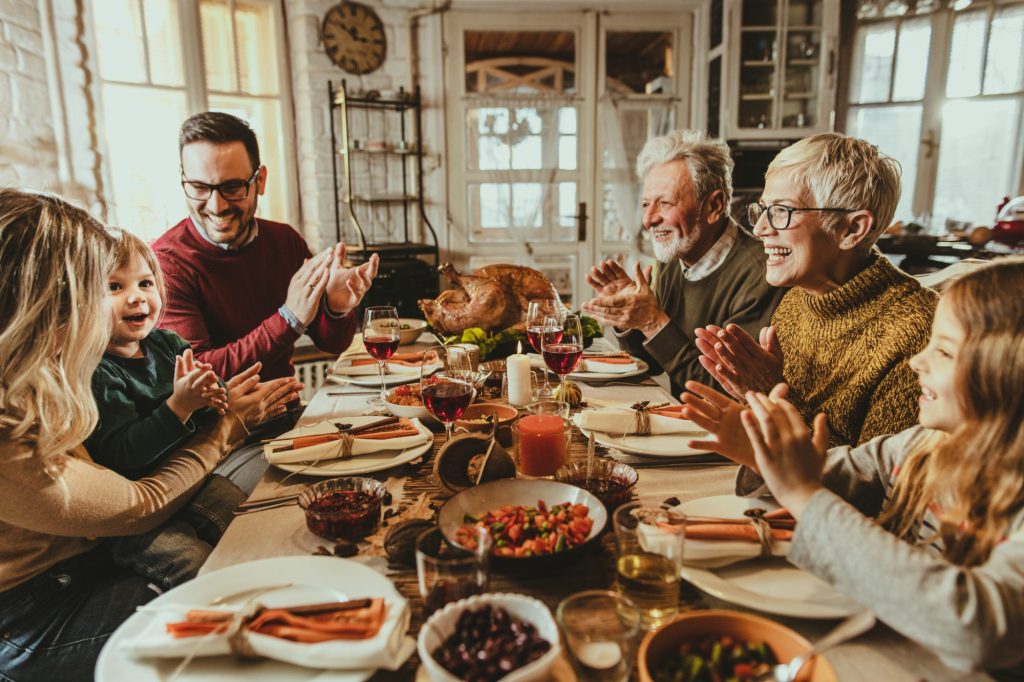
What’s wrong with this picture? Well, first of all, it’s a big family dinner with all the trimmings in which all the participants are openly delighted with one another. And they’re actually listening to one another. Where’s the strange uncle wearing the red MAGA hat? Where are the scowling teenagers? On the plus side, there isn’t any food on the plates yet, though there’s a big turkey at the far end of the table waiting to be carved. So perhaps there’s still time for the expression of discontent.

Martine and I both agreed that we liked Halloween better than Thanksgiving or Christmas. There was no need for any pretense of a closely-knit family. One just pretends to be someone else and pigs out on candy. Americans don’t do family well. We talk about it a lot, but most families at best have the appearance of an armed truce.

Read J. D. Vance’s Hillbilly Elegy or Tara Westover’s Educated to get an accurate picture of family life in America. Oh, I’m not saying that the disaffection is universal, just that it’s dismayingly prevalent.

It wasn’t that way for my own family: but, being Hungarians, we did not care that much for American holiday traditions. Except my brother and I really got into the Halloween sugar rush. We never had turkey for dinner in Cleveland, as both my father and I did not like it very much, and I still don’t. We usually had Christmas dinner with my aunt and uncle in Novelty, Ohio, but it was usually as much Hungarian as it was American. Come to think of it, back then we enjoyed the holidays without feeling in any way obliged to grin and bear it.

We now usually go out for Thanksgiving with friends. But over the last several years, Martine and I celebrate Christmas with home-cooked beef stew served with a Hungarian red wine, preferably Egri Bikavér (Bull’s Blood of Eger).

Pumpkins and Skeletons

This last Saturday, Martine and I visited the Grier Musser Museum, which had just re-opened to the public after the Covid-19 lockdown. I have always particularly loved their Halloween antiques, art, and other displays, such as the above throw pillow. Martine wore her witch costume (see yesterday’s post: Decidedly a Good Witch). We both resolved to re-visit them just before Christmas, when their displays will be less horrific.

Tonight, I watched four horror films in a row, three of which were the original Universal Frankenstein releases:

  • Frankenstein (1931)
  • Bride of Frankenstein (1935)
  • The Son of Frankenstein (1939)
  • The Plague of Zombies (1966)—a Hammer horror film

I waited by the door just in case some trick-or-treaters would come. As usual none came. I don’t think any have climbed the stairs for upwards of thirty years. I thought this year would be different because my downstairs neighbors are Ukrainian refugees with two young daughters.

Now that Halloween is almost past, I realize we are in the HallowThanksMas Continuum, where three Holidays seem to come one after the other like falling dominoes.

This October, I read four horror-related books in celebration of Halloween:

  • Tales of Terror from Blackwood’s Magazine (1817-1834)
  • Ann Radcliffe’s The Romance of the Forest (1791), the first half of which is set in a spooky abandoned monastery
  • Edith Wharton’s Ghosts (1937), selected by the author
  • Peter Ackroyd’s The Casebook of Victor Frankenstein (2008), a re-telling of the original Mary Shelley story

Decidedly a Good Witch

Above is Martine dressed as a witch—but as a good witch, to be sure! On a whim, she bought a great witch’s hat and dress at a Santa Monica costume shop and has been wearing it everywhere the last few days. The comments she has been receiving during that time have been overwhelmingly positive.

Beware of making any negative comments lest she wave her magic wand at you and turn you into a batrachian (tailless amphibian of the order Anura; a frog or toad).

Middle Wigwam

The Hanover NH Cemetery

As a student at Dartmouth College in the mid 1960s, I spent four years in the second farthest dormitory from the center of campus. Why? It was one of three new dormitories, and many of the older dormitories didn’t appeal to me for various reasons. Initially, my dorm was called Middle Wigwam; then it changed its name to McLane Hall. God knows what it’s called now, as the college erected numerous other buildings in the immediate vicinity and called another building McLane Hall. I certainly hope that the McLanes are happy with that.

There were several problems about being so far from the center, which mostly became apparent in the fierce New Hampshire winter. First of all, the central heating plant was more than a mile away. When the temperature dipped down to -30° degrees Fahrenheit (-34° Celsius), it wasn’t particularly easy to heat the building. Fortunately, I had an electric blanket for those days when the mercury sank way below comfort level. We never needed a refrigerator most of the year: windows were festooned with gallon jugs of apple cider.

Secondly, in going to and from classes and meals, I had to take a long walk on a frequently icy (and in Spring slushy) Tuck Mall past the Hanover town cemetery, which at night was a scary experience. Many of the graves dated back to the 18th century and looked ominous from dusk on.

Baker Library (As It Was Called Then) at Dartmouth

In my college years, I was frequently sick with severe frontal headaches that made going to class or the dining hall a misery. It was only after I graduated that I found the cause: a benign tumor was growing in my pituitary gland and pressing on the optic nerve. I was basically a pretty unhealthy young man who was taking long walks every day during the school year. Of course, once I got to my classes or the dining hall, I hung out in the Baker Library (now the Baker-Berry Library) or the Hopkins Center or—that’s where my habit began—the Dartmouth Bookstore.

I was fortunate to have survived my college years. All the times I showed up to the student infirmary, I was told I had migraines or hay fever or some such—pure bosh! But then, in those early years, all they had to go on were X-Rays; and the pituitary, being directly in the center of the head, did not show up well on the X-Rays of the period. MRIs and CAT Scans were all in the future.

Even so, I enjoyed most of my time at Dartmouth. It was a beautiful place, with majestic elm trees all over the place. No more! And the college’s aggressive building program has destroyed much of the campus’s charm.

The Year of Reading Dictionaries

My first real job in Los Angeles was for System Development Corporation (SDC) in Santa Monica. My predecessor in the job was a young woman who was murdered by a UCLA film student. How odd that she was succeeded by another UCLA film student—me!

The nature of the job was to proofread two transcriptions of Merriam-Webster dictionaries. Thy had been punched on paper tape and converted to character files that were sent to a line printer. The first was the Merriam-Webster Seventh Collegiate Dictionary and the other was the M-W Pocket Dictionary.

Everything had been entered—not only the definitions but the pronunciations and etymologies as well. This was a database to be used to assist in computer translation between languages. Was it, in fact, ever used for this purpose? I don’t really know, because my part of the project ended before the database was ever used for any practical purpose.

The project ended with a publication in June 1969 of which I was a co-author: Two Dictionary Transcripts and Programs for Processing Them. Volume I. The Encoding Scheme, PARSENT, and CONIX. My co-authors were Richard Reichert and John Olney. If you are interested in reading it, you will find a copy in the Library of Congress.

Apparently Not a Parent

Somebody Else’s Life

I found out in the most brutal way possible. I was in the endocrinologist’s clinic. The doctor mentioned in an aside, “You know, of course, that you’re sterile?” At that point in my life, I was appalled. Of course I wanted to raise a family, with perhaps two offspring. But it was apparently not to be. I had one major adjustment surviving brain surgery a couple years earlier, but now I had another major adjustment in the offing. No kids. No normal family life.

Upon hearing this several acquaintances (they could never really be my friends) would pipe in with, “You can always adopt!” If I adopted a child, it would be mine only by an act of will stretching decades into the future … to care for someone who, biologically, had nothing in common with me. Okay, so I am not Mother Teresa. I make no claims to sainthood.

I made the adjustment. The women I went out with just assumed that I was telling an untruth when I told them I was sterile, so I went along with it until I went to my doctor who tested me and certified that, yes, indeed, I was shooting only blanks.

Now, in my seventies, I look back on my life and am happy that I did not have to raise any children. My one long-term relationship has been with Martine, a woman who did not ever want to have children. I don’t think I would have been a good father, and as Francis Bacon wrote, “He that hath wife and children hath given hostages to fortune; for they are impediments to great enterprises, either of virtue or mischief.”

Not that I have ever had any great enterprises….