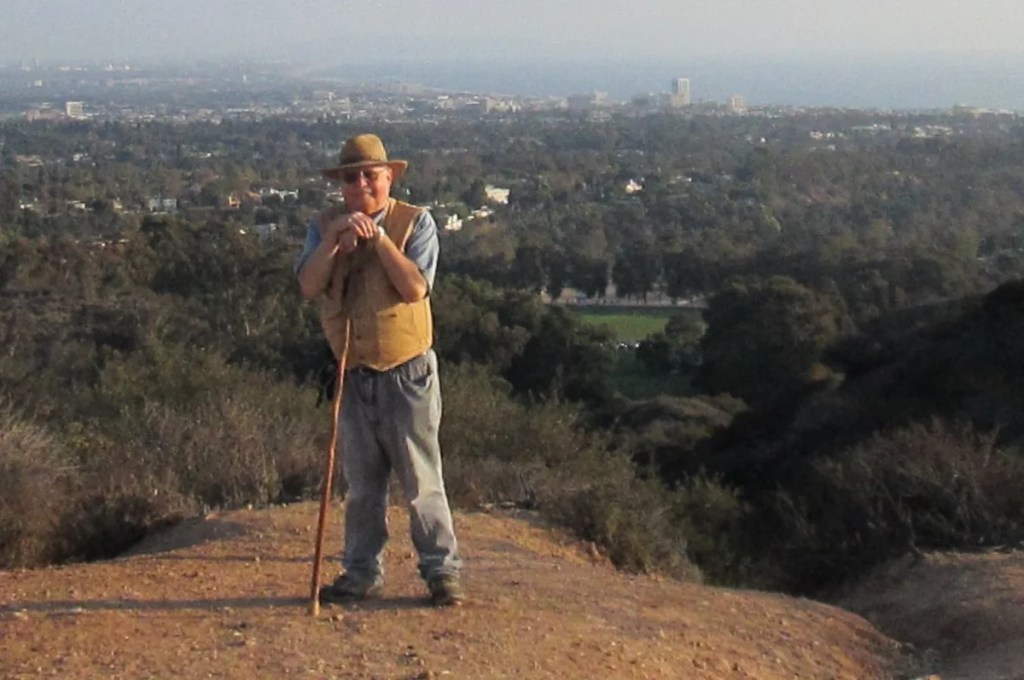
Today I took a hike … sort of. Now that we are not being flooded out very week, I needed some exercise—only to find that I was way out of shape. I drove to the Will Rogers State Historical Park in Pacific Palisades. Now this is a trail I had hiked many times before, but today I couldn’t quite make it to the top. And that despite the fact that the trip there and back was only 9/10 of a mile (1.5 km) with a total gain of 119 feet (36 meters)!
I am resolved to try again soon. It is amazing how a long spell of bad weather can expose how out of shape one is.
No matter. I still enjoyed the experience. The hills were covered with purple and gold wildflowers, and at several points there were still rivulets seeping from the hills right through the center of the trail. At three points along the trail, there are benches . I took advantage of them once on the way up and once on the way down. It was a lovely day, with coastal fog starting to come in at the lower elevations.
In another ten or twelve weeks, it’ll be too hot to hike this trail, so I had better do it again soon perhaps two or three times. When it gets really hot in L.A., it’s better to stick to level ground—and that early in the morning. Once 11 am rolls along, it becomes a sweaty ordeal.
When I finished the walk, I sat down on one of the three rocking chairs on the porch of Will Rogers’s old house and watched parents play with their children on the wide lawn in front.
Uh oh! A couple days ago, I felt a sharp pain in one of my upper molars. Plus, when I drank anything cold, I felt the same pain. My last dental siege involved a new crown for one of my bicuspids, which couldn’t stay on. That was followed by two root canals of the bicuspid and an adjacent tooth, which had to be scrapped by having the tooth pulled. Total cost: about $4,500.
That sort of sequence is not exactly balm to someone like me on a fixed income. After that adventure, I did something I had never really done before. I purchased an electric toothbrush and did a thorough brushing of the gums and all tooth surfaces (fore, aft, and sides) for two full minutes—timed—before going to bed.
Today, I saw my dentist and had the sore tooth x-rayed. Apparently, the problem was caused by the molar next to the extracted bicuspid sticking out a little too far. So my dentist carefully measured my bite and trimmed the tooth so it wouldn’t receive too much pressure from my normal chewing of food.
The Fastest Checkmate on the Board—By the Black Pieces, No Less!
I first learned how to play chess at the age of nine, thanks to the husband of my mother’s best friend. Ever since then, I was hooked. Central and Eastern Europeans have always had a special affinity for the game. My parents respected my love of the game even when they were annoyed by my being a bookworm: It was considered acceptable to Hungarians to go gaga over the game.
Mind you, I don’t consider myself to be a particularly strong player. My main weakness is my game to too undynamic, frequently bypassing attacking sacrifices and, what is worse, not paying close attention when attacking sacrifices are played against me.
On the other hand, I have taught over thirty people how to play the game. Some of them went on to beat me, the ungrateful pups!
In my retirement, I frequently play six or more games a day against the computers at Chess.Com. Shamefully, I take moves back when I have made an obvious mistake. And I tend to play weaker automated opponents. When I do play human opponents using Chess.Com, I find myself rated as a middling player, verging on (but never quite reaching) advanced status.
It is still possible to love the game when one is just what chess players refer to as a patzer.
My first flight was in the summer of 1959—to Florida of all places. Way back around 1946-47, we had all lived in Lake Worth, now a suburb of West Palm Beach. My Dad had the worst job in the world for someone with a delicate stomach: disposing of the bodies of dead alligators. My Mom worked as a checker in a supermarket. So when Mom wanted to hook up with her Florida friends a dozen or so years later, my Dad wanted no part of it.
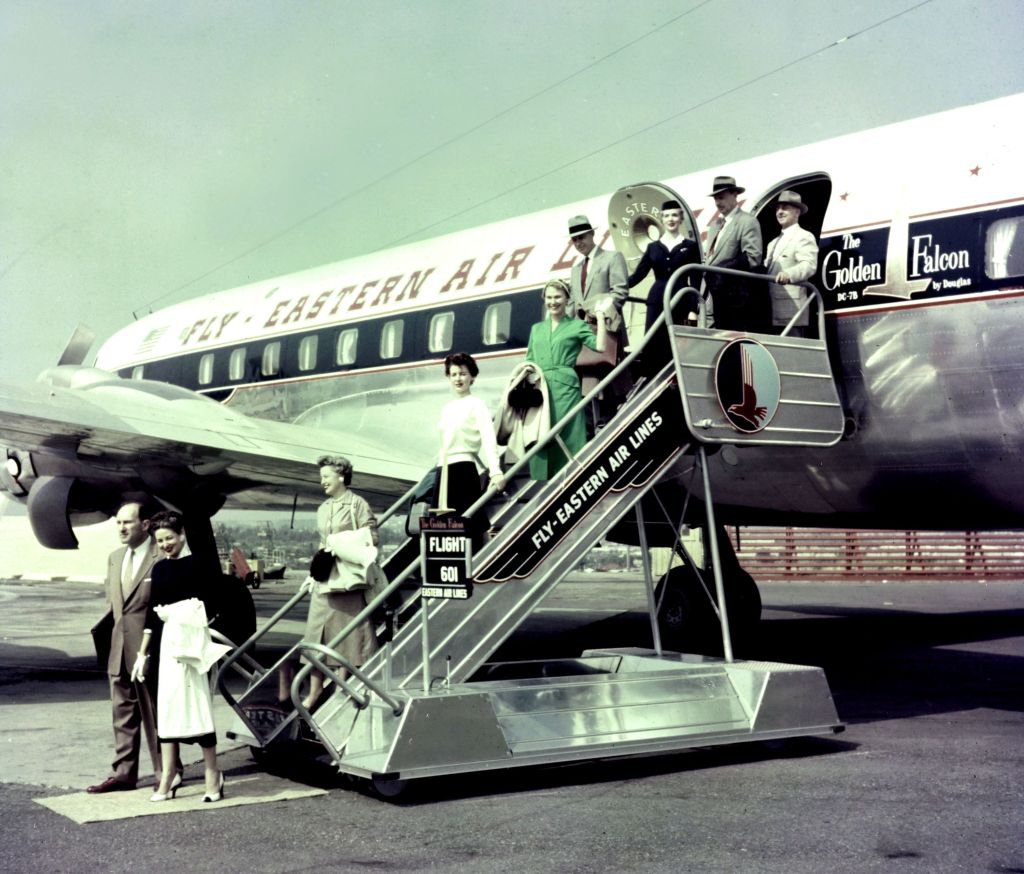
Wait a minute! Florida in the summer? Were we out of our minds? Apparently. It was either June or July, and Mom had made a reservation at an apartment on Federal Highway in Lake Worth. So Mom, my brother (then seven years old), and me (aged fourteen) were off to Cleveland Hopkins Airport, where we boarded a prop plane similar to the one shown above and flew to Jacksonville, where we landed to embark and disembark passengers, and continued on to West Palm Beach.
That second leg of the flight was a real doozy. We were flying at low altitude through a violent thunderstorm. I saw a stewardess lose her footing and dump a tray of beverages into the laps of a row of passengers.
Then, when we finally landed in West Palm Beach and stepped out of the plane, it was as if we were hit in the face with a hot, wet towel. Cleveland in the summer was humid, but nowhere near so bad as Florida. We sort of got used to it. We even got used to seeing dead palmetto bugs as big as mice piled up along the curbs.
Bookworm that I was, even at that early age, I remember vividly that I was reading Lew Wallace’s novel Ben-Hur, which I completed there and started reading MorrisWest’s The Shoes of the Fisherman. Good reading for a devout Catholic schoolboy, though I couldn’t stomach it today.
One interesting memory of that trip: My Mom had worked for a rich widow in Palm Beach named Mrs. Gregory. One day, we went to visit her. Mom always thought that some rich person would out of the goodness of her heart shower us with money and gifts. It never happened. Instead, we went for a ride in her chauffeured Cadillac with no air conditioning and the windows resolutely closed on a sweltering day. Afterwards, she generously offered us a glass of ice water.
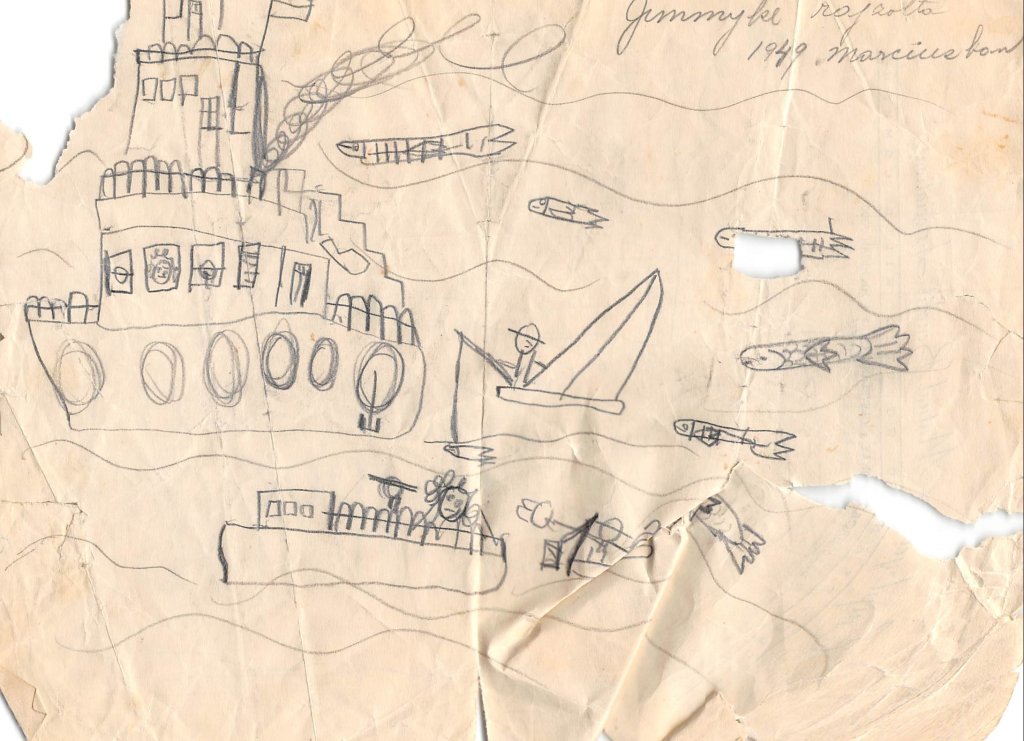
It’s in execrable shape—but then, so am I—but here is a pencil drawing I made at the age of four. It is inscribed by my mother in Hungarian “Jimmy drew this in March 1949.” It displays an attention to detail surprising for a little boy who did not have access to television and who did not know a word of English. All I had were the stories my mother told me. Interestingly, she made them up herself most of the time. A lot of them involved fairy princesses and dark forests.
Then, too, there were the stories she read to me from library books. We would go together to the public library near Harvey Rice School (where I would go for kindergarten and half of first grade) and pick them out, mostly based on the pictures in them. My mother knew English: she was born in Cleveland, but taken back to Hungary to be raised. She would meticulously translate the selected stories from English to my little-boy Magyar tongue. (Magyar means Hungarian in the Hungarian language.)
At the time, we were living at 2814 East 120th Street in the Buckeye Road Hungarian neighborhood of Cleveland. For several blocks around, one could be born, live, and die without knowing a word of English. Not any more, of course. Eventually all the Hungarians moved out and it became a black ghetto. We moved out, too, in 1951, shortly after my brother was born.
Today I got taken out for my upcoming birthday. I had lunch with my brother and sister-in-law, my niece Jennifer, and her boyfriend John. I didn’t expect that birthday would be remembered—in fact, I haven’t given any thought to it at all. So it came as a pleasant surprise.
We were at the Kalaveras Restaurant in Redondo Beach. I was in the mood for a plato de carnitas with the pork slightly crispy. One of my favorite Mexican meals are home-made carnitas soft tacos with guacamole, hot sauce, and fire-roasted jalapeño chiles. The carnitas at Kalaveras came with cooked plantains and the usual beans and rice.
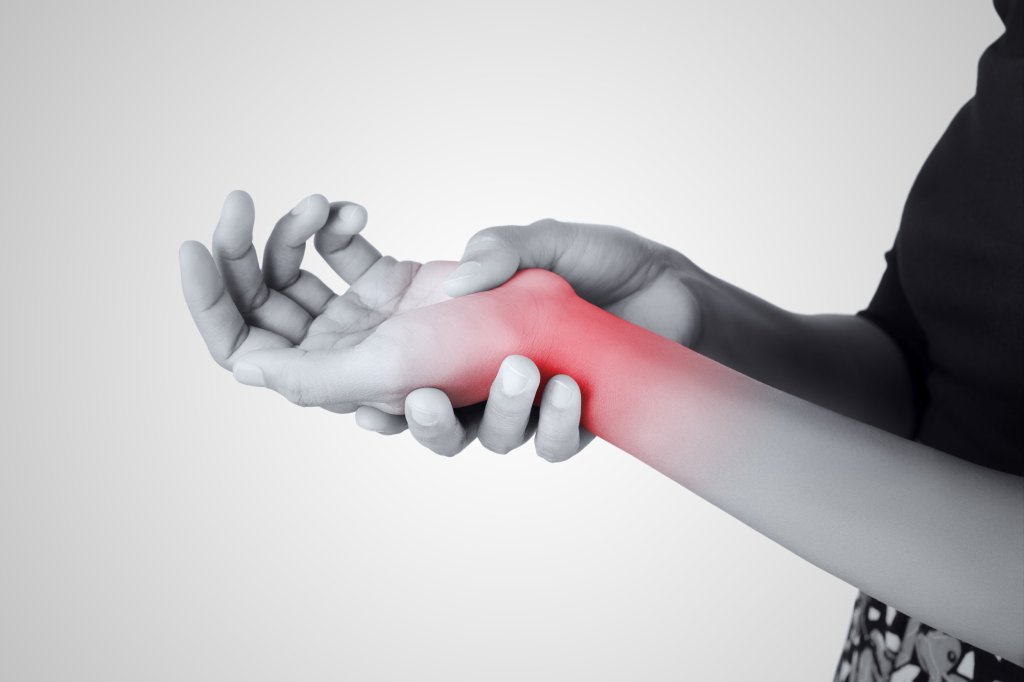
What with the conversation and the great food, I haven’t enjoyed myself half so much since Martine and I spent a week in Honolulu in September. Martine did not join us as she is still enduring the pain of a cast on her right arm after she broke two wrist bones late in December. She has a orthopedist appointment on Tuesday, so we’re both hoping the cast comes off, or is replaced with something less painful.
I don’t usually feel good about my birthday. In fact, I usually don’t feel anything about my birthday. Somehow, this year looks to be different.
I first met Martine when she was living in Sacramento and working as a civilian at the old Sacramento Army Depot. My mother was alive at the time and lived near McClellan Air Force Base. One day, while I was visiting her, I saw this young woman approach the front door carrying a bag of oranges. It was my first meeting with Martine, whom I invited out on a date set for New Years Eve.
It was a strange date. We saw a Swedish film called My Life as a Dog, then we went out to a Chinese restaurant. We had difficulty finding one, as there were rolling power outages occurring all around the city. But we finally found one where the lights were on.
When I would drive up to visit Martine around Christmas time, she typically listened to a radio station that played nothing but Christmas carols. That didn’t bother me much, except they always snuck in “The Little Drummer Boy” (pa-rum pum pum pum).
Once, as it was nearing midnight on Christmas Day in 1988 or 1989, they started to play that damned song. Somebody at the radio station must have been of my mind, because just as they were to ring out with the nth pa-rum pum pum pum, at the stroke of midnight there was a sound as if a chicken were having its neck wrung. And that was it for the Christmas carols on that station that year. I laughed so hard I started coughing.
Although I am of two minds about the Christmas holidays, the better angels of my nature have urged me to wish for all of you a time of caring and warmth. Even if you don’t have a tree decorated with ornaments and tinsel, even if you don’t send out a hundred Christmas cards, even if you don’t spend hundreds of dollars on carefully wrapped presents—may the real meaning of the holiday catch up with you and leave you with a good feeling all throughout this year and the year to come.
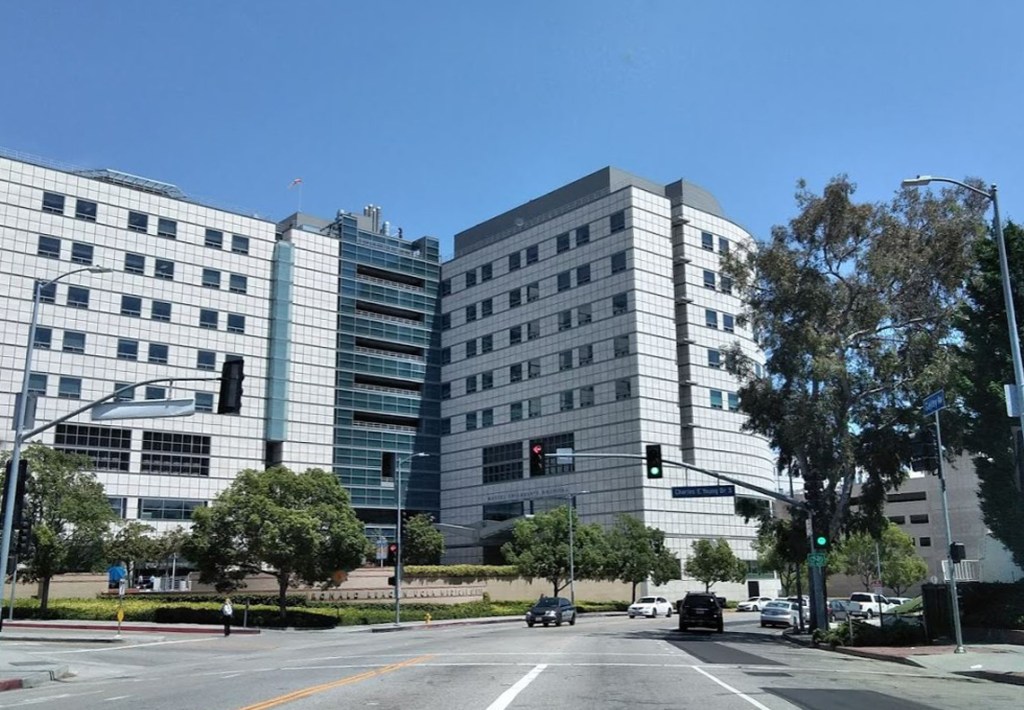
Yesterday morning, I found myself being admitted to UCLA Hospital’s emergency room. That morning, I awoke around six in the morning to go to the bathroom. Coming back I found myself bumping into things. When I tried to get back into bed, I slipped and fell on the floor pinning my left shoulder between the bed and my nightstand. I was too weak to make a serious attempt to get up.
Martine heard my fall and frantically tried to help me. But how could she, with her right wrist in a cast from when she broke it the week before. For hours she tried to make me comfortable and gave me water to sip through a straw. Fortunately, she had the presence of mind to give me 30mg of Hydrocortisone, which, as it happened, is the cure for the symptoms I was experiencing.
Time and time again, she asked if I wanted an ambulance. My consciousness was improving from the Hydrocortisone Martine gave me, so I finally said yes. It seemed that the bedroom was crawling with Emergency Medical Technicians from the Fire Department within minutes. They hauled me out of my wedged position and dumped me on the bed. Their strongly recommended I be admitted to the hospital. I tried to resist their suggestion until I had the feeling that it was pretty much de rigeur in their profession.
So, as when I had my last serious Addisonian Crisis on December 30, 2017, I was trundled down the apartment steps, plunked into the ambulance, and driven to the UCLA Hospital emergency room (but without the sirens).
What was wrong with me? The scientific term is panhyopituitarism, which means I no longer have a pituitary gland. It all happened many years ago. To read the gory story of my near-death experience in 1966, click on this post from April 2015.
By the time I got to UCLA, I was feeling pretty good as the Hydrocortisone was doing its job; but I knew I would have to go through the medical profession’s equivalent of the death of a thousand cuts. I was wheeled from one clerk to another and asked for details which were entered into their system. Fortunately, In December 2017, I had roughly the same situation.
Still, it seems that emergency wards assume you have some internal organ problem such as a heart attack or cancer, so I was hooked up with little stickies all over my upper body and probed with needles until the doctors determined that, yes, I would not be likely to die on the spot. My problem was not a disease of an internal organ, but the fact that I was missing the body’s master gland and occasionally needed to have extra amounts of ACTH (adrenocorticotropic hormone) in lieu of natural adrenaline.
On at least two dozen times, I made the point that the problem was that I had no pituitary. I had to talk with an endocrinologist because my ailment was not a common one, certainly not one that a typical emergency room physician would grasp. Not only that, but the cure had been applied hours before when Martine gave me my medications. Back in 2017, the same hospital held me for three days until the resident endocrinologist strolled in with her hands in her pockets and, immediately understanding my situation, had me released.
Fortunately, I was released late that afternoon. Maybe it was the record of my 2017 experience that convinced them to let me go. Maybe it was because they had me walk to the bathroom and saw that I was fully mobile. And apparently, the doctors did talk to the endocrinologist who told them to let me go. I felt bad to be around all those persons who were really suffering. I kept telling the nurses I felt I was occupying space in their emergency room under false pretenses.
So I took a taxi home, and Martine was at the front of the apartment to give me my wallet so I could pay the driver.
The funny thing is, there is little advanced warning when one is about to suffer an Addisonian Crisis. In this case, I didn’t suspect something was wrong until I returned from the bathroom to go to bed. That was approximately a half-minute warning.
Last Tuesday, I posted here that Martine broke her wrist in two places. Worse luck, it was her right wrist; and she is right-handed. I suddenly found myself in the position of being on call fifty times a day or more to help dress her, open jars, wash dishes, help with the laundry, and carry out the garbage and recycling, Neither of us has been in a particularly good mood throughout this ordeal, though our eruptions are fortunately short-lived.
Today Martine had her plastered splint removed and replaced with a fiberglass cast. It turned out she replaced one fiercely uncomfortable hard wrap with another. At first, the fiberglass cast was a vast improvement—until it hardened and pinched as bad as the plaster and splint ever did.
Until such time as Martine’s wrist heals, I am the only pair of working hands in this household.






You must be logged in to post a comment.