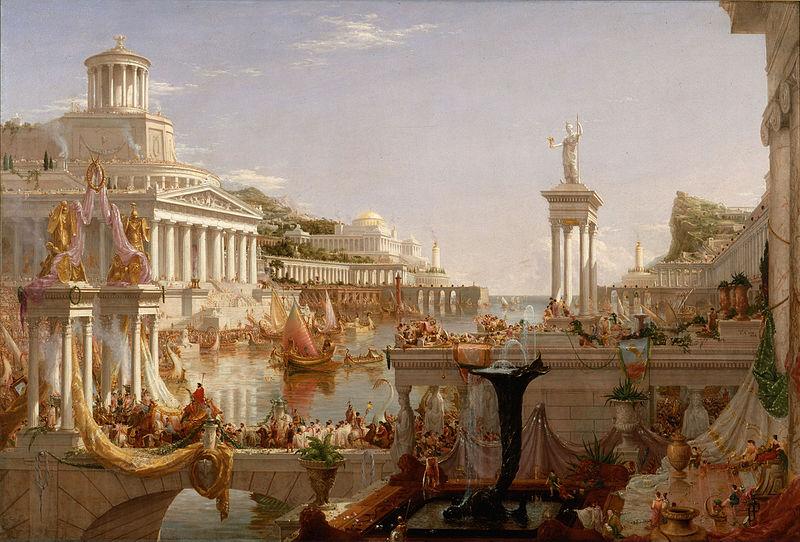
The Fall of Rome

Cole Thomas’s “The Course of Empire”

Cole Thomas’s “The Course of Empire”

That’s the title of this poem by W. H. Auden, dedicated to his friend Cyril Connolly:

The piers are pummelled by the waves;
In a lonely field the rain
Lashes an abandoned train;
Outlaws fill the mountain caves.

Fantastic grow the evening gowns;
Agents of the Fisc pursue
Absconding tax-defaulters through
The sewers of provincial towns.

Private rites of magic send
The temple prostitutes to sleep;
All the literati keep
An imaginary friend.

Cerebrotonic Cato may
Extol the Ancient Disciplines,
But the muscle-bound Marines
Mutiny for food and pay.

Caesar’s double-bed is warm
As an unimportant clerk
Writes I DO NOT LIKE MY WORK
On a pink official form.

Unendowed with wealth or pity,
Little birds with scarlet legs,
Sitting on their speckled eggs,
Eye each flu-infected city.

Altogether elsewhere, vast
Herds of reindeer move across
Miles and miles of golden moss,
Silently and very fast.

The Fisc refers to Britain’s tax agency, also known as The Inland Revenue.


“That Came to Pass This Also May”

Anglo-Saxon Court

Anglo-Saxon Court

This blog posting consists of three views of an Anglo-Saxon poem called “Deor.” First I suggest you click here to see the poem being recited aloud in the original language.

Next, here is Seamus Heaney’s translation of the poem in modern English:

Welund himself knew misery by worms.
The brave man knew hardship,
had to himself for company sorrow and longing,
winter-cold misery; He often found woe,
since Nithhad by force laid a thin sinew-bond onto the better man.

That came to pass, this also may!

Beadohilde was not as sorrowful from her brothers’ death
as from her own thing,
that she certainly understood that she was pregnant;
She was never able to think confidently,
about what she should do.

That came to pass, this also may!

We found out that for Maethhilde,
many became the bottomless embraces of the Geat,
that the sorrowful love deprived her of all sleep.

That came to pass, this also may!

Theodric possessed for thirty winters the city of Maeringa;
That was known to many.

That came to pass, this also may!

We discovered the wolfen thought of Ermanaricus;
He occupied widely the people of the kingdom of the Goths.
That was a harsh king.
Many a man lived bound to sorrows,
woe in expectation,
often wishing that this kingdom was overcome.

That came to pass, this also may!

He lived sorrowful, deprived of joy,
he grew dark in his spirit,
it seemed to him that the troubles would be endless.
I might then think that throughout this world the wise Lord changes enough,
shows honour to many a man, true splendor,
a portion of woes to some.

That I by myself wish to tell,
that I once was a scop of the Heodenings,
dear Lord.

The name ‘Deor’ was mine.

I had for many winters a good fellowship, a loyal lord,
until now Heorrenda, a man skilled in poetry,
received a privilege that the protecting lord once gave to me.

That came to pass, this also may!

Finally, here is the written poem in the original Anglo-Saxon:

Welund him be wurman    wræces cunnade.
Anhydig eorl    earfoþa dreag,
hæfde him to gesiþþe    sorge ond longaþ,
wintercealde wræce,    wean oft onfond,
siþþan hine Niðhad on    nede legde
swoncre seonobende    on syllan monn.
Þæs ofereode,    þisses swa mæg!
Beadohilde ne wæs    hyre broþra deaþ
on sefan swa sar    swa hyre sylfre þing:
þæt heo gearolice    ongieten hæfde
þæt heo eacen wæs—    æfre ne meahte
þriste geþencan,    hu ymb þæt sceolde.
Þæs ofereode,    þisses swa mæg!
We þæt Mæðhilde    monge gefrugnon
wurdon grundlease    Geates frige,
þæt hi seo sorglufu    slæp ealle binom.
Þæs ofereode,    þisses swa mæg!
Ðeodric ahte    þritig wintra
Mæringa burg—    þæt wæs monegum cuþ.
Þæs ofereode,    þisses swa mæg!
We geascodan    Eormanrices
wylfenne geþoht;    ahte wide folc
Gotena rices.    Þæt wæs grim cyning.
Sæt secg monig    sorgum gebunden,
wean on wenan,    wyscte geneahhe
þæt þæs cynerice    ofercumen wære.
Þæs ofereode,    þisses swa mæg!
Siteð sorgcearig    sælum bidæled,
on sefan sweorceð,    sylfum þinceð
þæt sy endeleas    earfoða dæl.
Mæg þonne geþencan    þæt geond þas woruld
witig dryhten    wendeþ geneahhe,
eorle monegum    are gesceawað,
wislicne blæd,    sumum weana dæl.
Þæt ic bi me sylfum    secgan wille,
þæt ic hwile wæs    Heodeninga scop,
dryhtne dyre.    Me wæs Deor noma.
Ahte ic fela wintra    folgað tilne,
holdne hlaford,    oþþæt Heorrenda nu,
leoðcræftig monn    londryht geþah,
þæt me eorla hleo    ær gesealde.
Þæs ofereode,    þisses swa mæg!

There are only two letters of the alphabet that are unfamiliar to most of us. There is the thorn (Þ), which is pronounced like the soft th in thick. Next is the edh (ð), pronounced like the hard th in then.

Notice how the poetic line is broken into two fragments, with the additional space indicating a pause.

After a while, the recurring refrain Þæs ofereode,    þisses swa mæg!—“That came to pass, this also may”stands out like the heart of Anglo-Saxon philosophy. The gentle fatalism of that refrain is one of the things we lost when Harold Godwinsson died at Hastings in 1066 with a Norman arrow in his eye.

I now know why Jorge Luis Borges was so intent on learning Anglo-Saxon towards the end of his life. It is a beautiful language and lends itself well to poetry.

A Red, Red Rose

Difficult, but Super Great!

Difficult, but Super Great!

Robert Burns is not popular with American readers. I suspect that is because he wrote in a broad Lowland Scots dialect that sends most Americans packing to a glossary. Fortunately, his poems are not all that way; and he is one of the few poets in the English language who were farmers before they were litterateurs. Below is his poem entitled “A Red, Red Rose”:

O my Luve is like a red, red rose
   That’s newly sprung in June;
O my Luve is like the melody
   That’s sweetly played in tune.

So fair art thou, my bonnie lass,
   So deep in luve am I;
And I will luve thee still, my dear,
   Till a’ the seas gang dry.

Till a’ the seas gang dry, my dear,
   And the rocks melt wi’ the sun;
I will love thee still, my dear,
   While the sands o’ life shall run.

And fare thee weel, my only luve!
   And fare thee weel awhile!
And I will come again, my luve,
   Though it were ten thousand mile.

All About Albertine

Marcel and Albertine from a Film Version

Marcel and Albertine from a Film Version

The following is both a long prose poem and a work of literary criticism by Canadian poet Anne Carson. It tells everything you ever wanted to know about Albertine, who appears in 5 of the 7 volumes of In Search of Lost Time. It’s called “The Albertine Workout.” The poem is taken from The London Review of Books.

1. Albertine, the name, is not a common name for a girl in France, although Albert is widespread for a boy.

2. Albertine’s name occurs 2363 times in Proust’s novel, more than any other character.

3. Albertine herself is present or mentioned on 807 pages of Proust’s novel.

4. On a good 19 per cent of these pages she is asleep.

5. Albertine is believed by some critics, including André Gide, to be a disguised version of Proust’s chauffeur, Alfred Agostinelli. This is called the transposition theory.

6. Albertine constitutes a romantic, psychosexual and moral obsession for the narrator of the novel mainly throughout Volume Five of Proust’s seven-volume (in the Pléiade edition) work.

7. Volume Five is called La Prisonnière in French and The Captive in English. It was declared by Roger Shattuck, a world expert on Proust, in his award-winning 1974 study, to be the one volume of the novel that a time-pressed reader may safely and entirely skip.

8. The problems of Albertine are
(from the narrator’s point of view)
a) lying
b) lesbianism,
and (from Albertine’s point of view)
a) being imprisoned in the narrator’s house.

9. Her bad taste in music, although several times remarked on, is not a problem.

10. Albertine does not call the narrator by his name anywhere in the novel. Nor does anyone else. The narrator hints that his first name might be the same first name as that of the author of the novel, i.e. Marcel. Let’s go with that.

11. Albertine denies she is a lesbian when Marcel questions her.

12. Her friends are all lesbians.

13. Her denials fascinate him.

14. Her friends fascinate him too, especially by their contrast with his friends, who are gay but very closeted. Her friends ‘parade themselves’ at the beach and kiss in restaurants.

15. Despite intense and assiduous questioning, Marcel cannot discover what exactly it is that women do together (‘this palpitating specificity of female pleasure’).

16. Albertine says she does not know.

17. Once Albertine has been imprisoned by Marcel in his house, his feelings change. It was her freedom that first attracted him, the way the wind billowed in her garments. This attraction is now replaced by a feeling of ennui (boredom). She becomes, as he says, a ‘heavy slave’.

18. This is predictable, given Marcel’s theory of desire, which equates possession of another person with erasure of the otherness of her mind, while at the same time positing otherness as what makes another person desirable.

19. And in point of fact, how can he possess her mind if she is a lesbian?

20. His fascination continues.

21. Albertine is a girl in a flat sports cap pushing her bicycle across the beach when Marcel first sees her. He keeps going back to this image.

22. Albertine has no family, profession or prospects. She is soon installed in Marcel’s house. There she has a separate bedroom. He emphasises that she is nonetheless an ‘obedient’ person. (See above on Albertine as a ‘heavy slave’.)

23. Albertine’s face is sweet and beautiful from the front but from the side has a hook-nosed aspect that fills Marcel with horror. He would take her face in his hands and reposition it.

24. The state of Albertine that most pleases Marcel is Albertine asleep.

25. By falling asleep she becomes a plant, he says.

26. Plants do not actually sleep. Nor do they lie or even bluff. They do, however, expose their genitalia.

27. a) Sometimes in her sleep Albertine throws off her kimono and lies naked.
27. b) Sometimes then Marcel possesses her.
27. c) Albertine appears not to wake up.

28. Marcel appears to think he is the master of such moments.

29. Perhaps he is. At this point, parenthetically, if we had time, which we don’t, several observations could be made about the similarity between Albertine and Ophelia – Hamlet’s Ophelia – starting from the sexual life of plants, which Proust and Shakespeare equally enjoy using as a language of female desire. Albertine, like Ophelia, embodies for her lover blooming girlhood, castration, casualty, threat and pure obstacle. Albertine, like Ophelia, is condemned for a voracious sexual appetite whose expression is denied her. Ophelia takes sexual appetite into the river and drowns it amid water plants. Albertine distorts hers into the false consciousness of a sleep plant. In both scenarios the man appears to be in control of the script yet he gets himself tangled up in the wiles of the woman. On the other hand, who is bluffing whom is hard to say.

30. Albertine’s laugh has the colour and smell of a geranium.

31. Marcel gives Albertine the idea that he intends to marry her but he does not. She bores him.

32. Albertine’s eyes are blue and saucy. Her hair is like crinkly black violets.

33. Albertine’s behaviour in Marcel’s household is that of a domestic animal which enters any door it finds open or comes to lie beside its master on his bed, making a place for itself. Marcel has to train Albertine not to come into his room until he rings for her.

34. Marcel gradually manages to separate Albertine from all her friends, whom he regards as evil influences.

35. Marcel never says the word ‘lesbian’ to Albertine. He says ‘the kind of woman I object to’.

36. Albertine denies she knows any such women. Marcel assumes she is lying.

37. At first Albertine has no individuality, indeed Marcel cannot distinguish her from her girlfriends or remember their names or decide which to pursue. They form a frieze in his mind, pushing their bicycles across the beach with the blue waves breaking behind them.

38. This pictorial multiplicity of Albertine evolves gradually into a plastic and moral multiplicity. Albertine is not a solid object. She is unknowable. When he brings his face close to hers to kiss she is ten different Albertines in succession.

39. One night Albertine goes dancing with a girlfriend at the casino.

40. When questioned about this she lies.

41. Albertine is a quick and creative liar; she may even be a natural liar. But she is a bad liar.

42. Albertine lies so much and so badly that Marcel is drawn into the game. He lies too.

43. Marcel’s jealousy, fury, envy, impotence, curiosity, pride, boredom, suffering and desire are all exasperated to their highest pitch by the game.

44. Who is bluffing whom is hard to say. (See above on Hamlet).

45. Near the end of Volume Five, Albertine finally runs away, vanishing into the night and leaving the window open. Marcel fusses and fumes and writes her a letter in which he claims he had just decided to buy her a yacht and a Rolls Royce when she disappeared, now he will have to cancel these orders. The yacht had a price tag of 27,000 francs, about $75,000, and was to be engraved at the prow with her favourite stanza of a poem by Mallarmé.

46. Albertine’s death in a riding accident on p.642 of Volume Five does not emancipate Marcel from jealousy, it removes only one of the innumerable Albertines he would have to forget. The jealous lover cannot rest until he is able to touch all the points in space and time ever occupied by the beloved.

47. There is no right or wrong in Proust, says Samuel Beckett, and I believe it. The bluffing, however, remains a grey area.

48. Let’s return to the transposition theory.

49. On 30 May 1914, French newspapers reported that Alfred Agostinelli, a student aviator, fell from his machine into the Mediterranean sea near Antibes and was drowned. Agostinelli, you recall, was the chauffeur whom Proust in letters to friends admitted that he not only loved but adored. Proust had bought Alfred the aeroplane, which cost 27,000 francs, about $75,000, and had had it engraved on the fuselage with a stanza of Mallarmé. Proust also paid for Alfred’s flying lessons and registered him at the flying school under the name Marcel Swann. The flying school was in Monaco. In order to spy on Alfred while he was there, Proust sent another favourite manservant, whose name was Albert.

50. Compare and contrast Albertine’s sudden fictional death by runaway horse with Alfred Agostinelli’s sudden real-life death by runaway plane. Poignantly, both unfortunate beloveds managed to speak to his/her lover from the wild blue yonder. Agostinelli, before setting out for his final flight, had written a long letter, which Proust was heartbroken to receive the day after the plane crash. Transposed to the novel, this exit scene becomes one of the weirdest in fiction.

51. Several weeks after accepting the news that Albertine has been thrown from her horse and killed, Marcel gets a telegram:

You think me dead but I’m alive and long to see you! affectionately Albertine.

Marcel agonises for days about this news and debates with himself whether to resume relations with her, only to realise that the signature on the telegram has been misread by the telegraph operator. It is not from Albertine at all but from another long-lost girlfriend whose name (Gilberte) shares its central letters with Albertine’s name.

52. ‘One only loves that which one does not entirely possess,’ says Marcel.

53. There are four ways Albertine is able to avoid becoming possessable in Volume Five: by sleeping, by lying, by being a lesbian or by being dead.

54. Only the first three of these can she bluff.

55. Proust was still correcting a typescript of La Prisonnière on his deathbed, November 1922. He was fine-tuning the character of Albertine and working into her speech certain phrases from Alfred Agostinelli’s final letter.

56. It is always tricky, the question whether to read an author’s work in light of his life or not.

57. Granted the transposition theory is a graceless, intrusive and saddening hermeneutic mechanism; in the case of Proust it is also irresistible. Here is one final spark to be struck from rubbing Alfred against Albertine, as it were. Let’s consider the stanza of poetry that Proust had inscribed on the fuselage of Alfred’s plane – the same verse that Marcel promises to engrave on the prow of Albertine’s yacht, from her favourite poem, he says. It is four verses of Mallarmé about a swan that finds itself frozen into the ice of a lake in winter. Swans are of course migratory birds. This one for some reason failed to fly off with its fellow swans when the time came. What a weird and lonely shadow to cast on these two love affairs, the fictional and the real; what a desperate analogy to offer of the lover’s final wintry paranoia of possession. As Hamlet says to Ophelia, accurately but ruthlessly, ‘you should not have believed me.’

58.

Un cygne d’autrefois se souvient que c’est lui
Magnifique mais qui sans espoir se délivre
Pour n’avoir pas chanté la région où vivre
Quand du stérile hiver a resplendi l’ennui

(Mallarmé, ‘Le vierge, le vivace et le bel aujourd’hui’)

a swan of olden times remembers
that it is he:
the one
magnificent but
without hope setting himself free
for he failed to sing
of a region for living
when barren winter
burned all around him with ennui

59. ‘Everything, indeed, is at least double.’

La Prisonnière p.362


Feathered Glory

Roman Statue Depicting Leda and the Swan

Roman Statue at the Getty Villa Depicting Leda and the Swan

Today, Martine and I spent most of the day at the Getty Villa in Pacific Palisades visiting their collection of ancient Greek, Roman, and Etruscan art. One of the pieces is a statue depicting the rape of Leda by Zeus in the form of a swan.

I cannot think of the subject without recalling William Butler Yeats’s poem, “Leda and the Swan”:

A sudden blow: the great wings beating still
Above the staggering girl, her thighs caressed
By the dark webs, her nape caught in his bill,
He holds her helpless breast upon his breast.

How can those terrified vague fingers push
The feathered glory from her loosening thighs?
And how can body, laid in that white rush,
But feel the strange heart beating where it lies?

A shudder in the loins engenders there
The broken wall, the burning roof and tower
And Agamemnon dead.
Being so caught up,
So mastered by the brute blood of the air,
Did she put on his knowledge with his power
Before the indifferent beak could let her drop?

According to Greek mythology, the children born of that rape were Polydeuces and Helen of Troy. The latter was responsible for the Trojan War when she was willingly abducted by Paris (no relation). Her half-sister was Clytemnestra, daughter of Leda’s legitimate husband Tyndareus. She was traumatized by the god’s rape of her mother. And Clytemnestra, of course, murdered her own husband Agamemnon when he returned from Troy. All this makes Yeats’s poem a wry comment on the inter-relatedness of history.

Do Not Give Up

Borges Takes On the I Ching

Borges Takes On the I Ching

My mind is still on Hexagram 52 (see yesterday’s post). It seems that Jorge Luis Borges had something to say about the ancient Chinese book of divination (and philosophy) that is germane to the discussion. It is called “For a Version of I Ching”:

The future is as immutable
As rigid yesterday. There is nothing
That is no more than a single, silent letter
In the eternal and inscrutable
Writing whose book is time. He who walks away
From home has already come back.
Our life Is a future and well-traveled track.
Nothing dismisses us. Nothing leaves us.
Do not give up. The prison is dark,
Its fabric is made of incessant iron,
But in some corner of your cell
You might discover a mistake, a cleft.
The path is fatal as an arrow
But God is in the rifts, waiting.

I love the poem’s final four lines. Here they are in Spanish:

Pero en algún recodo de tu encierro
Puede haber un descuido, una hendidura,
El camino es fatal como la flecha
Pero en las grietas está Dios, que acecha.

Happiness perhaps lies in discovering that mistake (descuido, which could also be translated as “neglect” or “omission”) or cleft (hendidura) and taking advantage of it. But then, is God waiting to entrap us anew, or to welcome us for evading His net?

“It’s Just Catastrophe”

Canadian-Born Poet Anne Carson

Canadian-Born Poet Anne Carson

Some day, if you feel like reading some great ancient Greek tragedies, I recommend you try to find a copy of Anne Carson’s Grief Lessons. She takes four relatively little-known plays by Euripides and turns them into wonderful poems in English, such as the following:

Come here, let me share a bit of wisdom with you.
Have you given much thought to our mortal condition?
Probably not. Why would you? Well, listen.
All mortals owe a debt to death.
There’s no one alive
who can say if he will be tomorrow.
Our fate moves invisibly! A mystery.
No one can teach it, no one can grasp it.
Accept this! Cheer up! Have a drink!
But don’t forget Aphrodite–that’s one sweet goddess.
You can let the rest go. Am I making sense?
I think so. How about a drink.
Put on a garland. I’m sure
the happy splash of wine will cure your mood.
We’re all mortal you know. Think mortal.
Because my theory is, there’s no such thing as life,
it’s just catastrophe.

And here is a kind of prose poem from the February 25, 2016 issue of The New York Review of Books entitled “What To Say of the Entirety”:

What to say of the entirety. The entirety should be smaller. Small enough to say something about. Humans. What if the guy you’re hanging up by this thumbs already has a razorplague of painapples roaming his chest inside. Do you regard that as his own fault? Do you really need to make it worse? Do you think of yourself as a well-loved person? Of course these are separate questions. Like dead salmon and coppermine tailings, separate. So these separations, this anesthesia, we should ponder a bit. Humans. What can you control? Wrong question. Can you treat everything as an emergency without losing the reality of time, which continues to drip, laughtear by laughtear? Where to start? Start in the middle (and why?) so as not to end up there, where for example the torture report ended up after all those years of work. You have to know what you want, know what you think, know where to go. New York City actually. Here we are. Trucks crash by. Or was that another row of doors slammed by gods? They’re soaked, the gods, they’ve tucked their toes up on their thrones as if they don’t know why this is happening. Poor old coxcombs.

I’m still trying to get my head around Anne Carson’s poetry … but then, that’s how I know it’s really good!

“World Within World”

See the Poem (Below) Inspired by This Photo

See the Poem (Below) Inspired by This Photo

Below is a poem by David Ray inspired by the above photograph. It is called “World Within World”:

Why has this picture
so long haunted me—

an American airman
on the stern deck

of an aircraft carrier
practicing golf,

his club in the air
about to be swung

as if he were back
home on the green?

One golf ball at a time
he lofts into the wake

churning in the blue
Persian Gulf, a white

road to the far horizon,
one sea at a time—one

war at a time, the duty
to fill up the sea with one

little world at a time.

“The Stars Are Not Wanted Now”

Wystan Hugh Auden, by Bill Potter, bromide print, 1972

Wystan Hugh Auden, by Bill Potter, bromide print, 1972

This poem by W. H. Auden, variously called “Funeral Blues” and “Stop All the Clocks, Cut Off the Telephone,” is the second part of “Two Songs for Hedli Anderson.” Antoinette Millicent Hedley Anderson (1907-1990) was an English singer and actor who was a good friend of the poet. As she outlived Auden by some twenty years, it appears the song was written for her to sing in a performance.

Stop all the clocks, cut off the telephone,
Prevent the dog from barking with a juicy bone,
Silence the pianos and with muffled drum
Bring out the coffin, let the mourners come.

Let aeroplanes circle moaning overhead
Scribbling on the sky the message He Is Dead,
Put crêpe bows round the white necks of the public
doves,
Let the traffic policemen wear black cotton gloves.

He was my North, my South, my East and West,
My working week and my Sunday rest,
My noon, my midnight, my talk, my song;
I thought that love would last for ever: I was wrong.

The stars are not wanted now: put out every one;
Pack up the moon and dismantle the sun;
Pour away the ocean and sweep up the wood.
For nothing now can ever come to any good.

“In the month of Athyr …”

Mummy Portrait of Deceased

Early Christian Mummy Portrait of Deceased

One of my favorite poets of the last century was Constantine P. Cavafy, who lived most of his life in Alexandria, Egypt. I have just finished reading E. M. Forster’s Pharos and Pharillon: A Novelist’s Sketchbook of Alexandria Through the Ages, which ends which a chapter on “The Poetry of C. P. Cavafy.”

In it, he talks about meeting Cavafy in the street and having a marvelous conversation with him:

It is delivered with equal ease in Greek, English, or French. And despite its intellectual richness and human outlook, despite the matured charity of its judgments, one feels that it too stands at a slight angle to the universe: it is the sentence of a poet.

What a wonderful line! “It too stands at a slight angle to the universe.”

The Poet

The Poet

In his book, Forster quotes (and, I suspect, translated) this fragmentary funerary poem of a young man who died one November (“Athyr”), probably not unlike the mummy facial covering illustrated above:

It is hard to read . . . on the ancient stone.
“Lord Jesus Christ” … I make out the word “Soul”,
“In the month of Athyr … Lucius fell asleep.”
His age is mentioned … “He lived years …”—
The letters KZ show … that he fell asleep young,
In the damaged part I see the words … “Him … Alexandrian”.
Then came three lines … much mutilated.
But I can read a few words … perhaps “our tears” and “sorrows”.
And again: “Tears” … and: “for us his friends mourning”.
I think Lucius … was much bloved.
In the month of Athyr … Lucius fell asleep ….

In case you have never heard of Cavafy before, he was a major inspiration for Lawrence Durrell’s The Alexandria Quartet.