Tiger Hunting

Jim Corbett with Man-Eating Tiger

There are relatively few tigers left in the world today; but, a hundred years ago, there were individual tigers who were responsible for the deaths of hundreds of villagers in the northwest Indian region of Kumaon, just west of Nepal. Perhaps the most famous of the “white hunters” of these man-eating tigers was Edward James Corbett, better known as Jim Corbett (1875-1955).

Now what am I doing talking about a killer of endangered tigers? Surprisingly, Corbett himself was a naturalist:

A tiger’s function in the scheme of things is to help maintain the balance in nature and if, on rare occasions, when driven by dire necessity, he kills a human being or when his natural food has been ruthlessly exterminated by man he kills two percent of the cattle he is alleged to have killed, it is not fair that for these acts a whole species should be branded as being cruel or bloodthirsty.

Corbett is as famous for photographing and preserving the tiger population as he is for hunting them. In the introduction to his most famous book, Man-Eaters of Kumaon, he writes:

When, therefore, a tiger is suffering from one or more painful wounds, or when its teeth or missing or defective and its claws worn down, and it is unable to catch the animals it has been accustomed to eating, it is driven by necessity to killing human beings.

I was surprised how well-written his book is. He is able to produce an elegant word picture of the circumstances of each hunt. Because of the strength and agility even of man-eating tigers, one rarely has time to reload if one misses. Even if he shoots his prey in the head, the tiger can survive long enough to make a meal of his hunter.


Born in Cleveland

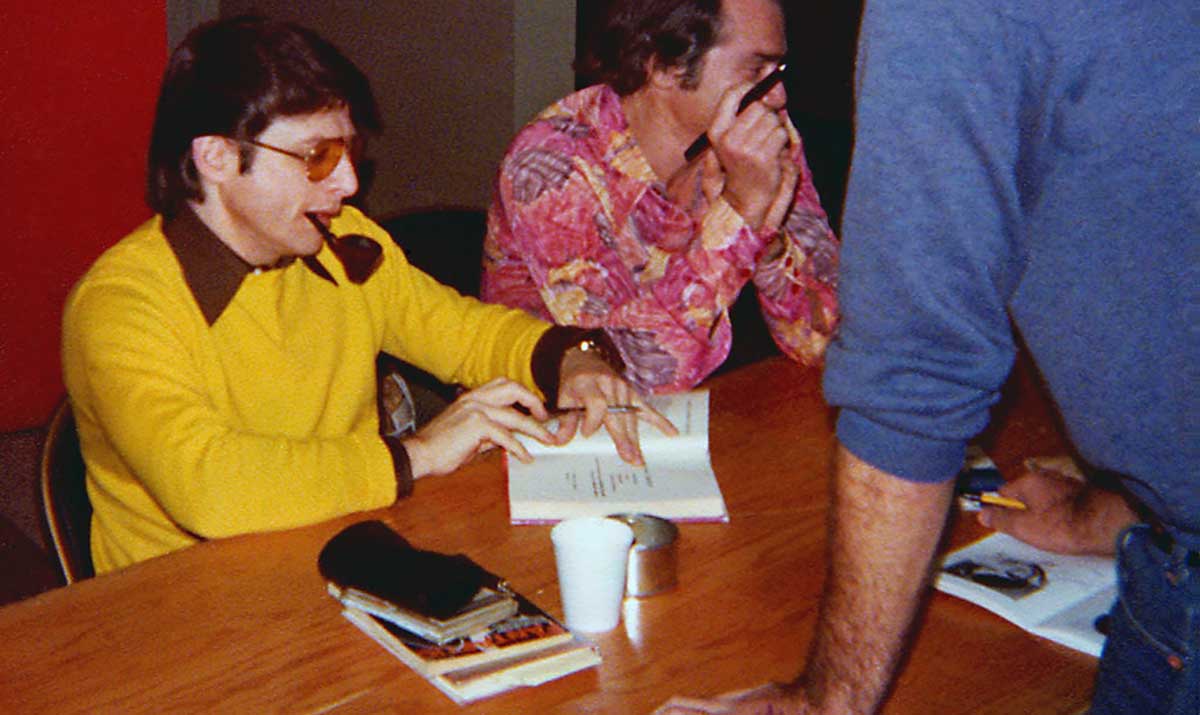
Sci-Fi Writer Harlan Ellison (1934-2018)

The city of my birth—Cleveland, Ohio—has given birth to few celebrities. Among actresses, there were the meltingly lovely Halle Berry and Dorothy Dandridge. Among literary figures, there was only one: Science Fiction author Harlan Ellison. During his career, Ellison has won eight Hugo Awards, four Nebula Awards, five Bram Stoker Awards, and two Edgar Awards.

More to the point, he has written some of the most striking and memorable stories in the sci-fi, horror, and mystery genres. These include “’Repent, Harlequin!“ Said the Tick-Tock Man” (1965) and “I Have No Mouth, and I Must Scream” (1968). He edited two famous sci-fi collections of stories in Dangerous Visions (1967) and Again, Dangerous Visions (1972). And he wrote what was probably the most remembered episode of the original “Star Trek” series entitled “The City on the Edge of Forever” (1967).

Most of his oeuvre consists of short stories which are as eye-popping today as when they first came out. I am slowly working my way through these stories.

This afternoon, I saw a 2007 film by Erik Nelson about the writer entitled Harlan Ellison: Dreams with Sharp Teeth, which includes multiple instances of the author’s abrasive style. During his heyday, that abrasiveness won him many enemies. In the end, however, what will be remembered are his stories.

It’s good to know that at least one great writer came from my home town.


The Truest Grit

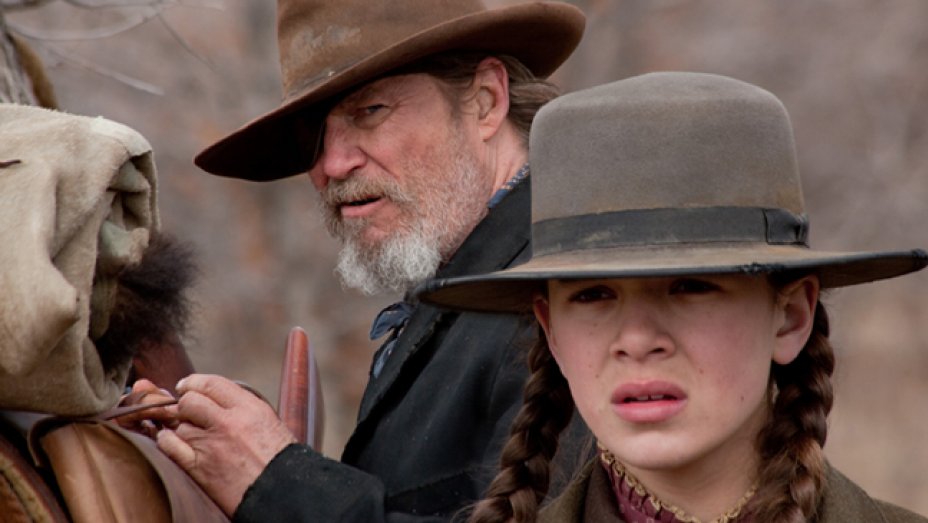
Jeff Bridges and Hailee Steinfeld in the 2010 Version of True Grit

It is generally considered a truism that a film remake is nowhere near as good as the original. Most of the time, that’s true. One case where it is not is the 2010 version of True Grit directed by Joel and Ethan Coen. I liked the John Wayne version with Kim Darby well enough, though I did not like Kim Darby near so much as I liked Hailee Steinfeld as the redoubtable Mattie Ross.

So today I decided to read Charles Portis’s 1968 novel. Earlier this year, I had read Dog of the South and Gringos and found in Portis a novelist very much to my liking. True Grit was even better. So good that I read straight through it, reveling in its language, which reminded me of the best of Mark Twain.

Novelist Charles Portis (1933-2020) with John Wayne as Rooster Cogburn in the Background

One of the things that struck me about Portis was how true he was to the idiom and the culture of his native Arkansas, even when he was setting his fiction in Mexico. Portis was not only authentic, but he was often funny and wildly entertaining. The ides of a 14-year-old-girl hiring a U.S. marshal to go after the killer of her father is by itself promising, but Portis made Mattie Ross into one of the most beloved girl characters in all of American fiction—all just by being fanatically true to her place and time.


South for the Summer

Southern Plantation

For someone who is basically unsympathetic to Trump and his followers, I spend a lot of time reading Southern literature, particularly during the summer. Now that the days are getting warmer, I look forward to reading some more William Faulkner, who is by far my favorite 20th century American author. Joining him will be novels by John D. MacDonald (particularly the Travis McGee series), James Lee Burke’s Dave Robicheaux novels set in Louisiana, Tennessee Williams, and Charles Portis—to name but a few. To that will be added one or more histories of the Civil War.

That also goes for Southern cooking. I love grits and sausage, and tomorrow I will prepare some jambalaya for Martine and me. (It won’t be authentic, as I do not use roux as a base, but it will be recognizable.) In fact, I may share the recipe in a future post.

Tomorrow, I begin reading Faulkner’s The Sound and the Fury for perhaps the third or fourth time. I will have at my side several reference books that will help me track down some of the author’s more obscure references. Difficult as the book is, I will enjoy it immensely, just as I did before.

Some day, when travel once again becomes possible, I would love to visit New Orleans—preferably for the two or three days of the year when the weather verges on the tolerable. It would be fun visiting some of the better Cajun restaurants and the sights of a city that has flown so many flags during its history.


A Tribute, Sort Of

David Foster Wallace (1962-2008)

Sometimes I think that David Foster Wallace was the type of writer I should have decided to dislike. Even though I have not ventured into his fiction masterpiece, Infinite Jest, I find myself so liking his essays and speeches that I am consciously rationing his work as if it were a delicacy that was doomed to disappear. Doomed like its author, who after years of depression and unhappiness hanged himself from one of the rafters of his house at the age of 46.

Just because much of his life was a horror story does not invalidated his brilliance or his humor, even though it could not save him.

I have just finished reading his book of essays entitled A Supposedly Fun Thing I’ll Never Do Again. The title essay runs for about a hundred pages and contains some 137 footnotes which are priceless about 7NC (7 Night Caribbean) passenger cruises and the people who taken them, as well as the people who conduct them. Many of DFW’s pieces are footnoted, though I suspect the magazines in which the essays originally appeared probably excised them with editorial exasperation.

My favorites of the seven essays were about tennis, the films of David Lynch, the Illinois State Fair, and, of course, the Caribbean cruises. I have also read his later collection, Consider the Lobster, which I also loved.

Over the next several months, god willing, I will tackle his fiction.


A Christian Sugar Coating

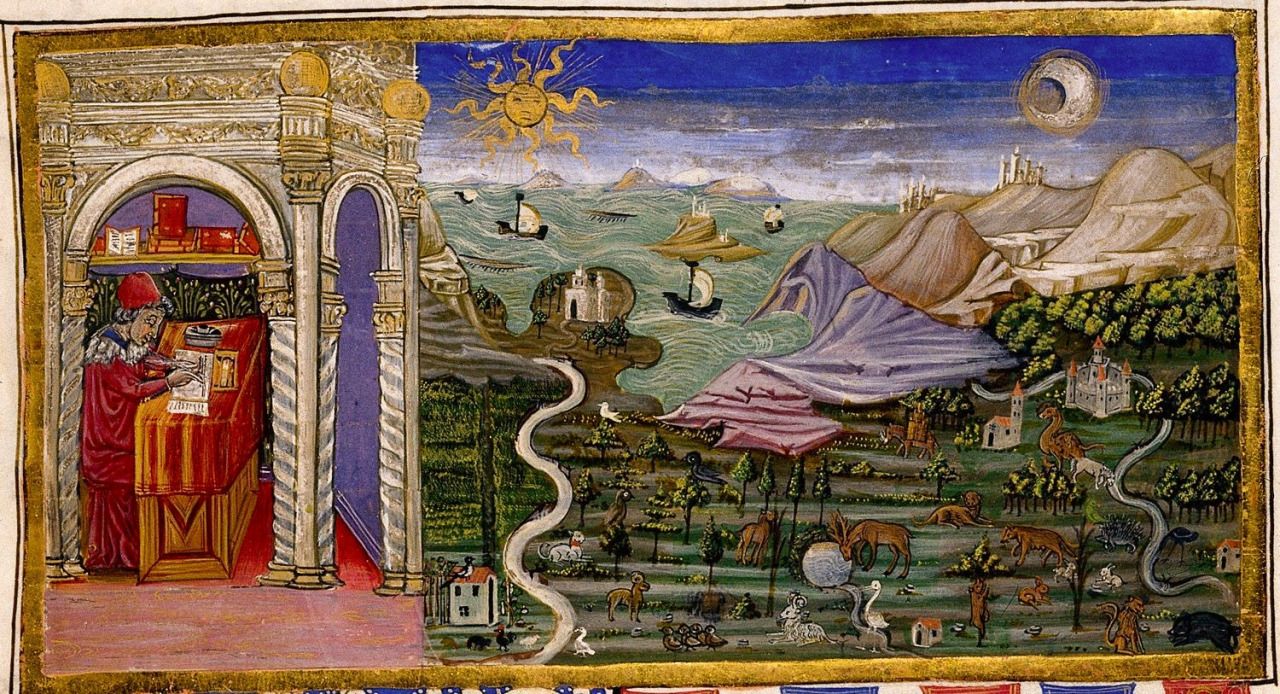
Landscape from Medieval Illuminated Manuscript

This is my first post since I promised to read several Arthurian manuscripts from the 11th and 12th centuries A.D. and report on my conclusions. The main conclusion is that we have been conditioned by later re-tellings of the legend to regard the tales as primarily Christian. That’s because the whole Matter of Britain including Arthur, the Holy Grail, Lancelot, and Camelot have been hijacked—first by Christian monks and then by Victorians such as Howard Pyle.

I am currently reading a work by the 12th century poet and troubadour Chrétien de Troyes entitled Lancelot, the Knight of the Cart (Lancelot, le Chevalier de la Charette). It contains what might be the earliest mention of Lancelot of the Lake, whose name is not even mentioned until halfway through the work. (Since there are so many unnamed knights in the work, it is difficult at times to follow the action.)

Lancelot Having Sex with Guinevere or Some Unnamed Damsel

In no other early Christian work does one find such unabashed indulgence in sex as one does in some of the earlier Arthurian romances. This seems to me somewhat contrary to Christian mores of the time, though probably not in actual practice. In Chrétien’s telling, several damsels want to give themselves to Lancelot, but he holds back because of his desire to rescue Guinevere from King Bademagu and his nasty son Meleagant, who kidnapped her. After Lancelot’s fight with Maleagant, the married Guinevere readily gives herself to the French knight:

Now Lancelot possesses all he wants, when the Queen voluntarily seeks his company and love, and when he holds her in his arms, and she holds him in hers. Their sport is so agreeable and sweet, as they kiss and fondle each other, that in truth such a marvellous joy comes over them as was never heard or known. But their joy will not be revealed by me, for in a story it has no place.

Lancelot Slaying Enemy Knights

The adulterous love is only one element borrowed from earlier pagan myths. There is something rather suspicious about medieval knighthood. It seems to derive from Celtic and Germanic sources of powerful warriors, but glazed over with a Christian sugar-coating.


Arthurian Spring

Perceval Arrives at the Castle of the Fisher King

Although I have always liked the philosophical and historical insights of Joseph Campbell, I have suddenly struck a particularly rich vein while reading his Romance of the Grail: The Magic and Mystery of Arthurian Myth. It is not unusual for me to suddenly change directions based on my reading. In this case, I foresee an Arthurian Spring.

By that I mean not just the Christian interpretation of the so-called “Matter of Britain,” but the nexus between that and a semi-Druidical interpretation allied to primitive, Islamic, and East Asian influences. In my book collection are a number of volumes of the originals in translation which I have either never read or read strictly through the eyes of later monastic sources.

The stories of the Holy Grail, the Knights of the Round Table, the Fisher King, and the Waste Land (including T. S. Eliot’s interpretation as influenced by Jesse L. Weston‘s From Ritual to Romance) are a rich treasure trove with interesting links to global sources. Most of the original works were written during a hundred-year period comprising parts of the eleventh and twelfth centuries A.D.

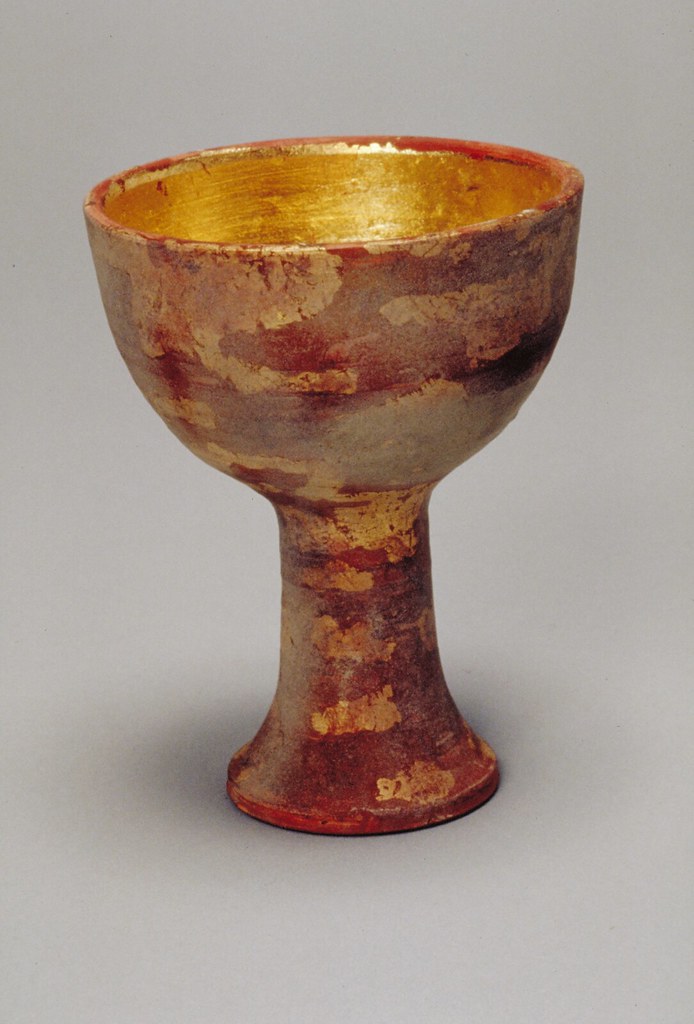
The Holy Grail of Indiana Jones

When most of us think of Camelot and the Arthurian legends, we think of Thomas Malory’s Morte d’Arthur or—worse yet—Howard Pyle’s 1903 re-telling in The Story of King Arthur and His Knights, which was my first introduction. Both are thoroughly influenced by the monastic hijacking of the legend that took place beginning late in the twelfth century.

So I am on my way to an absorbing world that should see me through much of the remaining quarantine and the transition to the worldwide economic depression that will inevitably follow.

Letters: In Search of a Bolt-Hole

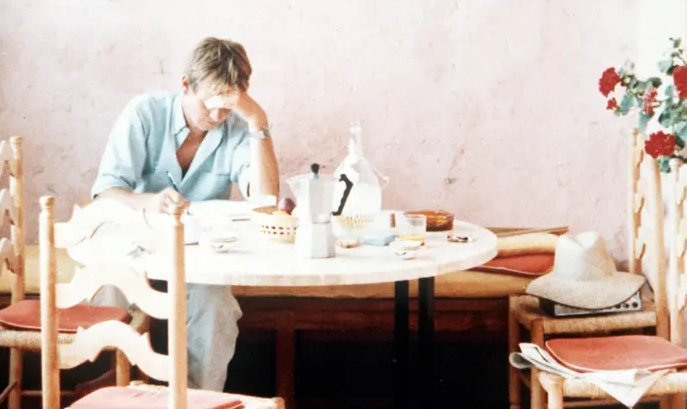
Bruce Chatwin Writing

This is the first in a series of posts on literary letters. I have just finished reading Under the Sun: The Letters of Bruce Chatwin, edited by Chatwin’s wife Elizabeth and his biographer Nicholas Shakespeare.

When I started reading Bruce’s work, he was a hero to me. One of the mixed blessings of biography is that you are likely to find out some uncomplimentary facts about your heroes. This is definitely the case with Bruce, who lived an oddly compartmentalized kind of life. He was married, yet carried on numerous affairs with men and women, some of which were predatory. Although I still love his writing, I would feel uncomfortable with the man himself. (For more on this subject, I would refer to two postings by his late friend, Patrick Leigh-Fermor entitled Bruce Chatwin: Letters from a Fallen Angel (or, A Woman Scorned and Bruce Chatwin’s Journey to Mount Athos.

Reading his letters, I find almost half of them deal with Chatwin’s search for a comfortable place to live, where he can read and write—separately from his semi-estranged wife Elizabeth—and carry on affairs. There was no love lost between him and the land of his birth, England. In a letter to Patrick Leigh-Fermor, he writes:

At least I thought that going to England in August might lessen the shock, climatically. But no! Nothing but rain. Freezing cold. I went wind-surfing on a scummy little reservoir near Oxford, and my hands were white and numb after ten minutes. But what I miss the most are the mountains! The country round here is tolerably attractive, immaculately kept: but then you keep running up against the cooling towers of the Didcot [nuclear] power-station; the antennae of Greenham Common; the nuclear installations at Harwell—all of which give me the feelings of claustrophobia.

But then there doesn’t seem to be anyplace that suits. It’s either too hot or too noisy or too crowded with tourists or yadda-yadda-yadda. To his in-laws, he complains:

But I’m afraid this gypsyish life cannot go on. I shall have, whether I like it or not, to get a proper bolt-hole to work in. Otherwise I find I can fritter away six months at a time without achieving anything, and that only makes me very bad-tempered. In a way, I like being in Italy, but the climate’s quite tough in winter, and the villages (because I’m sure it must be in a village) are usually quite depressing. Our old stamping ground in the Basses-Alpes is not half bad. Uzès is another possibility. What it’ll mean, I’m afraid, is that the London flat will have to go. I’m after 3 rooms: one to sleep and work in; one to live in, and a spare room. It’ll have to have a terrace, somewhere to sit out at least; and walks in neighborhood.

Alas, Bruce died without finding his perfect bolt-hole in a land with perfect climate. Every place has its disadvantages, even Los Angeles. Last night, I was jolted awake at 12:03 am by a Richter 3.7 earthquake whose epicenter was only a few miles south of me. And so it goes!


Letters

Say Goodbye to One of My Favorite Literary Forms

When was the last time you actually took pen in hand and wrote a letter to someone? I don’t mean an e-mail or a “text.” I rather think that most of the electronic communications will all disappear into some digital hell, and no one will actually write letters. As the Japanese novelist Haruki Murakami wrote, “How wonderful it is to be able to write someone a letter! To feel like conveying your thoughts to a person, to sit at your desk and pick up a pen, to put your thoughts into words like this is truly marvelous.”

As I continue to read the collected letters of Bruce Chatwin, I foresee that within a very short time (if not now), no one will write letters. The thought saddens me, as I think back on great letters of the past from such writers as Dostoyevsky, Tolstoy, Aldous Huxley, Chekhov, Joseph Conrad, Flaubert, Sir Walter Scott, and countless others. Already in Chatwin, many of the letters are scribbles on postcards, interspersed with a few lengthy think pieces.

Now there are so many more ways to communicate, including telephone, text messaging, e-mail, and more ad infinitum. I can’t for the life of me think of an e-mail I’ve written that was worth saving for any reason except for passing convenience.

People used to save letters because of their sentimental or literary value. Long-distance relationships were conducted in the mails, resulting in bundles of letters that were saved for decades, letters that warmed the soul as the cold of age started to set in. Do I save my text messages? Not for more than a week or two. As for e-mails, I do large-scale erasures every six months or so.

I think I will highlight in future posts some of my favorite letters from authors and poets.

Perpetuum Mobile

Author and World Traveler Bruce Chatwin (1940-1989)

I have several things in common with the late British writer Bruce Chatwin. He was not in love with the land of his birth: In one letter, he writes, “England is gradually closing in on me again, and the moments of euphoria become rarer and rarer as one gets paler and paler and fatter and fatter and the backbiting conversations grow bitchier and bitchier, and everyone thinks and talks of selling something to somebody else.” To his friend Ivry Freyberg, he writes,“My life at present is the way I like it. Perpetuum mobile.”

In like manner, although I had a happy childhood in Cleveland, I desperately wanted to get away from the place and see the world—this at a time when the family’s finances were unencouraging. I got my four-year scholarship to Dartmouth College and went off to graduate school in California, but it was to be another nine years after graduation in 1966 that I went beyond the borders of the U.S.

Reading the letters of Chatwin (published as Under the Sun: The Letters of Bruce Chatwin), I feel some of the same excitement as when I read his two masterpieces, In Patagonia and The Songlines. I loved reading about Bruce’s travels when he was at his best. At the same time, I am well aware of the flip side of his way of life. As his friend John Kasmin wrote, “Bruce’s biggest problem was where to be. He never knew where to be. It was always somewhere else.”

Even more damning was his wife Elizabeth’s judgment on his travels:

He would wear out people in certain places and then have to move on. Everything was absolute paradise etc for about a month and then things were not quite what he wanted them to be. I discovered after years of this nonsense that the sure-fire way of making Bruce not buy a house was for me to agree.

Part of Chatwin’s wanderlust was his own dual life as a bisexual. The letters show him to be seemingly happily married, yet spending most of his time on the road, enthusing about various places and people.

I, too, would like to be a traveler; but I am content to use Southern California as my base. And I hope not to be tempted by a double life.