Serendipity: “A Pretty Girl with an Arid Heart”

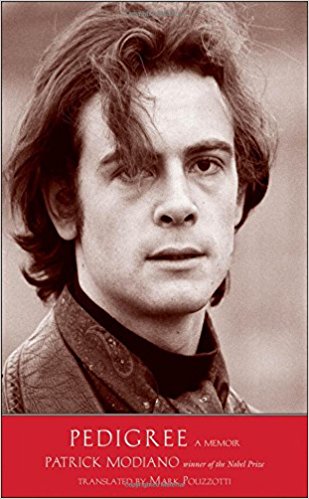
Patrick Modiano in 1968, the Year His First Novel Was Published

I have just finished reading the book whose cover is shown above. It is an autobiographical essay by a Nobel-Prize-winning (2014) author that covers the years from his earliest childhood to the publication of his first book in 1968. I believe I have mentioned elsewhere that Patrick Modiano is by far my favorite living French author. He is approximately the same age as I am, and I feel a unique kinship with him and his work. So far I have read six books by him, and I am just getting started.

His autobiographical essay Pedigree: A Memoir is painful to read. The author was raised—or I should rather say neglected by—two parents who did not particularly care to see him and shunted him off to various boarding schools, the farther apart from Paris the better. Below is a savage description of his mother, who was a small-time actress:

She was a pretty girl with an arid heart. Her fiancé [after her divorce from Patrick’s father] had given her a chow-chow, but she didn’t take care of it and left it with various people, as she would later do with me. The chow-chow killed itself by leaping from a window. The dog appears in two or three photos, and I have to admit he touches me deeply and that I feel a great kinship with him.


Miguel Ángel Asturias

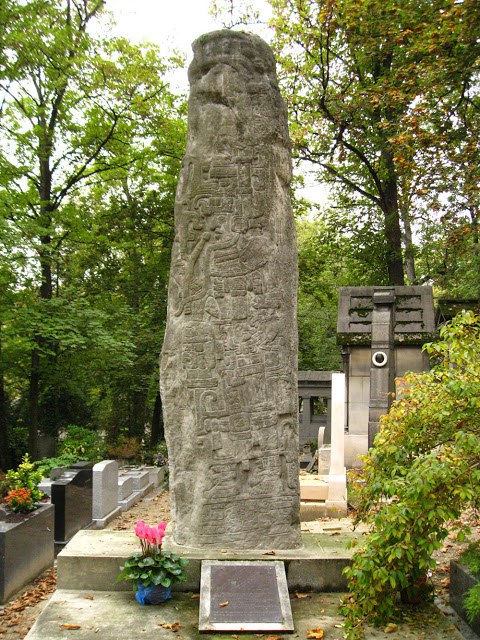
Grave of Miguel Ángel Asturias at Père Lachaise Cemetery in Paris

It was almost twenty years ago that Martine and I were wandering through Paris’s gigantic Père Lachaise cemetery in the 20th Arrondissement. There were a number of surprises, one of which was the grave of Miguel Ángel Asturias, who died in 1974. Rising above a bronze funerary plaque is a Maya stela similar to the ones found at the ruins of Quiriguá in his native country. To this day, he is Central America’s lone winner of the Nobel Prize for Literature, which was awarded to him in 1967.

I have been interested in visiting Guatemala for many years. During the time I was most available to go, Guatemala was in the middle of fighting an armed insurrection by a mostly Maya peasantry who were tired of being forced off their land, enslaved, or massacred. Between 1960 and 1966, some 200,000 Guatemalans died fighting, mostly Maya campesinos. I have just finished re-reading Asturias’s first major novel, El Señor Presidente, set during the presidency of Manuel Estrada Cabrera, who ruled from 1898 to 1920. I have been a big Asturias fan since 1975.

Miguel Ángel Asturias

Now that I am pretty much decided on Guatemala as my next vacation destination, I will add at least two or three more Asturias novels to the ones I have already read. To date, I have finished:

  • El Señor Presidente (1946), his most famous novel
  • Men of Maize (1949)
  • Strong Wind (1950), the first volume of the United Fruit Company trilogy
  • Mulata (1963)

I plan to finish the other two volumes in the trilogy—The Green Pope (1954) and The Eyes of the Interred (1960)—both of which were translated by Gregory Rabassa, one of my favorite translators from the Spanish.

Although Asturias is so identified with the Maya, it is interesting to note that he comes from a well-to-do Creole family that could trace its origins back to 1660.

B Traven and the Jungle Novels

British Arrest Photo for Ret Marut (B Traven?)

One of the mysteries of 20th century literature was the identity of B Traven, who is probably best known for having written the novel that the film The Treasure of the Sierra Madre (1947) was based on. In the late 1960s I first ran into the subject from a leftist magazine, probably Ramparts, which in the 1960s speculated that Traven was a German author and anarchist named Ret Marut who fled to Mexico in the early 1920s.

While in Mexico, B Traven wrote a series of novels that dealt with the exploitation of the Indian population by Europeans and Ladinos (Europeanized Mestizos). In addition to The Treasure of the Sierra Madre (1927) and The Bridge in the Jungle (1929), which I think is his masterpiece, he published six Jungle Novels:

  • Government (1931)
  • The Carreta (1931)
  • The March to the Monteria, a.k.a. The March to Caobaland (1933)
  • Trozas (1936)
  • The Rebellion of the Hanged (1936)
  • A General from the Jungle (1940)

To date, I have real all but Trozas, but I am about to remedy that within the next few weeks.

Traven lived in Mexico until his death (at the age of 87?) in 1969.


“Perhaps the Most Interesting Book of Travel Ever Published”

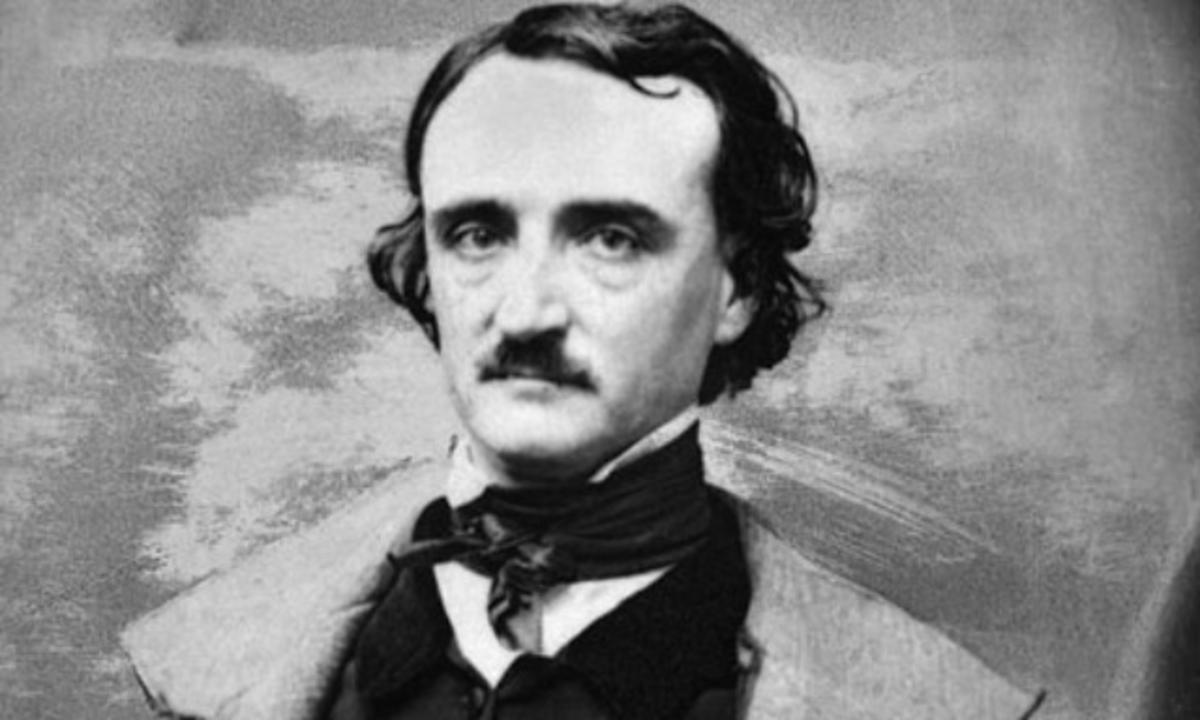
Edgar Allan Poe (1809-1849)

As soon as I saw that one of the fans of travel writer John Lloyd Stephens was none other than Edgar Allan Poe, I was intrigued. Although I have the lengthy Library of America collection of Poe’s Essays and Reviews, I could not find any mention of Incidents of Travel in Central America, Chiapas and Yucatán among the reviews, I did find this intriguing note on the Internet. It is from an 1841 issue of Graham’s Magazine:

We are not prepared to say that misunderstandings of this character will be found in the present “Incidents of Travel.” Of Central America and her antiquities Mr. Stephens may know, and no doubt does know, as much as the most learned antiquarian. Here all is darkness. We have not yet received from the Messieurs Harper a copy of the book, and can only speak of its merits from general report and from the cursory perusal which has been afforded us by the politeness of a friend. The work is certainly a magnificent one — perhaps the most interesting book of travel ever published. An idea has gone abroad that the narrative is confined to descriptions and drawings of Palenque; but this is very far from the case. Mr. S. explored no less than six ruined cities. The “incidents,” moreover, are numerous and highly amusing. The traveller visited these regions at a momentous time, during the civil war, in which Carrera and Morazan were participants. He encountered many dangers, and his hair-breadth escapes are particularly exciting.

I find it interesting that Poe committed himself so far without actually having a copy of the book in hand. Perhaps he saw the proofs or an advanced copy, as he hints above. I will continue to search to see whether Poe actually did write a more comprehensive review of the book.


Letters of Transit

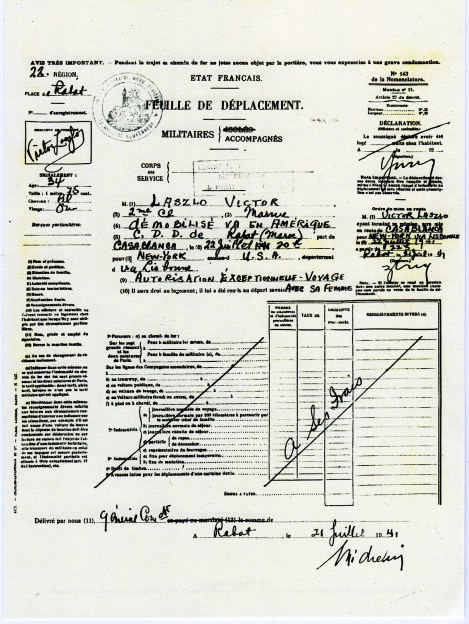
Prop from the Film Casablanca: The Letter of Transit

I have just finished reading a magnificent novel by Anna Seghers entitled Transit (1944). At the time it was being written—around 1942—a film entitled Casablanca was being made starring Humphrey Bogart and Ingrid Bergman. The film’s “maguffin,” as Alfred Hitchcock would have called it, are certain letters of transit that have been stolen from Nazi authorities allowing the bearer to leave Morocco for any desired destination.

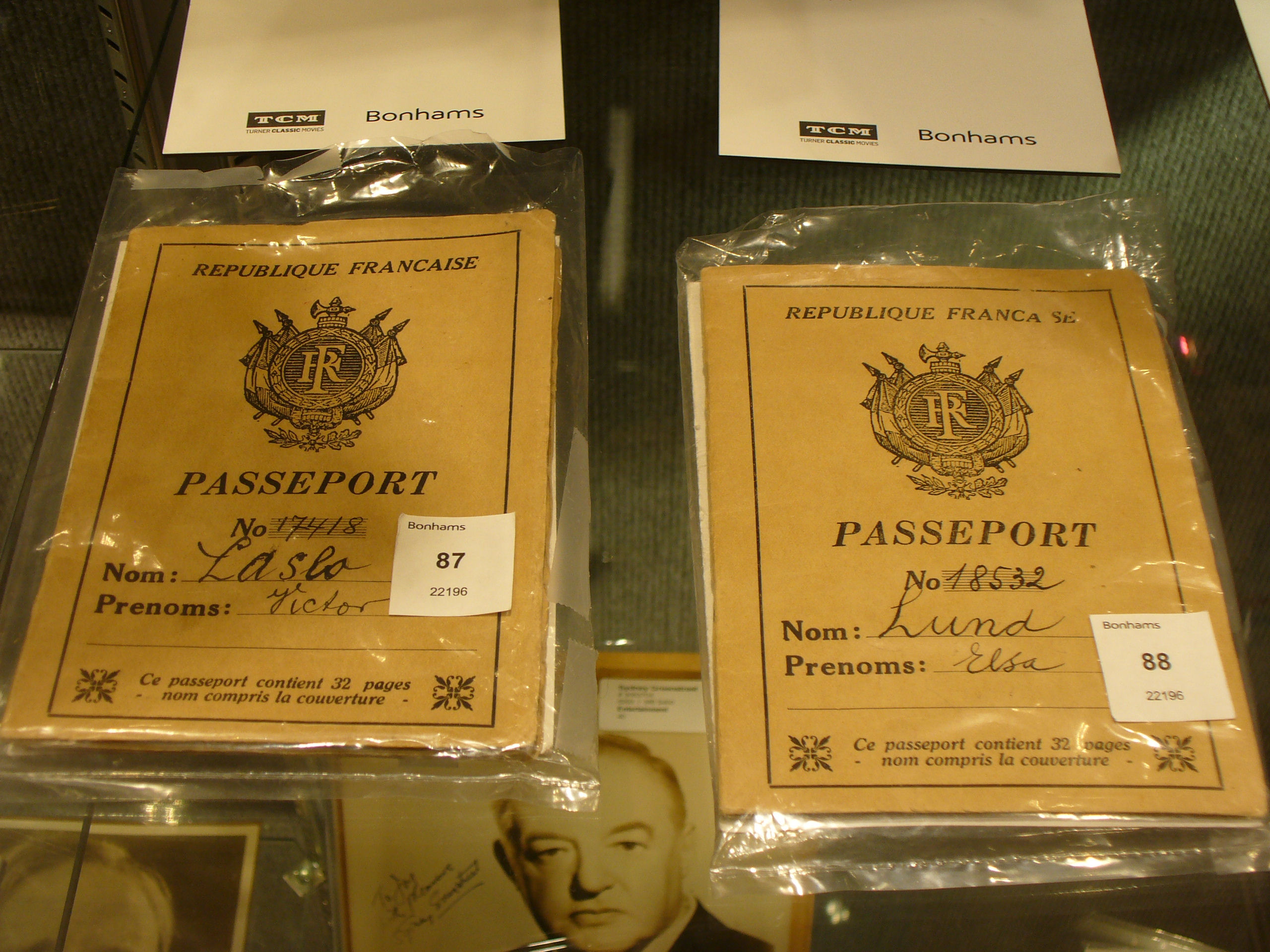
Such was the film’s premise. Above is the prop used as the Letter of Transit, duly filled out in the name of Victor Laszlo (Paul Henreid) and wife. Note, however, that the issuer is the “State of France.” At the end of the film, the Laszlos fly to Lisbon from Casablanca, en route to the United States. Strictly speaking, the so-called Letter of Transit is only an exit visa and does not bear the stamp of the Portuguese consul, let alone the American one.

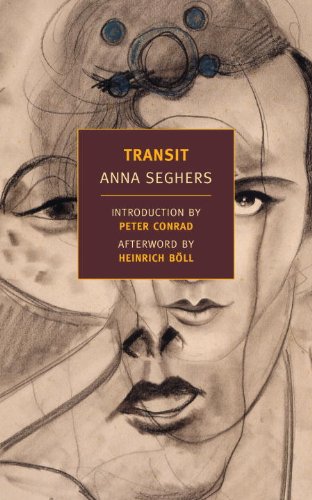
Transit by Anna Seghers

Anna Segher’s novel tells the tale of refugees from the approaching Nazi terror gathered in Marseilles, trying vainly to collect the series of official papers that would:

  1. Allow them to leave Marseilles legally. The document above appears to be an exit visa rather than a letter of transit.
  2. Pass through other countries en route to their final destination. These are the actual letters of transit, and must be stamped by the consular authorities for each country along the way.
  3. A visa allowing entry to their final destination.
  4. Tickets for transportation along each leg of the journey.

Transit follows various Europeans frantically trying to collect the necessary paperwork before any of the stamped legal papers in their possession expire, which would require them to re-start the process.

Quoted in Segher’s novel is this passage from 2 Corinthians 11:25-26:

Three times I was beaten with rods; once I was stoned; three times I was shipwrecked; a night and a day I have been in the deep; in journeys often; in perils of waters, in perils of robbers, in perils of my own countrymen, in perils of the Gentiles, in perils of the city, in perils of the wilderness, in perils of the sea, in perils among false brethren.

More Props: The Passports of Victor Laszlo (Here Misspelled) and Ilsa Lund

The hero of Transit is a German worker and prison camp escapee named Seidler who has assumed the identity of a writer named Weidel who, despairing, had committed suicide in Paris. Curiously, he has no desire to leave Marseilles, finding the city to be a destination in its own right. (It wasn’t: The Germans eventually occupied it.) He runs into Weidel’s wife, is attracted to her, and finally merely helps her to leave, deciding to stay behind:

It’s true, I realized. Everything just passes through me. And that’s why I was still roving about unharmed in a world in which I didn’t know my way well at all. Indeed, even the fit of anger that had decided my life back then in my own country was only temporary. I didn’t stay angry; I wandered around afterward, my anger gone. What I really like is what endures, that which is different from me.

I was so blown away by this book that I regard Seghers as the peer of Thomas Mann and Hermann Hesse, and behind only Franz Kafka (who wrote in German). She is probably best known for The Seventh Cross, which was filmed in 1944 by director Fred Zinnemann starring Spencer Tracy and Signe Hasso. During the Second World War, she lived in Mexico, having escaped Marseilles like some of her characters in Transit. She ended up after the war living in East Germany.


Borges in a Nutshell

The Artistry of Jorge Luis Borges in a Single Image

When I was in Buenos Aires in 2015, I wanted to visit the Centro Cultural Borges in the Galerias Pacifico run by the author’s widow, Maria Kodama. I had expected to see more about Borges rather than various displays of modern art. There was one image that summarized Borges nicely, though my photograph does not do it justice.

At the top right is a drawing of Jorge Luis Borges, next to a representation of the Tower of Babel. This refers to his tale “The Library of Babel,” which sees the universe as an infinite collection of hexagonal library rooms, each containing uniformly-sized books representing not only books written, but all possible books. The tower rests on a pile of books, among which I can make out three titles:

  • The stories of Rudyard Kipling
  • The complete works of Edgar Allan Poe
  • The Thousand and One Nights

The Galerias Pacifico Where the Centro Cultural Borges Is Located

Other works that Borges discussed at length could possibly include the works of Robert Louis Stevenson, the Icelandic Sagas, the stories and essays of G.K. Chesterton, and the Argentinian José Hernández’s Martin Fierro.

I started reading Borges in the early 1970s, when an article in The New Yorker alerted me to the publication of Labyrinths and Ficciones. The seed sown by those two collections led me the richness of world literature—a treasure hoard I am still exploring and will not cease exploring until my eyes are closed for the last time.


Farmers and Hipsters

Seafood Stand at the Old Farmers’ Market

Originally, there was the Original Farmers’ Market at Third and Fairfax. Even on the hottest days, it is a cool, shaded place with dozens of good restaurants and interesting stores. Naturally, this being Los Angeles, the real estate developers couldn’t leave well enough alone. Adjacent to the old market sprang up The Grove, consisting primarily of chains oriented toward young hipsters.

In the original market, I can take a book or Kindle and sit down for hours reading without being bothered. Oh, I buy lunch there, and maybe have a cup of tea when I arrive—and maybe even some snacks to take home.

At The Grove, there is no place to sit and read. After all, hipsters don’t read. It’s just not cool enough.

Hipster Duds at The Grove (Yawn!)

Fortunately, the presence of The Grove has not killed the Original Farmers’ Market. It’s still a major tourist attraction. So is The Grove, for that matter. Both are full of people taking selfies. I think that if The Grove swallowed the old market, people would protest loud and long. Also, I have a sneaking feeling that The Grove may require several re-designs as the new hipsters replace the old. The Farmers’ Market, on the other hand, should be preserved exactly as it is.

Today at the market, I finished reading the first volume of Sigrid Undset’s Kristin Lavransdatter and then started in with Elena Ferrante’s My Brilliant Friend. Plus I had two great vegetarian tacos at The Lotería, one with nopalitos (marinated prickly pear cactus) and potatoes with poblano chiles. With it, I had a delicious watermelon agua fresca.


NYRB

Currently My Favorite Publisher

I have always played favorites with particular publishers. When I was in high school and hung around at Schroeder’s Books on Public Square in Cleveland, I was enthralled by the New Directions paperbacks. As I went to college and for years afterwards, I was particularly interested in Penguin Books (though I have been disappointed in how poorly they age). Then, for a while I collected the pocket sized hardback Oxford World Classics. Now, I find myself quite addicted to New York Review Books.

In fact, I recently counted how many NYRB titles I read in 2017. The total came to fifteen titles! They included, in the order I read them:

  • Teffi’s Tolstoy, Rasputin, Others, and Me: The Best of Teffi
  • Antonio di Benedetto’s Zama
  • Natsume Soseki’s Mon [The Gate]
  • John Williams’s Stoner
  • Robert Bresson’s Notes on the Cinematograph
  • Georges Simenon’s Tropic Moon
  • Georges Simenon’s Mr Hire’s Engagement
  • Kingsley Amis’s Girl, 20
  • Kingsley Amis’s One Fat Englishman
  • Patrick Modiano’s Young Once
  • Kingsley Amis’s Ending Up
  • Norman Mailer’s Miami and the Siege of Chicago
  • Kingsley Amis’s Take a Girl Like You
  • Raymond Quenaeau’s Zazie in the Metro
  • Henry Green’s Loving

Looking back over this list, there wasn’t a single clinker in the bunch. And my plans for 2018 call for me continuing to plow through the NYRB list.

A Forty-Year Labor of Love

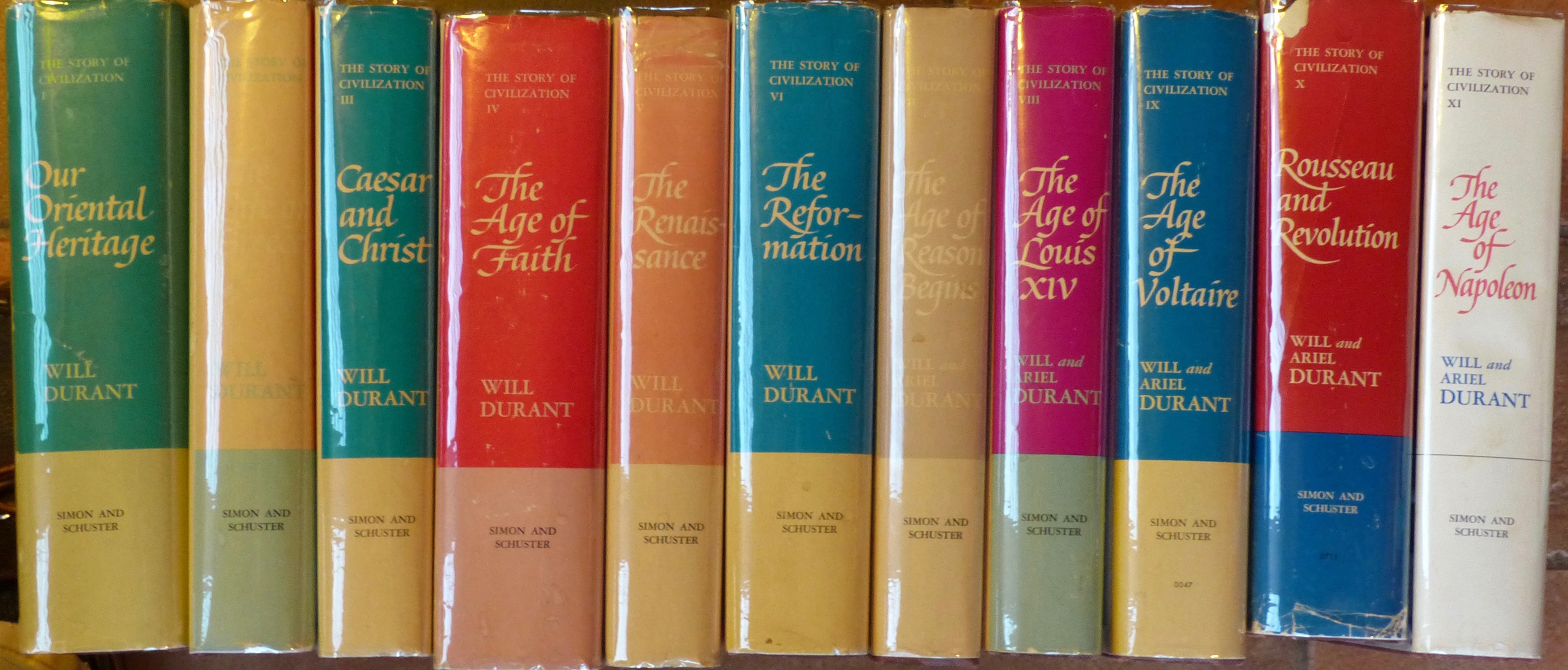
The Eleven Volumes of the Durants’ The Story of Civilization

If you’ve walked into a used bookstore within the last half century, you’ve no doubt seen the volumes of Will and Ariel Durant’s The Story of Civilization. Many have bought the complete set, only to use it to weight their bookshelves to keep them from blowing away in the wind. I myself own just seven of the volumes, and by the end of the month, I will have finished reading three of them:

  • The Life of Greece, Volume II (1939)
  • The Reformation, Volume VI (1957)—I am currently two-thirds of the way to completion
  • The Age of Napoleon, Volume XI (1975)

Instead of berating the authors for having produced a coffee-table set that is large enough to crush many coffee tables, I am amazed to find that the volumes I have read are superb introductions to the periods they cover. They cover not only the events, but the leading characters, changes in the culture of the mostly European countries, and the main art and literary trends.

When reading history books, we usually settle on a small slice of a place and time and trust that we will catch up on the general trends. The Durants go particularly deep into the period between 1500 and 1815, which accounts for six of the volumes. I can vouch for the fact that The Life of Greece covers in one volume hundreds of years of Greek history, from Homeric times to the Roman takeover.

Will and Ariel Durant

The Durants provide detailed bibliographies, footnotes, and alphabetic indexes in all the volumes, which make them excellent references for delving into sources and further details.

It is sometimes too easy to pooh-pooh books that have been honored by such organizations as The Book of the Month Club. Fortunately, they weren’t always far off the mark. Certainly not in the case of the Durants. Do not make the mistake of ignoring these splendid books.


Difficulties with Girls at 1 Lower Ground

British Author Kingsley Amis (1922-1995)

When last I saw the characters Patrick Standish and Jenny Bunn, they were just starting their relationship in Kingsley Amis’s Take a Girl Like You.

Now, years later, they are stilled married, but childless due to Jenny’s miscarriage. They’ve moved to a maisonette at 1 Lower Ground in London. Jenny is still the same sweetheart; and Patrick, the same opportunistic whoreson. Jenny knows this and sorrowfully reproves his husband for his erring ways. Being in the book publishing business, Patrick goes to an inordinate number of parties where opportunities for excessive drinking and sexual provender abound.

Many of his problems are no farther than a few feet from his front door. His new neighbor Tim Valentine is a clueless young man who is mildly confused about his own sexuality and seems to pop in at least once a day. Next door are Eric and Stevie, a gay couple who are incessantly fighting each other. Also nearby is Wendy Porter-King, with whom Patrick has a brief but intense fling.

I have always enjoyed Amis’s novels, even when they are not the best. I preferred Take a Girl Like You, but Difficulties with Girls is not at all bad. By now I have read almost half of his novels and will probably read more in the coming year.

My Reading Station at the Fairfax Farmers Market

I finished reading the book at the Original Farmers Market at 3rd and Fairfax, where I was able to read uninterrupted and break for a tasty lunch. It looks as if I head to the Market around once a week. No matter how hot it may be outside, it always seems cooler in the covered shade over the tables here.