Letters of Transit

Prop from the Film Casablanca: The Letter of Transit

I have just finished reading a magnificent novel by Anna Seghers entitled Transit (1944). At the time it was being written—around 1942—a film entitled Casablanca was being made starring Humphrey Bogart and Ingrid Bergman. The film’s “maguffin,” as Alfred Hitchcock would have called it, are certain letters of transit that have been stolen from Nazi authorities allowing the bearer to leave Morocco for any desired destination.

Such was the film’s premise. Above is the prop used as the Letter of Transit, duly filled out in the name of Victor Laszlo (Paul Henreid) and wife. Note, however, that the issuer is the “State of France.” At the end of the film, the Laszlos fly to Lisbon from Casablanca, en route to the United States. Strictly speaking, the so-called Letter of Transit is only an exit visa and does not bear the stamp of the Portuguese consul, let alone the American one.

Transit by Anna Seghers

Anna Segher’s novel tells the tale of refugees from the approaching Nazi terror gathered in Marseilles, trying vainly to collect the series of official papers that would:

  1. Allow them to leave Marseilles legally. The document above appears to be an exit visa rather than a letter of transit.
  2. Pass through other countries en route to their final destination. These are the actual letters of transit, and must be stamped by the consular authorities for each country along the way.
  3. A visa allowing entry to their final destination.
  4. Tickets for transportation along each leg of the journey.

Transit follows various Europeans frantically trying to collect the necessary paperwork before any of the stamped legal papers in their possession expire, which would require them to re-start the process.

Quoted in Segher’s novel is this passage from 2 Corinthians 11:25-26:

Three times I was beaten with rods; once I was stoned; three times I was shipwrecked; a night and a day I have been in the deep; in journeys often; in perils of waters, in perils of robbers, in perils of my own countrymen, in perils of the Gentiles, in perils of the city, in perils of the wilderness, in perils of the sea, in perils among false brethren.

More Props: The Passports of Victor Laszlo (Here Misspelled) and Ilsa Lund

The hero of Transit is a German worker and prison camp escapee named Seidler who has assumed the identity of a writer named Weidel who, despairing, had committed suicide in Paris. Curiously, he has no desire to leave Marseilles, finding the city to be a destination in its own right. (It wasn’t: The Germans eventually occupied it.) He runs into Weidel’s wife, is attracted to her, and finally merely helps her to leave, deciding to stay behind:

It’s true, I realized. Everything just passes through me. And that’s why I was still roving about unharmed in a world in which I didn’t know my way well at all. Indeed, even the fit of anger that had decided my life back then in my own country was only temporary. I didn’t stay angry; I wandered around afterward, my anger gone. What I really like is what endures, that which is different from me.

I was so blown away by this book that I regard Seghers as the peer of Thomas Mann and Hermann Hesse, and behind only Franz Kafka (who wrote in German). She is probably best known for The Seventh Cross, which was filmed in 1944 by director Fred Zinnemann starring Spencer Tracy and Signe Hasso. During the Second World War, she lived in Mexico, having escaped Marseilles like some of her characters in Transit. She ended up after the war living in East Germany.


Borges in a Nutshell

The Artistry of Jorge Luis Borges in a Single Image

When I was in Buenos Aires in 2015, I wanted to visit the Centro Cultural Borges in the Galerias Pacifico run by the author’s widow, Maria Kodama. I had expected to see more about Borges rather than various displays of modern art. There was one image that summarized Borges nicely, though my photograph does not do it justice.

At the top right is a drawing of Jorge Luis Borges, next to a representation of the Tower of Babel. This refers to his tale “The Library of Babel,” which sees the universe as an infinite collection of hexagonal library rooms, each containing uniformly-sized books representing not only books written, but all possible books. The tower rests on a pile of books, among which I can make out three titles:

  • The stories of Rudyard Kipling
  • The complete works of Edgar Allan Poe
  • The Thousand and One Nights

The Galerias Pacifico Where the Centro Cultural Borges Is Located

Other works that Borges discussed at length could possibly include the works of Robert Louis Stevenson, the Icelandic Sagas, the stories and essays of G.K. Chesterton, and the Argentinian José Hernández’s Martin Fierro.

I started reading Borges in the early 1970s, when an article in The New Yorker alerted me to the publication of Labyrinths and Ficciones. The seed sown by those two collections led me the richness of world literature—a treasure hoard I am still exploring and will not cease exploring until my eyes are closed for the last time.


Farmers and Hipsters

Seafood Stand at the Old Farmers’ Market

Originally, there was the Original Farmers’ Market at Third and Fairfax. Even on the hottest days, it is a cool, shaded place with dozens of good restaurants and interesting stores. Naturally, this being Los Angeles, the real estate developers couldn’t leave well enough alone. Adjacent to the old market sprang up The Grove, consisting primarily of chains oriented toward young hipsters.

In the original market, I can take a book or Kindle and sit down for hours reading without being bothered. Oh, I buy lunch there, and maybe have a cup of tea when I arrive—and maybe even some snacks to take home.

At The Grove, there is no place to sit and read. After all, hipsters don’t read. It’s just not cool enough.

Hipster Duds at The Grove (Yawn!)

Fortunately, the presence of The Grove has not killed the Original Farmers’ Market. It’s still a major tourist attraction. So is The Grove, for that matter. Both are full of people taking selfies. I think that if The Grove swallowed the old market, people would protest loud and long. Also, I have a sneaking feeling that The Grove may require several re-designs as the new hipsters replace the old. The Farmers’ Market, on the other hand, should be preserved exactly as it is.

Today at the market, I finished reading the first volume of Sigrid Undset’s Kristin Lavransdatter and then started in with Elena Ferrante’s My Brilliant Friend. Plus I had two great vegetarian tacos at The Lotería, one with nopalitos (marinated prickly pear cactus) and potatoes with poblano chiles. With it, I had a delicious watermelon agua fresca.


NYRB

Currently My Favorite Publisher

I have always played favorites with particular publishers. When I was in high school and hung around at Schroeder’s Books on Public Square in Cleveland, I was enthralled by the New Directions paperbacks. As I went to college and for years afterwards, I was particularly interested in Penguin Books (though I have been disappointed in how poorly they age). Then, for a while I collected the pocket sized hardback Oxford World Classics. Now, I find myself quite addicted to New York Review Books.

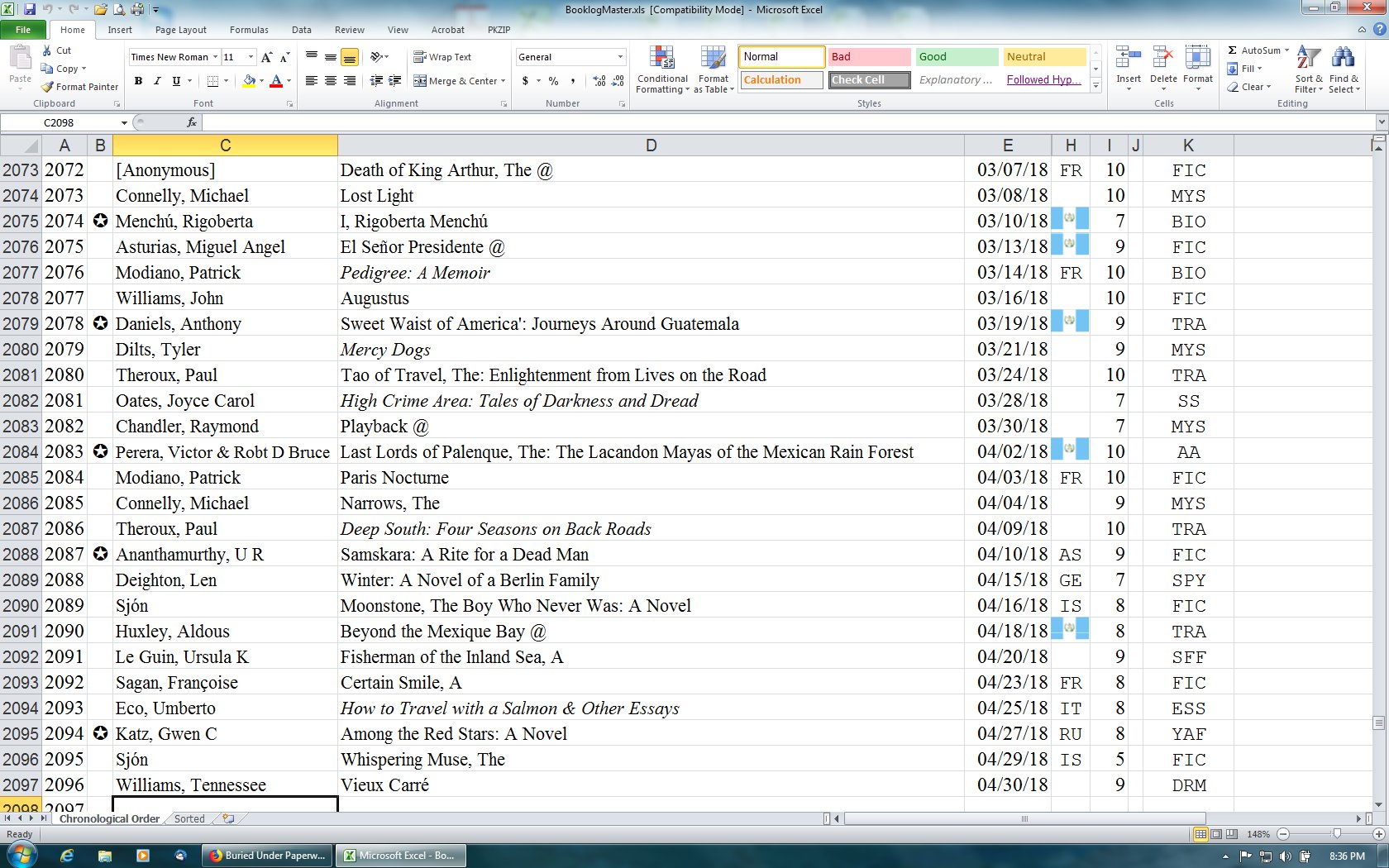
In fact, I recently counted how many NYRB titles I read in 2017. The total came to fifteen titles! They included, in the order I read them:

  • Teffi’s Tolstoy, Rasputin, Others, and Me: The Best of Teffi
  • Antonio di Benedetto’s Zama
  • Natsume Soseki’s Mon [The Gate]
  • John Williams’s Stoner
  • Robert Bresson’s Notes on the Cinematograph
  • Georges Simenon’s Tropic Moon
  • Georges Simenon’s Mr Hire’s Engagement
  • Kingsley Amis’s Girl, 20
  • Kingsley Amis’s One Fat Englishman
  • Patrick Modiano’s Young Once
  • Kingsley Amis’s Ending Up
  • Norman Mailer’s Miami and the Siege of Chicago
  • Kingsley Amis’s Take a Girl Like You
  • Raymond Quenaeau’s Zazie in the Metro
  • Henry Green’s Loving

Looking back over this list, there wasn’t a single clinker in the bunch. And my plans for 2018 call for me continuing to plow through the NYRB list.

A Forty-Year Labor of Love

The Eleven Volumes of the Durants’ The Story of Civilization

If you’ve walked into a used bookstore within the last half century, you’ve no doubt seen the volumes of Will and Ariel Durant’s The Story of Civilization. Many have bought the complete set, only to use it to weight their bookshelves to keep them from blowing away in the wind. I myself own just seven of the volumes, and by the end of the month, I will have finished reading three of them:

  • The Life of Greece, Volume II (1939)
  • The Reformation, Volume VI (1957)—I am currently two-thirds of the way to completion
  • The Age of Napoleon, Volume XI (1975)

Instead of berating the authors for having produced a coffee-table set that is large enough to crush many coffee tables, I am amazed to find that the volumes I have read are superb introductions to the periods they cover. They cover not only the events, but the leading characters, changes in the culture of the mostly European countries, and the main art and literary trends.

When reading history books, we usually settle on a small slice of a place and time and trust that we will catch up on the general trends. The Durants go particularly deep into the period between 1500 and 1815, which accounts for six of the volumes. I can vouch for the fact that The Life of Greece covers in one volume hundreds of years of Greek history, from Homeric times to the Roman takeover.

Will and Ariel Durant

The Durants provide detailed bibliographies, footnotes, and alphabetic indexes in all the volumes, which make them excellent references for delving into sources and further details.

It is sometimes too easy to pooh-pooh books that have been honored by such organizations as The Book of the Month Club. Fortunately, they weren’t always far off the mark. Certainly not in the case of the Durants. Do not make the mistake of ignoring these splendid books.


Difficulties with Girls at 1 Lower Ground

British Author Kingsley Amis (1922-1995)

When last I saw the characters Patrick Standish and Jenny Bunn, they were just starting their relationship in Kingsley Amis’s Take a Girl Like You.

Now, years later, they are stilled married, but childless due to Jenny’s miscarriage. They’ve moved to a maisonette at 1 Lower Ground in London. Jenny is still the same sweetheart; and Patrick, the same opportunistic whoreson. Jenny knows this and sorrowfully reproves his husband for his erring ways. Being in the book publishing business, Patrick goes to an inordinate number of parties where opportunities for excessive drinking and sexual provender abound.

Many of his problems are no farther than a few feet from his front door. His new neighbor Tim Valentine is a clueless young man who is mildly confused about his own sexuality and seems to pop in at least once a day. Next door are Eric and Stevie, a gay couple who are incessantly fighting each other. Also nearby is Wendy Porter-King, with whom Patrick has a brief but intense fling.

I have always enjoyed Amis’s novels, even when they are not the best. I preferred Take a Girl Like You, but Difficulties with Girls is not at all bad. By now I have read almost half of his novels and will probably read more in the coming year.

My Reading Station at the Fairfax Farmers Market

I finished reading the book at the Original Farmers Market at 3rd and Fairfax, where I was able to read uninterrupted and break for a tasty lunch. It looks as if I head to the Market around once a week. No matter how hot it may be outside, it always seems cooler in the covered shade over the tables here.


Serendipity: How Rat’s Family Got Rich

How to Make the Best of a Bad Lot

This weekend, I read Haruki Murakami’s first novel, Hear the Wind Sing. While it was not quite the level of his more recent work, it had some choice moments. The unnamed narrator has a friend called Rat, who comes from a wealthy family. It was amusing to find out how his family made its fortune:

Rumor had it that Rat’s father had been penniless before the war. On the eve of hostilities, though, he had managed, after much difficulty, to lay his hands on a small chemical factory, where he began producing insect repellent cream. There was considerable doubt as to its effectiveness, but, fortunately for him, the war spread to the South Pacific at that juncture, and the stuff flew off the shelves.

When the war ended, the Rat’s father moved his stock of ointment into warehouses and began marketing a sketchy health tonic; then, toward the end of the Korean War, in an abrupt move, he shifted to household cleaners. Rumor has it that the ingredients were identical in all cases. Not inconceivable.

In other words, the same ointment slathered on the heaped bodies of Japanese soldiers in the jungles of JNew Guinea twenty-five years ago can today be found, with the same trademark, gracing the toilets of the nation as a drain cleaner.

Thus did the Rat’s father join the ranks of the wealthy.


Substantially True

Polish Writer Ryszard Kapuściński (1932-2007)

Although he is usually classified as a writer on non-fiction, the late Ryszard Kapuściński has been “outed” by some journalists for embroidering the truth. In this era of fake news and outright official lying, I feel we need to appreciate someone who is 95% true, or even 90% true. Almost no one is 100% true. I keep thinking back to the ancient Greek and Roman historians who put polished speeches into the mouths of Greek heroes such as Pericles and Augustus Caesar. The idea was to give the general idea, and to adjust the truth just enough to show the basics. No matter that the historian spoke more elegantly than Pericles or Augustus ever could. Shall we dump Thucydides, Herodotus, Tacitus, and Livy for such venial sins, which were certainly not considered as sins at the time they were writing?

According to a biography by Artur Domoslawski, friend of Kapuściński, occasionally crossed the boundary between straight reportage and fiction: “Sometimes the literary idea conquered him. In one passage, for example, he writes that the fish in Lake Victoria in Uganda had grown big from feasting on people killed by Idi Amin. It’s a colourful and terrifying metaphor. In fact, the fish got larger after eating smaller fish from the Nile.”

It seems Domoslawski was perhaps less than a real friend of Kapuściński: He also included numerous accounts of the author’s sexual peccadillos and collaborations with Soviet intelligence.

I am reminded of another travel writer whose work I love, Bruce Chatwin, author of In Patagonia and Songlines. Instead of 90% truth, Chatwin aimed at perhaps 70% truth and occasionally fell short of that mark. And there was, with Chatwin, a lot of sex going on with even with his sources. (He died of AIDS in 1989 at the age of 49.) I still classify both authors as non-fiction, even though Domoslawski thinks they should be on the shelf with fiction.

After Domoslawski’s book came out, a bunch of other writers jumped on the topic, including such notable historians as Timothy Garton-Ash. I know that, for many years, Ryszard Kapuściński  has been on the short list to receive the Nobel Prize for Literature. Now that he is dead, he does not qualify. More’s the pity.


Serendipity: The Existence of Ghosts

My Belief Is: They Exist

The Original Farmer’s Market at 3rd and Fairfax is like a sort of souk for tourists and those L.A. natives who like to sit and reflect while drinking a cup of tea or eating a good lunch. I sat there this morning reading Chris Abani’s The Virgin of Flames, when I ran across this passage:

“Well, yes. Everyone is attended by ghosts,” Iggy said. What matters is whether we begin to attend to them.”

“How do you mean?”

“With some people, the ghosts are transparencies, barely visible as they hover around, sit at the table next to them and so on. They are particularly hard to see in bright sunlight. Sometimes, when memories are revisited, there is a flickering of light and shadow, image and text across them, and for a moment they flare up and then vanish.”

“So are you saying that ghosts are our memories?”

“Ghosts are the things, the shapes we make with our memories,” she said.

“Ah. So if some are light like…”

“Like well-worn lace drapes blowing in the wind.”

Black smiled.

“Yeah, like that. Then what are the other ghosts like? The ones we attend?”

“Like thick black lines drawn in a notebook. They are visible, brooding dark clouds that we drag around with us like reluctant sulky children. We feed them and they grow big and their haunting dominates our lives. We love them and we hate them and we are always measuring them for a coffin, yet we cannot let them die.”

“Why?”

”Madness, my friend. Madness.”


Time Off in Siberia

Tsarist Prisoners in Siberia

I have a particular love for Russian prison literature. For the third time, I am reading Fyodor Dostoyevsky’s The House of the Dead. By no means is it anywhere near the greatest of Dostoyevsky’s novels, but the subject has always fascinated me.

After the October Revolution, and especially during Josef Stalin’s reign, the literature of the GULAGs became a standard literary genre. I love Alexander Solzhenitsyn’s massive The GULAG Archipelago as well as One Day in the Life of Ivan Denisovich and The First Circle. Also well worth reading is Varlam Shalamov’s grim Kolyma Tales.

It is a common misconception that Dostoyevsky’s book is not a novel but just a thinly fictionalized account of his own four years in Omsk. At the time he wrote it, he was trying to reestablish his literary reputation after four years in prison and subsequent time with the Siberian Army Corps of the Seventh Line Battalion in Semipalatinsk. He was worried that if he wrote a book that was less than uplifting, he would once again be regarded as a political prisoner and suffer excessive censorship.

While it is anything but pollyanna-ish, The House of the Dead provided a rare look at the Tsar’s prison colonies on the other side of the Ural Mountains.