Serendipity: How Rat’s Family Got Rich

How to Make the Best of a Bad Lot

This weekend, I read Haruki Murakami’s first novel, Hear the Wind Sing. While it was not quite the level of his more recent work, it had some choice moments. The unnamed narrator has a friend called Rat, who comes from a wealthy family. It was amusing to find out how his family made its fortune:

Rumor had it that Rat’s father had been penniless before the war. On the eve of hostilities, though, he had managed, after much difficulty, to lay his hands on a small chemical factory, where he began producing insect repellent cream. There was considerable doubt as to its effectiveness, but, fortunately for him, the war spread to the South Pacific at that juncture, and the stuff flew off the shelves.

When the war ended, the Rat’s father moved his stock of ointment into warehouses and began marketing a sketchy health tonic; then, toward the end of the Korean War, in an abrupt move, he shifted to household cleaners. Rumor has it that the ingredients were identical in all cases. Not inconceivable.

In other words, the same ointment slathered on the heaped bodies of Japanese soldiers in the jungles of JNew Guinea twenty-five years ago can today be found, with the same trademark, gracing the toilets of the nation as a drain cleaner.

Thus did the Rat’s father join the ranks of the wealthy.


Substantially True

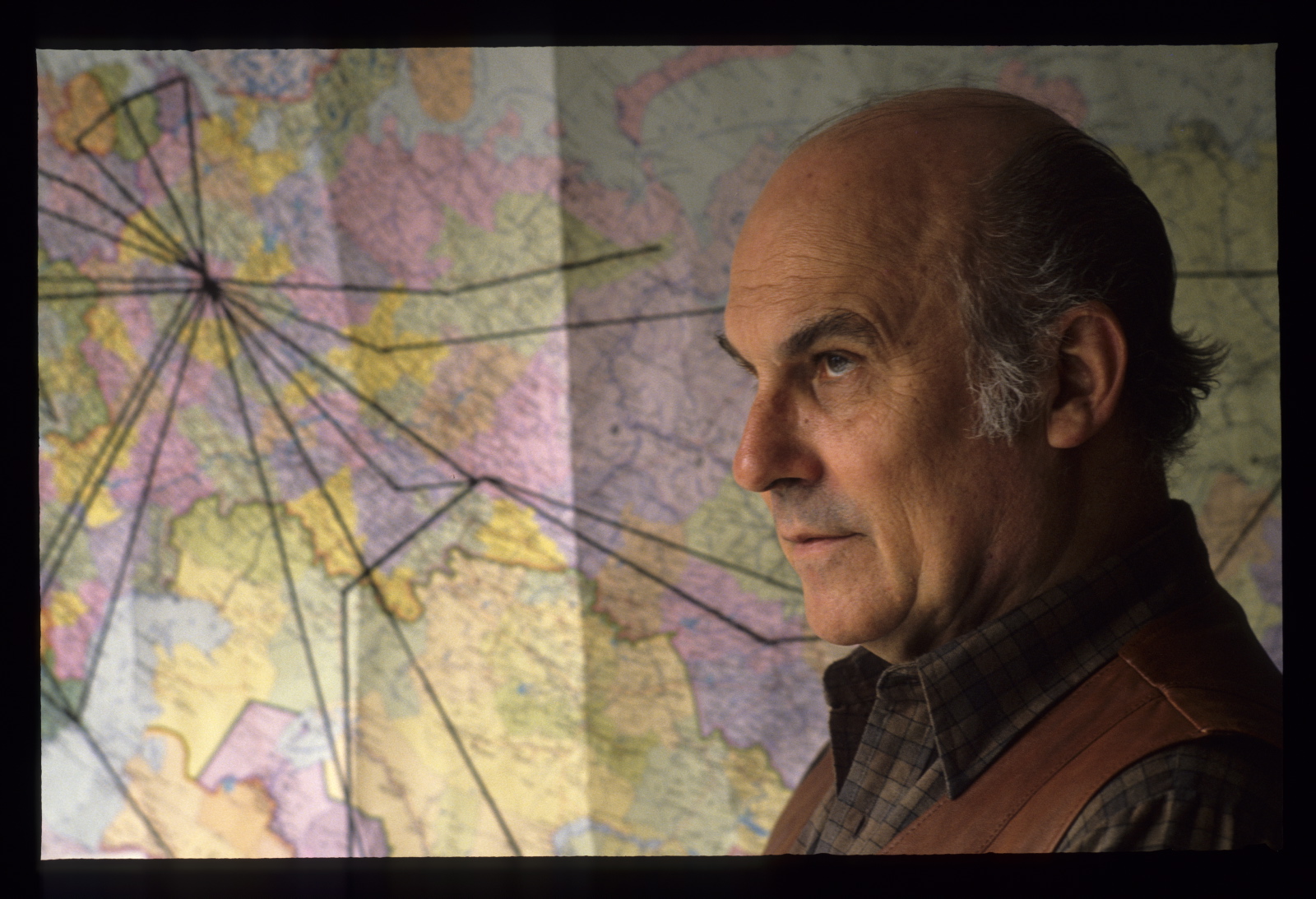
Polish Writer Ryszard Kapuściński (1932-2007)

Although he is usually classified as a writer on non-fiction, the late Ryszard Kapuściński has been “outed” by some journalists for embroidering the truth. In this era of fake news and outright official lying, I feel we need to appreciate someone who is 95% true, or even 90% true. Almost no one is 100% true. I keep thinking back to the ancient Greek and Roman historians who put polished speeches into the mouths of Greek heroes such as Pericles and Augustus Caesar. The idea was to give the general idea, and to adjust the truth just enough to show the basics. No matter that the historian spoke more elegantly than Pericles or Augustus ever could. Shall we dump Thucydides, Herodotus, Tacitus, and Livy for such venial sins, which were certainly not considered as sins at the time they were writing?

According to a biography by Artur Domoslawski, friend of Kapuściński, occasionally crossed the boundary between straight reportage and fiction: “Sometimes the literary idea conquered him. In one passage, for example, he writes that the fish in Lake Victoria in Uganda had grown big from feasting on people killed by Idi Amin. It’s a colourful and terrifying metaphor. In fact, the fish got larger after eating smaller fish from the Nile.”

It seems Domoslawski was perhaps less than a real friend of Kapuściński: He also included numerous accounts of the author’s sexual peccadillos and collaborations with Soviet intelligence.

I am reminded of another travel writer whose work I love, Bruce Chatwin, author of In Patagonia and Songlines. Instead of 90% truth, Chatwin aimed at perhaps 70% truth and occasionally fell short of that mark. And there was, with Chatwin, a lot of sex going on with even with his sources. (He died of AIDS in 1989 at the age of 49.) I still classify both authors as non-fiction, even though Domoslawski thinks they should be on the shelf with fiction.

After Domoslawski’s book came out, a bunch of other writers jumped on the topic, including such notable historians as Timothy Garton-Ash. I know that, for many years, Ryszard Kapuściński  has been on the short list to receive the Nobel Prize for Literature. Now that he is dead, he does not qualify. More’s the pity.


Serendipity: The Existence of Ghosts

My Belief Is: They Exist

The Original Farmer’s Market at 3rd and Fairfax is like a sort of souk for tourists and those L.A. natives who like to sit and reflect while drinking a cup of tea or eating a good lunch. I sat there this morning reading Chris Abani’s The Virgin of Flames, when I ran across this passage:

“Well, yes. Everyone is attended by ghosts,” Iggy said. What matters is whether we begin to attend to them.”

“How do you mean?”

“With some people, the ghosts are transparencies, barely visible as they hover around, sit at the table next to them and so on. They are particularly hard to see in bright sunlight. Sometimes, when memories are revisited, there is a flickering of light and shadow, image and text across them, and for a moment they flare up and then vanish.”

“So are you saying that ghosts are our memories?”

“Ghosts are the things, the shapes we make with our memories,” she said.

“Ah. So if some are light like…”

“Like well-worn lace drapes blowing in the wind.”

Black smiled.

“Yeah, like that. Then what are the other ghosts like? The ones we attend?”

“Like thick black lines drawn in a notebook. They are visible, brooding dark clouds that we drag around with us like reluctant sulky children. We feed them and they grow big and their haunting dominates our lives. We love them and we hate them and we are always measuring them for a coffin, yet we cannot let them die.”

“Why?”

”Madness, my friend. Madness.”


Time Off in Siberia

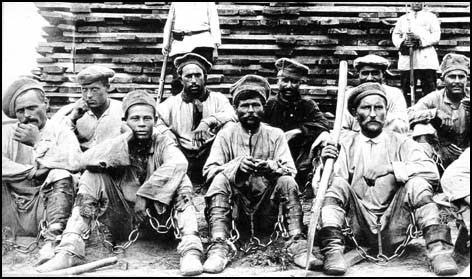
Tsarist Prisoners in Siberia

I have a particular love for Russian prison literature. For the third time, I am reading Fyodor Dostoyevsky’s The House of the Dead. By no means is it anywhere near the greatest of Dostoyevsky’s novels, but the subject has always fascinated me.

After the October Revolution, and especially during Josef Stalin’s reign, the literature of the GULAGs became a standard literary genre. I love Alexander Solzhenitsyn’s massive The GULAG Archipelago as well as One Day in the Life of Ivan Denisovich and The First Circle. Also well worth reading is Varlam Shalamov’s grim Kolyma Tales.

It is a common misconception that Dostoyevsky’s book is not a novel but just a thinly fictionalized account of his own four years in Omsk. At the time he wrote it, he was trying to reestablish his literary reputation after four years in prison and subsequent time with the Siberian Army Corps of the Seventh Line Battalion in Semipalatinsk. He was worried that if he wrote a book that was less than uplifting, he would once again be regarded as a political prisoner and suffer excessive censorship.

While it is anything but pollyanna-ish, The House of the Dead provided a rare look at the Tsar’s prison colonies on the other side of the Ural Mountains.

Ten Short Horrors

Edgar Allan Poe (1809-1849)

Think of this as my Halloween contribution. For the last several years, I have celebrated Halloween not by Trick-or-Treating, not by gorging myself with candy, but by reading collections of horror stories, mostly those published by Dover Publications. I find that the best works of horror fiction are usually not the longest (sorry, Stephen King), but either short stories or novellas.

Here is a list of ten of my favorites, in order of publication:

  • Edgar Allan Poe, “The Masque of the red Death” (1842)
  • J S Le Fanu, “Carmilla” (1871)
  • Robert Louis Stevenson, “The Body Snatcher” (1884)
  • Henry James, “The Turn of the Screw” (1898)
  • Bernard Capes, “An Eddy on the Floor” (1899)
  • W W Jacobs, “The Monkey’s Paw” (1902)
  • Arthur Machen, “The White People” (1904)
  • Algernon Blackwood, “The Willows” (1907)
  • M R James, “Casting the Runes” (1911)
  • H P Lovecraft, “The Colour Out of Space” (1927)

Happy Halloween, and Boo!


Koizumi Yakumo

Lafcadio Hearn (1850-1904)

Martine is gone, and the terrible heat of the last ten days is slowly beginning to abate. I find that I am reading more than ever. (How much more can I read than I’m reading now, I do not know. So far eighteen books this month.) The most recent is by an American who became a Japanese. I refer to Lafcadio Hearn, who went under the Japanese name of Koizumi Yakumo. He married a Japanese wife, raised four children with her. It appears that I have many of Hearn’s books about Japan, which were published by Charles E. Tuttle & Company of Rutland, Vermont and Tokyo, Japan in paperback editions during the 1970s.

When I was traveling to and from Dartmouth College, I took a White River Coach from Hanover to White River Junction, and from hence another White River Coach to Rutland. At Rutland, I would wait for the Vermont Transit bus that would take me to Albany, New York, where I would board the New York Central night train to Chicago, which let me off in Cleveland. There, my parents waited for me.

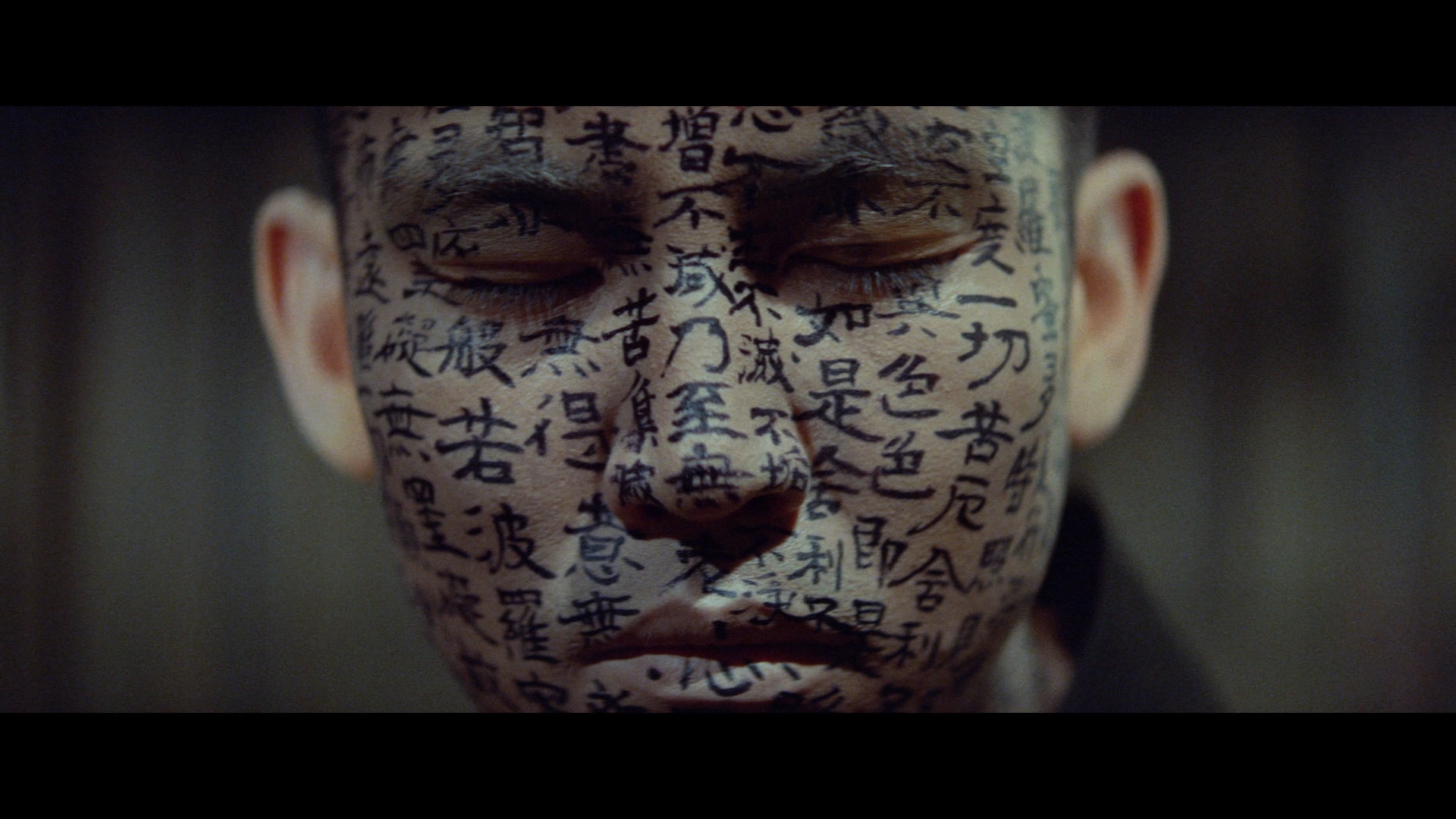
Because of Tuttle’s proximity, while at Dartmouth I grew interested in Japanese culture. I attended an exhibit of Sesshu Toyo’s “Long Scroll” at Hopkins Center, and saw all the Japanese films that came my way. One of the best of them is Masaki Kobayashi’s Kwaidan (1965), made the year before I graduated.
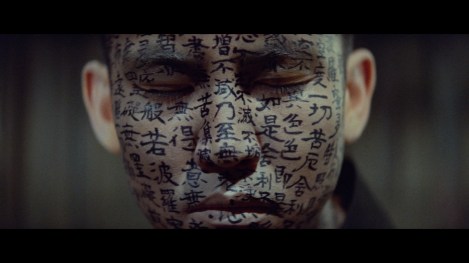
Scene from Masaki Kobayashi’s Kwaidan (1965)

It is only now, more than fifty years after I graduated, that I picked up my copy of Hearn’s Kwaidan: Stories and Studies of Strange Things (1904) and began reading it with increasing enjoyment. The Kobayashi film took four stories from Hearn’s works, two of them from the book entitled Kwaidan. I was enthralled by Hearn’s stories, such that I can see myself picking the other Hearns off the shelf (I have almost ten of them) and reading them with intense pleasure. The book is not all ghost stories: At the end are three delightful essays about butterflies, mosquitoes, and ants as seen in Chinese and Japanese cultures.  Here is a brief excerpt from his essay on ants:

The work daily performed by these female [ant] laborers comprises road-making, bridge-building, timber-cutting, architectural construction of numberless kinds, horticulture and agriculture, the feeding and sheltering of a hundred varieties of domestic animals, the manufacture of sundry chemical products, the storage and conservation of countless food-stuffs, and the care of the children of the race. All this labor is done for the commonwealth—no citizen of which is capable even of thinking about “property,” except as a res publica;—and the sole object of the commonwealth is the nurture and training of its young,—nearly all of whom are girls. The period of infancy is long: the children remain for a great while, not only helpless, but shapeless, and withal so delicate that they must be very carefully guarded against the least change of temperature. Fortunately their nurses understand the laws of health: each thoroughly knows all that she ought to know in regard to ventilation, disinfection, drainage, moisture, and the danger of germs,—germs being as visible, perhaps, to her myopic sight as they become to our own eyes under the microscope. Indeed, all matters of hygiene are so well comprehended that no nurse ever makes a mistake about the sanitary conditions of her neighborhood.

In spite of this perpetual labor no worker remains unkempt: each is scrupulously neat, making her toilet many times a day. But as every worker is born with the most beautiful of combs and brushes attached to her wrists, no time is wasted in the toilet-room. Besides keeping themselves strictly clean, the workers must also keep their houses and gardens in faultless order, for the sake of the children. Nothing less than an earthquake, an eruption, an inundation, or a desperate war, is allowed to interrupt the daily routine of dusting, sweeping, scrubbing, and disinfecting.

For many years, much of what the West knew about Japan came from Hearn’s pen. I cannot imagine a more delightful introduction to any culture.

The Conversationalist

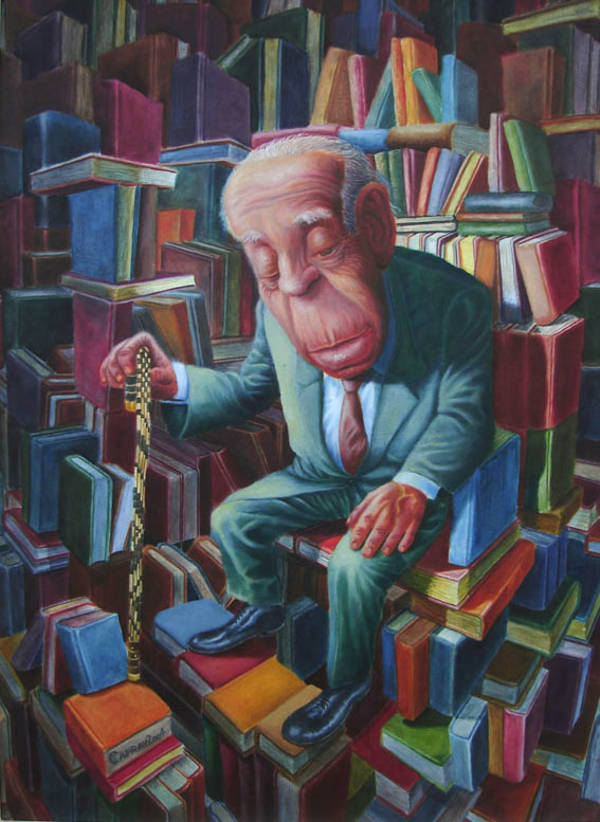
Jorge Luis Borges and His Books

Blindness was a curse in Jorge Luis Borges’s family. Not only his father, but his grandfather and great-grandfather all died blind. Fortunately for us, Borges had lived for more than fifty years before the gathering darkness prevented him from picking a book from his shelf and reading it. Because he lived on for thirty-five years or so longer, the Argentinian writer and poet managed to find a role for himself that would help keep his amazing erudition alive and produce works of interest to a worldwide public that was just beginning to discover him.

Enter Borges the interviewee. I first experienced this in Paul Theroux’s The Old Patagonian Express, when the American author describes a meeting with Borges in Buenos Aires. It began with Borges requesting that Theroux read some passages from Kipling to him and went on from there. From this point on, I continued finding published interviews, and I started collecting them alongside his original poems and stories, whose output diminished as he aged.

In a brief interview with Amelia Barili,  he is asked about the meaning of life:

If life’s meaning were explained to us, we probably wouldn’t understand it. To think that a man can find it is absurd. We can live without understanding what the world is or who we are. The important things are the ethical instinct and the intellectual instinct, are they not? The intellectual instinct is the one that makes us search while knowing that we are never going to find the answer. I think Lessing said that if God were to declare that in His right hand He had the truth and in his left hand He had the investigation of the truth, Lessing would ask God to open His left hand—he would want God to give him the investigation of the truth, not the truth itself. Of course he would want that, because the investigation permits infinite hypotheses, and the truth is only one, and that does not suit the intellect, because the intellect needs curiosity. In the past, I tried to believe in a personal God, but I do not think I try anymore. I remember in that respect an admirable expression of Bernard Shaw: “God is in the making.”

Willis Barnstone’s Borges at 80: Conversations has this little gem. When asked about the wrong women he has loved and the wrong days he has spent, Borges replied:

All those things, the wrong women, the wrong actions, the wrong circumstances, all those are tools to the poet. A poet should think of all things as being given him, even misfortune. Misfortune, defeat, humiliation, failure, those are our tools. You don’t suppose that when you are happy, you can produce anything. Happiness is its own aim.

As one who has personally suffered from dictators—Juan Perón made him a poultry inspector for the markets of Buenos Aires—Borges describes what he thinks of them:

It really seems a childish idea, don’t you think? I believe the idea of giving orders and being obeyed is more to be associated with a child’s mind than that of a man. I don’t think dictators generally are very intelligent people. Fanaticism can lead to it too. Take Cromwell’s case, for example: I think he was a Puritan; he was a Calvinist and believed he had every right. But in the case of more recent dictators, I don’t think they’ve been motivated by fanaticism. I think they were impelled by histrionic zeal, by the desire for applause, for being obeyed, and perhaps by the mere childish craving for publicity, which is a craving I don’t understand. [Sounds a lot like Trumpf, no?]

This last comes from Fernando Sorrentino’s Seven Conversations with Jorge Luis Borges, one of the better collections of interviews with Borges.

Jorge Luis Borges was, fortunately, a great conversationalist. I still like to pick up one or other of his interviews and re-read it just for the pleasure of the man’s company.


Massaraksh!

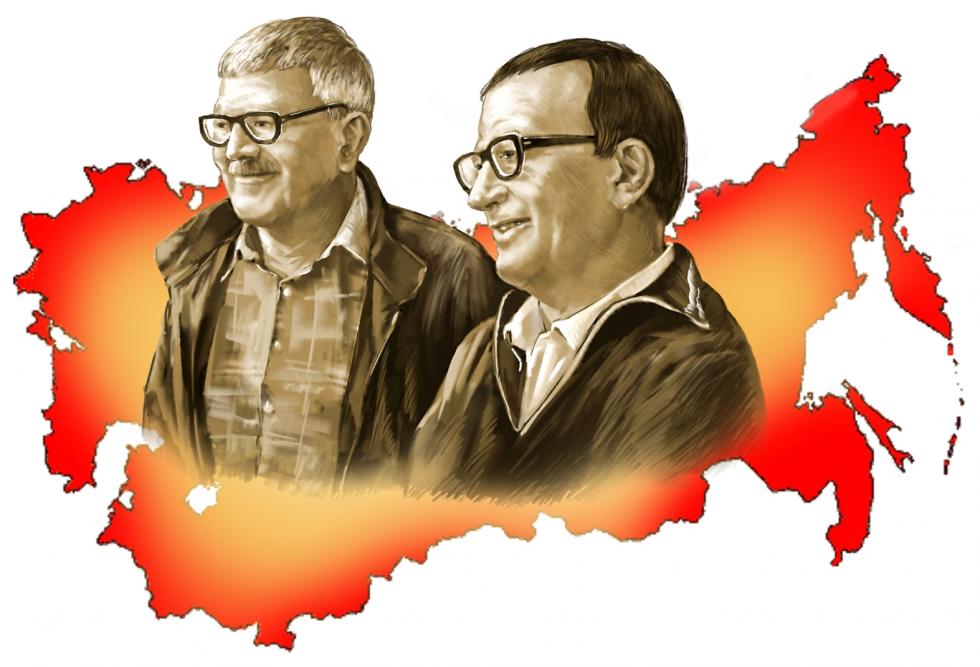
Arkady and Boris Strugatsky with the Soviet Union in the Background

The expression means “World Inside Out!” It is the most frequently used expression in Arkady and Boris Strugatsky’s great novel of the Noonday Universe, Prisoners of Power (Обитаемый остров, 1969). Over the years, I have read twelve of their works, most of which were excellent or better. The best by far, though, is Roadside Picnic (Пикник на обочине, 1972), which was made into an equally great movie by Andrei Tarkovsky called Stalker (1979).

Both are dead now (Arkady in 1991 and Boris in 2012), and only slowly is the world beginning to realize what it has lost. It is not easy to find their works in print (except for Roadside Picnic); it is only on the top floor of the Los Angeles Central Library that I am finding a treasure trove of their work. And I will read them all, making my way through their collection like a Beetle in the Anthill (Жук в муравейнике, 1980) —itself the title of another Strugatsky work.

In the first paragraph, I referred to the Noonday Universe, which is a theme of about half the Strugatsky novels I have read. According to Wikipedia:

The victory of communism and the advance of technological progress on the Earth of the Noon Universe resulted in an over-abundance of resources and eliminated the need for most types of manual labor.

Mankind is capable of near-instantaneous interstellar travel. Earth social organization is presumably communist, and can be described as a highly technologically advanced anarchistic meritocracy. There is no state structure, no institutionalized coercion (no police etc.), yet functioning of the society is safeguarded by raising everyone as responsible individuals, with guidance of a set of High Councils accepted by everyone in each particular field of activity.

One of the controversial occupations is progressor. They are agents embedded in less advanced humanoid civilizations in order to accelerate their development or resolve their problems. Progressors’ methods range from rescuing local scientists and artists to overthrowing local governments.

The main governing body is the World Council, composed of the brightest scientists, historians, doctors and teachers. The local matters are handled by the regional versions of the council. Planetary councils are present on each Earth colony (e.g. [Far] Rainbow), as well, although “colony” in this context refers to a planet that wasn’t home to any sentient life before the arrival of Terran settlers. In the Noon Universe, Earth has never attempted to seize permanent control over any other civilization.

The universe is populated by a number of sentient races. Some of them are humanoid, while others are so alien that humanity didn’t realize that they were sentient for decades. Several sentient races maintain diplomatic relations with Earth’s society. Many planets in Noon Universe are inhabited by races identical to humans in all but minor genetic differences. It has been speculated that they were humans who wound up on other worlds due to the Wanderers’ manipulations (as Beetle in the Anthill shows, that is hardly unprecedented).

The Wanderers are the most mysterious race in the Noon Universe. Technologically advanced and highly secretive, the Wanderers are suspected to manipulate sentient beings throughout Noon Universe for their own purposes. While those purposes were never clarified, it was hinted that they try to “progress” various sentient beings.

The Noonday Universe is a kind of allegorical device used by the Strugatsky Brothers to subtly disguise a critique of the Soviet system in a fashion that has been described as Aesopic. For instance, the world in Prisoners of Power is crippled by a stupid bureaucracy. The Earthman Maxim Kammerer, whose spaceship is stranded on the nameless planet, is immune to many of the methods used by the “Creators” to keep their people under their control, and even survives several bullets which he simply “passes.” Eventually, he allies himself to the society’s underground and dedicates himself to toppling the control mechanisms that keep the people prisoners of power.

I have read the following Strugatsky titles over the years:

  • Space Apprentice (Стажеры, 1962)
  • Escape Attempt (Попытка к бегству, 1962) *
  • Far Rainbow (Далёкая Радуга, 1963), the first one I read and still one of my favorites *
  • Hard to Be a God (Трудно быть богом, 1964) *
  • The Final Circle of Paradise (Хищные вещи века, 1965)
  • The Second Invasion from Mars (Второе нашествие марсиан, 1967)
  • Prisoners of Power (Обитаемый остров, 1969) *
  • The Dead Mountaineer’s Hotel (Отель «У Погибшего Альпиниста», 1970)
  • Roadside Picnic (Пикник на обочине, 1972), definitely the best of the bunch
  • Definitely Maybe (За миллиард лет до конца света, 1977)
  • Beetle in the Anthill (Жук в муравейнике, 1980) *
  • The Time Wanderers (Волны гасят ветер, 1986) *

The titles above appearing with asterisks are considered to be part of the Noon Universe series. Of the Strugatsky Brothers’ twenty-seven novels, only some four have not appeared in English translations.

Nouvelle Vague

Patrick Modiano, Winner of the 2014 Nobel Prize for Literature

To date, I have read five of Patrick Modiano’s novels and loved all of them. In order of publication, they are:

  • Missing Person (1980)
  • Young Once (1981)
  • After the Circus (1992)
  • Out of the Dark (1998)
  • In the Café of Lost Youth (2007)

With each of them, I felt I was back in the 1960s, in the world of the French New Wave (Nouvelle Vague), the Paris of Jean-Paul Belmondo in Breathless and Giani Esposito in Paris Nous Appartient. Relationships are quickly entered into, but turn into quicksand. In After the Circus, we are not altogether sure of the main characters’ names. Describing his roommate, “Lucien” writes:

He had something in common with my father: they both wore suits, ties, and shoes like everyone else. They spoke unaccented French, smoked cigarettes, drank espresso, and ate oysters. But when in their company, you were seized by doubt and you felt like touching them, the way you rub cloth between your fingers, to make sure they really existed.

Earlier, he writes, “But topographical details have a strange effect on me: instead of clarifying and sharpening images from the past, they give me a harrowing sensation of emptiness and severed relationships.” That’s a good summary of the feeling of the novel: emptiness and severed relationships. “Lucien” is never sure when he parts from his girlfriend “Gisèle” that she will not just disappear forever into the warren of streets without a word of warning.

Fortunately, Modiano is a prolific writer, and many if not most of his works have been translated into English. Of the five novels I have read, I prefer the three most recent ones.

The Great American Novel

Maybe the Great American Novel Will Be a Mystery …

Up until fifty or sixty years ago, the great American Novel would have been by someone like Ernest Hemingway, F. Scott Fitzgerald, or William Faulkner. Then something happened. Specifically what happened were writers like Raymond Chandler and Dashiell Hammett, followed by scores of other excellent mystery writers such as Ross Macdonald, James Ellroy, David Goodis, Jim Thompson, Cornell Woolrich, and Elmore Leonard.

I just finished reading Leonard’s Get Shorty, primarily because I loved the 1995 movie directed by Barry Sonnenfeld and starring John Travolta as Chili Palmer, the loan shark from Miami suddenly turned movie producer.

Renee Russo and John Travolta in Get Shorty

Recently, I just finished re-reading most of Raymond Chandler’s novels (except for Playback, which I’ll get to shortly). And I’ve been reading other mysteries and noir novels and enjoying them immensely. I am beginning to think that, years into the future, this will be looked at as a golden age of genre novels.

America’s contribution is mostly in the mystery genre, but there have been great science fiction classics, especially from Philip K. Dick (Do Androids Dream of Electric Sheep?) and Ray Bradbury, Ursula K. LeGuin, and Kurt Vonnegut, to name just a few. I will have to beg off on romance classics because, jeez, I’m a guy and the genre makes me alternatively giggle and puke.

If we eliminated genre novels from consideration, I would probably say that Herman Melville’s Moby Dick was the Great American Novel. But I don’t think we really should cut off the 20th Century American genre novel from a shot at the title.