W. H. Auden’s “Good Angel”

Hannay, Lynton; Professor W. P. Ker (1855-1923)

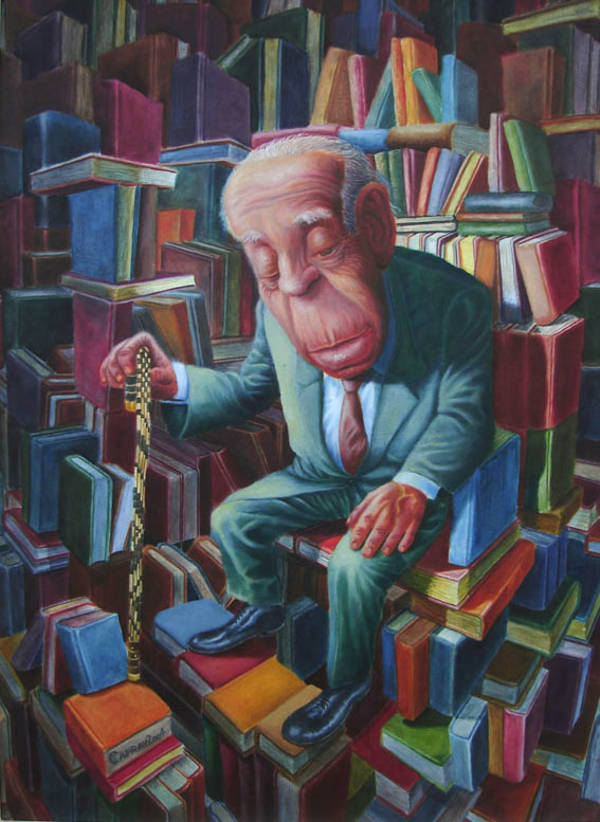
Extending from the reign of Queen Victoria to the aftermath of World War II, Britain produced a bumper crop of great literary scholars and essayists. I have already written about F. L. Lucas (1894-1967). I am currently exploring the work of W. P. Ker, short for William Paton Ker. It was poet W. H. Auden who, in The Dyer’s Hand, penned this tribute to the Scottish scholar:

[w]hat good angel lured me into Blackwell’s [Oxford Bookstore] one afternoon and, from such a wilderness of volumes, picked out for me the essays of W. P. Ker? No other critic whom I have subsequently read could have granted me the same vision of a kind of literary All Souls Night in which the dead, the living and the unborn writers of every age and tongue were seen as engaged upon a common, noble and civilizing task. No other could have so instantaneously aroused in me a fascination with prosody, which I have never lost.

I have been reading Volume I Ker’s Collected Essays, which one of the literature librarians at the Los Angeles Central Library entrusted me to take out, though it belongs to the Reference Collection. I read with interest until, suddenly, beginning with Page 109, I hate pay dirt. No doubt the name of Horace Walpole probably doesn’t mean much to most people, unless they suffered through the gothic The Castle of Otranto in college English. Instead, Ker concentrates on Walpole’s letters. Here he describes the country around Chamonix in the Alpes in a letter to his friend Paget Toynbee on September 18, 1739:

But the road, West, the road! winding round a prodigious mountain, and surrounded with others, all shagged with hanging woods, obscured with pines, or lost in clouds. Below, a torrent breaking through cliffs, and tumbling through fragments of rocks! Sheets of cascades forcing their silver speed down channeled precipices, and hastening into the roughened river at the bottom. Now and then and old footbridge, with a broken rail, a leaning cross, a cottage or the ruin of an hermitage. This sounds too bombastic and too romantic to one who has not seen it, too cold for one that has. If I could send you my letter post between two lovely tempests that echoed each other’s wrath, you might have some idea of this noble roaring scene, as you were reading it.

There are almost no collections of literary letters being written now, because there are no letters. There are scads of e-mails, tweets, text messages—few of which will be (or deserve to be) saved. Ker himself explains why such letters are valuable:

There is an interest in reading a series of letters like this which is not found even in personal memoirs. It may be a childish idea, but somehow in reading letters one seems to be nearer to the reality than in reading any other history. The phantoms of the past rise there less pale and shadowy than in common history, they come nearer to us, the colours deepen, the voices are more distinct. Letters like those of Cicero are not a record of the time; they are the life itself, the very accents of the time. He does not write any more to Atticus or to his brother: he writes to us: he tells us how Caesar came to stay with him, how they talked at dinner, how they spoke, Caesar spoke.

I wasted no time in buying Volume I of Horace Walpole’s collected letters (only 99 cents on Kindle). And I will, of course, finish reading Ker’s Collected Essays.

Ker’s Excellent The Dark Ages (1904)

This is not the first work of Ker’s that I have read. I own an old Mentor paperback edition of his The Dark Ages, and I have read portions of his Epic and Romance (1908), which is still available through Dover Publications.

Its Own Culture

The Zia, Symbol of New Mexico

Not too many states can be said to have their own culture. I, for one, couldn’t say anything about the state in which I was born—Ohio—except that it’s mostly featureless with some rolling hills. And as for distinguishing it from Michigan, Indiana, or Pennsylvania, forget about it! Even California doesn’t quite have its own culture: It has several of them coexisting within its 164,000 square miles. But New Mexico is a different story altogether. Its capital, Santa Fe, was settled in 1610 and is the highest state capital in the U.S.

When I used to visit New Mexico in the 1980s (with Chaco Canyon my main destination), I was told by residents never to refer to the Hispanic people as Mexicans, but as Spanish. They claim descent not from the people south of the Rio Grande so much as from the conquistadores who quelled them. Their cuisine resembles Mexican food only in certain dishes, most of their cuisine being unique to the region.

Now, as I prepare for my trip there next month, I am beginning to discover it has its own literature. Both Rudolfo Anaya’s Bless Me, Ultima and John Nichols’s The Milagro Beanfield War (and no, I never saw the movie) are set in the northeastern part of the state among the rural Spanish population. I am reading the latter book now, and find it marvelously entertaining, as in this passage about the local sheriff and his wife:

The one real fight Bernabé and Carolina had had in their life together occurred because of the saints. It had been an abnormally dry year (every other year in Milagro was an abnormally dry year, alternating with all those abnormally wet years), and so one day, during the Death of the Fruit ree blossoms time, Carolina carried their San Isidro out into the back field asking it to rain on their cucumbers. Well, sure enough, it raines all right, then the rain turned to snow, and the snow turned into a blizzard, so Carolina ran outside with their Santo Niño de Atocha, begging him to queer the blizzard before the cucumbers and the fruit trees were destroyed, and so the blizzard stopped and it began to rain again and the rain froze and tree branches fell down onto everything, and some cows Bernabé had up in the canyon froze to death. Whereupon suddenly, gnashing his teeth so hard little pieces of porcelain literally spewed from his mouth, the sheriff jumped up and grabbed an armload of her saints and threw them into the holocaust. Carolina shrieked, plunged into the storm, retrieved her precious little statues, and cried for three days.

I have been laughing since I started reading The Milagro Beanfield War and look forward to four more days of guffawing.

My Periodicals

The New York Review of Books (Semi-Monthly)

There are four periodicals to which I subscribe which I actually read. They are, in descending order of importance to me:

  • The New York Review of Books, a semimonthly on politics with book and art reviews.
  • The New Yorker, a weekly that has seen better days, but still publishes at least one or two great essays a month.
  • Gilbert, the monthly publication of the American Chesterton Society.
  • Chess Life, a monthly which I scan and about which I entertain a pipe dream of being able to read with the attention it deserves.

The one that is probably least familiar to most readers is Gilbert. Each issue has a couple of rare essays by G. K. Chesterton and other articles on Catholicism and distributism, Chesterton’s pet economic policy that is described at length in several of his books.

A Recent Issue of Chess Life Featuring U.S. Grandmaster Hikaru Nakamura

I’ve always had this dream of being able to take the time to analyze grandmaster-level chess games intelligently. It takes intense work, and if in public, one is likely to be interrupted by someone who wants to play chess with you. (I would prefer to avoid playing chess with strangers—too much ego involved!)  I don’t actually want to be able to play chess well as much as I want to develop better analytical skills. At my age, I don’t think I can become a much better chess player than I already am, but it is fun to see the decision-making skills of people like Hikaru Nakamura. It’s actually more of an aesthetic impulse on my part.

I also have a library of books with annotated chess games by the great masters. Whether I will ever be able to spend any time doing this remains to be seen. Some people go for golf or fishing. Fior me, it’s chess.

Unutterably Alien

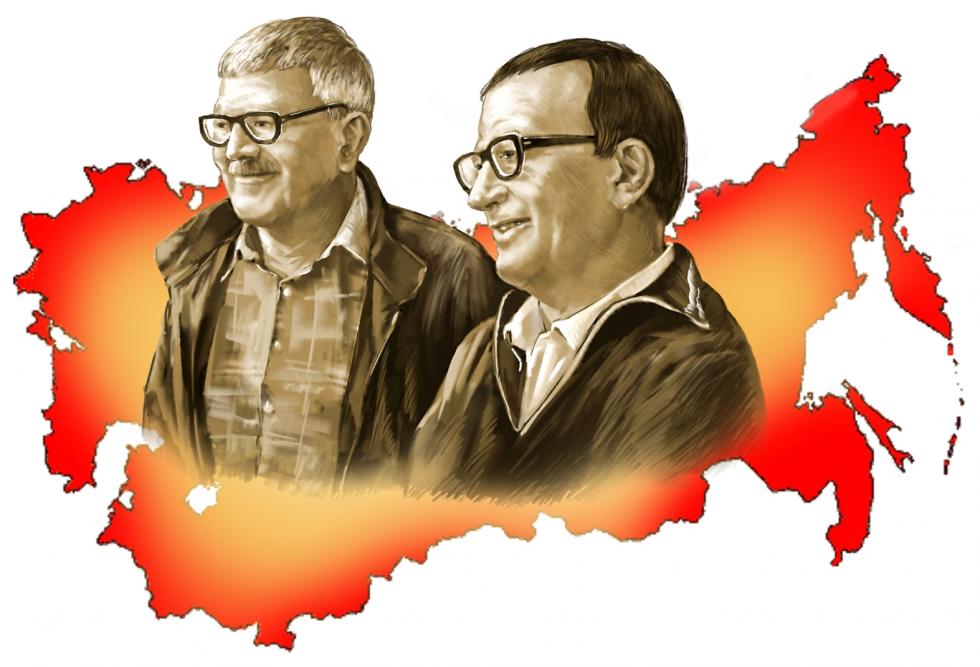
Arkady (1925-1991) and Boris (1933-2012) Strugatsky, the World’s Greatest Sci-Fi Writers

There is something about these two Russian brothers: They wrote the simply most incredible science fiction novels. I am thinking particularly of Roadside Picnic (Пикник на обочине), writen in 1972. At some time in the past, parts of Earth were visited by one or more bands of interstellar travelers. They left their mark on the places they have stayed—in strange, unaccountable ways. Nowhere is there a description of the visitors: no one alive has ever seen them. But the laws of matter and energy don’t seem to work there any more.

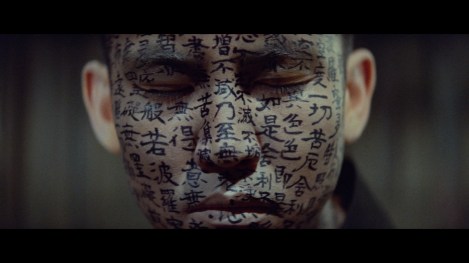
The novel was turned into a film by fellow Russian Andrei Tarkovsky in 1979. The film was called Stalker, and it was one of the greatest films produced anywhere in that decade. The film so influenced Geoff Dyer that he wrote a book in 2012 called Zona about his memories of the movie.

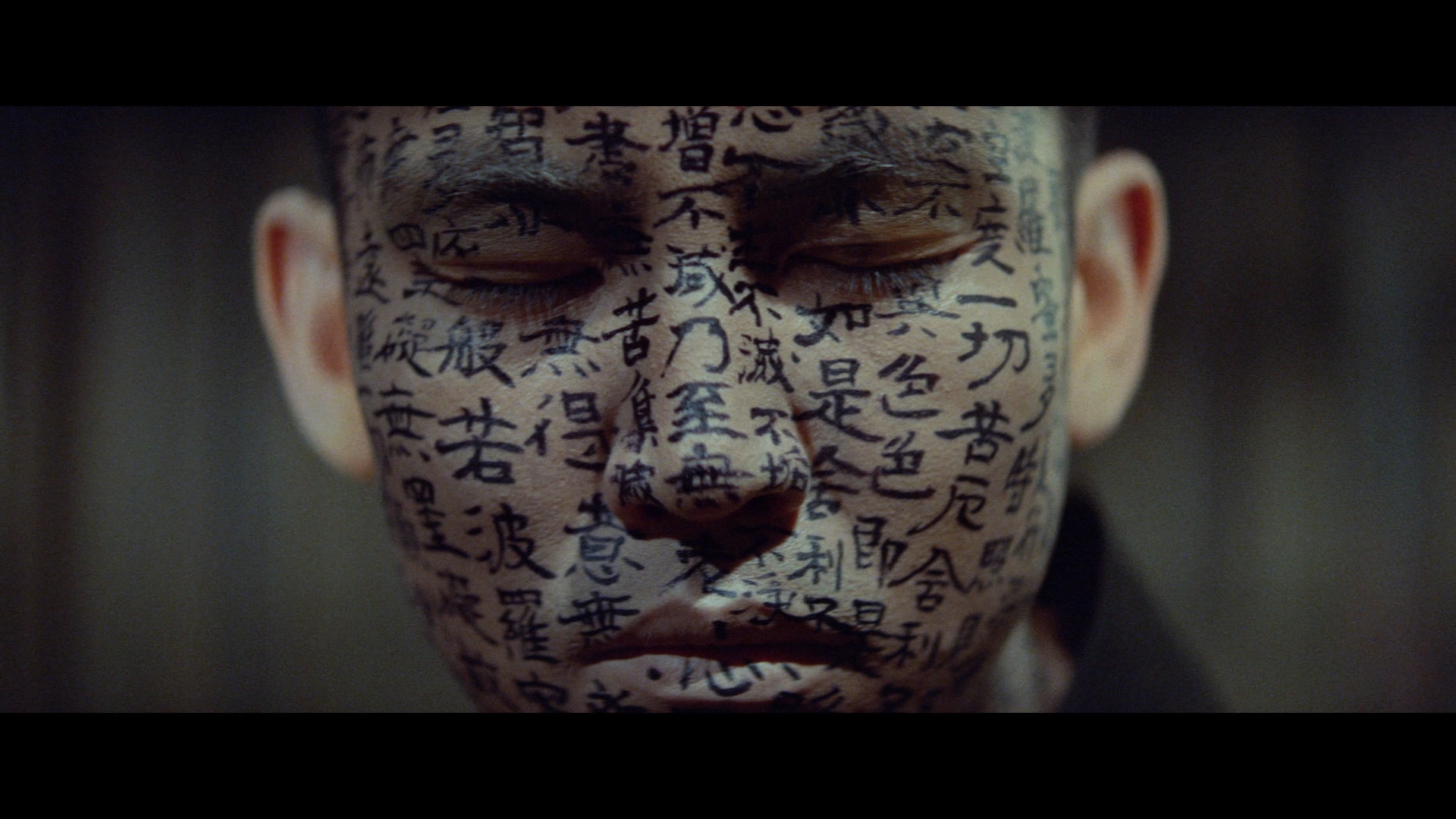
Scene from Tarkovsky’s Stalker

This is some powerful stuff. Those two brothers had some freaky visions that could so influence so many follow-on works. I am currently reading one of their earlier works, Space Apprentice (Стажеры) (1962). It’s not quite the level of Roadside Picnic, but it is fascinating.

While we’re on the subject of Eastern European sci-fi writers, I thought I’d put in a word for Poland’s Stanisław Lem , author of Eden (1959). In that novel, the earthling explorers go to a strange new world, where they are ignored. The protagonists can make nothing whatsoever of the local inhabitants.

The L.A. Times Book Festival

Hitting the Books on Earth Day

I used to go every year to the Los Angeles Times Book Festival, back when it was held on the nearby UCLA Campus. Then I went to the first festival at USC and decided that they didn’t know how to handle it right. For one thing, they haven’t yet realized that the temperature that far inland is generally ten degrees warmer; and the need for shade correspondingly greater. This year, things were better—but I still wish it moved back to UCLA.

I picked up five books at the festival:

  • Juan Gabriel Vásquez, Reputations, by an up and coming Colombian novelist
  • Joan Didion, South and West: From a Notebook
  • Yukio Mishima, Five Modern Nō Plays
  • Irène Némirovsky, Suite Française
  • Dashiell Hammett, The Big Knockover

Some of the prices were great, others were at the publisher’s suggested price. No matter: I plan to read them all, and will probably enjoy them all.

Fortunately the temperature wasn’t too hot today, and we didn’t make the mistake of driving. It cost us only 35¢ each to take the Expo Line train, which let us off right at the back gate of the festival. Else, I would have had to pay $15.00 and walk several blocks each way.


L. A. Writers: Michael Connelly

Why Is It That So Many L. A. Writers Are Mystery Writers?

I read five of his novels before deciding that, yes, Michael Connelly is indeed an L. A. writer. It bothers me that so many of the writers I see as L. A. writers are into the mystery genre. That was true of Raymond Chandler, certainly, and also James Ellroy and Tyler Dilts. If I wanted to, and I may in the future, I could add Joseph Wambaugh and a handful of others.

Perhaps there’s something about Los Angeles itself that brings forth so many fictional investigations into the dark heart of the place. When one things of the noir genre, one could just as easily think of New York or Chicago or Miami or—for heaven’s sake—even my own home town, Cleveland, Ohio. But there is something about Los Angeles that is different. I think I put my finger on it when writing about the film version of The Big Sleep in Alain Silver and Elizabeth Ward’s Film Noir: An Encyclopedic Reference to the American Style: “Los Angeles adds a horizontal dimension to film noir. In place of the looming monoliths and endless urban alleyways of the Eastern cityscape, there is a physical and moral sprawl, a chain of suburbs full of legal and illegal activities linked by wide boulevards and expressways.”

The Concrete Blonde, which I have just finished reading, is about one (or possibly two?) murderers who prey on porno stars and prostitutes. Connelly’s homicide detective Harry (short for Heironymus) Bosch shoots one killer at the start of the novel, and winds up in a long civil suit for having killed an “innocent man” according to the widow and her attorney. And, when the killings continue, it looks as if Bosch could be in the wrong. While attempting to defend himself, the homicide detective concludes that there is a second killer, whom the LAPD christens “The Follower,” who is responsible for these other killings. Bosch frantically attempts to pin the tail on the right perpetrator.

Unlike Raymond Chandler’s Philip Marlowe or Tyler Dilts’s Danny Beckett, Harry Bosch comes from a troubled background. In Viet Nam, he blew up Viet Cong tunnels. While he was still young, his mother was murdered. He has had difficulty hanging on to girlfriends, because at a certain point they become frightened of  the “black heart” of Los Angeles that he must fight on a regular basis.

To date, I have read the following Connelly titles, all of which I recommend:

  • The Black Echo (1992)
  • The Black Ice (1993)
  • The Concrete Blonde (1994)
  • Trunk Music (1997)
  • The Lincoln Lawyer (2005)


Trying to Convince Callicles

Plato Was Perhaps the Greatest Philosopher Who Ever Lived

In the early 20th century, something happened to philosophy: It became ever more remote from the human experience—a matter for trained professionals. Whenever I get chilled by the likes of Wittgenstein, Ayer, Heidegger, or Derrida, I like to go back to the Ancient Greeks, and most especially Plato. His dialogues are probably the height of philosophy. Given their general appeal, it is no wonder that so many of them survived some 2,500 years of war and rapine.

Today, I finished reading Gorgias, which starts on the subject of rhetoric, and which, thanks to the persistence of Socrates, turns into a dialogue on how goodness and morality are more important than hedonism and success. Ultimately, Socrates says, it is better to be the victim of another’s wrongdoing than to perpetrate any wrongdoings oneself. That is because “it takes true goodness to make a man or woman happy, and an immoral, wicked person is unhappy.” [471a]

Something interesting happens in this dialogue. One of the participants, Callicles, refuses to accept the drift of Socrates’s argument. Even when he finds himself agreeing to individual points, he keeps on backtracking in favor of hedonism over morality. He interrupts the conversation between Socrates and Polus to say:

Socrates, may I ask you a question? Are we to take it that you’re serious in all this, or are you just having us on? You see, if you’re serious, and if what you’re saying is really is the truth, surely human life would be turned upside down, wouldn’t it? Everything we do is the opposite of what you imply we should be doing. [481c]

This is a big change from the usual philosophical dialogue, when the recipient of Socrates’s wisdom is reduced to saying “Yes, that is so” or “That’s absolutely inevitable!” Callicles, on the other hand, frequently backtracks and says things like, “Tell me, Socrates, doesn’t it embarrass you to pick on people’s mere words and to count it a godsend if someone uses the wong expression by mistake?” or “You’re not being altogether sincere, Socrates.”

Without losing track of his argument, Socrates keeps trying to get through to his interlocutor, despite his contrariness.

This Socrates was certainly a dangerous man. I could see why his enemies arranged to have him tried, convicted, and executed.

If you’re interested in reading Plato, I suggest the translations by Robin Waterfield.

From Point A to Point B

UPS Freight Jets

There is a growing branch of literature which consists of nonfiction. How is that possible? The Nobel Prize for Literature in 1996 was awarded to Svetlana Alexievich of Belarus for her work, which consists primarily of interviews of people affected by the nuclear accident at Chernobyl or the Soviet War in Afghanistan. As for Americans, we have John McPhee, who has written a series of nonfiction works of high literary quality.

I have just finished reading his Uncommon Carriers, which deals, in turn, with long-haul truckers; a place in France where ships’ pilots are trained; boats that tow barges on American rivers; the parcel sorting services of UPS; and mile-and-a-half-long coal trains. In between, there is a delightful essay by the author about retracing the route of Henry David Thoreau and his brother John described in A Week on the Concord and Merrimac Rivers—which I had read when it was first published in the New Yorker.

McPhee likes to take what looks like a boring subject that nobody would write about and turn it into a gem. For instance, there is that tetralogy he wrote about American geology beginning with Basin and Range and ending with Assembling California. One would think that McPhee’s books might be a tad boring, but they never are.

To date, I have read—in the order of publication—the following ten McPhee titles:

  • The Crofter and the Laird
  • Pieces of the Frame
  • Giving Good Weight
  • Basin and Range
  • In Suspect Terrain
  • La Place de la Concorde Suisse
  • Rising from the Plains
  • The Control of Nature
  • Looking for a Ship
  • Uncommon Carriers

There’s not a single boring read in the bunch. Each McPhee I read whets my appetite for more.

L.A. Writers: Raymond Chandler

The Creator of Philip Marlowe

When I started writing this series of posts, I should have started it off with Raymond Chandler. He is, in so many ways, the quintessential L.A. writer. I did not because I mistakenly thought he was British. Look at that picture: Those eyeglasses, that pose—they partake of this prototypical English gentleman. In fact, Chandler was born in Chicago of an American father and an Irish mother. Although he spent many years in Britain, and even at one point became a naturalized British citizen, his writing career was pure Los Angeles.

I have just finished re-reading his fifth novel, The Little Sister (1949), and kept running into passages that screamed L.A. to me. When told he was in love with the beautiful actress Mavis Weld, Chandler replies:

That would be kind of silly. I could sit in the dark with her and hold hands, but for how long? In a little while she will drift off into a haze of glamour and expensive clothes and froth and unreality and muted sex. She won’t be a real person any more. Just a voice from a sound track, a face on a screen. I’d want more than that.

One of Chandler’s LAPD homicide detectives delivers this thoughtful description of the life of a cop in the city:

It’s like this with us, baby. We’re coppers and everybody hates our guts. And as if we didn’t have enough trouble, we have to have you. As if we didn’t get pushed around enough by the guys in the corner offices, the City Hall gang, the day chief, the night chief, the Chamber of Commerce, His Honor the Mayor in his paneled office four times as big as the three lousy rooms the whole homicide staff has to work out of. As if we didn’t have to handle one hundred and fourteen homicides last year out of three rooms that don’t have enough chairs for the whole duty squad to sit down in at once. We spend our lives turning over dirty underwear and sniffing rotten teeth. We go up dark stairways to get a gun punk with a skinful of hop and sometimes we don’t get all the way up, and our wives wait dinner that night and all the other nights. We don’t come home any more. And nights we do come home, we come home so goddam tired we can’t eat or sleep or even read the lies the papers print about us. So we lie awake in the dark in a cheap house on a cheap street and listen to the drunks down the block having fun. And just about the time we drop off the phone rings and we get up and start all over again. Nothing we do is right, not ever. Not once. If we get a confession, we beat it out of the guy, they say, and some shyster calls us Gestapo in court and sneers at us when we muddle our grammar. If we make a mistake they put us back in uniform on Skid Row and we spend the nice cool summer evenings picking drunks out of the gutter and being yelled at by whores and taking knives away from greaseballs in zoot suits. But all that ain’t enough to make us entirely happy. We got to have you.

The “you” of the quote is Philip Marlowe, whom the police accuse of withholding evidence on two icepick murders and waltzing scot-free because of his private investigator’s license.

Chandler’s descriptions of night in L.A. rise almost to the verge of poetry:

I drove east on Sunset but I didn’t go home. At La Brea I turned north and swung over to Highland, out over Cahuenga Pass and down on to Ventura Boulevard, past Studio City and Sherman Oaks and Encino. There was nothing lonely about the trip. There never is on that road. Fast boys in stripped-down Fords shot in and out of the traffic streams, missing fenders by a sixteenth of an inch, but somehow always missing them. Tired men in dusty coupés and sedans winced and tightened their grip on the wheel and ploughed on north and west towards home and dinner, an evening with the sports page, the blatting of the radio, the whining of their spoiled children and the gabble of their silly wives. I drove on past the gaudy neons and the false fronts behind them, the sleazy hamburger joints that look like palaces under the colors, the circular drive-ins as gay as circuses with the chipper hard-eyed carhops, the brilliant counters, and the sweaty greasy kitchens that would have poisoned a toad. Great double trucks rumbled down over Sepulveda from Wilmington and San Pedro and crossed towards the Ridge Route, starting up in low-low from the traffic lights with a growl of lions in the zoo.

Behind Encino an occasional light winked from the hills through thick trees. The homes of screen stars. Screen stars, phooey. The veterans of a thousand beds. Hold it, Marlowe, you’re not human tonight.

Not human? Hardly: No one is more human than Marlowe. He is like the knight in Albrecht Dürer’s “Knight, Death, and Devil,” as shown below:

Knight, Death, and the Devil

Poor Marlowe, he doesn’t even have the friendship of a dog as shown in the engraving above.

An Impassioned Plea for Freedom

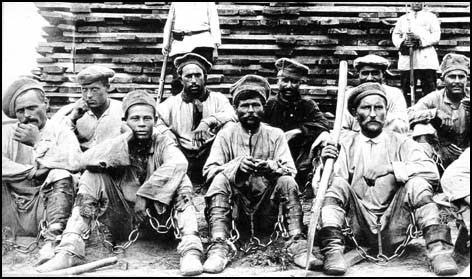
Gulag Prisoners in Siberia

Gulag Prisoners in Siberia

Fyodor M. Dostoyevsky could hardly believe his eyes. He had spent four years in a Siberian prison camp and six years in the Russian military in Siberia. His first published works after returning to St. Petersburg were comedies: Uncle’s Dream and The Village of Stepanchikovo. Now he wrote two short pieces for publication about his experience in the camp. The first was approved by the Tsarist censors; the second, rejected—because it was thought that Dostoyevsky was saying that life in the Gulags was actually quite appealing.

That could not be allowed to stand. Dostoyevsky immediately penned a supplement to that piece, which included the following:

What is bread? They [the convicts] eat bread to live, but they have no life! The genuine, the real, the most important is lacking, and the convict knows he will never have it; or he will have it, if you like, but when? … It’s as if the promise is made only as a joke.

Try an experiment and build a palace. Fit it out with marble, pictures, gold, birds of paradise, hanging gardens, all sorts of things…. And step inside. Well, it may be that you would never wish to leave. Perhaps, in actual fact, you would never leave. Everything is there! “Let well enough alone!” But suddenly—a trifle! Your castle is surrounded by walls, and you are told: “Everything is yours! Enjoy yourself! Only, don’t take a step outside!” And believe me, in that instant you will wish to quit your paradise and step over the wall. Even more! All this luxury, all this plenitude, will only sharpen your suffering. You will even feel insulted as a result of all this luxury…. Yes, only one thing is missing: a bit of liberty! a bit of liberty and a bit of freedom!

This impassioned plea is perhaps the germ of Dostoyevsky’s great works which were to follow: Notes from the Underground, Crime and Punishment, The Idiot, The Possessed, and The Brothers Karamazov.