L. A. Writers: Ry Cooder (?!)

Master of the Slide Guitar and ... Writer?

Master of the Slide Guitar and … Noir Writer?

So you think I’m kidding, do you? You think I don’t know that Ry Cooder is a musician? Aha, but in 2011 that same Ry Cooder wrote a book of short stories published by City Lights, entitled Los Angeles Stories. These stories, set between 1940 and the 1950s, are not only great L. A. Noir, but they sing with their own unique brand of chicken skin music. John Lee Hooker puts in an appearance, as does Charlie Parker. And the stories are rife with musical references:

Four Chinese girls were sitting at the corner table laughing and drinking. They were all excited about the dance hall where they’d been and the swing band they saw and the musicians they liked. I knew the place, the Zenda Ballroom, on Seventh and Figueroa. Tetsu Bessho and his Nisei Serenaders played there every Monday night. Jimmy Araki, the sax player, he was sharp. Joe Sakai was cute. The girls spoke English with a lot of hip slang, like musicians use, and as far as I could tell they were no different from any other American girls, except they were Chinese.

In fact, Cooder has a real ear for the race and ethnicity of his characters, from black musicians to Mexican Pachucos to white trailer trash to Chinese cooks.

Born in Santa Monica, he also has a great sense of place. We see Chavez Ravine before Dodger Stadium was built, the old Bunker Hill neighborhood, Playa Del Rey, Venice, and even Santa Monica.

Los Angeles Stories consists of eight tales, one better than the other. Insofar as I know, this is the only fiction he ever wrote; but I hope it is not the last. He has a great turn of phrase, as in “I am happy to have a little luck once and [sic] a while…. Too much, and fate pays a call. La Visita, my grandmother called it.”

There’s even nifty song lyrics:

Too many Johnnys, ’bout to drive me out of my mind
Yes, too many Johnnys, ’bout to drive me out of my mind
It have wrecked my life an’ ruint my happy home

When I first got in town, I was walkin’ down Central Avenue
I heard people talkin’ about the Club Rendezvous
I decided to drop in there that night, and when I got there
I said yes, people, man they was really havin’ a ball, yes I know!
Boogie!

I might cut you, I might shoot you, I jus’ don’ know
Yes, Johnny, I might cut you, I might shoot you, but I jus’ don’ know
Gonna break up this signifyin’,
’Cause somebody got to bottle up and go

I know that they gave the Nobel Prize for Literature to Bob Dylan. In my humble opinion, Ry Cooder is even a better writer. Believe it!


Leaving Tabasco

Flooding in the Streets of Villahermosa

Flooding in the Streets of Villahermosa

To begin with, you can forget the vinegary hot sauce from McIlhenny Company. I’m talking about the State of Tabasco in Southeastern Mexico. I have had four encounters with this state, two by visiting its inappropriately named capital of Villahermosa in 1979 and sometime in the 1980s, and two from literature.

Tabasco first entered my thoughts when reading Graham Greene’s The Power and the Glory back in High School, and subsequently reading the same author’s book about his travels there in The Lawless Roads. From around 1920 to 1935, Tomás Garrido Canabal was virtual dictator of the State of Tabasco. A devout anti-Catholic, he persecuted the church and executed many priests and religious. So Greene went there and investigated for himself, writing his two books. (The Power and the Glory was later made into a film called The Fugitive, directed by John Ford and starring Henry Fonda.)

My first visit to Tabasco was in 1979 with my brother. We planned to overnight in Villahermosa before visiting the Mayan reuins at Palenque in nearby Chiapas. We were stunned to find that Pemex, the Mexican petroleum monopoly, was block-booking all the hotels for its employees and suppliers, leaving us nothing but the down-at-heels Casa de Hospedaje Mary (which my brother christened the “Casa de Hopes-You-Die Mary”), where we were awakened every 15 minutes from our damp and fitful sleep by roosters crowing on the roof and church bells tolling the quarter hour. That was after a dreadful meal of shrimp coated with tar and two hours spent looking for a bus terminal that wasn’t where the guidebook said it was.

Olmec Head at Parque La Venta

Olmec Head at Parque La Venta

The second visit was by myself several years later. I visited the giant Olmec heads at the Parque-Museo de la Venta, taking advantage of a long plane delay flying between Mérida, Yucatán, and Tuxtla Gutiérrez, Chiapas. I was smart enough not to try to spend the night in Villahermosa, which struck me as a jungle shit-pit which was at the confluence of Mexico’s two largest (and oft-flooded rivers), the Grijalva and the Usumacinta.

Finally, I just finished reading a novel called Leaving Tabasco by the talented Carmen Boullosa. Here was an authentic voice from rural Tabasco who uses magical realism to signal her disillusionment with her character Delmira Ulloa’s childhood in the village of Agustini.

Carmen Boullosa

Carmen Boullosa

Safely ensconced in Europe, Delmira muses about her origins:

For three decades I didn’t sleep in a hammock, I saw no strange objects floating in water. No albino crocodile popped into my room, no army of Indians came by sucking voluptuously on juicy insects, no legion of toads exploded against my balcony, there were no imposing witches hawking fake merchandise, no rainstorms purchased for cash. I’ve spent six times five years here without hearing once the nightly tale of my grandmother. I came here in search of a world that obeyed the laws of physics; it is now all around me, but I can’t say I’ve come to terms with it.

Leaving Tabasco ends with a lot of questions, but no answers. That’s all right with me, because I don’t believe too much in answers—and I have a lot of questions of my own. One thing for sure: After reading Boullosa, I want to read more by her … and maybe … just maybe … I’d like to give Tabasco another chance.

Belief and Technique for Modern Prose

Jack Kerouac and Friend

Jack Kerouac and Friend

The following is an itemized list in its entirety of how to write modern prose like a beatnik by Jack Kerouac. It was published in The Evergreen Review, Volume 2, No. 8, in 1959. As usual, Jack varies between the profound and the mundane, all mixed up like:

  1. Scribbled secret notebooks, and wild typewritten pages, for yr own joy
  2. Submissive to everything, open, listening
  3. Try never get drunk outside yr own house [a rule often violated by Jack]
  4. Be in love with yr life
  5. Something that you feel will find its own form
  6. Be crazy dumbsaint of the mind
  7. Blow as deep as you want to blow
  8. Write what you want bottomless from bottom of the mind
  9. The unspeakable visions of the individual
  10. No time for poetry, but exactly what is
  11. Visionary tics shivering in the chest
  12. In tranced fixation dreaming upon object before you
  13. Remove literary, grammatical and syntactical inhibition
  14. Like Proust be an old teahead of time
  15. Telling the story of the world in interior monolog
  16. The jewel center of interest is the eye within the eye
  17. Write in recollection and amazement for yourself
  18. Work from pithy middle eye out, swimming in language sea
  19. Accept loss forever
  20. Believe in the holy contour of life
  21. Struggle to sketch the flow that already exists intact in mind
  22. Dont [sic] think of words when you stop but to see the picture better
  23. Keep track of every day the date emblazoned in yr morning [eh?]
  24. No fear or shame in the dignity of yr experience, language & knowledge
  25. Write for the world to read and see yr exact pictures of it
  26. Bookmovie is the movie in words, the visual American form
  27. In Praise of Character in the Bleak inhuman Loneliness
  28. Composing wild, undisciplined, pure, coming in from under, crazier the better
  29. You’re a Genius all the time
  30. Writer-Director of Earthly movies Sponsored & Angeled in Heaven

The above is reprinted in Fred W. McDarrah’s book Kerouac & Friends: A Beat Generation Album, a not bad introduction to the movement together with photos of its main characters.

If there is a lot of unevenness in the whole beat vision, I think you can see why.


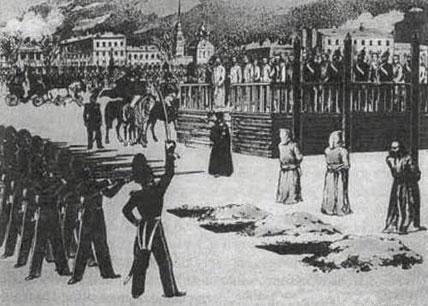
The Incident in Semenovsky Square

A Christmas Present from Tsar Nicholas I

A Christmas Present from Tsar Nicholas I

On the mrning of December 22, 1849, a number of prisoners were taken in closed carriages from their prison cells to St. Petersburg’s Semenovsky Square where there was a firing squad waiting for them. They were dressed in long white peasant blouses and nightcaps. Asked to bare their heads to receive their sentences: In every case, the verdict was “The Field Criminal Court has condemned all to death sentence before a firing squad, and on December 19 His Majesty the Emperor personally wrote, ‘Confirmed.’” As the first three were tied to stakes, the prisoners found out that Tsar Nicholas I had commuted all their sentences to prison terms in Siberia.

The most prominent of the prisoners was a young writer named Fyodor M. Dostoyevsky, who described what he felt twenty years later in the words of the main character of The Idiot, Prince Myshkin:

It seemed to him that, in those five minutes, he was going to lead such a great number of lives that there was no place to think of the last moment. So that he divided up the time that still remained for him to live:two minutes to say good-bye to his companions; two minutes for inward meditation one last time; and the remainder to look around him one final time. He remembered perfectly having fulfilled those dispositions just as he had calculated. He was going to die at twenty-seven [Dostoyevsky has just turned twenty-eight in 1849], full of health and vigor. He recalled that, at the moment of saying good-bye, he asked one of his companions a rather indifferent question, and he took a keen interest in the reply. After saying good-bye, he began the period of two minutes reserved for inward meditation. He knew in advance what he would think about: he wished to focus his intention firmly, and as clearly and rapidly as possible, on what was going to happen: right now, he was existing and living; in three minutes, something would occur; someone or something, but who, where? He thought to resolve these uncertainties during these two final minutes. Nearby rose a church whose golden cupola sparkled under a brilliant sun. He recalled having looked at that cupola and the rays it reflected with a terrible obstinacy; he could not take his eyes away; those rays seemed to him to be that new nature that was to be his own, and he imagined that in three minutes he would become part of them…. His uncertainty and his repulsion before the unknown, which was going to overtake him immediately, was terrible.

After spending four years at the forced labor camp of Omsk in Siberia, Dostoyevsky was released and—for the second part of his sentence—inducted into the army and made to serve as a private in the Siberian Army Corps of the Seventh Line Battalion. For a period of almost ten years, he was forbidden to publish any of his writings.

Before he was sentenced for belonging to the Petrashevsky Circle of suspected dissidents, Dostoyevsky had written a number of works which are not often read today. I read most of them and liked them, but they were nothing compared to novels like Crime and Punishment (1866), The Idiot (1869), The Devils (1872), and The Brothers Karamazov (1880) that were to follow his return to civilian life.

Could it be that the intensity of those masterpieces owed something to Dostoyevsky’s sufferings in Siberia?

The Magnificent Seven

Table for Two at La Biela: Statues of Jorge Luis Borges and Adolfo Bioy Casares

Table for Two at La Biela: Statues of Jorge Luis Borges and Adolfo Bioy Casares

At Recoleta’s busy La Biela Café, a table is permanently reserved for those two lions of Argentine literature: Jorge Luis Borges and Adolfo Bioy Casares. They naturally belong together, as they were lifelong friends and collaborated together on several books.

In my readings of the literature of Argentina, I have come upon seven writers whose works are equal (when they don’t actually surpass) the best of European and American literature. I will confine my comments only to those works written in the 20th century, as earlier works, such as Hernandez’s Martin Fierro and Guiraldes’s Don Segunda Sombra belong more to the Gaucho myth than to literature.

Here are the seven writers whose works I recommend:

JORGE LUIS BORGES is, to my mind, one of the giants of 20th century literature. Although he never wrote any novels, his poems, short stories, and essays are must reads. Start with his collections Ficciones, Labyrinths, and The Aleph.

ADOLFO BIOY CASARES is not only Borges’s friend and collaborator, but is the author of several novels including The Invention of Morel and The Adventures of a Photographer in La Plata. He was married to

SILVINA OCAMPO. Together, they were known as Los Bioy. Her Kafkaesque short stories are collected in a volume called Thus Were Their Faces. She is the sister of Victoria Ocampo, founder and editor of Sur, a magazine and a noted publishing house.

CÉSAR AIRA is a recent find for me. I have written several blog postings about him and his highly original narrative style (resembling a Roomba vacuum cleaner that always moves forward). I particularly liked The Hare and The Seamstress and the Wind (my favorite novel about Patagonia).

JULIO CORTÁZAR is known primarily for being the author of the short story which Michelangelo Antonioni adapted into his film Blow Up. I think his short stories are his best work.

THOMAS ELOY MARTÍNEZ has written novels about the Peróns. My favorite is about the long journey taken by the body of Evita Perón after her death by Cancer: Santa Evita. Today, Evita’s corpse is finally at rest at Recoleta Cemetery under her maiden name, Duarte.

JUAN JOSÉ SAER writes about El Litoral, the area along the River Paraná centered around Santa Fe. I think he may be up there with Borges and Bioy Casares. Currently, I am reading The Clouds. Another excellent title is The Witness.

If you feel your reading is in a rut, I highly recommend you turn your attention South—way South—and read one of these Argentinean classics.


Why I Hate Sonny Bono

Tombstone of Sonny Bono at Cathedral City’s Desert Memorial Park

Tombstone of Sonny Bono at Cathedral City’s Desert Memorial Park

My original plan was to empty my bladder on Sonny (“Watch Out for That Tree!”) Bono’s grave, but Martine prevented me. For many years, I had borne a grudge for the former singer and Congressman, as have all serious book collectors.

The reason is the Sonny Bono Copyright Term Extension Act of 1998. It is also referred to as the Mickey Mouse Protection Act, because the unspoken aim was to extend Walt Disney Studio’s copyright of Mickey Mouse. According to Sonny’s widow, Mary Bono, he had wished to extend the copyright forever. He was deterred when it was pointed out to him that what he wanted was unconstitutional.

Now one of my favorite writers is Marcel Proust. There recently was a new translation by various hands of In Search of Lost Time. My access to the last three volumes of the series—The Prisoner, The Fugitive, and Finding Time Again—was impaired by Bono’s legislation. Eventually, I got my hands on the paperback edition; but the hardbound will not be available to me unless I buy it in Europe or I live to a very, very ripe old age.

Of course, Sonny did not live to see his legislation become law. He died in a skiing accident when he hit a tree at the (aptly named) Heavenly Ski Resort near South Lake Tahoe, California.

Martine and I had been visiting the Desert Memorial Park in Cathedral City, where we also saw the graves of Frank Sinatra and Magda Gabor (sister of Zsa Zsa).

The Approach to J. L. Borges

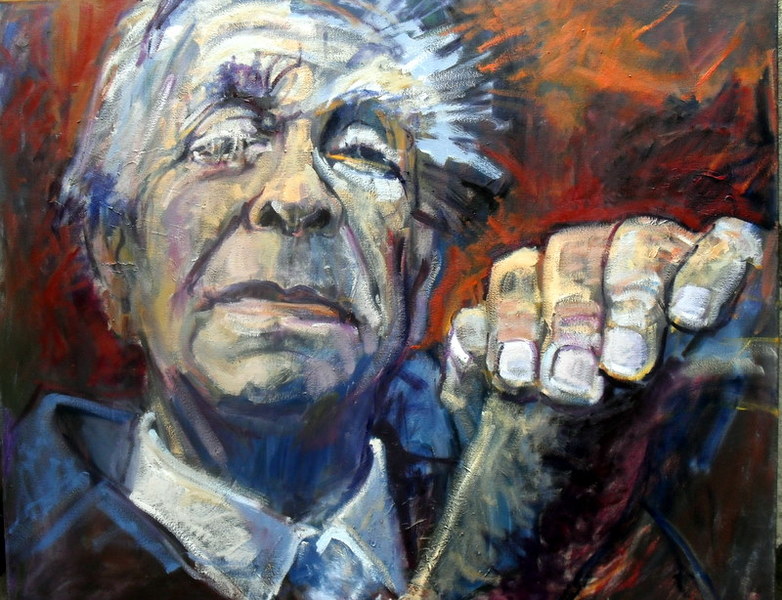
Argentinian Author and Poet Jorge Luis Borges

Argentinian Author and Poet Jorge Luis Borges

In 1935, Jorge Luis Borges wrote a story entitled “The Approach to al-Mu’tasim.” In it, he writes of a man who, after a religious riot between Hindus and Muslims, “becomes aware of a brief and sudden change in that world of ruthlessness—a certain tenderness, a moment of happiness, a forgiving silence in one of his loathsome companions.” He concludes that “somewhere on the face of the earth is a man from whom this light has emanated; somewhere on the face of the earth there exists a man who is equal to this light.”

For me, the source of that light—at least in the world of 20th Century literature—is Jorge Luis Borges himself. I have read all his works that have been translated into English, and even the many interviews he conducted toward the end of his life. I am now on the lookout for ever more obscure works … and I think I have found a good candidate.

The book is by Argentinian author and filmmaker Edgardo Cozarinsky, and its title is Borges In/And/On Film (New York: Lumen Books, 1988). Its three parts consist of:

  1. Reviews of films written by Borges before his blindness became total in the 1950s.
  2. The influence of Borges on film critics and filmmakers (mostly French).
  3. A survey of films based on Borges’s stories or scripts.

The parts become decreasingly interesting from one part to the next. He had a curious liking for the films of Josef von Sternberg—before that director had discovered Marlene Dietrich. Afterwards he regards him as “a devotee of the inexorable Muse of Bric-à-Brac.” Reviewing an Argentinian film, Borges writes it “is unquestionably one of the best Argentine films I have seen, which is to say, one of the worst films in the world.”

Of Citizen Kane, he writes that it “suffers from gigantism, from pedantry, from tediousness. It is not intelligent, it is a work of genius—in the most nocturnal and Germanic sense of that bad word.”

Of Victor Fleming’s version of Doctor Jekyll and Mr. Hyde, Borges complains that he “avoids all surprise and mystery; in the early scenes of the film, Spencer Tracy fearlessly drinks the versatile potion and transforms himself into Spencer Tracy, with a different wig and Negroid features.”

Although Borges did no write many film reviews, many of his observations are interesting. He also has made one notable howler: Recalling Sergei Eisenstein’s Battleship Potemkin (1925), he writes:

Thus, in one of the noblest Soviet films, a battleship bombards the overloaded port of Odessa at close range, with no casualties except for some marble lions. The markmanship is harmless because it comes from a virtuous, maximalist battleship.

It is not the Potemkin that bombards Odessa, but the Czarist Black Sea Fleet, whose shooting results in a massacre.

The above painting is the work of Beti Alonso.

The Journalist

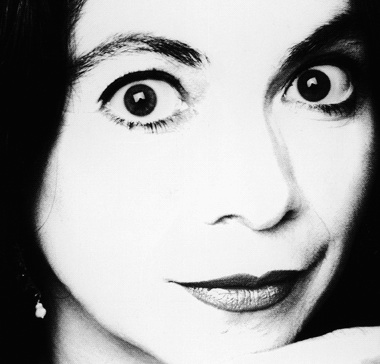
Svetlana Alexievich, Winner of the 2015 Nobel Prize for Literature

Svetlana Alexievich, Winner of the 2015 Nobel Prize for Literature

I have only read two of her books so far, but they were both knockouts. First, there was Zinky Boys (1991), about the Soviet experience in Afghanistan. Now, added to that is Voices from Chernobyl: The Oral History of a Nuclear Disaster (1997). Both books are descriptions of incredible suffering, and they are both powerful disincentives from enlisting in the Soviet military.

Svetlana Alexievich (b. 1948) is usually described as a Belorussian journalist, though she herself rejects the title: She has been known to edit the first person testimonials from one edition to the next, which is a big no-no for oral historians, but the mark of an imaginative writer. I do not mind, because I will accept 99-44/100% accuracy if it involves stylistic or other improvements.

Both Afghanistan and Chernobyl were unspeakable disasters that seemed to go on forever (the latter is still claiming victims), and you cannot hope for a better introduction to both than read Alexievich’s books.

In Voices from Chernobyl, the wife of one Soviet soldier who was involved in the cleanup says:

They say, “Chernobyl,” and they write, “Chernobyl.” But no one knows what it is. Something frightening opened up before us. Everything is different for us: we aren’t born the same, we don’t die the same. If you ask me, How do people die after Chernobyl? The person I loved more than anything, loved him so much that I couldn’t possibly have loved him more if I’d given birth to him myself—turned—before my eyes—into a monster. They’d taken out his lymph nodes, so they were gone and his circulation was disrupted, and then his nose kind of shifted, it grew three times bigger, and his eyes became different—they sort of drifted away, in different directions, there was a different light in them now, and I saw expressions in them I hadn’t seen, as if he was no longer himself but there was still someone in there looking out. Then one of the eyes closed completely.

I do not recommend reading the book on a full stomach. The same with Zinky Boys:

We were combing through a village. You fling open the door and throw in a grenade in case there’s a machine-gun waiting for you. Why take  a risk if a grenade could sort it out for you? I threw the grenade, went in and saw women, two little boys and a baby in some kind of box making do for a cot.

You have to find some kind of justification to stop yourself going mad. Suppose it’s true that the souls of the dead look down on us from above?

I know that we considered the Soviets to be our enemies, but these books describe scenes that one wouldn’t wish upon one’s worst enemy.


Regarding Henry

Henry Miller (1891-1980)

Henry Miller (1891-1980)

Is Henry Miller famous? Or is he just infamous? Or is he both?

I have just finished reading a book of his essays, reviews, and prefaces entitled Stand Still Like the Hummingbird (1962) and find myself alternately idolizing and deploring the man’s work. Of course, he is probably most famous for his novels featuring S-E-X, especially The Tropic of Cancer (1934). And yet, he can write like a Bodhisattva, as in the essays “The Hour of Man” and “The Immorality of Morality.”

In the latter essay, he wrote what I regard as the definitive answer as to how to live in the era of Trump:

Neither would I urge one to run away from the danger zone. The danger is everywhere: there are no safe and secure places in which to start a new life. Stay where you are and make what life you can among the impending ruins. Do not put one thing above another in importance. Do only what has to be done—immediately. Whether the wave is ascending or descending, the ocean is always there. You are a fish in the ocean of time, you are a constant in an ocean of change, you are nothing and everything at one and the same time. Was the dinner good? Was the grass green? Did the water slake your thirst? Are the stars still in the heavens? Does the sun still shine? Can you talk, walk, sing, play? Are you still breathing?

And yet, in another essay entitled “To Read or Not To Read,” Miller brags about reading fewer books “I tried to make it clear that, as a result of indiscriminate reading over a period of sixty years, my desire now is to read less and less.”

One of Miller’s Water Colors

One of Miller’s Water Colors

Is it perhaps because Miller also sees himself as a painter, particularly of water colors? The ones I have seen are pretty good, and I shouldn’t be surprised if the author likes the act of pure creativity involved in coming up with these scenes, which he does not paint from life.

In the end, I see Henry Miller as, at times, gifted by his muses—and at other times merely producing when the muses aren’t present. There is a certain lack of consistency in his work. I will continue to read him for the times I find he is spot on.

L.A. Writers: James Ellroy’s Dark Places

James Ellroy, Age 10, with His Murdered Mother

James Ellroy, Age 10, and His Murdered Mother

Given his childhood, it is no wonder that the vision of crime novelist James Ellroy is full of dark places. At the age of 10, he experienced being orphaned when his divorced mother, Jean, was raped and murdered. To this date, the crime has not been solved. But it has resonated through the work of its littlest victim.

To date, I have read seven of his novels, most of which are set in Los Angeles. You can believe me when I say that the author’s L.A., the sun doesn’t shine much. He is perhaps most famous for his L.A. Quartet, which consists of:

  • The Black Dahlia (1987)
  • The Big Nowhere (1988)
  • L.A. Confidential (1990)
  • White Jazz (1992)

As a reviewer for National Public Radio wrote, “His L.A. might not be a city of angels, but the devils he conjures up tell one hell of a tale.”

At times, Ellroy twists the English language into a strange rhythm, as if he were the American Louis Ferdinand Céline. Some of his books, such as White Jazz and American Tabloid, are sometimes difficult to read because of their driving, staccato style. But the energy keeps you moving along. When you are finished with one of his books, you need to relax a bit.

I just finished reading Blood on the Moon (1984), which is set on an axis from West Hollywood (“Boys’ Town”) to Silverlake, with occasional visits to the LAPD’s Parker Center downtown. The novel has a fine local feel that is the hallmark of a real L.A. writer. He may have set some stories elsewhere, but L.A. is somehow the real center of his oeuvre.

Below is a picture of the writer as he is today:

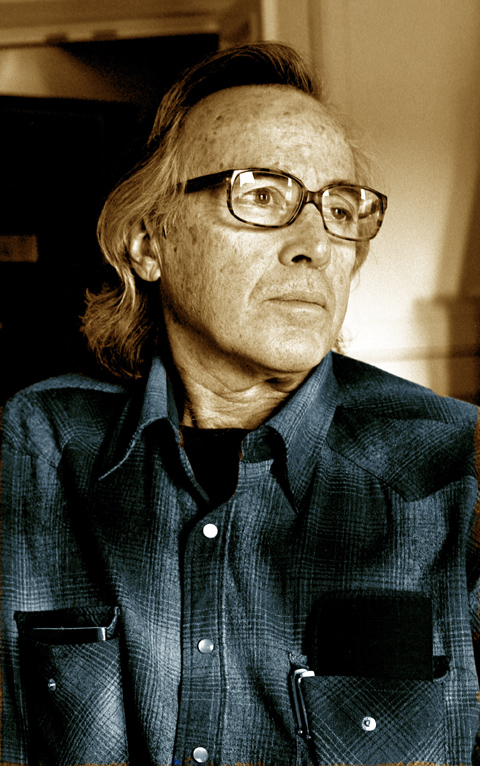
James Ellroy Today

James Ellroy Today

I met the author several years ago when he spoke at the Los Angeles Times Book Festival back when it was still being held at UCLA. I remember his strange description of how he spent his hours alone in the dark, carrying on imaginary conversations with women who were not in the room with him.

Dark. Strange. Indeed—but also brilliant.