Serendipity: “Nothing Perishes”

C. K. Scott Moncrieff, Translator

C. K. Scott Moncrieff, Translator (Painting by Edward Stanley Mercer)

This is a translation of a passage by the Roman poet Ovid from The Metamorphoses. The remarkable thing is that is was made by a thirteen-year-old boy who later grew up to translate Marcel Proust’s multi-volume masterwork, In Search of Lost Time:

Everything is changed but nothing perishes. The spirit wanders, going hence, thither, coming thence, hither and takes possession of any limbs it pleases. With equal ease it goes from beasts into human bodies and from us into beasts, nor in any length of time does it fail. And as wax is easily moulded in new shapes, nor remains as it had been before, nor keeps the same form, but is yet itself the same; so do I teach that the soul is ever the same, but migrates into different shapes.

Although many think that Scott Moncrieff’s translations are growing a little long in the tooth, there is no doubt of their excellence. As Walter Kaiser wrote in The New York Review of Books (June 4, 2015):  “Not surprisingly, Scott Moncrieff’s translations from Latin and Greek in the examination that year [1903] were awarded higher scores than anyone else’s, for it turns out that the astutely ingenious, poetic use of language for which he is celebrated in his great translation of Proust was his from an early age.”


Summer in Balbec

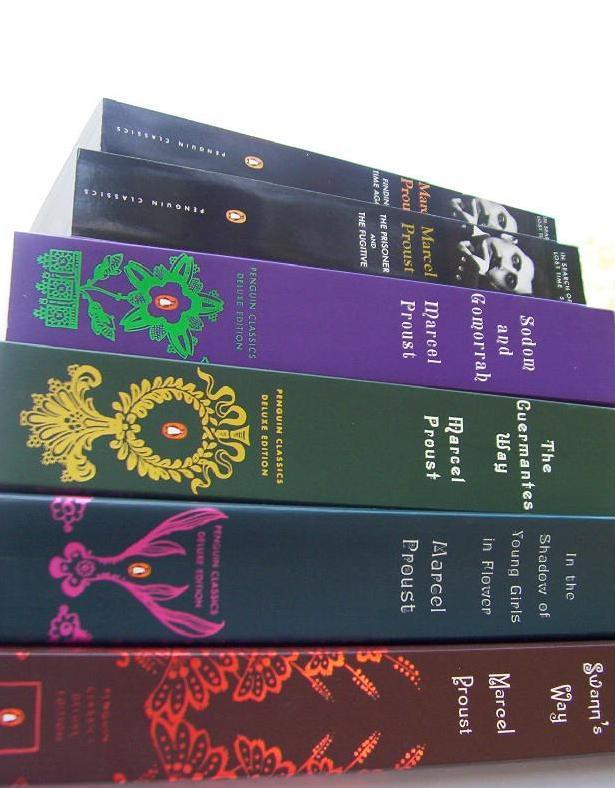
The Viking Penguin Edition of Proust Edited by Christopher Prendergast

The Viking Penguin Edition of Proust Edited by Christopher Prendergast

It has been beastly hot in Southern California, but I have been diverted from mere animal sweating by reading Marcel Proust’s In the Shadow of Young Girls in Flower as translated by James Grieve. Although his translation is considered the bastard orphan of the series as pictured above, I still loved it—after reading the authoritative C. K. Scott-Moncrieff translation twice.

Generally, it takes me a whole decade to go through the entire In Search of Lost Time, but it’s time well spent. I hope to tackle The Guermantes Way (again, for the third time) after my vacation; and I hope to live long enough for at least one or two more complete re-readings.

Many who have tackled Swann’s Way have been put off by its opening, in which young Marcel schemes for about fifty pages to have his mother come in to his bedroom and kiss him goodnight despite his father’s general disapproval of the practice. Then there are those long sentences that seem to go on forever—but which carry a significant amount of meaning in the process. Once you get over those two hurdles, the rewards come fast and furious.

Chief among those rewards is being in the mind of Marcel, the narrator. (He never gives his last name.) His hopes and desires are sketched with such intensity that few have experienced in this life. These relate to his family, his acquaintances, his heroes, his reading, his knowledge of art (just tracking the paintings he mentions is a full-time job), and his loves.

In the Shadow of Young Girls in Flower is mostly about his two main loves, Gilberte Swann and Albertine Simonet. In the first volume of the book, he reluctantly gives up on Gilberte, who has on occasion treated him contemptuously. Still, he hangs out with her parents hoping to demonstrate to the daughter that he is worthy of her attention.

In the second volume, Marcel is with his grandmother at the seaside resort of Balbec. There, he meets Robert de Saint-Loup, who becomes his friend, and the “little gang” of girls that become his obsession. Of the latter, Marcel toys with Andree, Rosemonde, and Gisele, but his real obsession is for Albertine. The book just stops short of the relationship with her actually commencing. (That, and Marcel’s anxieties about Albertine, are for the later volumes.)

Reading Proust takes a long time: I devoted two weeks to this book, but I loved every minute of it.

One Word Makes a Difference

Argentinian Writer Jorges Luis Borges (1899-1986)

Argentinian Writer Jorge Luis Borges (1899-1986)

There is a wonderful novel by José Saramago called The History of the Siege of Lisbon (1989) in which a historian introduces a single word—“not”—to indicate that Crusaders failed to help lift the Portuguese king lift the siege of the city of Lisbon from the attacking Moors. The other day, I saw an article in the I Love Chile News in which the word “not” was inadvertently omitted, changing the whole sense of the passage.

In an interview with Maria Kodama, Borges’s widow, the I Love Chile News said that the Nobel Prize Committee actually wanted Borges to accept an honor from dictator Augusto Pinochet. It is generally thought that the Committee refused to give the Nobel Prize for Literature to Borges because he was hobnobbing with rightist dictator. Following is the text of the story as it was printed:

According to an interview with the Spanish newspaper El País, before traveling to Chile in 1976 to receive an honorary award of the Faculty of Philosophy and Humanities of the University of Chile, the author received a call from Stockholm.

He was awarded the Nobel Prize and they warned him that he should [here’s where the “not” belongs] go forward with his visit to the South American country.

According to Kodama, Borges told the Nobel Foundation member: “Look, gentleman: I am grateful for your kindness, but after what you just told me my duty is to go to Chile. There are two things that a man can not allow: bribe or be bribed. Thank you very much, good morning.”

Historical Background

Borges arrived in Chile in mid-September, in the same days in which the socialistic ex-chancellor Orlando Letelier was murdered in Washington.

A few months earlier, Borges had already received the Order of Bernardo O’Higgins from the Chilean embassy in Buenos Aires. It was the highest honor you could receive from the military dictatorship as a foreigner at the time.

In his acceptance speech in Santiago, Borges paid tribute to the repression by saying that “in this era of anarchy in here, between the mountains and the sea, there is a strong country. (The Argentine poet Leopoldo) Lugones preached strong homeland when he spoke of the time of the sword. I declare to prefer the sword, the clear sword, to the furtive dynamite,” he said, quoting a verse.

“And I say this knowing very clearly, very precisely, what I say. Well, my country is emerging from the swamp, I think, with happiness. I think we deserve to go out of the morass in which we were. We are already going through the work of swords, exactly. And here they have already emerged from the swamp. And here we are: Chile, the region, the country, which is both a long country and an honorable sword,” said Borges.

At the time Argentina was under the dictatorship of General Jorge Videla, who according to official figures killed thousands of people during the repression.

The next day, Borges also met Pinochet and said “he is an excellent person, his warmth, his goodness … I’m very satisfied … The fact that here, also in my country, and in Uruguay, the freedom and the order is saved, especially in an anarchy continent, a continent undermined by communism. I expressed my satisfaction, as an Argentine, of which we should have here nearby a country of order and peace.”

There are several things questionable about the story. I doubt that the Nobel Prize Committee would have been so overt about dangling the award in front of Borges. It may well be true that kowtowing to Pinochet cost Borges his Nobel, but Ms. Kodama has been known to embroider the facts on occasion.

Dreaming of Proust

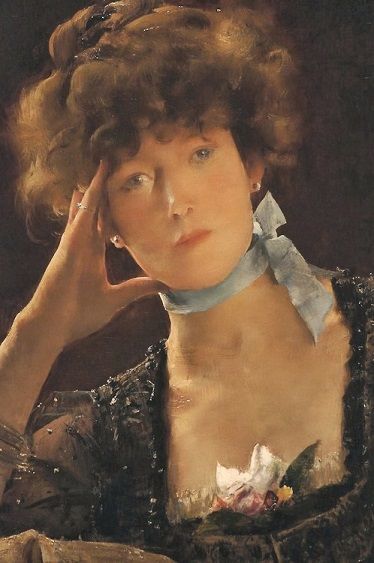
Alfred George Stevens’s “Portrait of Sarah Bernhardt” (1885)

Alfred George Stevens’s “Portrait of Sarah Bernhardt” (1885)

When you’re a hopeless intellectual like me, you, too, will have dreams that smack of literary criticism. This one is from last Saturday night. Despite the hot, humid weather we’re having in Los Angeles, I had just begun re-reading the second volume of Proust’s In Search of Lost Time, in the David Grieve translation called In the Shadow of Young Girls in Flower. (That title alone gives rise to dreams of a sort.)

Marcel has finally won the right to go to the theater to see the great actress La Berma (thought to be Sarah Bernhardt) as Racine’s Phèdre, albeit chaperoned by his grandmother. Feeling he is about to be exposed at long last to the holy grail, Marcel awaits the magical moment. It comes, but, alas, the lad is disappointed. Although he claps and cheers madly with the audience, Marcel feels that the actress did not live up to her hype.

That’s where my dream begins. I am thinking: Well, now, the entire heptology is full of disappointments: In the first volume Swann is cruelly deceived by his love, Odette de Crécy … but marries her anyhow. Marcel idealizes the ancient nobility of the Oriane, Duchesse de Guermantes, but gives us ample opportunities throughout the series to see how trivial her decorous life has become. As for Palamède, Baron de Charlus, he is given to affairs with lower class young men and, in the final volume, ends up being flagellated by one of them in a male bawdy house. Albertine does wind up in a relationship with Marcel, but he agonizes constantly that she is bi-sexual. Besides, she dies young.

Again and again, it almost seems as if Proust’s grand theme is either “You can’t always get what you want” or “Nothing is as good as it seems at first.”

And that’s where my dream left off. In the end, though, I rejected my dream interpretation. Marcel’s inner life is so vivid and intense that all the disappointments still make it all worthwhile. If that negativity were the only thing I got from reading Proust, why would I be reading the seven volumes for a third time? (Er, aside from THAT, I mean).

Incidentally, the original Stevens portrait of Sarah Bernhardt (above) is at the Hammer Museum in Westwood, near my place of work.


The Most Influential Books in My Life

I Read All These Books Multiple Times, Starting at Least Thirty Years Ago

I Read All These Books Multiple Times, Starting at Least Thirty Years Ago

These are not necessarily the greatest books I have ever read. They are, however, the ones that have most influenced me. Each of them, I have read multiple times, and I first read them all before 1985. I have presented them here in alphabetical order by author:

  1. Anonymous. Njals Saga. Why haven’t more Americans read this book? It tells of a time when Iceland was governed by clans, and justice was crude but effective. It’s one of two Icelandic sagas that have a museum dedicated to them. The Njals Saga museum is in Hvöllsvollur, and I have visited it twice. The other honors Egils Saga and is located in Borgarnes.
  2. Balzac, Honoré de. Old Goriot. How does a young man make his way through life? Balzac’s hero, Eugène de Rastignac, is one of the great heroes in fiction.
  3. Borges, Jorge Luis. Labyrinths. Borges has been one of my teachers, having turned me on to so many of the books, people, and places that have mattered in my life. I am re-reading it now for the fifth time.
  4. Chatwin, Bruce. In Patagonia. Maybe not every word that Chatwin writes is true, but even his fictions have lured me to the southern tip of Argentina twice, and soon, for the third time.
  5. Chesterton, G. K. The Man Who Was Thursday. Learn with Gabriel Syme how to see the lamppost from the light of the tree instead of vice versa. Here we are in the world of paradox.
  6. García Marquez, Gabriel. One Hundred Years of Solitude. This is a book I bought at a souvenir stand at the ruins of Chichén Itzá in Yucatán. It showed me that life was magical.
  7. Highet, Gilbert. The Art of Teaching. Originally, I wanted to become a college professor. I never quite made it, but Highet made me wish I had. I first read this book while I was in high school.
  8. Orwell, George. Keep the Aspidistra Flying. Another high school read: How does one tread the fine line between genteel poverty and selling out?
  9. Proust, Marcel. In Search of Lost Time. I am reading this now for the third time. I hope to live to read it several times more. Generally, it takes me a decade to re-read all seven novels in the series. When reading it, I am totally absorbed in the world of Marcel.
  10. Strunk, William and White, E. B. The Elements of Style. Strunk & White showed me that good writing is essentially simple and direct. Another classic from my teen years.

I could easily add more titles, but these titles keep swirling around in my head and influencing me.


The Antiquarian

It’s Funny How Times Change....

It’s Funny How Times Change….

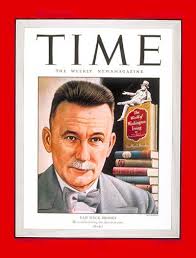
In the 1940s, Van Wyck Brooks’s reputation was riding high. There he is in 1944 on the cover of Time magazine, along with an inset photo of his book which I have just finished reading: The World of Washington Irving. Go to a used book store, and you won’t have much trouble finding nice hardbound copies of his best books, titles like The Flowering of New England, The Times of Melville and Whitman, and New England: Indian Summer. Go to a new book store, and you are not likely to find any of his work.

I guess it’s all a matter of fashion. I read The World of Washington Irving and The Flowering of New England with rapt attention, Brooks’s knowledge of his subject matter was nothing less than awesome. But the tone is different from today’s literary critics. Brooks was an antiquary: He worshiped and celebrated the past, which for him was a pageant from beginning to end.

Take, for example, this quote from a letter written by Philip Pendleton Cooke to Edgar Allan Poe, about how rural Southerners were no longer as literate as they used to be:

My wife enticed me to visit her kinspeople in the country, and I saw more of guns and horses and dogs than of pens and paper. Amongst dinners, barbecues, snipe-shooting, riding parties, etc., I could not get my brains into humour for writing to you or to anybody else.

And yet, Brooks had, I felt, a better of understanding of Poe than any other writer I have read:

Meanwhile, the tales Poe was writing had much in common with [his poems],—and they were sometimes as musical in the beauty of their prose,—and there one also found dim tarns, wild and dreary landscapes and phantom figures flitting to and fro. Evil things in robes of sorrow presided over some of these tales, with their strange effects of horror, the macabre and the grotesque, a world of the phantasmagoric, suggesting the dreams of an opium-eater and reverberant with Thomas de Quincey’s “everlasting farewells.”

Brooks is one of those writers who sends me looking for new authors. The Flowering of New England introduced me to Francis Parkman, and I suspect that The World of Washington Irving will send me on a similar voyage of discovery with its eponymous writer as well as William Bartram, John James Audubon, William Cullen Bryant, and James Fenimore Cooper.

Not coincidentally, I want to read more Brooks. Perhaps I, too, am an antiquarian of sorts, but nowhere in his league!

“The Absence of Life”

The Beast in the Jungle?

The Beast in the Jungle?

In his An Introduction to American Literature, Jorge-Luis Borges wrote of Henry James, “Despite the scruples and delicate complexities of James his work suffers from a major defect: the absence of life.” Borges got Henry James wrong, just as he got William Faulkner wrong. I can understand, because I thought the same about James—up until the time I actually started reading him.

Granted he can appear to be insufferably bland and insufferably gentlemanly. At the same time, he knew what he was about; and he had a moral sense that was more finely wrought than almost all other writers. In his story “Maud-Evelyn,” he writes about a middle-aged couple called the Dedricks:

“Whom do they know?”

“No one but me. There are people in London like that.”

“Why know no one but you?”

“No—I mean no one at all.  There are extraordinary people in London, and awfully nice. You haven’t an idea. You people don’t know every one. They lead their lives—they go their way. One finds—what do you call it?—refinement, books, cleverness, don’t you know, and music, and pictures, and religion, and an excellent table—all sorts of pleasant things. You only come across them by chance; but it’s all perpetually going on.”

Sounds rather boring, doesn’t it?—until, that is, you find out what the Dedricks are up to with their dear-departed daughter. With James, it’s all too easy to get stuck on this surface frou-frou.

Henry James

Henry James

If you read James’s best story, “The Beast in the Jungle,” you will have the pleasure of seeing James write about himself under the name of John Marcher. Our Mr. Marcher feels that he is being reserved for an unknown and dire fate. His woman friend May Bartram puts it this way: “You said you had from your earliest time, as the deepest thing within you, the sense of being kept for something rare and strange, possibly prodigious and terrible, that was sooner or later to happen to you, that you had in your bones the foreboding and the conviction of, and that would perhaps overwhelm you.”

We spend about forty pages then trying to find out the nature of this curse. In the meantime, John Marcher does not fall in love, though he has a sort of Darby-and-Joan relationship with May Bartram. One pictures him sitting by, his shoulders hunched against the threat of what he calls “the beast in the jungle” that is waiting around some dark corner to pounce on him. In the meantime, May sickens and dies, but not before suspecting the nature of Marcher’s curse.

Eventually Marcher, too, finds out, as he watches a grieving mourner at the cemetery near May’s grave. And the nature of the beast?

The fate he had been marked for he had met with a vengeance—he had emptied the cup to the lees; he had been the man of his time, the man, to whom nothing on earth was to have happened. That was the rare stroke—that was his visitation…. The Beast had lurked indeed, and the Beast, at its hour, had sprung.

Think of Henry James as a John Marcher: He never gets married or falls in love. He exchanges social amenities with all the best people. But he uniquely knows that his very bloodlessness chills many readers to the bone.

The truth is an elusive quantity. Sometimes it comes best expressed by a writer whom one chronically underestimates because of his style of life.


Smurov Is Alive—and Dead!

First, You Have to Understand About Schrödinger’s Cat

First, You Have to Understand About Schrödinger’s Cat

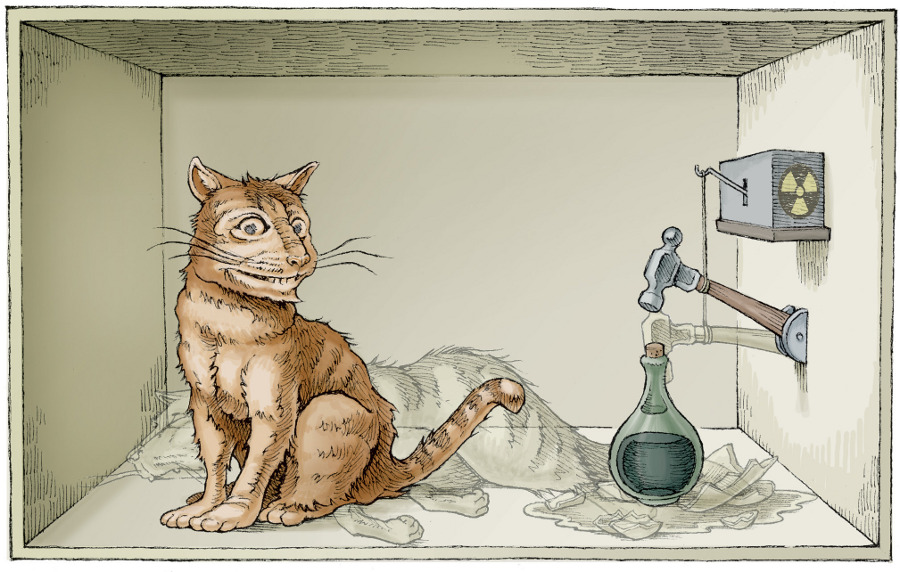
Vladimir Nabokov in his 1930 novelette The Eye seems to have anticipated Austrian physicist Erwin Schrödinger’s famous thought experiment of 1935. According to Wikipedia, it goes as follows:

Schrödinger’s cat: a cat, a flask of poison, and a radioactive source are placed in a sealed box. If an internal monitor detects radioactivity (i.e. a single atom decaying), the flask is shattered, releasing the poison that kills the cat. The Copenhagen interpretation of quantum mechanics implies that after a while, the cat is simultaneously alive and dead. Yet, when one looks in the box, one sees the cat either alive or dead, not both alive and dead. This poses the question of when exactly quantum superposition ends and reality collapses into one possibility or the other.

Naturally, most people do not entertain the notion of being alive and dead at the same time.  Yet in The Eye, the narrator Smurov commits suicide at the very beginning after having been ignominiously caned by the husband of his mistress Matilda. The rest of the story consists of Smurov investigating his own life among the Russian emigré population of Berlin, finding that he is roundly disliked by most everyone.

So, the question arises: Is Smurov alive or dead? Or is Smurov both alive and dead? (Or could the narrator be unreliable, having missed his heart with the revolver bullet?)

In an article in the May 2, 2015, issue of The New Scientist, Douglas Heaven speculates:

For [Physicist John Archibald] Wheeler, this meant the universe couldn’t really exist in any physical sense—even in the past—until we measure it. And what we do in the present affects what happened in the past—in principle, all the way back to the origins of the universe. If he is right, then to all intents and purposes the universe didn’t exist until we and other conscious entities started observing it.

Sound crazy? Then try this one on for size. Another interpretation of quantum mechanics is Hugh Everett’s many worlds hypothesis, which posits that everything that could happen has and does, in an infinite number of universes. Every time you make a decision, the universe splits in two, with you in one branch and an alternative you in the other, living the other possibility. The universe you occupy is, in some sense, an individual universe of your own making.

This idea is enough to give anyone a reality check. “My natural inclination is to be a realist,” says Chris Timpson, a philosopher of physics at the University of Oxford. “But if you’re going to be a realist about the quantum world then you’re left with a world that is very peculiar.” So peculiar, in fact, that the idea that it only exists because of us seems almost sensible.

There now, I’ll leave it up to you to decide whether Smurov is alive or dead or both. It all depends on your understanding of quantum mechanics in any universe you appear to be inhabiting at the moment, whatever THAT means!


Tarnmoor’s ABCs: William Shakespeare

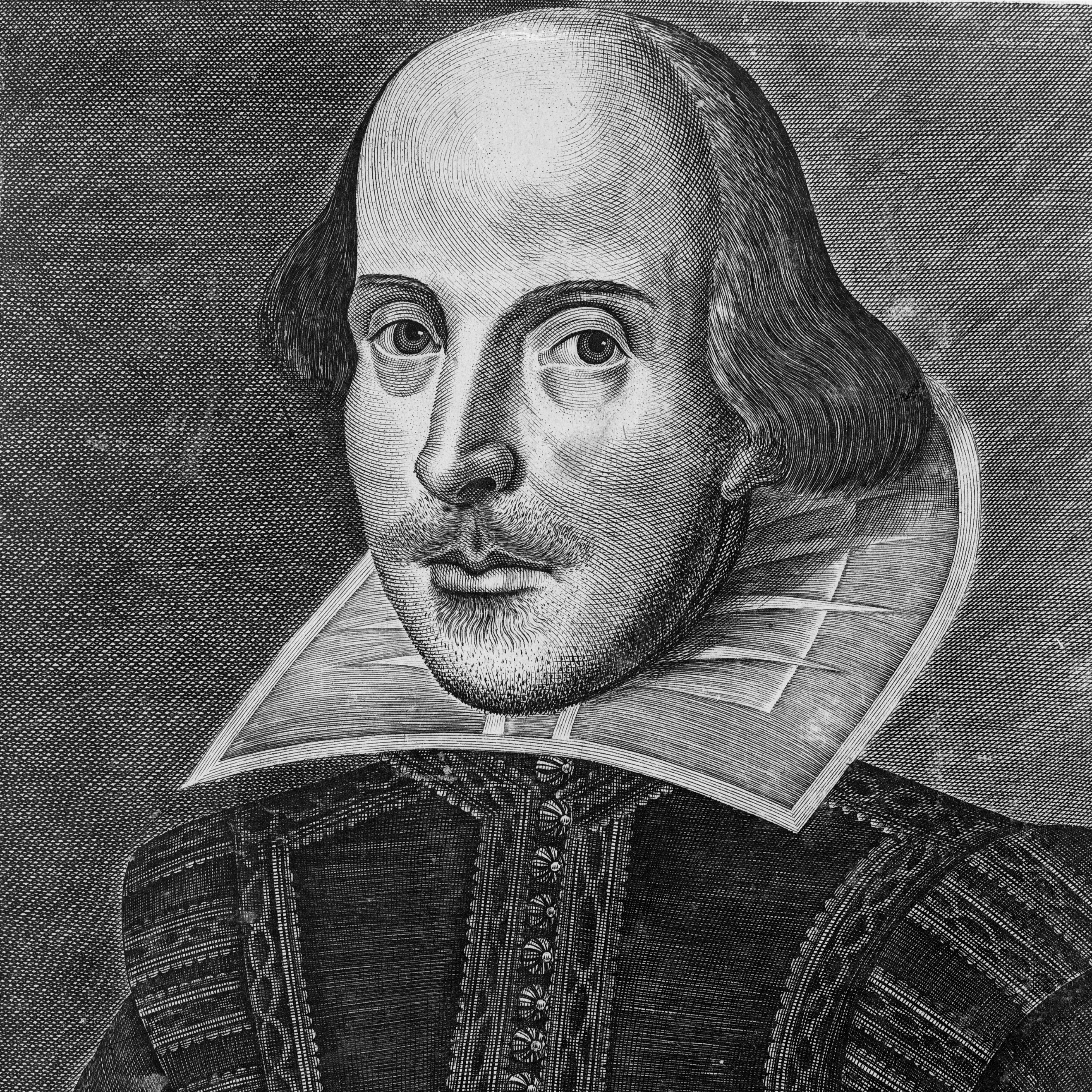
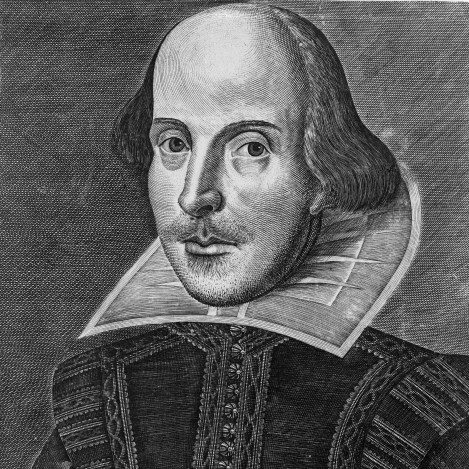
The Famous Droeshout Portrait of the Bard

The Famous Droeshout Portrait of the Bard

All the blog posts in this series are based on Czeslaw Milosz’s book Milosz’s ABC’s. There, in the form of a brief and alphabetically-ordered personal encyclopedia, was the story of the life of a Nobel Prize winning poet, of the people, places, and things that meant the most to him.

My own ABCs consist of places I have loved (Iceland, Patagonia, Quebec, Scotland), things I feared (Earthquakes), writers I have admired (Chesterton, Balzac, Proust, and Borges); locales associated with my past life (Cleveland, Dartmouth College, and UCLA), people who have influenced me (John F. Kennedy), foods I love (Olives and Tea), and things I love to do (Automobiles and Books). This blog entry is my own humble attempt to imitate a writer whom I have read on and off for thirty years without having sated my curiosity. Consequently, over the weeks to come (there are only three letters left in the alphabet: X, Y, and Z), you will see a number of postings under the heading “Tarnmoor’s ABCs” that will attempt to do for my life what Milosz accomplished for his. To see my other entries under this category, hit the tag below marked “ABCs”. Today is W for William Shakespeare.

On one hand, it is pretty easy to make fun of the Immortal Bard. The following is from Jonathan Miller’s On Further Reflection: 60 Years of Writing:

Take this my hand, and you fair Essex this
And with this bond we’ll cry anon
And shout Jack Cock o’London to the foe.

Or: “Is it botched up then, Master Puke?” Or: “Now is steel ’twixt gut and bladder interposed.”

If one is not in the habit of reading difficult or old works, tackling Shakespeare can be a chore. His rich, even overripe, use of language goes against everything we have been taught about written communication. And yet, and yet, there are many complex thoughts and emotions that have never been better expressed before or since.

Over the last six months, I have been reading the “tetralogy” of Henry VI Parts 1, 2, and 3, followed by Richard III. Not too many people venture to read Henry VI, but from them come some great thoughts, such as this from Part 2, scene 3:

What stronger breast-plate than a heart untainted!
Thrice is he arm’d, that hath his quarrel just;
And he but naked, though lock’d up in steel,
Whose conscience with injustice is corrupted.

Also from Henry VI comes such phrases as “main chance,” “let’s kill all the lawyers,” “I owe him little duty and less love,” “O, tiger’s heart, wrapped in a woman’s hide!,” and “hasty marriage seldom proveth well.”

And yet these are all in a minor key when you compare them to the four great tragedies—Hamlet, Macbeth, King Lear, and Othello—which will shake the world of whoever reads, hears, or sees the plays. Take this from the wretched Lear in Act IV:

Ay, every inch a king:
When I do stare, see how the subject quakes.
I pardon that man’s life. — What was thy cause? —
Adultery? —
Thou shalt not die: die for adultery! No:
The wren goes to’t, and the small gilded fly
Does lecher in my sight.
Let copulation thrive; for Gloster’s bastard son
Was kinder to his father than my daughters
Got ’tween the lawful sheets.
To’t, luxury, pell-mell! for I lack soldiers. —
Behold yond simpering dame,
Whose face between her forks presages snow;
That minces virtue, and does shake the head
To hear of pleasure’s name; —
The fitchew nor the soiled horse goes to’t
With a more riotous appetite
Down from the waist they are centaurs,
Though women all above.
But to the girdle do the gods inherit,
Beneath is all the fiend’s; there’s hell, there’s darkness,
There is the sulphurous pit; burning, scalding, stench, consumption! — fie, fie, fie! pah, pah! Give me an ounce of civet, good apothecary, to sweeten my imagination: there’s money for thee.

I will continue reading the history plays, and then I’ll tackle the tragedies and comedies again. Shakespeare just gets deeper as you continue reading. One is never done with him.


Down On His Luck

From a New Book on LA Crime Scene Photos from 1953

From a New Book on LA Crime Scene Photos from 1953

Crime writer James Ellroy has come out with a new book of crime scene photos from 1953. The book is called, simply, LAPD ’53. The victim is one Jésus Fernández Muñoz, who, according to Ellroy’s description, was “a good guy down on his luck. The coroner’s register one-sheet is perfunctory. It’s an accidental death. He was walking on or sleeping on a concrete beam below the Aliso Street bridge.” He suddenly dropped 50 feet to the hard surface of the L.A. River, which in that area is a concrete flood channel.

I always loved Ellroy’s L.A. detective novels, especially the so-called L.A. Quartet, consisting of:

  • The Black Dahlia (1987)
  • The Big Nowhere (1988)
  • L.A. Confidential (1990)
  • White Jazz (1992)

I’ve read a few others, but need to read more, as I think he is one of the best working today. And his picture of Southern California is right on the money. I understand he is working on a new series set in L.A.