Don’t Fall For His Poor Old Blind Man Act

Jorge Luis Borges

Jorge Luis Borges

It is easy to be fooled by Jorge Luis Borges (1899-1986). He spent the last couple decades of his life giving out interviews, some of them book-length. The damned thing of it all is that he was a devious interview subject. He would insist that he was apolitical:

I am not politically minded. I am aesthetically minded, philosophically perhaps. I don’t belong to any party. In fact, I disbelieve in politics and in nations. I disbelieve also in richness, in poverty. Those things are illusions. But I believe in my own destiny as a good or bad or indifferent writer.

Yes, but, at the same time he irked one Swedish literary critic that he single-handedly prevented Borges from receiving the Nobel Prize in Literature because, at one time, he accepted an honor from Chile’s dictator General Pinochet Ugarte. Also, he so burned up Juan Peron that he derisively appointed the Argentinean to be the poultry inspector for Buenos Aires.

In an article for the L.A. Review of Books that was reprinted by Salon.Com, Filipina writer Gina Apostol has an interesting perspective on Borges, who, as you may or may not know, is one of my favorite authors:

As a writer from the colonized world, I find Borges’s work almost intolerably revealing, as if spoken directly to the political debates that beset my country. Borges’s postcolonial critique and analysis in his ficciones are obscured by his philosophical sleights of hand, startling plots, and narrative wizardry, but though buried, his critique is powerful. In particular, I am struck by his logic of the inverse. His use of doppelgangers (sometimes triplegangers) and mirrors and refractions and texts within texts — spies that become victims, heroes that are villains, detectives caught in textual traps of their own making, translators who disappear in puffs of smoke in someone else’s writer’s block — in Borges’s stories, these astonishing mutations force us to see reality from new perspectives, force us to question our own encrusted preconceptions. While questions of ontology and Berkeleyan illusion and all those philosophical games beloved of Borges are paramount, the constant revisiting of the problems of fictionality and textuality in these stories have profound echoes for the postcolonial citizen, bedeviled by and grappling with questions of identity and nation, questions seething always under our every day, our working hours, our forms of art.

What I find interesting is that Borges himself claims he is an unreliable interviewee. He instructs his interviewers to doubt everything he says. Because he was an old blind man, we tended too often to give him the benefit of the doubt, when he was very artfully putting us on.

Because he lived through so many dictatorships, such as those of Peron and the juntas of the 1930s and 1970s, Borges has learned to be what Eastern Europeans used to call an aesopic writer. According to Dr. Gerd Reifahrt:

One possibility is for [authors] to seek refuge in the realm of the Aesopic. Aesop is said to have written fables in the sixth Century B.C. to veil his opinions, and writers 26 centuries later continue to use and develop his method. In symbolic and coded terms, they write fairy tales and fables, and employ myths and elements of folklore. New forms of discourse emerged, where political realities and social truths were referred to in symbolic and coded terms rather than explicitly mentioned, and where, concurrently, these realities and truths were re-framed and re-contextualized. Protest and subversion found a new voice.

So all those tricks with mirrors and identity that Jorge Luis Borges employs represent a sophisticated method of confronting what some dire realities were for Argentinians in the not too distant past. Apostol writes, “Borges’s writing was always, to some degree, a creative form of reading, and many of his best fictions were meditations on the condition of fictionality: reviews of invented books, stories whose central presences were not people but texts.” Behind the invented lay the unvarnished reality, which he confronted indirectly.



Mischa the Penguin

A Lone King Penguin Among Magellanic Penguins on Isla Pajaros

A Lone King Penguin Among Magellanic Penguins on Isla de Pájaros

Serendipity strikes again. I just read an obscure Ukrainian crime story by Andrey Kurkov entitled Death and the Penguin. The narrator is one Viktor Akelseyevich Zolataryov who writes for publication what his editor refers to as obelisks. These are obituary essays written about living people so that, when death comes to them, the newspaper is not caught short for materials to publish quickly. Oddly, though, it seems that all too many of the individuals Andrey memorializes in his deathless prose wind up … dead.

My favorite character is Viktor’s pet and companion, the King Penguin Mischa. When the zoo in Kiev was suffering a financial meltdown, they sold their penguins; and Viktor bought the one he called Mischa.

Mischa is very like the King Penguin at the right in the above picture, which was taken on the Isla de Pájaros on the Beagle Channel in Tierra Del Fuego. The largish penguin took a wrong turn into the Beagle Channel and wound up in a rookery consisting mostly of Magellanic Penguins and some Gentoos. It was obviously very lonely and disappointed. Every once in a while, he would try to mate with one of the Magellanic females, but caused uproars every time he tried.

Viktor’s Mischa shambles around the apartment, looking into the mirror, establishing a kind of hiding place behind some furniture, and displaying all the symptoms of a morose and puzzled disposition occasionally verging on depression. Even while Viktor worries that his writing job is connected with an assassination ring, Mischa slowly keeps getting worse. At the same time, he winds up taking care of Sonya, the daughter of one “Mischa-non-penguin,” who was associated with the editor who hired the writer, and who disappears after leaving money and a pistol. He also hires a teenage girl, the niece of his friend Sergey (who dies mysteriously) as a nanny for Sonya, who lethargically enters into a relationship with him.

I loved Death and the Penguin for its mellow strangeness. For a man surrounded by violent death, to which he may be contributing in some unexplained way, Viktor is relatively cool. Eventually, the situation changes rapidly. Mischa becomes ill and gets a heart transplant; and Viktor, well, let us say he takes action of an unexpected kind.

Reading in the Desert

Our Patio at the Borrego Valley Inn

Our Patio at the Borrego Valley Inn

Martine and I have just returned from four days in the Anza Borrego Desert, the largest contiguous state park in the United States. Compared to the larger National Parks, it is something of a poor orphan; but there is much to be seen. The only problem is it’s very much a do-it-yourself experience. The trails are not very well marked. On Friday, we took what we thought was the Narrows Trail off State Route 78, only to find that there was no clearly defined trailhead, no clearly defined trail, and a plethora of steps leading off in every direction. On Saturday we had better luck. Nonetheless, I even enjoyed our missteps.

Because she lived in Twenty Nine Palms for three years working at the Naval Hospital there, Martine does not value the desert as much as I do: I would not live there, but I find that a visit there helps clarify my mind and brings a sense of peace.

Shown above is our private patio at the Borrego Valley Inn in Borrego Springs. On the table are my two Kindles and a tall glass of ice water. I finally managed to finish reading Tony Judt’s massive Postwar: A History of Europe Since 1945, and I made a large dent in Junot Diaz’s The Brief Wondrous Life of Oscar Wao. While Martine watched television, I read hundreds of pages after returning from our day trips. The combination of exercise and reading concentrates the mind nicely.

In the days to follow, I will write several postings about our desert experiences.


Tarnmoor’s ABCs: Books

Some of My Books About Iceland

Some of My Books About Iceland

I was very impressed by Czeslaw Milosz’s book Milosz’s ABC’s. There, in the form of a brief and alphabetically-ordered personal encyclopedia, was the story of the life of a Nobel Prize winning poet, of the people, places, and things that meant the most to him. Because his origins were so far away (Lithuania and Poland) and so long ago (1920s and 1930s), there were relatively few entries that resonated personally with me. Except it was sad to see so many fascinating people who, unknown today, died during the war under unknown circumstances.

This blog entry is my own humble attempt to imitate a writer whom I have read on and off for thirty years without having sated my curiosity. Consequently, over the next few months, you will see a number of postings under the rubric “Tarnmoor’s ABCs” that will attempt to do for my life what Milosz accomplished for his. I don’t guarantee that I will use up all 26 letters of the alphabet, but I’ll do my best. My previous posting on this theme was last month.

Well, B is for Books, the love of my life. It all started before I could read … before I could even speak English. I remember my mother reading me stories (translating them into Hungarian). And when she didn’t have a story to read, she made up one. These were just as good as the published stories. I remember walking with her from our apartment on East 120th Street to the public library next to Harvey Rice School. A few doors down, between Buckeye Road and Van Aken, there was a very good doughnut shop where we would sometimes stop.

In 1951, after my brother Dan was born, we moved to the then treeless suburbs of the Harvard-Lee area. I guess my parents didn’t want to have two boys who couldn’t speak English. I was signed up to attend second grade (even though I completed only the first half of first grade at Harvey Rice—Shhh! Please don’t tell anyone) at Saint Henry School on Harvard Road.

Once I got a handle on the English language, by about the fourth or fifth grade, I started accumulating books. On one hand, my parents were delighted at my strides in understanding English. On the minus side, whenever they got some insurance document written in legalese, I had to interpret it for them. (Ever since, I have hated that fine print crap.)

Also, the books started getting to my parents. “Jimmy, why do you need so many books?” “Uh, because I just do.” “Well, pick up after yourself please.”

Years later, the books started getting to Martine. “Jimmy, why do you need so many books?” “Uh, because I just do.” “Well, pick up after yourself please.”

Actually, I have improved some. I now own two Kindles with fifteen hundred books on them. How many physical books do I own? Oh, somewhere around six or seven thousand.

Currently, I read something like ten books a month, usually literature and history, but some travel, science, economics, and philosophy on occasion. If you are curious about my bookish habits, I suggest you check out my page on Goodreads.Com. You’ll see reviews of every book I read. Click here. You can see links to reviews off to the right side of the four or five books I have read most recently.

I have always assumed that God would let me live as long as I have books to read. And I keep buying more books. It’s like finding the genie in the bottle and wishing for an infinite number of wishes.

Okay, so I’m a bit delusional.


Some Things Get Better

The Rare Ballantine Adult Fantasy Edition

The Rare Ballantine Adult Fantasy Edition

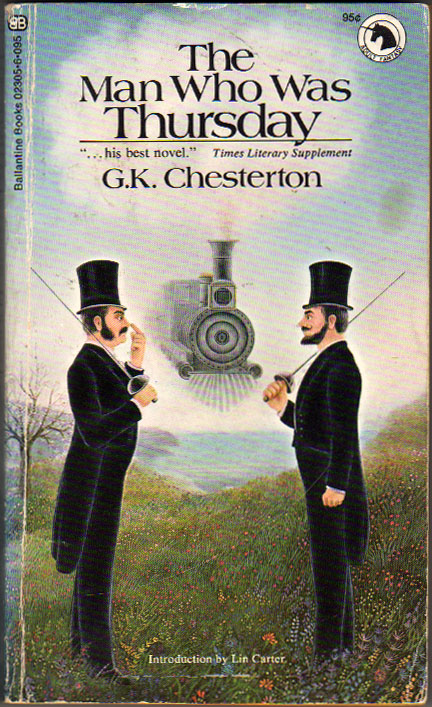
I am currently re-reading G. K. Chesterton’s The Man Who Was Thursday, perhaps his best work of fiction. I came to it first some forty years ago, and since then have read it two or three times. After going through all the Chesterton volumes at the Santa Monica Public Library—that took all of ten years—I decided to start collecting his work. At the outset, there weren’t many works in print. Fortunately, Ignatius Press of San Francisco started coming out with an edition of his Collected Works. To date, I have all the volumes that have been released so far: I say “so far” because they are still dribbling out at a rate of one or two a year.

Currently, all of Chesterton’s major works are in print, sometimes in multiple editions. It is only in some of the more abstruse titles such as GKC as MC, The Victorian Age in Literature, Sidelights of New London and Newer York, and William Cobbett that require some digging around. But Gutenberg.Com has full texts of more than forty of his works, including fiction, plays, essays, journalism, and poetry. (Click here and scroll about 40% of the way down.)

It isn’t easy to compile the complete works of someone who was so prolific as GKC. His short pieces appear in newspapers and magazines from all over the English-speaking world, many in publications which no longer exist. Fortunately, most of his books are still around. In fact, I would have been delighted (and bankrupted) if such were the case in 1986. I regularly scour the listings in eBay, but only once or twice a year can a find a title I don’t have on my shelves in some form.

In addition, Chesterton is also widely available cheap or free for readers of Kindles and other e-books.

Before I go any further, let me answer one question that might be hovering at the back of your mind if you’ve gotten this far: What is the point of reading Chesterton at all? I mean, didn’t he convert to Catholicism and write a whole lot of religious books?

Yes, he did—among scores of books not relating to religious subjects—despite the fact that the Catholic Church is considering canonizing him as a saint. Having read widely in both his religious and secular works, I think they are equally of value. His biographies of Saints Francis and Thomas Aquinas are well worth a read, as well as The Everlasting Man. He is probably most famous for the Father Brown stories, in which the hero/detective is a Catholic priest. Although his Catholicism certainly enters into the stories, it is not in an obtrusive way. (There is also an excellent 1954 British comedy called The Detective, starring Alec Guinness as Father Brown.)

What I like most about Chesterton is the way he exorcised his own demons, and he had a few. The early years of the Twentieth Century were an anxious time in Europe, with a nasty arms race between Britain and Germany, and the prospect of a war looming in the near horizon. At the same time, it was the high water mark of both anarchism and international socialism. And that was not to mention any personal demons lurking in the writer’s heart. GKC faced his demons with optimism, humor, and style. He did it so successfully that even today I will read an obscure Chesterton if I am feeling down in the dumps. In his own way, he is much like P. G. Wodehouse in that regard—but that is another story.


The World of Marcel

The Comtesse Elisabeth de Greffulhe (1886)

The Countess Elisabeth de Greffulhe (1886)

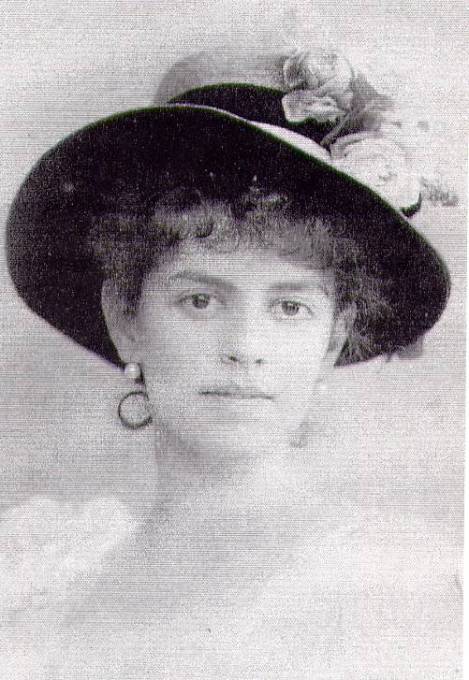
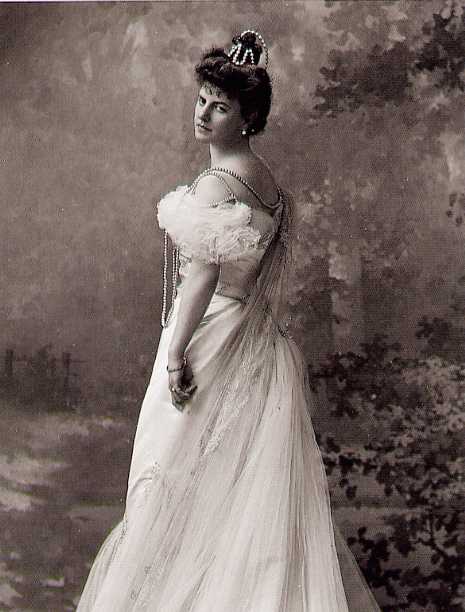
Marcel Proust’s In Search of Lost Time is one of the most incredible worlds to be found in all of literature. Stretched over seven volumes, it consists of some 3,000 pages published over a period of fourteen years, during the last several of which its author was no more. It tells of the life and loves of one Marcel (last name never supplied), who falls in unrequited love with a young girl named Gilberte Swann. At the same time, he adores—though not in a sexual way—the Duchess Oriane de Guermantes, who, in her person, represents the French aristocracy dating all the way back to the Middle Ages to the days of Gilbert the Bad. Above (and below) are illustrations of the Countess Elisabeth de Greffulhe, who is thought to be one of the models for the Duchess. Later he falls for bad girl Albertine Simonet, based on his male Italian chauffeur Alfred Agostinelli, the most successful transgender operation in fiction.

Over the last several days, I have read the last volume of the series—Finding Time Again—for the second time. I found myself so deeply involved in Proust’s world that I resolved to do a third reading of the entire series, beginning with Swann’s Way, during tax season. I can’t have enough of Proust’s world, such that I feel that I inhabit it in some way.

I see the Duchess de Guermantes in her elegant draperies and with her piercing azure eyes in my sleep. And sometimes in my waking hours. Here is another view of her, taken by the photographer Felix Nadar in 1900:

Countess Elisabeth de Greffulhe (1900)

The Countess Elisabeth de Greffulhe (1900)

The fin-de-siècle world of Marcel is a fragile one, with the horrendous Dreyfus affair on one side (fully as divisive as our own cultural divisions between religious conservatives and sane people) and the First World War on the other. Proust takes us through all, from his childhood to his doubts expressed in the last volume whether he can live long enough to do justice to his memories. Fortunately, he did. Although he never finished editing the last three volumes of the series, enough remains intact to warrant equating their quality to the first four.

Many of my friends cannot stand Proust. One, a very literate high school teacher of English, found Swann’s Way to be unreadable. In fact, we have not seen each other much after that because he thought I was reading too many works he regarded as being doubtful. What, Proust, doubtful? Far from doubtful, he is the Twentieth Century’s Gold Standard for other writers to aspire to, but never reach, not by a country mile.

This spring, I will return to the world Marcel made and dream of the piercing gaze of Oriane de Guermantes. It is as if I could see it already….

Sorrow and the Writer

Sorrow

Sorrow

Sometimes, when a painful section is still in rough draft, a new attachment, and new suffering, come along which enable us to finish it, to give it substance. One cannot really complain too much about these great but useful sorrows, because there is no shortage of them and they do not make us wait long for them. None the less, we have to hurry if we are to profit from them, for they do not last very long: one finds consolation, or else, if they are too overwhelming, and if one’s heart is no longer very sound, one dies. Because happiness alone is good for the body; whereas sorrow develops the strength of the mind. Moreover, even if it did not reveal a law to us each time this happened, it would be no less indispensable for returning us each time to the truth, forcing us to take things seriously, and uprooting each time the weeds of habit, scepticism, levity and indifference. Admittedly this truth, which is not compatible with happiness, or with health, is not always compatible with life either. Sorrow kills in the end. At each new, unbearable affliction, we feel yet another vein stand out, extending its deadly sinuosity across our temples, or under our eyes. And it is in this way that are gradually formed those terrible, ravaged faces of the old Rembrandt, and the old Beethoven, whom everybody used to laugh at.—Marcel Proust, Finding Time Again (Trans. Ian Patterson)

Noir

"William Irish" Was a Pen Name Used by Cornell Woolrich

“William Irish” Was a Pen Name Used by Cornell Woolrich

Over the past several months, I have been reading the large Library of America omnibus volume entitled Crime Novels: American Noir of the 1930s and 40s. Included were the following titles:

  • James M. Cain’s The Postman Always Rings Twice (filmed by Tay Garnett starring John Garfield and Lana Turner)
  • Horace McCoy’s They Shoot Horses, Don’t They? (Sidney Pollack’s 1969 film of this starred Jane Fonda)
  • Edward Anderson’s Thieves Like Us (made into a great Nicholas Ray film called They Live by Night)
  • Kenneth Fearing’s The Big Clock (made into a great John Farrow film with Ray Milland and Charles Laughton)
  • William Lindsay Gresham’s Nightmare Alley (another great John Farrow film, this time with Tyrone Power)
  • Cornell Woolrich’s I Married a Dead Man (published under the pen name William Irish)

So many of the noir novels of the period were turned into classic films that I begin to think the whole genre is a mirror in which we as Americans see ourselves. Although the British are just as famous with their detective novels, it was an American who invented the genre with Edgar Allan Poe’s stories such as “The Gold Bug,” “The Purloined Letter,” and “The Murders in the Rue Morgue.” And while Arthur Conan Doyle, Agatha Christie, Josephine Tey, and countless others were practicing their craft in Britain, their American counterparts created works that were more urban, more mean, and more essentially American.

Frankly, I came to the novels by way of the films. I was a collaborator (though in a minor way) with my friends Alain J. Silver and James Ursini in their genre-defining book Film Noir: The Encyclopedia published by Overlook Press. Other great resources are the same authors’ The Noir Style (also Overlook) and the Taschen Book entitled Film Noir.

Both the novels and the films generally tend to be excellent and well worth your time.

A Writer Who Understands People As They Are

Anton Chekhov (1860-1904)

Anton Chekhov (1860-1904)

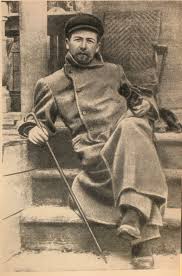
It started last summer, when I reread his novelette The Steppe in a Reykjavik guesthouse. I said to myself, “This is a writer who understands people as they are.” Tonight, I read his play The Seagull, which gives us a rural Russian estate and introduces us to a group of people of are dissatisfied with themselves and one another. If I have my way, I will read a good deal more of Anton Chekhov this next year. It is so easy to be cowed by Tolstoyevsky—as my late mother used to refer to the two giants of 19th century Russian literature—that one is prevented from reading their contemporaries.

This is a great pity, because there are so many great writers to choose from among their contemporaries. I am thinking not only of Chekhov, but also Ivan Goncharov, Nikolai Leskov, Ivan Turgenev, Mikhail Lermontov, and Alexander Pushkin. And I am sure there are half a dozen more that I just don’t know about yet.

Chekhov was a physician, a playwright, and perhaps the world’s greatest writer of short stories. In addition, he wrote a great travel book about a visit to the island of Sakhalin off the East coast of Siberia, which was an early prison colony. In addition to a description of the conditions there, we have his description of the trip there and back in the days before the Trans-Siberian Railroad was built.

Chekhov was a prolific writer who lived a short life. Like so many of his contemporaries, he was a victim of tuberculosis. As a doctor, he knew what was happening to him. Yet his writing never suffered any ill effects.

In addition to his plays, there are a handful of his stories that are well worth seeking out. My favorites are “The Steppe,” “The Lady with the Dog,” and “Ward Number Six.”

Judging a Book by Its Cover

In 1960, This Looked Ultra-Cool

In 1960, This Looked Ultra-Cool

It is always a good idea to re-examine from time to time a book or movie that had particularly impressed you. I decided yesterday to re-read A. E. Van Vogt’s Empire of the Atom (1957), which I first read around 1960, and twice subsequently. Its hero, Lord Clane is a mutant as a result of exposure to radioactivity. The time is at some remote point in the future, presumably after a nuclear war. All of Earth is under control of the House of Linn, which rules the planet as if it were the Roman Empire.

So very much, in fact, like the Roman Empire that the first half of the book was cribbed from Robert Graves’s 1934 classic I, Claudius. There is a one-to-one correspondence between Van Vogt’s characters and Graves’s Romans: Clane is Claudius; Creg, Germanicus; the Lord Leader, Augustus; Lydia, Augustus’s wife Livia; and Lord Tews, Livia’s son Tiberius. Only about 60% into the story does Van Vogt escape from his slavish borrowing. At least he doesn’t try to muddy his story by introducing an equivalent to Caligula. It bothers me that I did not notice all this when I re-read the book in 1990, years after I had read the Graves books and seen the BBC I, Claudius TV series.

Still, even with the plagiarism, there are numerous incongruities. The Linns have spaceships with which they conduct wars on Venus and Mars; yet their main weapons are bows and arrows, lances, and swords. They use nuclear energy, but regard it as a “gift from the gods.” Their gods, in fact, are Uranium, Plutonium, Radium, and Ecks (“X”?).

Well, then, what was it that drew me to this book? Pure and simple, I loved the cover (shown above). As a teen, I was a rather sickly individual with frequent headaches—by this time I already was suffering from the pituitary tumor (chromophobe adenoma) that was to reach a climax six years later. Clane was actually a handsome man provided he wore the flowing temple robes that hid his deformities:

After re-reading the message, [Clane] walked slowly to the full-length mirror in the adjoining bathroom, and stared at his image.

He was dressed in the fairly presentable reading gown of a temple scientist. Like all his temple clothing, the cloth folds of this concealed the “differences” from casual view. An observer would have to be very acute to see how carefully the cloak was drawn around his neck, and how tightly the arm ends were tied together at his wrists.

Whoever was responsible for the book’s dust jacket was a genius. Man, I wouldn’t have minded being a mutant if I had a face like that! But, like many teens, especially short, chubby ones, I used fantasy to escape the realities of my situation. Now, half a century and more onward, it doesn’t seem to matter as much any more. I am what I am, and I do not look unkindly on what and who I have become.