
From the Confederate Point of View

Historian Shelby Foote (1916-2005)

Historian Shelby Foote (1916-2005)

If you have ever seen the multipart Ken Burns documentary on the Civil War first broadcast by PBS in September 1990, you will undoubtedly remember Shelby Foote (above), who is famous for his trilogy The Civil War: A Narrative. For today, I decided to post my review of the second volume of his trilogy, covering the pivotal year of 1863.

Ever since I first came across the works of Bruce Catton in my teens, I have been an aficionado of the American Civil War. So much concentrated slaughter among peoples who resembled one another so much! Also, so many lessons to be learned about the arts of leadership, and what happens when they are lacking—as in all but the last generals in charge of the Army of the Potomac!

This is the second volume of three of historian Shelby Foote’s The Civil War: A Narrative. Nestled away in the “Bibliographical Note” section at the end is this revealing quote:

As for method, it may explain much for me to state that my favorite historian is Tacitus, who dealt mainly with high-placed scoundrels, but that the finest compliment I ever heard paid a historian was rendered by Thomas Hobbes in the forward to his translation of The Peloponnesian War, in which he referred to Thucydides as “one who, though he never digress to read a Lecture, Moral or Political, upon his own Text, nor enter into men’s hearts, further than the Actions themselves evidently guide him … filleth his Narrations with that choice of matter, and ordereth them with that Judgement, and with such perspicuity and efficacy expresseth himself that (as Plutarch saith) he maketh his Auditor a Spectator. For he setteth his Reader in the Assemblies of the People, and in their Senates, at their debating; in the Streets, at their Seditions; and in the Field, at their Battels.” There indeed is something worth aiming at, however far short of attainment we fall.

I don’t think Foote falls far short at all. In Periclean Athens, there was not much first-hand information upon which the historian could rely, whereas the Civil War is one of the most written-about episodes in all of world history. In addition to making his information vivid, Foote has to wade through terabytes of minutiae to find interesting episodes. One example: Southern General Nathan Bedford Forrest, encountering one of his men in headlong retreat, stopping him in his tracks, pulling down his trousers, and administering a savage spanking with a brush in front of his peers to motivate him to reconsider, which he did.

The period covered by the volume is calendar year 1863, in which two of the most decisive Union victories took place: Gettysburg and Vicksburg — right around the 4th of July. The other major battle discussed was Chickamauga, a Southern victory which ruined the careers of both generals, Rosecrans and Bragg, and which could have gone either way if a third of the Union line had not panicked and run. There is also a brief look-ahead to the spring of 1864, when U.S. Grant was named a Lieutenant General and appointed to the Army of the Potomac.

This 966-page book seems shorter than its weight would imply. That is due to Foote. In fact, this volume is so good that two extracts have been separately published as books: The Stars in Their Courses about Gettysburg and The Beleaguered City about Vicksburg, both of which are excellent reads in their own right.


Not Just About Rocks

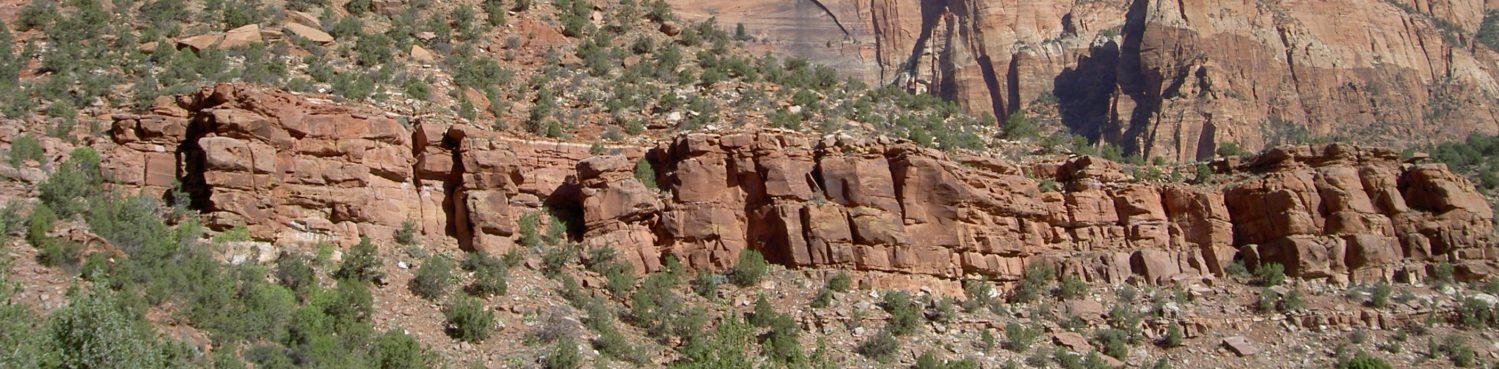
Zion National Park

Zion National Park

Geology is one of those subjects I would like to know much more about. Although I took the subject in college during late Ordovician times, it was all dictated by synclines, geosynclines, and anticlines, which I never quite understood—nor did the geologists who promulgated the notion.

Living as I do in the American Southwest, where the rocks are not covered by all that dirt, geology is something that seems more immediate. All the more so when the earth shakes as the tectonic plates are slowly marching on their pre-ordained paths to their next destination.

Geology is the history of what lies under our feet. It’s not just the study of rocks—though I can see where that could be interesting—but the study of long, slow processes that are changing the face of the earth. I saw some of those processes in action at Vatnajökull Glacier in Iceland, which has retreated hundreds of meters since the 1930s, when a road around the whole of the country was a laughable ides. Even now, the road across the black sands drained by the glacier is only a temporary expedient.

But then we are all temporary. If we want to see how small we are, we could make a study of the stars. But why go that far? The earth under our feet can be just as bizarre and alien. We talk about global warming as if it had never occurred before. It is just as likely that the currents of the oceans will reverse, bringing cold weather southward; and the glaciers may just start to re-form. We just don’t know.

I just finished reading John McPhee’s book In Suspect Terrain, about the forces that formed the eastern part of the United States, mostly the Appalachian Mountains. Plate tectonics explains some things, but as one geologist remarked, “While geologists argue, the rocks just sit there. And sometimes they seem to smile.”

This and the other titles in McPhee’s geological tetralogy, are good books to read if you want to puncture a few misconceptions.

“A Heart-Breaking Shop”

Bookstore Window

Bookstore Window

But what were even gold and silver, precious stones and clockwork, to the bookshops, whence a pleasant smell of paper freshly pressed came issuing forth, awakening instant recollections of some new grammar had at school, long time ago, with “Master Pinch, Grove House Academy,” inscribed in faultless writing on the fly-leaf! That whiff of russia leather, too, and all those rows on rows of volumes, neatly ranged within—what happiness did they suggest! And in the window were the spick-and-span new works from London, with the title-pages, and sometimes even the first page of the first chapter, laid wide open; tempting unwary men to begin to read the book, and then, in the impossibility of turning over, to rush blindly in, and buy it! Here too were the dainty frontispiece and trim vignette, pointing like hand-posts on the outskirts of great cities, to the rich stock of incident beyond; and store of books, with many a grave portrait and time-honored name, whose matter he knew well, and would have given mines to have, in any form, upon the narrow shelf beside his bed at Mr Pecksniff’s. What a heart-breaking shop it was!—Charles Dickens, Martin Chuzzlewit

Laughing in the Face of Death

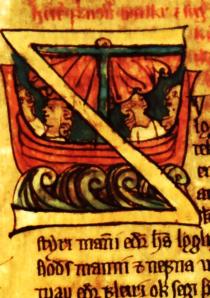
A Viking Battle Scene

A Viking Battle Scene

Once again, I am inspired by one of Jóhannes Benediktsson’s “Daily Life” columns on the Iceland Review website. This one appeared on March 7 of this year, while I was involved in a typical tax season imbroglio not unlike the one illustrated above.

The subject of Jóhannes’s column was based on a meditation about the inevitability of death:

I’ve come to the conclusion, that I must somehow cheat death. Like artists do. They live on through their art. And the same goes for politicians. They will always be remembered in history books.

But there is another way to become immortal, I’ve discovered. And it is so much easier.

The trick is, according to the Icelandic Sagas, to say something incredibly witty, right before you die. It doesn’t matter who you are.

Following are some (well, actually most) of the highlights from his column. First up is a messenger sent by some assassins to see whether Gunnar of Hlidarendi was home:

“You’ll have to find that out for yourself. I do know his halberd was home.”

The name of the assassin, according to Njals Saga (the greatest of all the Icelandic sagas), was Þorgrímur Austmaður, and it is his only appearance in the saga. After his famous line, he collapsed in his own blood. Shown below is a halberd:

A Halberd

A Halberd

When gutted by a spear in the Gisla Saga (a.k.a. Gisli Sursson’s Saga), Véstein Vésteinsson cried out, “Bullseye!” (Mighty sporting of him, that!)

Then, in my second favorite saga, Grettir’s Saga, Átli Asmundarson cries out when hit by a broad spear: “Ah! It seems that broad spears have become fashionable.”

Finally, there is poor Þormóður Kolbrúnarskáld in The Saga of the Confederates who is all but disemboweled. Looking at his guts lying on the ground, he exclaims, “The king has fed us well!”

Now there are many reasons to love the sagas, and there is far more than gory violence and unbelievable sangfroid to be encountered in them (though it is by no means absent). I have read all the sagas from which Jóhannes quotes, most of them more than once, and keep finding myself sucked in by a frontier society that strives to arrive at some sort of balance in the absence of a king or any effective hierarchical government.

All the early Icelanders had to rely on was themselves, with the occasional help of some of the more prosperous families who offered their services as intermediaries in the disputes that inevitably arose.

In many ways, it was very much like our own Wild West.

Iceland’s Bell

A Long Review of Halldór Laxness’s Great Novel

A Long Review of Halldór Laxness’s Great Novel

The following is a review I published on Goodreads.Com yesterday:

There are several Icelands in history. Best known is the Iceland of the Vikings, roughly from the time of settlement in the 9th century to the transfer of the country to the Norwegian King Haakon in the 13th century. Then we skip the better part of a millennium to come to the hip modern Iceland, land of the runtur and of bankruptcy.

In between those two extremes was the Iceland of poverty and servitude. The Danes took over Iceland from the Norwegians and installed their merchants, gifting them with monopolies that made the merchants wealthy, but impoverished the natives. Halldór Laxness, the country’s only winner of the Nobel Prize for Literature (in 1955), wrote Iceland’s Bell to remind his countrymen of the utter waste and fecklessness of the Danish rule. (This theme is similar to the same author’s World Light, which is set in a later period.)

Iceland’s Bell is set early in the 18th century and is presented in three acts, each with a different hero. We begin with Jon Hreggvidsson of Skagi, who is arrested for stealing a length of cord. (Apparently, the Danes, not needing fish themselves, deliberately made it harder for the Icelanders to feed themselves with the piscine riches of their island.) Things go from bad to worse for Jon, who is then arrested for murdering the hangman who whipped him for his crime. But he is let loose on the night before his hanging by …

Snæfriður Bjornsdóttir, daughter of the magistrate who sentences Hreggviðsson, is a young beauty whose hand in marriage is sought by Icelanders of the best families. Unfortunately, the fair maiden weds a drunk, though really she loves the Icelander Arnas Arnaeus, a thinly disguised portrait of Arni Magnusson, famous for collecting texts of the old Icelandic sagas and advising the Danish king how to control his subjects.

Arnaeus is a patriot of sorts, but an unfaithful suitor to Snæfriður. His belief is that the texts which he has collected, and which are almost burned in a massive fire in Copenhagen, are the source of his people’s pride and fame. It is Arnaeus who says, “A fat servant is not much of a man. A beaten servant is a great man, because in his breast freedom has its home.” On another occasion, he says, “I regret nothing that has happened, neither in words nor thoughts. It may be that the most victorious race is the one that is exterminated.”

And under Danish rule, Iceland did come close on several occasions to being utterly annihilated, from plague and smallpox; from the volcanic eruption at Lakagigur in the 1780s that led to an even more vicious plague; and starvation.

Laxness is not only a great Icelandic and Scandinavian author: He is perhaps one of the very best novelists of the Twentieth Century—period! His love for Iceland and its sad plight shows itself frequently throughout the book:

Over verdant lowlands cut by the deep streamwaters of the south hangs a peculiar gloom. Every eye is stifled by clouds that block the sight of the sun, every voice is muffled like the chirps of fleeing birds, every quasi-movement sluggish. Children must not laugh, no attention must be drawn to the fact that a man exists, one must not provoke the powers with frivolity — do nothing but prowl along, furtively, lowly. Maybe the Godhead had not yet struck its final blow, an unexpiated sin might still fester somewhere, perhaps there still lurked worms that needed to be crushed.

I have now read all but three novels by Laxness that have been translated into English. I intend to read them all, and to hope against hope that the novelist’s other work finds a translator.

The Source of the Greatest Song

Icelandic Nobelist Halldór Laxness (1902-1998)

Icelandic Nobelist Halldór Kiljan Laxness (1902-1998)

He lived through a broad swath of the Twentieth Century, won the Nobel Prize for Literature in 1955, yet is mostly unknown outside his little country. I have read most of his novels now, and will probably finish Iceland’s Bell by Thursday. There are many of his contemporaries with inflated reputations: There are few who are more deserving of all the praise the world can bestow upon them.

Reading his work, one is often startled by the insight of Halldór Laxness, as in the following quote:

This was the first time that he has ever looked into the labyrinth of the human soul. He was very far from understanding what he saw. But what was of more value, he felt and suffered with her. In years that were yet to come, he relived this memory in song, in the most beautiful song this world has known. For the understanding of the soul’s defencelessness, of the conflict between the two poles, is not the source of the greatest song. The source of the greatest song is sympathy.

He has written many novels, stories, poems, plays, and essays; but only the following are available in English translation:

  • The Great Weaver from Kashmir (1927)
  • Salka Valka (1931-32)—long out of print
  • Independent People (1934-35)—probably his most famous work.
  • World Light (1937-39)
  • Iceland’s Bell (1943-46)
  • The Atom Station (1948)
  • The Fish Can Sing (1957)
  • Paradise Reclaimed (1960)
  • Under the Glacier (1968)

The only ones I have not read are the first two and the last one. I would rate Independent People, World Light, and Iceland’s Bell as his best works—though all are worth reading.

The Laxness Novel I Am Now Reading

The Laxness Novel I Am Now Reading

I have always been amazed by relatively small countries that have produced great writers—people like Augusto Roa Bastos of Paraguay, Czeslaw Milosz of Lithuania, Ivo Andric of Bosnia, V. S. Naipaul of Trinidad, Gyula Krúdy of Hungary, and Franz Kafka of Czechoslovakia. But smaller than the smallest of the above is Iceland, with only 300,000 or so people.

Sometimes big things can indeed come in small packages.


Sons and Dóttirs

Icelandic Mystery Writer Yrsa Sigurdardóttir

Icelandic Mystery Writer Yrsa Sigurdardóttir

The following is loosely excerpted from a review I wrote on Goodreads.Com about Ashes to Dust by the Icelandic mystery writer Yrsa Sigurdardóttir:

Yrsa Sigurdardóttir’s work reminds me of an Icelandic “delicacy” called hákarl, which consists of shark meat which is fermented for several months, sometimes underground, until the ammoniac stench is strong enough to repel the most ravenous shorebirds. I do not mean to imply that Ashes to Dust is as appetizing as road kill: It is just that its author has a tendency to go for the gamier edge of crime. That was also the case with her first book, Last Rituals. I was surprised to read that Ms. Sigurdardóttir is an engineer, because I would have guessed that she was a pathologist.

Ashes to Dust is about three bodies — accompanied by a severed head — which were discovered more than thirty years after the eruption of the volcano Eldfell on the Westmann Islands, which destroyed some 400 homes on the main island of Heimaey. Attorney Thóra Gudmundsdóttir is trying to build a case for the innocence of the man accused of the murders, back when he was a teenager and the volcano erupted in January 1973. The story gets rather complicated (as in her other book that I read), but the author manages to keep all the threads in play until the very end.

Iceland is becoming quite a haven for mysteries: In addition to Yrsa and Arnaldur Indriðason—not to mention the American Ed Weinman (who has lived in Iceland for many years)—there seems to be a growing trend for the small island to become a major force in the production of mystery novels.

I thought I would segue into a not entirely unrelated topic, namely Icelandic names. You may have noticed that most of the names I’ve mentioned in this post end either in -dóttir or -son. That is partly because, until recently, it wasn’t considered quite kosher to have a last name that was anything but a patronymic.

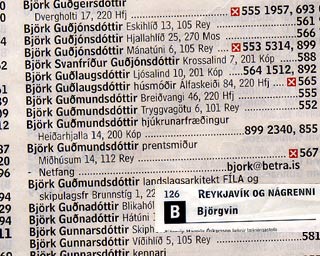
Let’s see how this works. If I were an Icelander, my name would be James Alexson, “James the Son of Alex,” and Martine would be Martine Wilsonsdóttir, “Martine the Daughter of Wilson.” Take a look at the image below from an Icelandic telephone directory:

Bjork to Your Heart’s Content!

Bjork to Your Heart’s Content!

Notice that the names in an Icelandic telephone directory are alphabetized by first name, in this case Björk, and patronymic. In case you didn’t already know, Björk Guðmundsdóttir is the Icelandic recording artist Björk. My guess is the recording artist is probably the one whose address is in Reykjavik 101, which is the Icelandic equivalent of Beverly Hills 90210.

White Heroes and Dark Heroes

Egil Skallagrimsson (d. A.D. 990)

Egil Skallagrimsson (d. A.D. 990)

As my need to escape the horrors of tax season grows apace, I am increasingly burying myself in the world of medieval Icelandic sagas. A few days ago, one of my favorite writers for The Iceland Review, Jóhannes Benediktsson, wrote the following in the “Daily Life” column:

I was taught in junior college, that there were two types of heroes in the Icelandic Sagas: White heroes and dark heroes. Mickey Mouse is an example of a white hero. Donald Duck is very dark.

In Njáls Saga, we have a good example of a white hero: Gunnar of Hlíðarendi.

Gunnar is described as being close to perfect. He’s exceptionally athletic and breathtakingly good looking. He’s an honorable man and very popular. Seemingly to me, he has only one flaw: He’s a bit shallow—a common trait found in people that go through life without experiencing any real adversity.

Skarphéðinn Njálsson is a dark hero from Njáls Saga. Like Gunnar, he’s very strong. But his appearance is not as light. His mood is heavy and he often grins when he hears about warfare that may be brewing.

Another good example of a dark hero is Egill Skallagrímsson, from The Saga of Egill. He’s described as being very ugly, but stronger than most men. He’s greedy and can be unfair. Some of his most heroic moments happened when he was the sole witness.  I think that is no coincidence.

These guys are not flawless. They are very complicated and have some serious issues. I have no idea what they’ll do next, and that makes me very excited.

Last night I just finished reading what Jóhannes calls The Saga of Egill, and which British and American publishers call Egil’s Saga. Over a space of about 250 pages, we see him carrying on a brutal war of vengeance against everyone he feels done him wrong, including two Norwegian kings, Harald Fine-Hair and Eirik Blood-Axe.

At the same time he was a redoubtable warrior, Egil Skallagrimsson was also a poet of some distinction, and he went back and forth between composing poems and planting axes in the heads and bodies of his enemies.

Jesse L. Byock, perhaps one of the world’s greatest scholars of Icelandic history during the saga era, wrote an article for The Scientific American in January 1995 about his personal search for Egil’s bones. It appears that Egil may have suffered from an ailment known as Paget’s disease, which may be partly responsible for his fearsome appearance. If you’re interested in the sagas, you should read Byock’s article. And, while you’re at it, you may want to hunt up a copy of his book Viking Age Iceland.

Support Your Local Bookseller

Alpine Village, Central Europe at the Edge of the Desert

Alpine Village, Central Europe at the Edge of the Desert

Today I got off early from tax work, so I suggested to Martine that we go to Captain Kidd’s Fish Market in Redondo Beach for a seafood lunch, followed by a visit to Alpine Village in nearby Torrance. At Alpine Village is not only an excellent European food market with great meats, but an excellent used bookstore that goes under the names of Collectible Books and Michael Weinstein, Bookseller.

Since tax season will get only worse as April 15 approaches, my food preparation will now eschew the fanciful and time-consuming. This next week, we will have knockwurst or German wieners with Brussels Sprouts, cauliflower, or other steamed vegetables. Perhaps the week after, it will be Hungarian Gyulai kólbasz sausage sautéed with onions, potatoes, and paprika—a dish my mother frequently cooked for us back in Cleveland when she was pressed for time.

I was a little disingenuous with Martine because I didn’t mention until later that I also wanted to visit the little used bookstore at Alpine Village, various called Collectible Books and Michael R. Weinstein, Bookseller. There I purchased three items:

  • R. R. Palmer’s Twelve Who Ruled: The Year of the Terror in the French Revolution. I had read this before, but made the mistake of selling it when I wanted to re-read it.
  • Percy Bysshe Shelley’s Selected Poems in a compact hardbound Oxford World Classics edition, suitable for travel.
  • A lovely Lakeside Press edition of William S. Hart’s My Life East and West, the autobiography of the silent cowboy star whose house in Newhall we visit two or three times a year. It is now a museum administered by the Los Angeles Museum of Natural History.

Not a bad haul for thirty bucks. I know, I know: I have too many books. But reading great books is what puts the light in my eyes. Martine knows that, so she forgives me my little vice.

A Tarheel in the Big Apple

Joseph Mitchell (1908-1996)

Joseph Mitchell (1908-1996)

In America, fiction writers get all the love. Because I know I can never write good fiction, I have a particular appreciation of nonfiction writers, particularly essayists. And one of my favorites was Joseph Mitchell, who came up from North Carolina to become a writer for The New Yorker, and stayed for most of his life.

Today, while I was munching on some curried vegetables at lunchtime, I read an unfinished article by Mitchell in the February 11 and 18 issue of The New Yorker about the author’s peregrinations through the five boroughs of the big city looking for architectural oddities. Entitled “Street Life,” it begins with interesting architectural features and ends up looking at church services at Catholic and other Christian churches (including various Eastern Orthodox), synagogues, and mosques:

I used to feel very much at home in New York City. I wasn’t born here, I wasn’t a native, but I might have well have been: I belonged here. Several years ago, however, I began to be oppressed by a feeling that New York City had gone past me and that I didn’t belong here anymore. I sometimes went on from that to a feeling that I had never belonged here, and that could be especially painful. At first, these feelings were vague and sporadic, but they gradually became more definite and quite frequent. Ever since I came to New York City, I have been going back to North Carolina for a visit once or twice a year, and now I began going back more often and staying longer. At one point, after a visit of a month and a half, I had about made up my mind to stay down there for good, and then I began to be oppressed by a feeling that things had gone past me in North Carolina also, and that I didn’t belong down there anymore, either. I began to feel painfully out of place wherever I was. When I was in New York City, I was often homesick for North Carolina; when I was in North Carolina, I was often homesick for New York City.

I know that feeling. Things have gone past me in Los Angeles, too, but I suspect that the reason is that my age cohort has passed into a gray area (referring mostly to the color of our facial hair). In no way am homesick for Cleveland, the land of my youth. All that remains of Cleveland for me is buried in several scattered cemeteries in Cleveland and in Pembroke Pines, Florida. My great-grandmother, my mother, my father, my uncle and my aunt. I have been away from there now for more than forty years.

The last time I was there was for my mother’s funeral in 1998. My brother Dan and I drove around the areas where we played as children. What surprised us the most was that our barren post World War Two suburban development in the Lee-Harvard area was now covered with large, stately trees. Even my old High School, St. Peter Chanel in Bedford, is shuttering its doors this year.

Getting back to Joseph Mitchell, I find, reading him, that I become nostalgic for places I have never seen, experiences I have never lived through. That is the mark of a great writer: He can make you feel that you are experiencing these places and events through his eyes.

Some day, if you want a good read, you might want to try one of his books:

  • My Ears Are Bent (1938)
  • McSorley’s Wonderful Saloon (1943)
  • Old Mr. Flood (1948)
  • The Bottom of the Harbor (1959)—My favorite.
  • Joe Gould’s Secret (1965)

I hope that The New Yorker can dig up some more of his old stories. His complete oeuvre is rather small, but it is choice.

The drawing of Joseph Mitchell shown here is by Nick Sung.