A Dangerous Time

It’s the Least Wonderful Time of the Year

It’s the Least Wonderful Time of the Year

I am a great believer in the Mayan calendar—not, mind you, of the many misconceptions relating to the end of the world and such. The Mayans were, in the long run, optimists. Their calendar begins with the creation of the world of humans on August 11, 3114 B.C. and just keeps chugging along. Whenever we come to the end of a baktun, as we may (or may not) have done in December 2012, when a bunch of nattering fools predicted the end of the world, we just move on to the next baktun. As Kurt Vonnegut would have said, “So it goes.”

In the meantime, the last five days of the Mayan 365-day year were called the uayeb, about which I wrote a year ago:

In the Haab’, or Mayan Solar Calendar, there are eighteen months of twenty days each. Where does that leave the other 5.25 days? To account for the difference, the Mayans created an intercalary five-day month referred to as the uayeb. Unlike other days in the Solar Calendar, the five days of the uayeb are thought to be a dangerous time….

According to Lynn Foster in Handbook to Life in the Ancient Mayan World, “During Wayeb, portals between the mortal realm and the Underworld dissolved. No boundaries prevented the ill-intending deities from causing disasters.” It was a time of fasting with abstention from sex and all celebrations. People avoided washing their hair or even leaving their huts during this time.

This being a Saturday, I will probably violate the spirit of Uayeb by going out for lunch and getting together with friends. There are other ways of honoring the Mayan gods, probably by not making any major decisions during this time unless I absolutely have to.

Text: Still a Good Book

Bible

The Bible

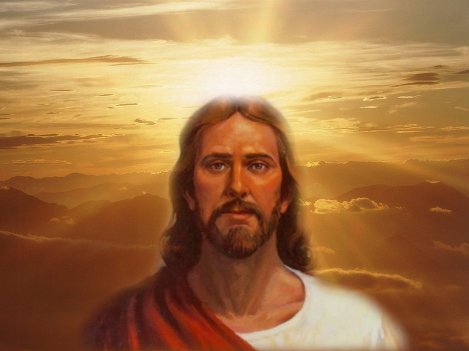
Textual problems have led some modern scholars to question the credibility of the Gospels and even to doubt the historical existence of Christ. These studies have provoked an intriguing reaction from an unlikely source: Julien Gracq—an old and prestigious novelist, who was close to the Surrealist movement—made a comment which is all the more arresting for coming from an agnostic. In a recent volume of essays, Gracq first acknowledged the impressive learning of one of these scholars (whose lectures he had attended in his youth), as well as the devastating logic of his reasoning; but he confessed that, in the end, he still found himself left with one fundamental objection: for all his formidable erudition, the scholar in question had simply no ear—he could not hear what should be so obvious to any sensitive reader—that, underlying the text of the Gospels, there is a masterly and powerful unity of style, which derives from one unique and inimitable voice; there is the presence of one singular and exceptional personality whose expression is so original, so bold that one could positively call it impudent. Now, if you deny the existence of Jesus, you must transfer all these attributes to some obscure, anonymous writer, who should have had the improbable genius of inventing such a character—or, even more implausibly, you must transfer this prodigious capacity for invention to an entire committee of writers. And Gracq concluded: in the end, if modern scholars, progressive-minded clerics and the docile public all surrender to this critical erosion of the Scriptures, the last group of defenders who will obstinately maintain that there is a living Jesus at the central core of the Gospels will be made of artists and creative writers, for whom the psychological evidence of style carries much more weight than mere philological arguments.—Simon Leys, The Hall of Uselessness: Collected Essays

Two Socialists: Pope Francis & Jesus

Gee, Maybe It’s OK to Be Socialist

Gee, Maybe It’s OK to Be Socialist

Now our right wing pundits are all attacking Pope Francis for being a Marxist. He has been deemed to be guilty for caring about the poor, just as Jesus Christ was some two thousand years ago. In fact, Christ had no compunction about attacking the rich:

I tell you the truth, it is hard for a rich man to enter the kingdom of heaven. Again I tell you, it is easier for a camel to go through the eye of a needle than for a rich man to enter the kingdom of God. When the disciples heard this, they were greatly astonished and asked, “Who then can be saved?” Jesus looked at them and said, “With man this is impossible, but with God all things are possible.” Matthew 19:23-26

Southern Nazarene University has an interesting website with Old and New Testament verses regarding the poor. Here is a little nugget I found from the Epistle of James:

“Suppose a man comes into your meeting wearing a gold ring and fine clothes, and a poor man in shabby clothes also comes in. If you show special attention to the man wearing fine clothes and say, ‘Here’s a good seat for you,’ but say to the poor man, ‘You stand there’ or ‘Sit on the floor by my feet,’ have you not discriminated among yourselves and becomes judges with evil thoughts? Listen, my dear brothers: Has not God chosen those who are poor in the eyes of the world to be rich in faith and to inherit the kingdom He promised those who love Him? But you have insulted the poor. Is it not the rich who are exploiting you? Are they not the ones who are dragging you into court?” James 2:2-6

Then there is this from 1 John 3:17-18: “If anyone has material possessions and sees his brother in need but has no pity on him, how can the love of God be in him? Dear children, let us not love with words or tongue but with actions and in truth.”

One doesn’t have to delve too deeply in the Bible to find that it is all stacked on the side of the poor and against the rich. And yet, so many right-wing Conservatives believe exactly the opposite. Why? Because it is the rich who are bankrolling them, not the poor.

It seems to me that Pope Francis is the real Christian, and all the pundits aligned against him are heretics who deserve to be burned at the stake. (Dear me, it’s my Catholic background coming out again.)


The Nature of the Soul

Cicero

Cicero

It’s impossible to locate an earthly origin of souls. There’s nothing mixed or compounded in souls, they’re not earth or made of earth. They’re not even moist or airy or fiery. There’s nothing in these elements that accounts for the power of memory, mind or thought, that recalls the past, foresees the future or comprehends the present. These faculties are divine; you won’t find a way for them to get to man except from god. The natural power of the soul is therefore unique, distinct from the usual and familiar elements. Whatever it is that thinks, knows, lives and grows must be heavenly, divine, and therefore eternal. And god, who is recognized by us, can only be recognized by a mind that is free and unencumbered, distinct from any mortal compound, sensing all and setting all in motion, itself endowed with eternal movement. The human mind consists of the same element, the same nature.—Marcus Tullius Cicero, Consolation

Guess Who’s Missing from the Constitution

And He’s Not in the Declaration of Independence Either

And He’s Not in the Declaration of Independence Either

With all the Evangelical hoo-hah about the United States being a Christian nation, you will not find any of the following words in the U.S. Constitution: “Jesus,” “Christ,” “God,” “Deity,” “Christian,” or “Christians.” And the word “God” appears only once in the Declaration of Independence in a phrase that is not quite the way it would be used in an American suburban megachurch:

When in the Course of human events, it becomes necessary for one people to dissolve the political bands which have connected them with another, and to assume among the powers of the earth, the separate and equal station to which the Laws of Nature and of Nature’s God entitle them, a decent respect to the opinions of mankind requires that they should declare the causes which impel them to the separation.

Note that the word “God” appears only after the phrase “Laws of Nature.” (Sounds like something the Sierra Club would write.)

If you don’t believe me, search these two documents yourself. You can find them at http://www.archives.gov/exhibits/charters/constitution_transcript.html and at http://www.archives.gov/exhibits/charters/declaration_transcript.html. We have so many misconceptions about the Founding Fathers of our country, especially those tricorn-hatted imbeciles who go by the name of Tea Party, that we don’t realize that the particular brand of Christianity practiced then was too remote and intellectual for most of today’s Holy Rollers. I am referring specifically to Deism. You might want to follow the link to learn for yourself in what they believed.

Note in particular the phrase “rejection of revelation and authority.” In other words, the Founding Fathers were not big-time Bible-readers.

I would like to see someone like Rush Limbaugh or Glenn Beck explain this curious omission.

God Hates Westboro Baptist Church

Gonzo Picketer for So-Called “Westboro Baptist Church”

Gonzo Picketer for So-Called “Westboro Baptist Church”

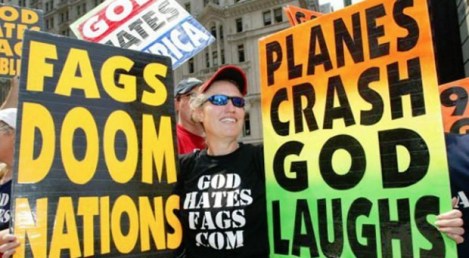
The “Westboro Baptist Church” is no more a church than I am the Pope of Islam. They are a right-wing group that delights in fomenting outrage by picketing events where the vast majority of people attending are against their believes. That doesn’t bother the folks at WBC, who say on their website: “0 – nanoseconds of sleep that WBC members lose over your opinions and feeeeellllliiiiiings.” Also on the same page is a counter of the number of souls God has cast into hell since the web page was loaded. (Yeah, like they know!)

At a time when so much that is called political discourse is actually nothing but grandstanding in front of the media, WBC holds down a particularly odious niche. After all, their website is called GodHatesFags.Com. Whenever some disaster occurs, you can count on these hucksters to tell us all that we had it coming because of our tolerance of gays or something else these misguided white people hate or feel threatened by.

I do not think that WBC will be around for much longer: How much further can they go without bringing peoples’ wrath down on their heads or violating the law in some gross way?

So enjoy them while you can.

Mind, Matter and the Great Unknown

Sometimes Philosophy Ignores the Most Important Subjects

Sometimes Philosophy Ignores the Most Important Subjects

Sometime around a hundred years ago, philosophers decided not to talk about anything that they couldn’t prove. Over the decades, biology was reduced to chemistry, which in turn was reduced to physics, which in turn was reduced to mathematical formulas.

In the meantime, what was ignored was the whole subject of mind.

It reminds me of an old joke:

“What is mind?”

“It doesn’t matter.”

“What is matter?”

“Never mind!”

And yet, mind exists. There is this thing we have called consciousness. It is that consciousness which, from time immemorial, prompted talk about the human soul. Whether the soul exists apart from consciousness, I don’t know. Whether consciousness can exist unhooked from the whole material superstructure that is the human body, I do not know.

I tend to think that because of my sense of my own consciousness—the thing that makes me who I am—that I say I believe in God. Certainly I am not beholden to any organized religion for my belief: I think that all the scriptures are merely metaphorical attempts to create a myth around a belief in the deity.

In his recent book Mind and Cosmos: Why the Materialist Neo-Darwinian Conception of Nature Is Almost Certainly False, Thomas Nagel writes:

I would like to defend the untutored reaction of incredulity to the reductionist neo-Darwinian account of the origin and evolution of life. It is prima facie highly implausible that life as we know it is the result of a sequence of physical accidents together with the mechanism of natural selection. We are expected to abandon this naive response, not in favor of a fully worked out physical/chemical explanation but in favor of an alternative that is really a schema for explanation, supported by some examples. What is lacking, to my knowledge, is a credible argument that the story has a non-negligible probability of being true. There are two questions. First, given what is known about the chemical basis of biology and genetics, what is the likelihood that self-reproducing life forms should have come into existence spontaneously on the early earth, solely through the operation of the laws of physics and chemistry? The second question is about the sources of variation in the evolutionary process that was set in motion once life began: In the available geological time since the first life forms appeared on earth, what is the likelihood that, as the result of a physical accident, a sequence of viable genetic mutations should have occurred that was sufficient to permit natural selection to produce the organisms that actually exist?

Nagel does not provide the answers, but he asks the right questions. Is my consciousness of myself an accident? And why is my consciousness of myself so different from everyone else’s consciousness of themselves?

What has dictated that mind across so many billions of instances should be so rich, so incredibly diversified, so beautiful (and sometimes so heinous)?

The answer, my friend, is blowing in the wind.


A Jesuit Paradise?

Stamps Commemorating the Jesuit Missions of Paraguay

Stamps Commemorating the Jesuit Missions of Paraguay

It is interesting to me that, for the first time in its history, the papacy is in the hands of a Jesuit, from South America no less. In southeastern Paraguay and in the Argentinean state of Misiones, there are numerous ruins attesting to the 17th and 18th century Jesuit missions—missions that were so powerful that they were, in effect, in control of the Guarani Indians of the area. If you ever saw Roland Joffe’s 1986 movie, The Mission, with Robert DeNiro, Liam Neeson, and Jeremy Irons, you have some idea of what the Jesuit government of Paraguay was like.

You can find out even more by reading the forgotten classic history by R. B. Cunninghame Graham entitled A Vanished Arcadia: Being Some Account of the Jesuits in Paraguay 1607 to 1767.

It even finds its way into Voltaire’s Candide, but its author being such an anticlerical cuss, he has his hero kill the Jesuit commandant of one of the missions. Yet he writes in Histoire Politique et Philosophique des Indes:

When in 1768 the missions of Paraguay left the hands of the Jesuits, they had arrived at perhaps the highest degree of civilization to which it is possible to conduct a young people, and certainly at a far superior state than that which existed in the rest of the new hemisphere. The laws were respected there, morals were pure, a happy brotherhood united every heart, all the useful arts were in a flourishing state, and even some of the more agreeable sciences: plenty was universal.

I have long thought that, if my thoughts had ever taken a turn toward the Catholic priesthood, I would have become a Jesuit. My teachers at St. Peter Chanel in Bedford, Ohio, wanted me to become one of them, a Marist. But, in the end, I became neither.

So now Pope Francis is a Jesuit from Argentina. He, I am sure, is quite aware of the history of the Jesuits in the southern cone of South America. It would be nice if he did for the Catholic Church what the Jesuits did for the Guarani in Paraguay and Argentina. Benedict XVI was a good man, but not strong enough for the task of making his faith relevant to a world that is falling away from the Church.


Pope on the Ropes

Adieu Benedict XVI!

Adieu Benedict XVI!

In a way, I liked Benedict XVI (whom Martine persists in calling Ratzo after his last name, Ratzinger); but I think the job was beyond the abilities of a conservative theologian. What with the Catholic Church being against gays in theory and, in effect, for same-sex molestation of the under-aged, there is too much of a disconnect. The world does not want theology at this juncture. In fact, many Catholics are fleeing the church because they feel it is either devious or too unemotional. Their destination? The various evangelical sects, which can be even more devious and certainly insincere in their emotionalism.

I shouldn’t be surprised if Benedict’s departure will open the doors to new revelations about perfidy by members of the clergy. What is that thing about the Pope’s butler? Shades of Godfather III! And now Britain’s only Cardinal has resigned for molesting priests!? (What I want to know is, why don’t the poor nuns ever get molested? Even Martin Luther did it.)

Catholicism is a religion which its adherents must cherry-pick if they wish to remain sane. You can like the great traditions, the Latin Mass, the saints, the miracles—while, at the same time, abhorring the stance on contraception, abortion, and the punishment of wayward pederast priests. For me, the things I love about the Church are the works of Thomas Merton and G. K. Chesterton (both converts) and the great saints, stretching back to Augustine and Thomas Aquinas.

I hope that Benedict is not too torn up by the Augean Stables that the Church has become. He was basically a good man in an impossible position.

The Monolith

Flag of Saudi Arabia

Flag of Saudi Arabia

What with all the turbulence wrought by the so-called Arab Spring, what is the likelihood that Saudi Arabia will be affected? So far, there have been no large-scale demonstrations, though the monarchy has jailed a fairly large number of people of opposite political stripes.

If Saudi Arabia were to follow the example of Syria, it would have the effect of destabilizing anew the whole Muslim world. Why? Because it is the obligation for every able-bodied Muslim to perform the hajj at least once in a lifetime by visiting the sacred sites of Mecca and Medina. The thought of this pilgrimage being curtailed in any way would be enough to cause widespread panic from Morocco to Indonesia, from the Muslim inhabitants of Europe to the Sahel in Africa. Just to see how international this movement is, click on the website of the Saudi Ministry of Hajj.

Islam cannot easily change its doctrines the way that Christianity, both Western and Eastern, could. There is no unified figure or body that decides what Muslims are to believe. Ever since Ataturk abolished the Ottoman caliphate in 1924, Islam has been substantially without a head. Although the religious leaders in Saudi Arabia would like to think they are in charge, that extends mainly to maintaining order during the massive influx of pilgrims (three million in 2011) during the annual  week of the Hajj, which changes from year to year because it is based on the lunar calendar.

I can only conclude that any major changes in Saudi Arabia will be cataclysmic on a global scale. As of 2010, there were an estimated 1.62 billion Muslims, comprising some 23% of earth’s total population. Both the United States and Britain have over 2.5 million adherents each. To see how the Islamic population is distributed across the nations of the earth, click here.

We tend to believe that tomorrow’s crises are basically the same as today’s, except possibly more so. A global Muslim dust-up would be qualitatively different.