When former military dictator of Argentina Juan Perón died in 1974, he couldn’t be buried at Buenos Aires’s exclusive Recoleta Cemetery. It was most galling to his followers that his widow Evita did manage to be buried there with the rest of her family (née Duarte). Eventually, his body was moved to the grounds of his estate in the exclusive barrio of Olivos.
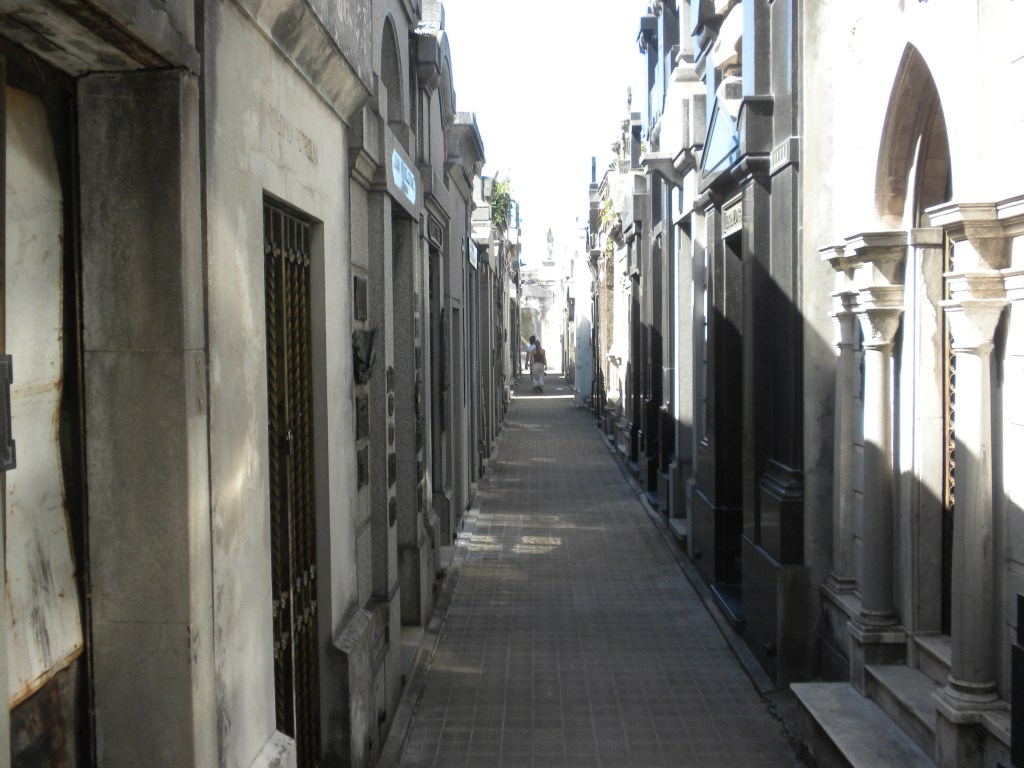
I have visited Recoleta during each of my three trips to Argentina. Why? It is actually the number one tourist destination in Buenos Aires—and it’s free. Just about everyone of note in Argentine history and culture is buried there. Adolfo Bioy Casares the writer is buried there, but the Argentina’s greatest writer, his friend Jorge Luis Borges, is buried in Geneva, Switzerland, where he died in 1986.
One of Many Bronze Commemorative Plaques Marking the Grave of Evita Perón
Among other famous denizens are past presidents such as Agustín Pedro Justo, Bartolomé Mitre, Domingo Faustino Sarmiento, Hipólito Yrigoyen, Julio Argentino Roca, Pedro Eugenio Aramburu, and Raúl Alfonsín. There’s famous boxer Luis Firpo; Isabelle Walewski, a granddaughter of Napoleon Bonaparte; warlord Facundo Quiroga; writer Silvina Ocampo and her sister, publisher Victoria Ocampo; and William Brown, Irish-born founder of the Argentinean Navy (widely known as Almirante Brown).
The Narrow Streets of Argentina’s Notable Dead
In fact, the last time I stayed in Buenos Aires, I stayed at a hotel right across the street from the west wall of the cemetery.
I have seldom been so impressed by an American novel—especially a recent one—as I was by Cormac McCarthy’s The Crossing. The young hero, Billy Parham, crosses back and forth three times between New Mexico and Old Mexico. Finding his parents killed and robbed of their livestock, he is not at home either in the United States or the mountains of Mexico.
McCarthy writes with an Old Testament intensity of the kindness and evil that Billy finds across the Rio Grande. At one point, he writes:
When the flames came up her eyes burned out there like gatelamps to another world. A world burning on the shore of an unknowable void. A world construed out of blood and blood’s alcahest and blood in its core and in its integument because it was that nothing save blood had power to resonate against that void which threatened hourly to destroy it.
After finding his family slain and dispersed, Billy manages to locate his younger brother, Boyd, and returns with him to Mexico looking for the horses stolen from his father. Boyd manages to impress the campesinos they meet, wins the nickname El Guërito, and is described by the author:
He looked fourteen going on some age that never was. He looked as if he’d been sitting there and God made the trees and rocks around him. He looked like his own reincarnation and then his own again. Above all else he looked to be filled with a terrible sadness. As if he harbored news of some horrendous loss that no one else had heard of yet. Some vast tragedy of the way the world was.
Author Cormac McCarthy
I have been impressed by McCarthy’s work before, when I read Blood Meridian, or The Evening Redness in the West (1985) and All the Pretty Horses (1992). So far, I have read the first two novels of McCarthy’s Border Trilogy, which consists of All the Pretty Horses, The Crossing (1994), and Cities of the Plain (1998). After reading the next novel in the trilogy, I will backtrack and read his first four novels, which are set in the South. Then I will move on to No Country for Old Men (2005) and The Road (2006).
One little note: I would not recommend that you read The Crossing unless you know some Spanish. Much of the dialog set in Mexico is in untranslated Spanish. I was able to get by pretty well, though I had my Cassell’s Spanish Dictionary at my side. But if you can tolerate the language factor, I think you will be mightily impressed by McCarthy’s work.
We Celebrate Our Independence by Playing at Terrorism
As I write these words, the air is full of explosions. Dogs and cats are whimpering as they hide under beds, tortured by their pet-loving owners who celebrate our independence with backyard barbecues and playing at being terrorists. I’m not sure that many Americans are giving any attention to the Declaration of Independence from King George III.
Ultimately we got our independence, but mainly because of help from France. You can read all you want about American history and not find a word about George Washington ever winning a battle. France helped us at a horrible cost to the French monarchy: their assistance bankrupted the treasury and was a major contributor to the French Revolution, which began shortly after we won our independence. Louis XVI and Marie Antoinette paid for helping us by being publicly beheaded in Paris’s Place de Grève.
Ingrates that we are, we tend to downplay the French role in winning our freedom. When the British under Cornwallis were tied up at Yorktown, it was because Admiral François Joseph Paul, Comte de Grasse, Marquis of Grasse-Tilly was backing up the Continental Army led by Washington and Lafayette.
Don’t think I’m feasting on escargots, Coquilles Saint-Jacques, and Pouilly-Fuissé because of this. I’m not celebrating at all, especially as it sounds like my street is being bombed.
Many charities accomplish great things. Many others—and not everyone knows which ones—serve only to provide jobs for people who work for them. The coronavirus outbreak has made many charities frantic in their fundraising, seeing as how many people are now without disposable cash.
I am amazed at the number of television ads for charities that ask for a fixed monthly amount—usually $19 for some odd reason. They include such unusual ads as those as the International Fellowship of Christians and Jews (IFCJ) which attempts to support holocaust survivors in Russia and Israel, for $19/month. Then there is the American Society for the Prevention of Cruelty to Animals (ASPCA), which saves abused dogs and cats (and whatever) from abusive owners who don’t feed and house them properly, for $19/month. This one gives you a garish “collectible” T-Shirt for your trouble.
If you do have some cash, you can easily be charged to death. Those repeating $19 charges never end, unless you make a concerted effort to stop them.
Thanks, I’ll Pass
Look, I’m not some horrible person who believes in abusing animals or elderly Jews. I’m sure some of that money goes for helping people and animals; but TV ads cost a lot of money. Instead of showing shivering, starving animals, I am sure the cameramen should first have refilled their water dish and fed them.
Then there are the telephone ads. Several years ago, when I was still working, I donated some money to a police relief fund. Ever since, I have been marked for a sucker and subject to repeated requests for cash—and not only for police, but for firemen and others. Yesterday, I received a call from a live person who talked over my voice pleading for him to save his breath because I wasn’t in a position to donate. He rudely hung up on me, angry that he hadn’t succeeded in making me snivel guiltily. Even the more responsible callers, try to wheedle a small donation out of me even after I said I wasn’t donating anything to anyone. This gets old fast.
Charities do buy sucker lists, so when you give to a charity, you will hear from at least a dozen others. I was never a philanthropist, but now I am on a fixed income. My guess is that the number of these calls, as well as desperate pleas in the mail, will not taper off anytime soon.
I never thought of Roberto Bolaño as a poet before, but his collection entitled The Romantic Dogs set me straight on that score.
LUPE
She worked in la Guerrero, a few streets down from Julian’s,
and she was 17 and had lost a son.
The memory made her cry in that Hotel Trébol room,
spacious and dark, with bath and bidet, the perfect place
to live out a few years. The perfect place to write
a book of apocryphal memories or a collection
of horror poems. Lupe
was thin and had legs long and spotted
like a leopard.
The first time I didn’t even get an erection:
and I didn’t want to have an erection. Lupe spoke of her life
and of what, for her, was happiness.
When a week had passed, we saw each other again. I found her
on a corner alongside other little teenage whores,
propped against the fender of an old Cadillac.
I think we were glad to see each other. From then on
Lupe began telling me things about her life, sometimes crying,
sometimes fucking, almost always naked in bed,
staring at the ceiling, hand in hand.
Her son was born sick and Lupe promised la Virgen
that she’d leave her trade if her baby were cured.
She kept her promise a month or two, then had to go back.
Soon after, her son died, and Lupe said the fault
was her own for not keeping up her bargain with la Virgen.
La Virgen carried off the little angel, payment for a broken
     promise,
I didn’t know what to say.
I liked children, sure,
but I still had many years before I’d know
what it was to have a son.
And so I stayed quiet and thought about the eerie feel
Emerging from the silence of that hotel.
Either the walls were very thick or were the sole
     occupants
or the others didn’t open their mouths, not even to moan.
It was so easy to ride Lupe and feel like a man
and feel wretched. It was easy to get her
in your rhythm and it was easy to listen as she prattled on
about the latest horror films she’d seen
at Bucareli Theater.
Her leopard legs would wrap around my waist
and she’d sink her head into my chest, searching for my
nipples or my heartbeat.
This is the part of you I want to suck, she said to me
     one night.
What, Lupe? Your heart.
Roberto Bolaño, The Romantic Dogs: 1980-1998 (New York: New Directions, 2006).
Lone Fire Fighter in Midst of Rapidly Growing Brush Fire
We have become used to talking about climate change as something that’ll take place in the future. Sorry, but it’s here already. It’s not like the Cold War, when we were constantly afraid of a nuclear holocaust that never happened, because both sides acted fairly reasonably.
But this is not the same America any more. Half the voting population is cray-cray, thinking that Democrats eat babies in the nonexistent basements of pizza parlors (as qAnon believes). Yes, and water flows uphill; the earth is flat; and the sun revolves around the earth. Vladimir Putin looked and acted more reasonable than our last president, who sounds more and more demented every time he opens his mouth.
Who would ever have thought that we, as a country, could become a victim of Alzheimer’s? Yet, it appears that we have.
So what am I going to do about it? I will continue to vote reasonably even if the others won’t. They are accumulating very bad juju and will eventually pay the price for it. I have some faith that the world will eventually right itself even if we continue to make disastrous mistakes.
I guess that makes me an optimist. Who would have thunk it?
At a time when most of the United States and Canada are burning up in the heat, I decided to spend the afternoon at the one place that is always almost preternaturally cool: Burton Chace Park in the middle of Marina Del Rey. No matter how hot it is in Los Angeles, there always seems to be a cool sea breeze at Chace. Today wasn’t particularly warm along the coast, but I was in the mood for a good breeze.
So there I sat at an isolated cement picnic table, finishing a French noir novella by Pascal Garnier entitled Boxes. As I had my new Kindle with me, I decided to sign in to the county park’s wi-fi and check out if Jeff Bezos was actually discounting something I wanted. Well, he wasn’t, but that’s okay.
I took a short walk around the tiny peninsula looking at boats and trying to see where the sea lions were. I had heard them while reading, but they had disappeared by the time I took my walk. I did, however, find these pigeons.
All in all, I spent three hours at Chace, returning home to my apartment, which is infested with fruit flies. Martine and i threw out a lot of the pasta they were feeding on, but somewhere they are being nourished by something else. As I sit here typing this post, they are landing in my hair, and I am reaching up to squeeze their little lives out.
This is a repost from Multiply.Com which I wrote some ten years ago:
Oh, oh! I’ve been thinking about Argentina again, and that means you’re going to hear about some more really obscure (but, IMHO fascinating) stuff.
To begin with, Argentina is such a Catholic country that it had to create additional saints native to its own soil. Let’s begin with La Difunta Correa, which means, literally, the Dead Correa:
According to popular legend, Deolinda Correa was a woman whose husband was forcibly recruited around the year 1840, during the Argentine civil wars. Becoming sick, he was then abandoned by the Montoneras [partisans]. In an attempt to reach her sick husband, Deolinda took her baby child and followed the tracks of the Montoneras through the desert of San Juan Province. When her supplies ran out, she died. Her body was found days later by gauchos that were driving cattle through, and to their astonishment found the baby still alive, feeding from the deceased woman’s “miraculously” ever-full breast. The men buried the body in present-day Vallecito, and took the baby with them. [from Wikipedia] All over the country, there are roadside shrines to La Difunta Correa, many surrounded by gifts left by truck drivers and travelers in a hope for a safe journey to their destination. Remember that Argentina is the eighth largest country on earth, and that distances can be farther than one ever imagines, especially on unpaved ripio roads.
There are two other popular saints with shrines all across the nation: Gauchito Gil (“Little Gaucho Gil”) and El Ángelito Milagroso, a.k.a. Miguel Ángel Gaitán.
Gauchito Gil hails from the state of La Rioja. A farmworker, Gil was seduced by a wealthy widow. When the police chief, who also had a thing for the widow, and her brothers came after Gil, he joined the army in the War of the Triple Alliance against Paraguay (perhaps the bloodiest war ever fought in the Americas, with the exception of our own Civil War). When he returned home, the Army came after him to join in one of Argentina’s many civil wars. Not to put too fine a point on it, the Gauchito deserted. He was discovered by the police, who wanted to execute him. Whereupon Gil prophesied to the head of the police detail that if he were merciful, the officer’s child, who was gravely ill, would get better. Instead of being shown mercy, Gil was executed.
When he returned home, the police officer found that his son was indeed very ill. So he prayed to Gauchito Gil, and his son got better. It was this police officer who returned to the scene of the execution, gave Gil a proper burial, and built a shrine in his memory. Today there are hundreds of such shrines scattered throughout the country.
By the way, the Gauchito is not the only deserter hero in Argentina’s past. Perhaps the national epic is Martin Fierro by José Hernández, about a gaucho who deserts from the so-called “Conquest of the Desert”—really a war of genocide against the native tribes of the Pampas—and is pursued by the police militia.
The Nineteenth Century in Argentina was unusually bloody, what with civil war, wars against the native peoples, and wars against other countries such as Paraguay and Brazil. So it is not unusual to find deserters as heroes, which is unthinkable in Europe and North America.
Finally, there is another La Rioja “saint” named Miguel Ángel Gaitán, El Ángelito Milagroso, who died at the tender age of one in 1967. When his body didn’t rot, the locals thought that meant it was supposed to be exposed for veneration—and so it was.
Chasing the White Whale in Herman Melville’s Moby-Dick
I think that Herman Melville’s Moby-Dick is the Great American Novel. There are a handful of other claimants, but the search for the White Whale—I think—knocks them all into a cocked hat.
Yet it was not always thus. Published in 1851, it took decades before it was recognized for the masterpiece it was. In his Conversations 1 with Osvaldo Ferrari, Argentinian writer Jorge Luis Borges makes an interesting observation:
I believe that [Moby-Dick], upon publication, remained invisible for some time. I have an old an excellent edition of the Encyclopaedia Britannica, the eleventh edition published in 1912. In it, there’s a not-too-long paragraph about Melville, describing him as a writer of travel novels. And though it mentions Moby-Dick, it is not distinguished from the rest of his books. It’s on the list but there is no mention that Moby-Dick is far more than a traveller’s tale or a book about the sea.
This makes me wonder how many American books written in the last sixty years will suddenly emerge to future generations as the *new* Great American Novel. Will it be something that we now regard as second-rate stuff? We may never know: The future is a closed book.
Yesterday, Martine and I visited the Autry Museum of the American West in Griffith Park. Many of the galleries were still closed due to the Covid-19 outbreak, but what there was, was choice. I am specifically referring to the exhibit of California Indian art entitled “When I Remember I See Red: American Indian Art and Activism in California.” What impressed me the most was work from a Nontipom Wintu artist from Northern California named Frank LaPeña (1937-2019).
Artist Frank LaPeña
What draws me to American Indian art is its spirituality and brilliant imagery—both qualities notably lacking in so many academic artists. These are not works to decorate a corporate boardroom: Instead, they are works to make you feel grounded in a separate reality, one that is part of the world from which the artist comes.
Frank LaPeña’s Dream Song
In a strange coincidence, there is an accused murderer with the same name who is totally unrelated to the artist. This other Frank LaPeña was recently released from prison in Nevada where he was wrongfully incarcerated for hiring a hit man to kill the wife of a Caesars Palace in 1974.
I will try in the week ahead to highlight some more California Indian artists from the Autry show.











 Tarnmoor
You must be logged in to post a comment.