“In the month of Athyr …”

Mummy Portrait of Deceased

Early Christian Mummy Portrait of Deceased

One of my favorite poets of the last century was Constantine P. Cavafy, who lived most of his life in Alexandria, Egypt. I have just finished reading E. M. Forster’s Pharos and Pharillon: A Novelist’s Sketchbook of Alexandria Through the Ages, which ends which a chapter on “The Poetry of C. P. Cavafy.”

In it, he talks about meeting Cavafy in the street and having a marvelous conversation with him:

It is delivered with equal ease in Greek, English, or French. And despite its intellectual richness and human outlook, despite the matured charity of its judgments, one feels that it too stands at a slight angle to the universe: it is the sentence of a poet.

What a wonderful line! “It too stands at a slight angle to the universe.”

The Poet

The Poet

In his book, Forster quotes (and, I suspect, translated) this fragmentary funerary poem of a young man who died one November (“Athyr”), probably not unlike the mummy facial covering illustrated above:

It is hard to read . . . on the ancient stone.
“Lord Jesus Christ” … I make out the word “Soul”,
“In the month of Athyr … Lucius fell asleep.”
His age is mentioned … “He lived years …”—
The letters KZ show … that he fell asleep young,
In the damaged part I see the words … “Him … Alexandrian”.
Then came three lines … much mutilated.
But I can read a few words … perhaps “our tears” and “sorrows”.
And again: “Tears” … and: “for us his friends mourning”.
I think Lucius … was much bloved.
In the month of Athyr … Lucius fell asleep ….

In case you have never heard of Cavafy before, he was a major inspiration for Lawrence Durrell’s The Alexandria Quartet.
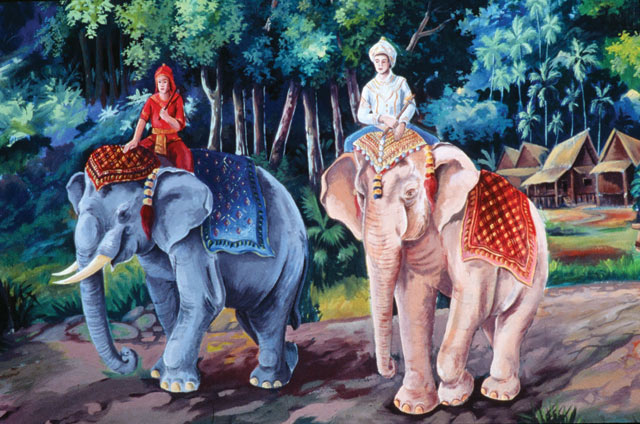
What Do These Burmese Kings Have in Common?

Put Your Thinking Caps On

Put Your Thinking Caps On

The four Burmese kings are: Uzana, Minrekyawswa, Razadarit, and (of course) Tabinshweti.

Uzana was trampled to death by an elephant in 1254; Minrekyawswa was crushed to death by an elephant in 1417;
Razadarit died while lassoing elephants in 1423; and Tabinshweti was beheaded while searching for an elephant in 1551.

Now if you were a king in Burma, that suggests you stay away from the GOP.

The above is courtesy of the Futility Closet.

Word

Now Which of These Can Be Considered as Medioxumous?

Now Which of These Can Be Considered as Medioxumous?

I was always a word freak. Even from my middle school years, I studied vocabulary books to increase my store of words. Imagine my delight when, in 1968, as a graduate student in film at UCLA, I got a job proofreading two computerized transcripts of Merrian-Webster dictionaries.

One interesting wrinkle was that my predecessor in my job, a young lady, was murdered by a graduate student in film at UCLA. (It wasn’t me, honest!)

In the process of proofreading thousands of pages of dictionary entries, I collected a few interesting words that don’t make it into print much these days:

  • Septemfluous: “flowing in seven streams,” describing the blood of the crucified Christ.
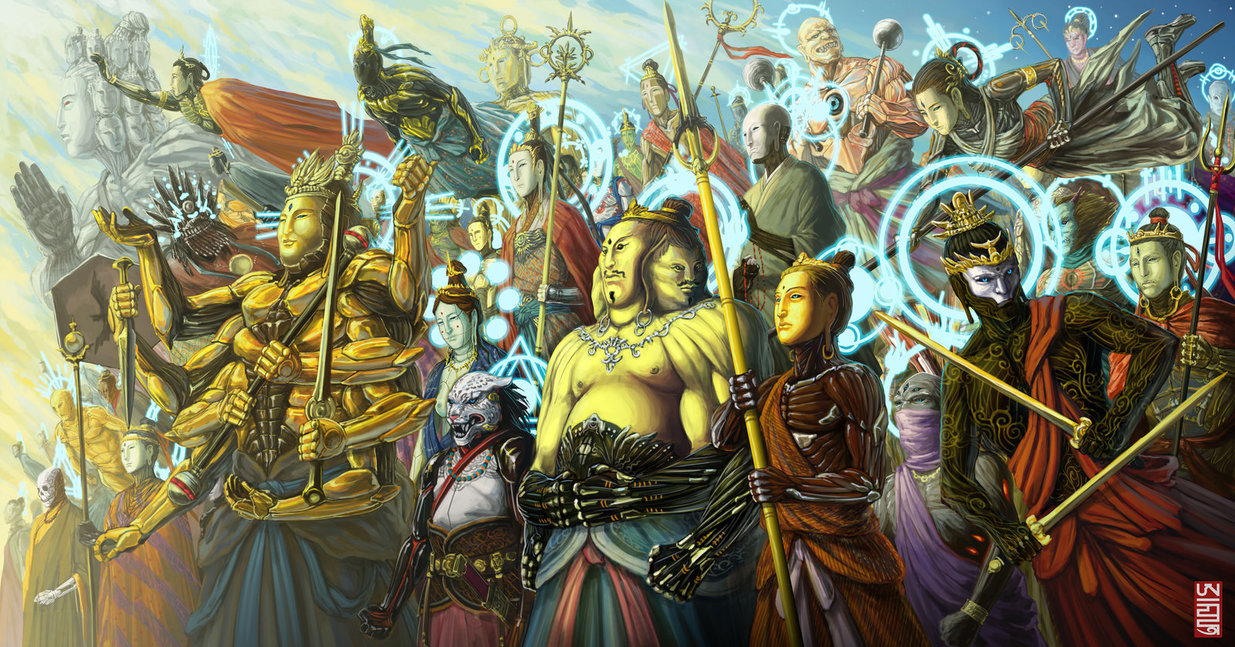
  • Medioxumous: “of or relating to the middle rank of deities”
  • Rotl: “any of various units of weight of Mediterranean and Near Eastern countries ranging from slightly less than one pound to more than six pounds”
  • And, coming to us from Welsh, cwm and crwth (not misprints), meaning “valley” and “crowd” respectively, and pronounced “coom” and “crooth.”

I have a few words to add to these from the 1755 edition of Dr. Samuel Johnson’s Dictionary of the English Language. They don’t seem to have made it into subsequent editions, though the Futility Closet managed to ferret them out:

  • Finger-flinger: “a pretender to astrology and prediction,” not to be confused with an irate motorist
  • Pissburnt: “stained with urine”
  • Centuriator: “a name given to historians, who distinguish times by centuries”
  • Longimanous: “long-handed; having long hands”
  • Overyeared: “too old,” like the writer of this blog

The illustration above is by the talented BurenErdene at DeviantArt.


So Much for Politics!

My Ultimate Political Statement

My Ultimate Political Statement

I’ve had it with politics.

Every time I post something about politics, I feel as if I’m yelling at a bunch of kids to get off my lawn. Particularly with the presidential race for 2016, I really have nothing new to add. I think Trump is a Fuehrer in training; Cruz, one of the Four Horsemen of the Apocalypse; and Rubio, a marionette dangling on a string. On the Democratic side, I distrust Hillary; and I like Bernie, but don’t think he’ll make it.

The next eight months will be a time of great ugliness and moral peril for this country. Before we get flushed down the commode of history, we will yet become the laughingstock of the world.

We’ve always overestimated ourselves, especially after we won the Second World War. After that magical moment, it was all downhill.

There, now I’ve said it all. I will vote of course, but have no further opinions about the race; and I don’t expect to be surprised. Why? I am deeply pessimistic when it comes to the American voter, who seems to look at the world around him as if it were a reality show on Fox.

When Technology Leads You Astray

In Some Places, You Just Can’t Trust GPS

In Some Places, You Just Can’t Trust GPS

This post is dedicated to two hilarious posts from The Iceland Review in which foreign tourists put explicit trust in their GPS systems and were led wildly astray.

In the first instance, reported on February 2 of this year, an American tourist was looking for the Hótel Frón on Laugavegur, the main shopping street in Reykjavík. The only problem is that the website he was relying on listed the address as Laugarvegur 22a. There was a Laugarvegur, as it turns out, in the remote herring fishing town of Siglufjörður in North Iceland, just a few klicks south of the Arctic Circle, some five hours of hard driving past Reykjavík.

No sooner did the Icelanders stop laughing about this incident than the following occurred, as reported in today’s Iceland Review posting:

The Suðurnes police today posted on their Facebook page the story of tourists who had little luck using their GPS. “Remember Noel?” the post begins, referring to the American tourist who accidentally drove to Siglufjörður, North Iceland, in search of a hotel in downtown Reykjavík, putting complete faith in his GPS.

This time, tourists were traveling in a rental car the short distance between Garður and Keflavík International Airport (normally a 15 minute drive) when their GPS convinced them to get off the beaten track, onto a gravel road and from there to a sidewalk. “Unfortunately, a garbage can stood where the gravel road meets the sidewalk; the car slid on an icy patch, hit the garbage can and ended up on top of it, completely stuck.”

Police were called out, but other travelers had already come to the aid of the unfortunate ones when police arrived, managing to get the car off the can. Reportedly, the tourists continued their travels, extremely relieved.

It’s not that I’m a technophobe—I’m not!—but I like to consult maps before driving in an unfamiliar place. I am particularly leery about renting cars at the airport in a strange city. When I have to, I try to fly to an airport in a smaller city in which my chances of getting lost are less. In 2012, I flew to Spokane rather than Seattle when Martine and I drove up to Jasper and Banff National Parks in Canada.

… And the Envelope Please …

#OscarsSoPolitical

#OscarsSoIrrelevant

This shouldn’t come as a surprise to anyone who knows me, but I have ignored the Oscars for the last thirty or forty years. For one thing, they have rarely honored the films I liked, and they primarily reflect the opinions of a lot of privileged old white men. Just as significant: I rarely see new films.

Los Angeles is something of a company town, so the media is full of “countdowns” to the Oscars. Do they really need a pre-game show?

Fortunately, a lot of people watch this and other awards shows. As with the Super Bowl, that clears the freeways of a lot of excess traffic. I plan to take advantage by going with Martine to visit my friends Bill and Kathy Korn in Altadena.

No offense to Chris Rock, who will probably be a lot more entertaining than the films being honored.

Get the H Out of There!

The Atacama-ization of Southern California

The Atacama-ization of Southern California

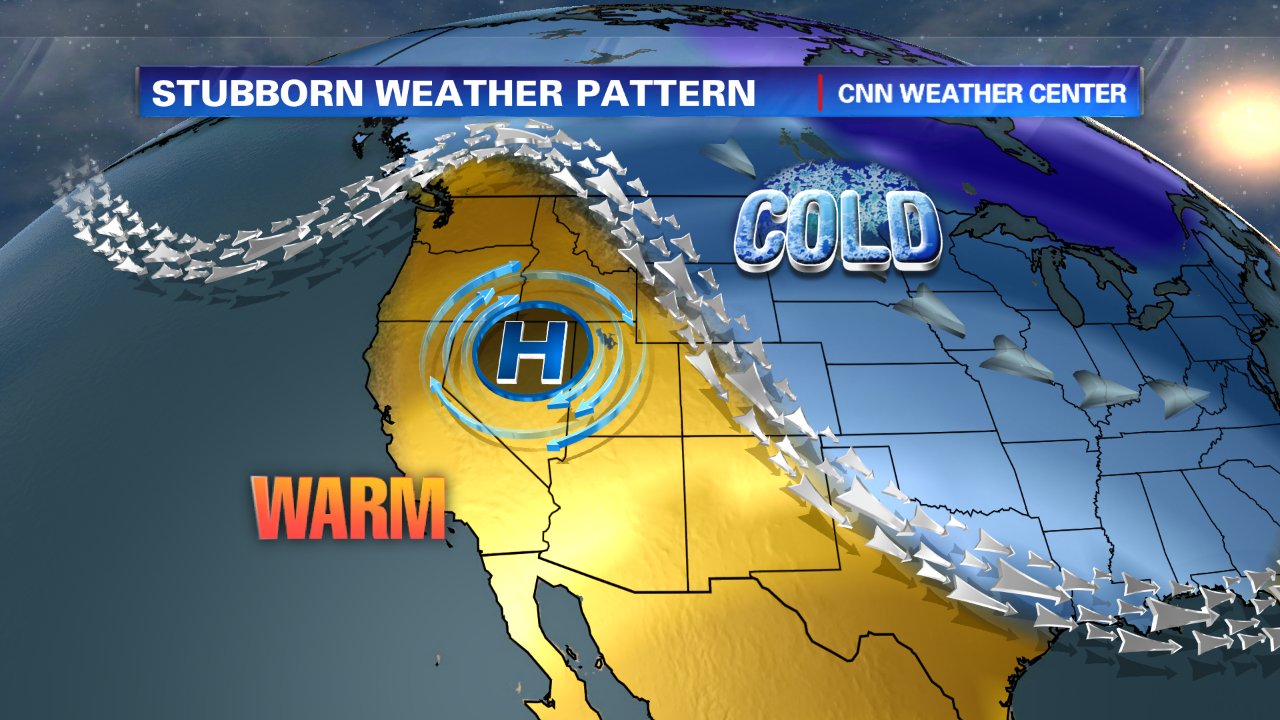
This was supposed to be a wet rainy season, courtesy of the strongest El Niño in years. Well, February is almost over; and we rarely get much, if any, rain in March and April. The El Niño has sent a lot of rain to Northern California, which is good, but now a high pressure ridge is setting up in the Rockies which will dry everything out and make the mercury rise. And it may result in the dwindling of the now respectable snowpack in the Sierras.

By the picture caption above, I mean that Southern California is becoming North America’s own equivalent of Chile’s Atacama Desert, where it almost never rains. I believe the last flood in the Atacama was witnessed by Noah.

In the meantime, Martine and I scoff more than ever at weather reporters. El Ninny strikes again!

Schachnovelle

Staunton Design Chess Pieces in Play

Staunton Design Chess Pieces in Play

Chess is for me a lifelong obsession. Not that I’m any good at it: I tend to be too unaggressive, too defensive. But I love to follow the game and even, from time to time, solve endgame problems.

Why am I drawn to chess? Is it because it approaches infinity in the number of possible chess games—a number that exceeds the number of atoms in the universe. According to Chess.Com:

The number of legal chess positions is 10^40 [that’s 10 to the 40th power], the number of different possible games, 10^120. Authors have attempted various ways to convey this immensity, usually based on one of the few fields to regularly employ such exponents, astronomy. In his book Chess Metaphors, Diego Rasskin-Gutman points out that a player looking eight moves ahead is already presented with as many possible games as there are stars in the galaxy. Another staple, a variation of which is also used by Rasskin-Gutman, is to say there are more possible chess games than the number of atoms in the universe. All of these comparisons impress upon the casual observer why brute-force computer calculation can’t solve this ancient board game. They are also handy, and I am not above doing this myself, for impressing people with how complicated chess is, if only in a largely irrelevant mathematical way.

After only a few moves, the chess player is staring at infinity. No doubt, many of the moves are atrocious, perhaps even borderline illegal; but the variety of possible moves is truly staggering.

Even if I am not a good player, I love the literature of chess. I have just finished re-reading Stefan Zweig’s Schachnovelle (translated as Chess Story). That short novel was itself turned into a great film directed by Gerd Oswald called Brainwashed (1960) starring Curd Jürgens.

Borges has written a great poem about chess, which I will post soon. Also, you can expect to see a short story by Lord Dunsany entitled “The Three Sailors’ Gambit.”

I will also tell you about some of my heroes, such as the Estonian Grandmaster Paul Keres, Former World Champion Mikhail Tal of Latvia, and. of course, the never-to-be-forgotten Bobby Fischer.


“A Poison Tree”

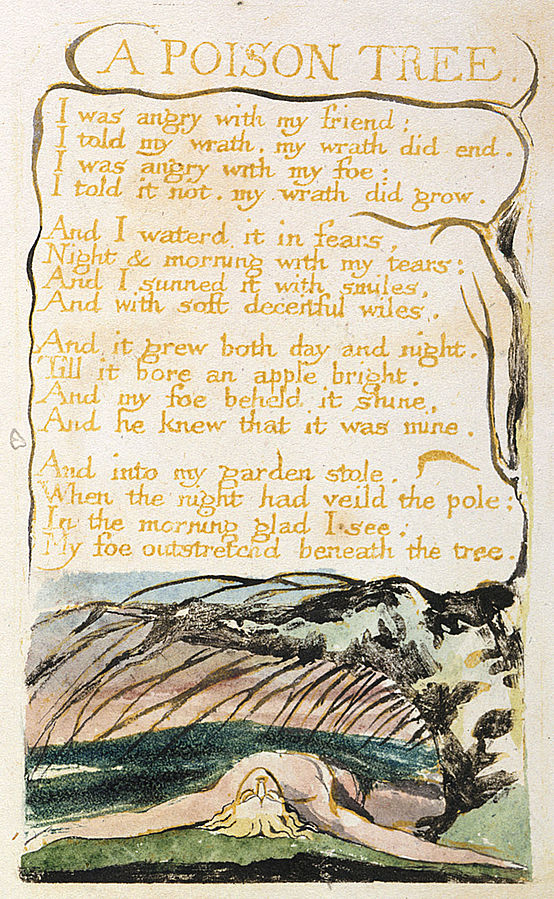
William Blake’s Original Art for “A Poison Tree”

William Blake’s Original Art for “A Poison Tree”

The following poem comes from William Blake’s Songs of Experience. In it, we see how repressed anger bears its own poison fruit, in this case, the death of an enemy.

A Poison Tree

I was angry with my friend:
I told my wrath, my wrath did end.
I was angry with my foe:
I told it not, my wrath did grow.

And I watered it in fears,
Night and morning with my tears;
And I sunned it with smiles,
And with soft deceitful wiles.

And it grew both day and night,
Till it bore an apple bright.
And my foe beheld it shine.
And he knew that it was mine,

And into my garden stole
When the night had veiled the pole;
In the morning glad I see
My foe outstretched beneath the tree.

I like Blake’s take on suppressed anger in this poem. The implication is that if the narrator had not “told his wrath” with his friend, it would have been his friend that suffered the dire consequences. Instead, he nurses his anger until it grows, has its dire effect on his foe, and leaves him gladdened at the results.

The Lion Dance

Lion Dancer at Chinese New Year Parade

Lion Dancer at Chinese New Year Parade

I have seen perhaps a dozen Chinese New Year parades, and I am quite used to seeing dragons and lion dancers. What I find interesting, however, is that there are no lions in China, nor have there been for about two thousand years. According to an article in China Highlights:

In traditional Chinese culture, the lion, like the Chinese dragon, was only an animal which existed in myth, and there were no actual lions in China. Before the Han Dynasty (202 BC – 220 AD), only a few lions had reached the Central Plains from the western area of ancient China (now Xinjiang), due to Silk Road trade.

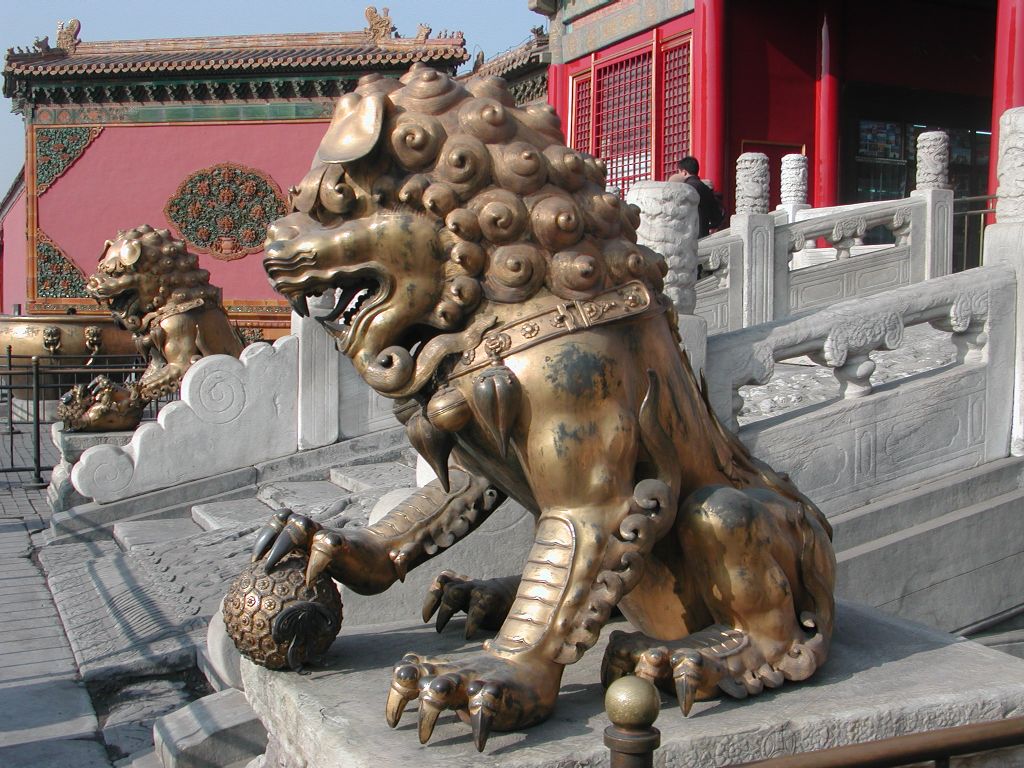
Stone lions can be seen, however, acting as guardians to Beijing’s Forbidden City (see below). And Chinese images and beliefs relating to the mythical strength of the lion have spread around the world with the Chinese diaspora.

Stone Lion at the Forbidden City in Beijing

Stone Lion at the Forbidden City in Beijing

There are two styles of lion dance, the Northern and the Southern. Although most Chinese-Americans originated in South China, all the lion dancers I have seen at New Years parades were of the Northern type, which is associated with Chinese martial arts organizations. In the Northern style, only one person manipulates the lion costume. According to the China Highlights website, “Northern lion dances are more gymnastic, involving rolling, wrestling, leaping, jumping, climbing, or kowtowing.” It’s quite entertaining to see the feats of gymnastics performed by Kung Fu practitioners.