Today was the fourth (or was it the fifth?) day of a brutal heat wave. I haven’t been able to accomplish much, and I refuse to cook any meals, as long as my living quarters resemble a sweat lodge.
If there are still any climate change deniers out there, I invite them to ascend a podium in the middle of the afternoon wearing a winter coat and explain their position in a hours-long speech without dropping dead.
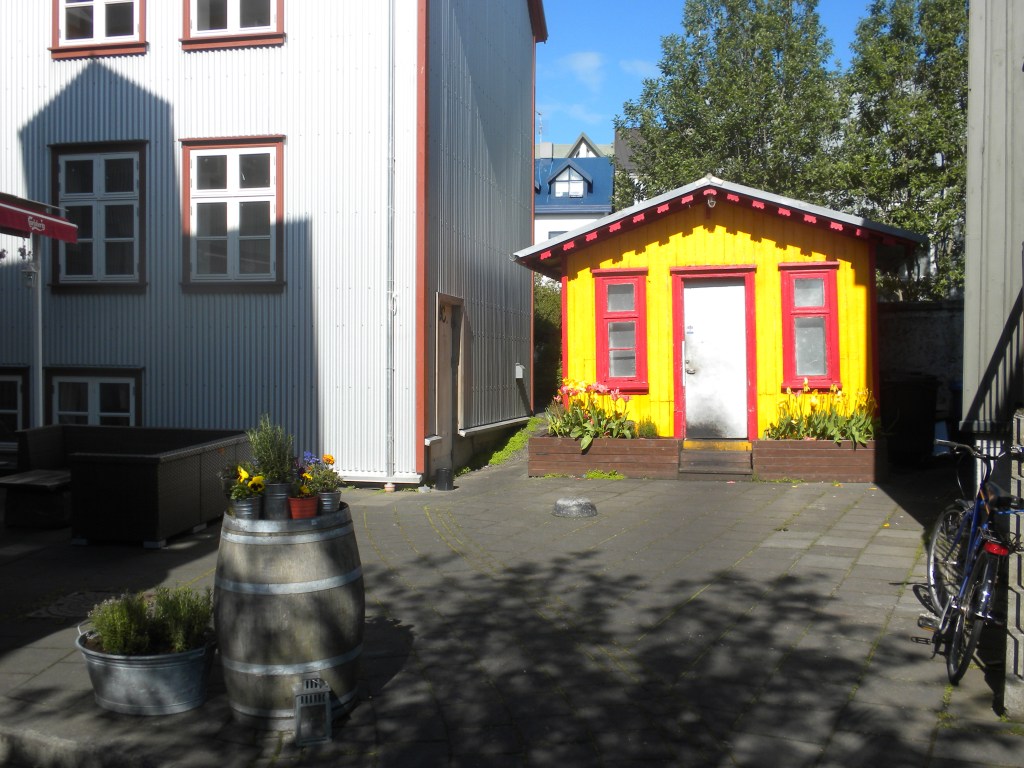
It’s not a terribly large city, only about 140,000 residents as of 2023. But when you add in the outskirts, it becomes 248,000, more than half the population of the entire island. It’s one of the most expensive cities in Europe, but one of the most approachable.
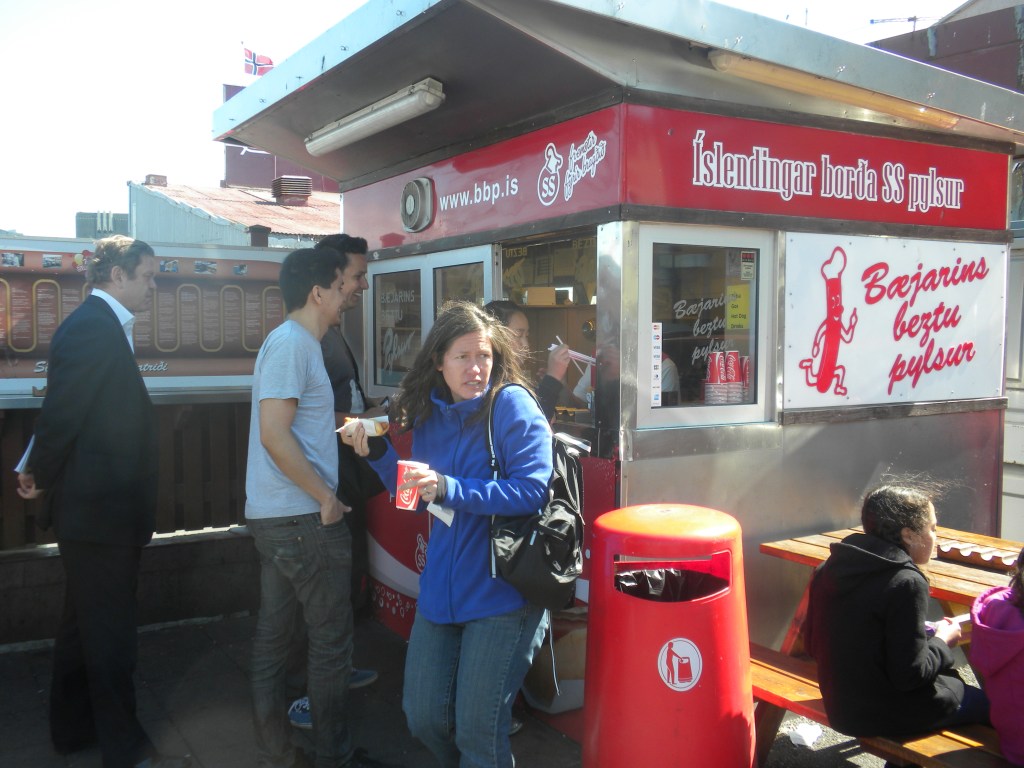
No, you don’t have to speak Icelandic—a version of medieval Norse—to understand the people, most of whom under the age of 80 speak English. One of the most beloved eating places in town is the hot dog stand pictured below:
Bææjarins Beztu Pylsur: The City’s Best Sausages
Its most famous customer was Bill Clinton, who famously asked for a hot dog with mustard only. To this day, if you order a Clinton at BBP, that’s what you get. I’d rather order the works, which include mustard, remoulade sauce, ketchup, raw onion, and fried onions.
If you like American fast food, you will find plenty of it not only in Reykjavík but around the island as well. That includes pizza, hamburgers, and hot dogs (pylsur), to name a few. There’s no McDonalds or Starbucks, but you will find Domino’s and Subway.
Where Are All the Skyscrapers?
Above is a view of central Reykjavík from a boat on a harbor puffin cruise. You can walk the heart of the city from one end to the other in about forty minutes. But I’ll bet you can’t do it without stopping a dozen places for coffee, books, souvenirs, ice cream, or beer.
I’ve been to Iceland in 2001 and 2013. I hope I can visit it again. It’s fun. It’s low key. And the fish is effing fantastic.
It had to happen eventually: the wind suddenly started coming from the east and blowing the hot air of the desert all through Southern California, even by the coast where we are usually protected by the Marine Layer. Well, now there is no Marine Layer. Only the beginnings of a nasty Santa Ana Wind that makes L.A. about as comfortable as the Mohave Desert.
Because I live in an apartment building that was built around the time I was born, before there was the slightest hint of global warming, we have no insulation in the walls and ceiling. That means the apartment gets super hot and stays that way until the wee hours of the morning.
Today I have gone through three trays of ice cubes fixing iced water and iced tea for me. I was going to cook Spanish Rice for dinner, but then I thought, “To hell with it! No way am I going to make the kitchen hotter than it already is.” Instead, Martine and I scrounged around for what we had lying around in the pantry and in the refrigerator.
As is usual with these Santa Ana Winds, they always last longer than predicted. To give you a feeling for what life is like under these conditions, just read the opening of Raymond Chandler’s story “Red Wind”:
There was a desert wind blowing that night. It was one of those hot dry Santa Anas that come down through the mountain passes and curl your hair and make your nerves jump and your skin itch. On nights like that every booze party ends in a fight. Meek little wives feel the edge of the carving knife and study their husband’s necks. Anything can happen. You can even get a full glass of beer at a cocktail lounge..
I ran into the word while reading a book of Anita Desai’s short stories. The word is badmash, meaning a rogue, ruffian, or miscreant. While using Google Images, I ran into an interesting phenomenon. In our society, words like “rogue,” “ruffian,” or “miscreant” are brand names for products aimed at people who like to be seen as badasses, even if they aren’t.
That explains a lot about the secret dream life of the American male. Find a word which has had a mostly negative charge, and it suddenly becomes something desirable.
The word badmash is variously claimed to have Hindi, Urdu (Pakistani), Persian, or Arabic roots. According to the Oxford English Dictionary, the word first came into the English language around 1840.
By the way, there is even an Indian restaurant in Los Angeles called Badmaash (a variant spelling). I guess it just goes to show you.
Today, with a heat wave beginning, I decided to spend the afternoon in an air-conditioned movie theater watching Deadpool & Wolverine. Martine wisely decided not to join me.
There is something about the whole Marvel Cinematic Universe that is ultimately ho hum, regardless how much action there is. Do I really care about any of the characters? Well, no. Superheroes who can survive what appear to be fatal wounds are ultimately anti-dramatic. There are multiple attempts in the film to make the characters seem interesting, but they inevitably refer to something that was chronicled in some comic book or an earlier film that I hadn’t seen.
Such a pity these characters—apparently immortal—are so uninteresting. To me, anyhow. I heard members of the audience audibly checking boxes when some off-screen event was referred to. But to me, it was ultimately greasy kid stuff.
What sticks out in the Marvel Cinematic Universe is a world of unmotivated action lacking any emotion but unexplained rage in which the characters are just action figures.
There are some strange byways in English poetry, such as Chidiock Tichborne’s “Elegy,” written the night before his execution for treason on September 20, 1586. At the age of twenty-four, he was eviscerated, hanged, and then drawn and quartered. His crime? Taking part in a plot to murder Queen Elizabeth I. He and all his co-conspirators were rounded up, tried, and executed.
Elegy
My prime of youth is but a frost of cares, My feast of joy is but a dish of pain, My crop of corn is but a field of tares, And all my good is but vain hope of gain; The day is past, and yet I saw no sun, And now I live, and now my life is done.
My tale was heard and yet it was not told, My fruit is fallen, and yet my leaves are green, My youth is spent and yet I am not old, I saw the world and yet I was not seen; My thread is cut and yet it is not spun, And now I live, and now my life is done.
I sought my death and found it in my womb, I looked for life and saw it was a shade, I trod the earth and knew it was my tomb, And now I die, and now I was but made; My glass is full, and now my glass is run, And now I live, and now my life is done.
The Iconostasis at Assumption of the BVM in Long Beach
On Saturday, Martine and I attended the annual festival at Assumption of the Blessed Virgin Mary Greek Orthodox Church in Long Beach. It was our third Greek festival of the year, and probably not the last. We like the food, the music, and the churches. The Long Beach church was perhaps a bit on the gaudy side, but it was all reverently done.
There remain two more Greek festivals over the next six weeks: St Anthony Greek Orthodox Church on September 20-22 and the big event at Saint Sophia Greek Orthodox Church on October 5-6. I am pretty sure that we’ll be at Saint Sophia. We’ve never been to St Anthony, but we’ll go if I could talk Martine into it.
I love ethnic festivals, particularly if they’re Hungarian. But these are becoming fewer in number as time goes on, and the Magyar population of Southern California becomes more acculturated and dispersed. The Greek festivals seem to be more of a going thing. I hope that it continues to be.
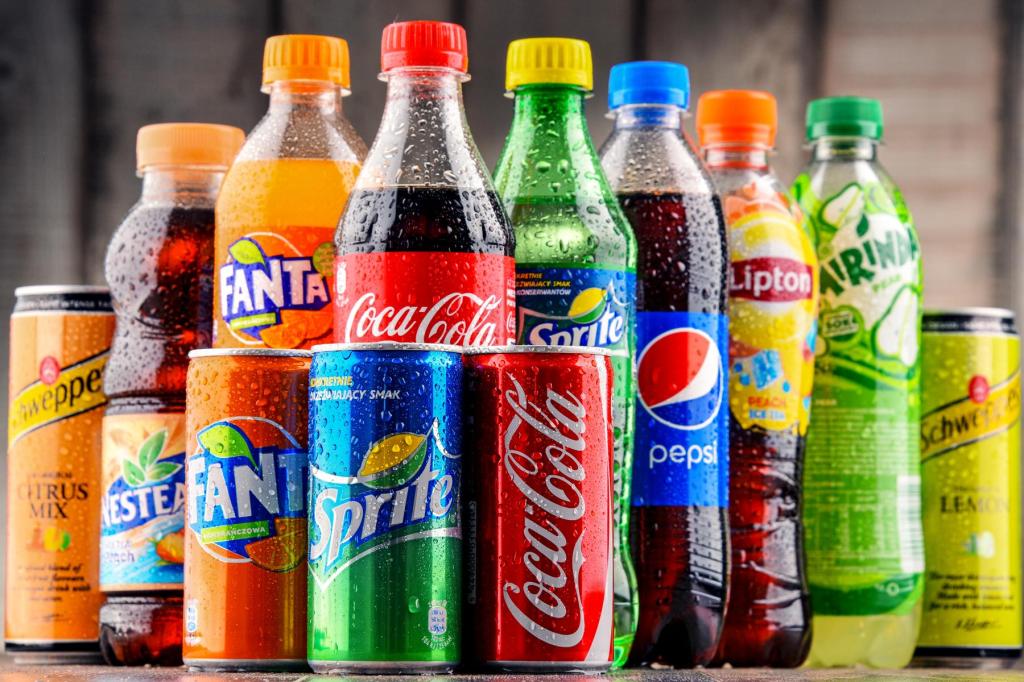
Every time I visit the supermarket, I am amazed by the large variety of sugary drinks, both carbonated and non, and the high price of same. Every so often, I get suckered in to try one, but usually find myself disappointed.
When I travel in Latin America, my usual beverage of choice at restaurants is agua mineral con gas, which is widely available and doesn’t cost much. For some reason, in the United States the beverages are much more expensive, and not always so tasty. I’ve always wondered why this is so.
That’s why at home I usually drink either iced water or my own iced tea, which consists of what remains in my cheap Japanese metal teapot after my breakfast hot tea. Right now, it’s Darjeeling, which makes it much higher quality than the bottled iced teas on the supermarket shelves, and unsweetened to boot. (I am diabetic, so have reason to cut back on sugar at every opportunity.)
As a result, my grocery bill is light on beverages, except for Martine’s low fat milk and distilled water. On the other hand, when I see other supermarket patrons, their carts are loaded down with alcoholic beverages and sweet fizzy water. (For me, the predominant item consists of fruits and vegetables.)
It took many years to switch from the inevitable Coke or Ginger Ale to what I am drinking today. Fortunately, as a result, my blood sugar is manageable, and, I think, my health overall is better.
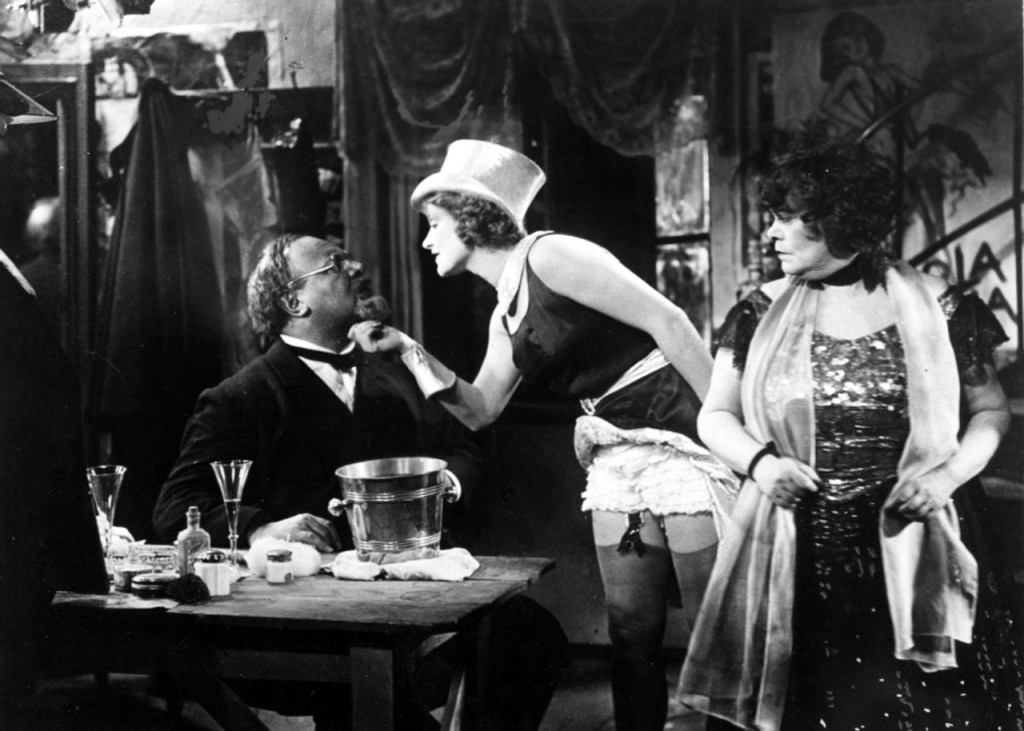
Emil Jannings (Left) and Marlene Dietrich (Center) in The Blue Angel
A cucoloris is defined by Wikipedia as “light modifier (tool, device) for casting shadows or silhouettes to produce patterned illumination…. The cucoloris is used to create a more natural look by breaking up the light from a man-made source. It can be used to simulate movement by passing shadows or light coming through a leafy canopy.”
The films of Josef Von Sternberg with Marlene Dietrich made extensive use of cucolorises. In scenes which other directors would open up, such as a troop of French Foreign Legionnaires marching through town in Morocco (1930) or a Chinese steam locomotive going down the middle of a crowded street in Shanghai Express (1932), Von Sternberg conveys a sense instead of claustrophobia and encroaching shadows.
Included in the series were:
The Blue Angel (1930), shot in Germany
Morocco (1930)
Dishonored (1932)
Shanghai Express (1932)
Blonde Venus (1932)
The Scarlet Empress (1934)
The Devil Is a Woman (1936)
Even in the later films, the same lighting technique can be found in The Shanghai Gesture (1941) and Macao (1952).
Cucoloris
It is almost as if all the films were set in Lola Lola’s dressing room in The Blue Angel. In many ways, he is the diametric opposite of John Ford, whose film scenes frequently extended to the far horizon.
The seven Sternberg/Dietrich films listed above are among my favorite films of all time. I have seen all of them multiple times and will continue to do so. When I was a student in UCLA’s Graduate School, I visited Von Sternberg at his house in Westwood (his wife taught in the art department) and knew his son Nicholas.
I own a copy of his rare autobiography, Fun in a Chinese Laundry, and read his hard-to-find 1920s novel Daughters of Vienna.
Weird Ice Floes at Jökulsárlón in Southeast Iceland
My mind keeps going over the places I’ve seen In Iceland duri9ng my two trips there in 2001 and 2013. One of the most amazing was the glacial lagoon at Jökulsárlón between Vík í Myrdal and Höfn. The lagoon was full of hundreds of ice floes that had broken off the giant glacier of Vatnajökul. Some were white, others had strange blue highlights; and some were coated with debris picked up en route to the lagoon.
The lagoon at Jökulsárlón is probably one of the top ten sights to see in Iceland. It’s too far from Reykjavík to do in a day trip (though it is offered by some tour operators). Usually, it’s a sight that only travelers who are doing the Ring Road (Route 1) around Iceland get to see. It is possible to take a boat ride around the lagoon.
Equally worth seeing is the black sand beach called Breiðamerkursandur that is just across the highway from the lagoon.
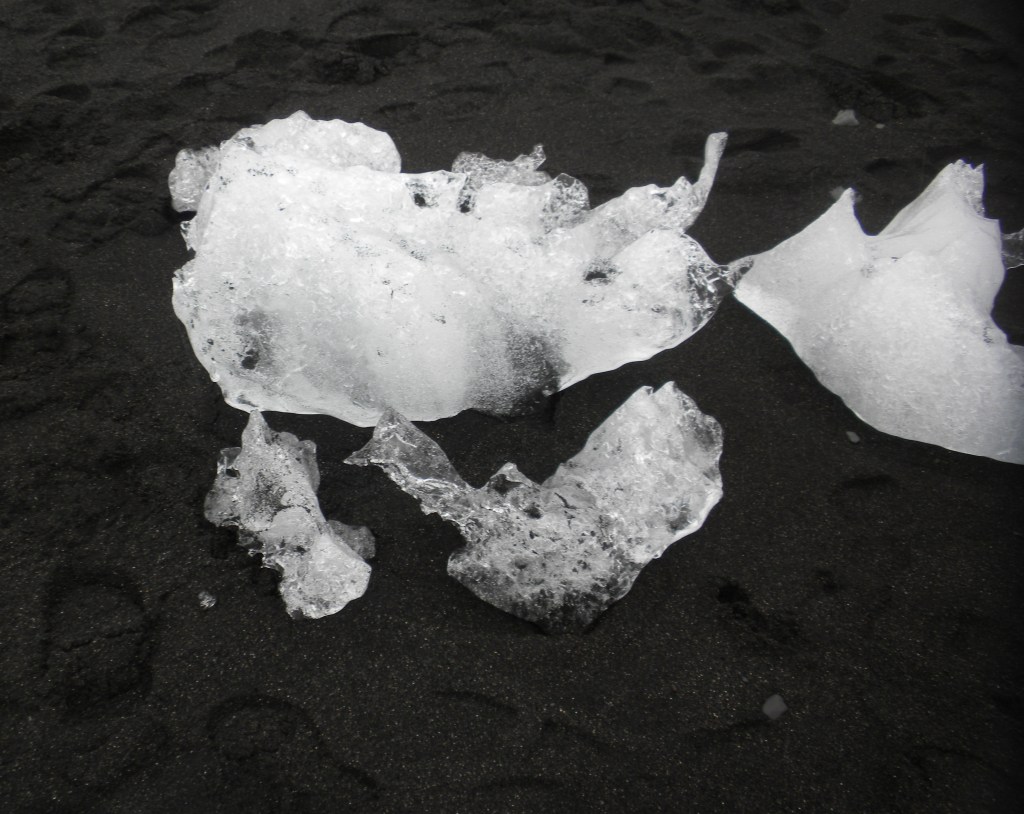
Glacial Ice on Breiðamerkursandur
As you walk along the black sand beach, you see chunks of ice from broken-up ice floes scattered along the sands like diamonds. Travelers have to be careful, because the area is known for occasional “sneaker waves” that could carry travelers off to an icy and wet death.







 Tarnmoor
You must be logged in to post a comment.