The Journalist

Svetlana Alexievich, Winner of the 2015 Nobel Prize for Literature

Svetlana Alexievich, Winner of the 2015 Nobel Prize for Literature

I have only read two of her books so far, but they were both knockouts. First, there was Zinky Boys (1991), about the Soviet experience in Afghanistan. Now, added to that is Voices from Chernobyl: The Oral History of a Nuclear Disaster (1997). Both books are descriptions of incredible suffering, and they are both powerful disincentives from enlisting in the Soviet military.

Svetlana Alexievich (b. 1948) is usually described as a Belorussian journalist, though she herself rejects the title: She has been known to edit the first person testimonials from one edition to the next, which is a big no-no for oral historians, but the mark of an imaginative writer. I do not mind, because I will accept 99-44/100% accuracy if it involves stylistic or other improvements.

Both Afghanistan and Chernobyl were unspeakable disasters that seemed to go on forever (the latter is still claiming victims), and you cannot hope for a better introduction to both than read Alexievich’s books.

In Voices from Chernobyl, the wife of one Soviet soldier who was involved in the cleanup says:

They say, “Chernobyl,” and they write, “Chernobyl.” But no one knows what it is. Something frightening opened up before us. Everything is different for us: we aren’t born the same, we don’t die the same. If you ask me, How do people die after Chernobyl? The person I loved more than anything, loved him so much that I couldn’t possibly have loved him more if I’d given birth to him myself—turned—before my eyes—into a monster. They’d taken out his lymph nodes, so they were gone and his circulation was disrupted, and then his nose kind of shifted, it grew three times bigger, and his eyes became different—they sort of drifted away, in different directions, there was a different light in them now, and I saw expressions in them I hadn’t seen, as if he was no longer himself but there was still someone in there looking out. Then one of the eyes closed completely.

I do not recommend reading the book on a full stomach. The same with Zinky Boys:

We were combing through a village. You fling open the door and throw in a grenade in case there’s a machine-gun waiting for you. Why take  a risk if a grenade could sort it out for you? I threw the grenade, went in and saw women, two little boys and a baby in some kind of box making do for a cot.

You have to find some kind of justification to stop yourself going mad. Suppose it’s true that the souls of the dead look down on us from above?

I know that we considered the Soviets to be our enemies, but these books describe scenes that one wouldn’t wish upon one’s worst enemy.


Regarding Henry

Henry Miller (1891-1980)

Henry Miller (1891-1980)

Is Henry Miller famous? Or is he just infamous? Or is he both?

I have just finished reading a book of his essays, reviews, and prefaces entitled Stand Still Like the Hummingbird (1962) and find myself alternately idolizing and deploring the man’s work. Of course, he is probably most famous for his novels featuring S-E-X, especially The Tropic of Cancer (1934). And yet, he can write like a Bodhisattva, as in the essays “The Hour of Man” and “The Immorality of Morality.”

In the latter essay, he wrote what I regard as the definitive answer as to how to live in the era of Trump:

Neither would I urge one to run away from the danger zone. The danger is everywhere: there are no safe and secure places in which to start a new life. Stay where you are and make what life you can among the impending ruins. Do not put one thing above another in importance. Do only what has to be done—immediately. Whether the wave is ascending or descending, the ocean is always there. You are a fish in the ocean of time, you are a constant in an ocean of change, you are nothing and everything at one and the same time. Was the dinner good? Was the grass green? Did the water slake your thirst? Are the stars still in the heavens? Does the sun still shine? Can you talk, walk, sing, play? Are you still breathing?

And yet, in another essay entitled “To Read or Not To Read,” Miller brags about reading fewer books “I tried to make it clear that, as a result of indiscriminate reading over a period of sixty years, my desire now is to read less and less.”

One of Miller’s Water Colors

One of Miller’s Water Colors

Is it perhaps because Miller also sees himself as a painter, particularly of water colors? The ones I have seen are pretty good, and I shouldn’t be surprised if the author likes the act of pure creativity involved in coming up with these scenes, which he does not paint from life.

In the end, I see Henry Miller as, at times, gifted by his muses—and at other times merely producing when the muses aren’t present. There is a certain lack of consistency in his work. I will continue to read him for the times I find he is spot on.

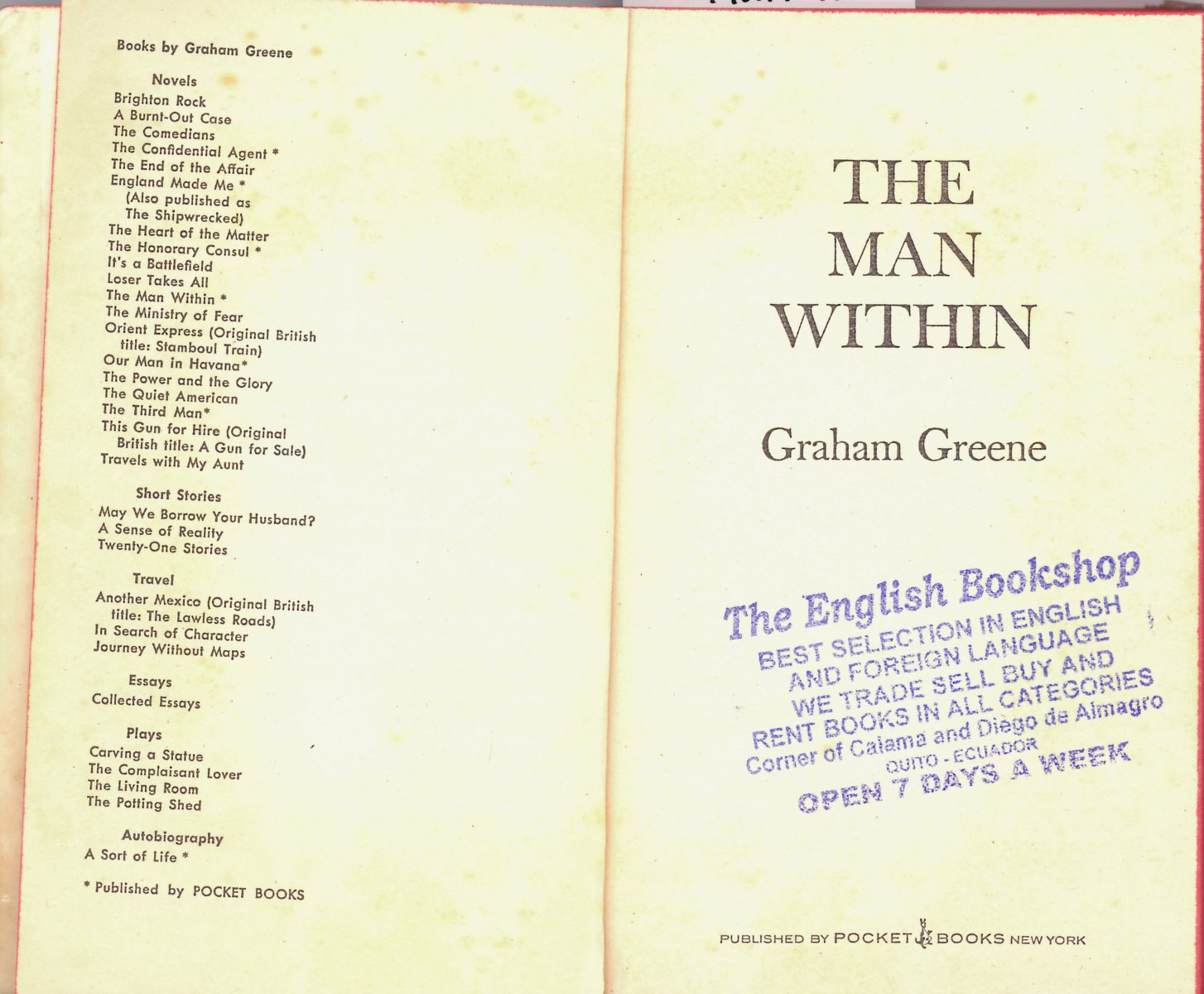
Quito’s English Bookshop

Mark Horton at the English Bookshop

Mark Halton at the English Bookshop

My brother had left a few days earlier, and I was due to fly back to Los Angeles the next day. Martine had given me strict instructions to bring back five Ecuador 2017 calendars that we could distribute as gifts, so I walked around the Mariscal district of Quito. A couple weeks earlier, Dan and I had stopped in at the English Bookshop at the corner of Calama and Diego de Almagro to ask if he had an Ecuador or Quito street atlas. The owner, Mark Halton, gave us a couple of good leads—though, alas, we could not find any such animal.

So, on this (dire) election day, I stopped back at the English Bookshop and got into an interesting discussion with Mark. He was kind enough to brew me an excellent cup of tea, and we had a wide-ranging conversation about books, politics, technology, and a variety of other subjects. He even told me where I could find the calendars. And they were exactly where he pointed me. There were just five left, and I bought all of them.

Mark has a large selection of hardbound and paperback books, mostly in English. It is a fun place for travelers to pick up some interesting titles and sit down and talk books.

If I ever find myself in Quito again—and I hope I do—I will make a point of stopping in at the English Bookshop and Mark’s excellent hospitality.

One of the Two Books I Bought There

One of the Two Books I Bought There

L.A. Writers: James Ellroy’s Dark Places

James Ellroy, Age 10, with His Murdered Mother

James Ellroy, Age 10, and His Murdered Mother

Given his childhood, it is no wonder that the vision of crime novelist James Ellroy is full of dark places. At the age of 10, he experienced being orphaned when his divorced mother, Jean, was raped and murdered. To this date, the crime has not been solved. But it has resonated through the work of its littlest victim.

To date, I have read seven of his novels, most of which are set in Los Angeles. You can believe me when I say that the author’s L.A., the sun doesn’t shine much. He is perhaps most famous for his L.A. Quartet, which consists of:

  • The Black Dahlia (1987)
  • The Big Nowhere (1988)
  • L.A. Confidential (1990)
  • White Jazz (1992)

As a reviewer for National Public Radio wrote, “His L.A. might not be a city of angels, but the devils he conjures up tell one hell of a tale.”

At times, Ellroy twists the English language into a strange rhythm, as if he were the American Louis Ferdinand Céline. Some of his books, such as White Jazz and American Tabloid, are sometimes difficult to read because of their driving, staccato style. But the energy keeps you moving along. When you are finished with one of his books, you need to relax a bit.

I just finished reading Blood on the Moon (1984), which is set on an axis from West Hollywood (“Boys’ Town”) to Silverlake, with occasional visits to the LAPD’s Parker Center downtown. The novel has a fine local feel that is the hallmark of a real L.A. writer. He may have set some stories elsewhere, but L.A. is somehow the real center of his oeuvre.

Below is a picture of the writer as he is today:

James Ellroy Today

James Ellroy Today

I met the author several years ago when he spoke at the Los Angeles Times Book Festival back when it was still being held at UCLA. I remember his strange description of how he spent his hours alone in the dark, carrying on imaginary conversations with women who were not in the room with him.

Dark. Strange. Indeed—but also brilliant.


The Photographer and the Cañar

St. Anthony Day Parade

St. Anthony Day Parade

In preparation for my trip, I am reading Judy Blankenship’s excellent Cañar: A Year in the Highlands of Ecuador. Although the text is excellent, what impressed me the most were Judy’s photographic portraits in black and white of the Cañar villagers she and her husband Michael got to know in the time they spent in the indigenous Andean area some two hours north of Cuenca. Unfortunately, these portraits must be well protected, because I was unable to hijack any of them to show you. (I guess you’ll just have to get your hands on the book.)

Below is one of Judy’s pictures in black and white of the Carnaval parade in Curreucu:

Carnaval Parade in Curreucu

Carnaval Parade in Curreucu

Although Judy Blankenship is not a professionally trained ethnologist, she could have fooled me. Her description of marriage, entrada (betrothal), funeral, and other rituals makes for delightful reading—not to mention her photography workshops for indigenous women and even a few nuns. Below is a photograph of the author:

Judy Blankenship

Judy Blankenship

At this point, I have not read anything else by her; but I do believe it would be worth hunting down some of her other work, most especially her photographs.

Slow Days, Fast Company

Eve Babitz

Eve Babitz

The following is based on a book review I published on Goodreads.Com yesterday:

In the 1960s and 1970s, when I used to dread the approach of another lonely weekend, I wished I could meet a girl like Eve Babitz, intelligent, articulate, and drop-dead beautiful. And there she was, living just a few miles from me in Hollywood while I was in Santa Monica. Describing a friend of hers, “she lacked that element, raw and beckoning, that trailed like a vapor” behind her.

Like her first book, Eve’s Hollywood, Slow Days, Fast Company: The World, the Flesh, and L.A. is a series of seemingly biographical essays with a hefty admixture of fiction. Where the first book talked about Eve’s teeny-bopper years in the 1960s, in her second she becomes the lovely, knowing score girl that everyone wants to meet … and bed. She hung out with the likes of Jim Morrison, Steve Martin, artist Ed Ruscha, and gallery owner Walter Hopps.

Highly Recommended

Highly Recommended

What she writes about in Slow Days, Fast Company is about her friendships and relationships with people who are usually not identified with their last names; and even their first names could have been modified. In the end, it doesn’t matter a bit. Eve knows success, and how it twists people so they becoming boring “celebrities” who rely on drugs and booze to get through the day. She writes:

But everyone knows that it would have been much better to have been popular in high school when your blood was clean, and pure lust and kisses lasted forever, Chocolate Cokes in high school are better than caviar on a yacht when you’re forty-five. It’s common knowledge.

Eve Babitz knew herself far better than most people, and she had a wicked sense of humor, as in this exchange:

The very next night I was having dinner with this fashionable young rich man who looked at me as I smoothed some paté over some toast and said, “You better watch out with that stuff. It’ll make you fat.”

“Well, gee,” I said to him, “there are so many perfect women, it’s just horrible you have to spend time sitting here with me.”

Horrible indeed! No use being morose about it, however. Even if I never found an Eve Babitz, I can appreciate her discriminating mind even at this distant remove. This is a girl who did not believe in the viability of most relationships: “The real truth is that I’ve never known any man-woman thing to pan out (it may pan out to them, of course, but couples in middle age who don’t speak to each other are not my idea of a good movie.)”

Eve Babitz in her time and place—Los Angeles in the 1960s and 1970s—was as good as they come. She is in many ways the best that Los Angeles has to offer. If you read her books, I think you will understand why.

Encountering an Old Friend

A Book That Greatly Influenced My High School Years

A Book That Greatly Influenced My High School Years

There it was on the shelf of Iliad Book Store in February 2009: A not-too-beat-up copy of the Committee on College Reading’s Good Reading, circa 1964. Naturally, I picked it up if for no other reason than to walk down memory road when I was a voracious reader. (And, if you read this blog, you know of course that I still am.)

I was the valedictorian of my class of 1962 at Chanel High School in Bedford, Ohio—a school that no longer exists. First it changed its name to Saint Peter Chanel, then, some years later, the Catholic Diocese of Cleveland shut it down. Even though I was in excruciating pain from a tumor that was pressing on my optic nerve, I still read as much as I could. On weekends, I would take the 56A bus downtown, stop in at Schroeder’s Bookstore on Public Square, and then spend some time at the main library, which was built in 1925.

What I felt I needed were books that served as a bibliographic reference to what I ought to be reading. That’s what Good Reading did. There were individual chapters by different members of the Committee on College Reading, all faculty members at various colleges. Just to give an example, here are some of Robert Clark White’s recommendations for 20th Century Continental Novels:

  • Samuel Beckett: Molloy
  • Albert Camus: The Stranger and The Plague
  • Karel Čapek: The War with the Newts
  • André Gide: The Counterfeiters
  • Jaroslav Hasek: The Good Soldier Schweik
  • Hermann Hesse: Steppenwolf and Siddhartha
  • Franz Kafka: The Trial
  • Thomas Mann: Buddenbrooks, The Magic Mountain, and The Joseph Tetralogy
  • Marcel Proust: The Remembrance of Things Past
  • Jean-Paul Sartre: Nausea and Troubled Sleep

These are not bad titles for the time. I probably would have added something by Iceland’s Halldor Laxness and Portugal’s Fernando Pessoa, but these are mere cavils. Thanks largely to this book, my attention was directed to great writers in every field. And the book covered more than literature: There was also history, philosophy, religion, anthropology, physical sciences, and other subjects.

I was such an earnest young student. Even while on the bus, I would pore over books such as Norman Lewis’s 30 Days to a More Powerful Vocabulary and Word Power Made Easy, taking all the quizzes in the books over and over until I got a perfect score. Despite all the physical pain, I had a good childhood, starting with what my loving parents gave me and adding what I could along the way.


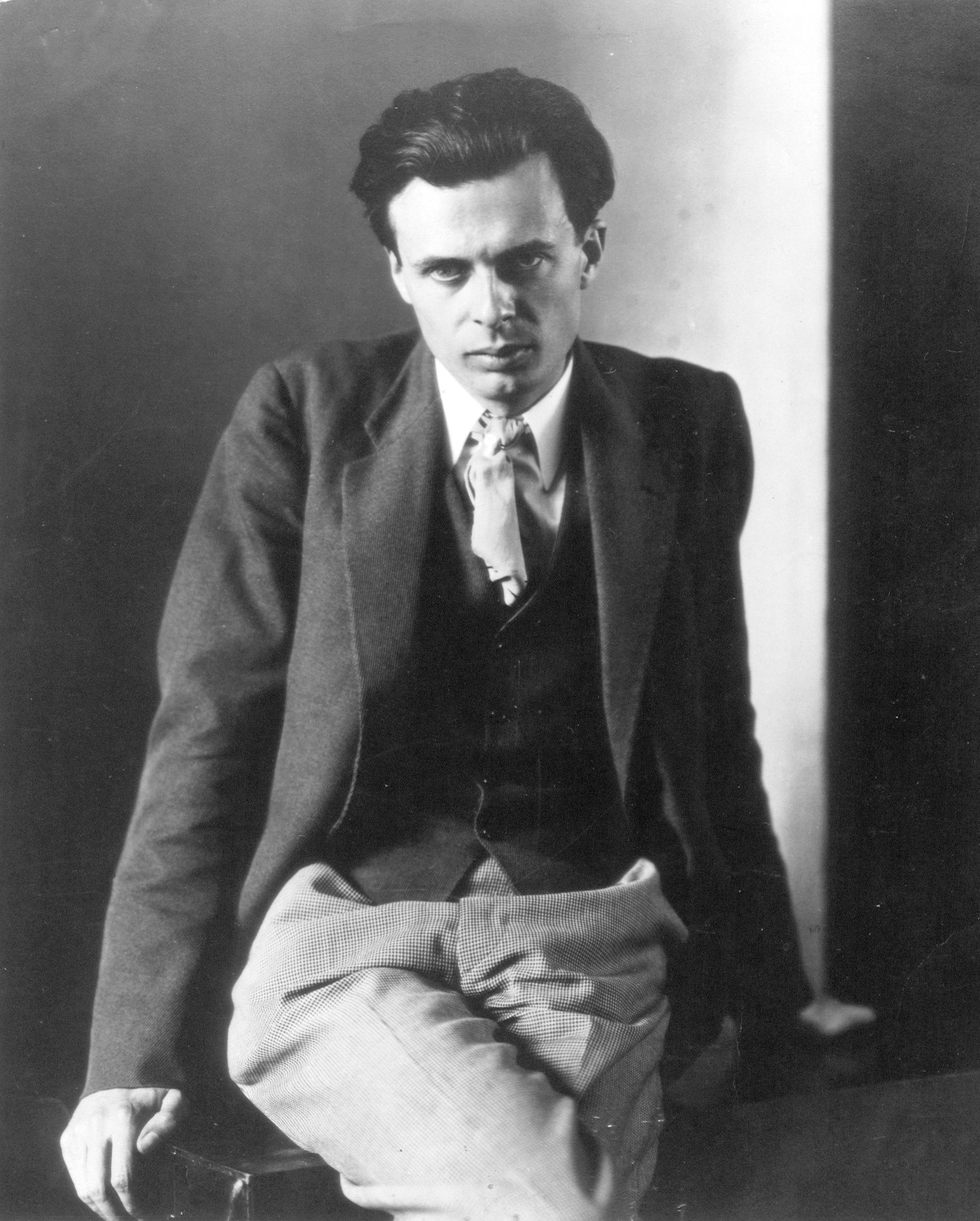
On Re-Reading

Aldous Huxley (1894-1963)

Aldous Huxley (1894-1963)

As Juan Vidal wrote for National Public Radio:

The best books are the ones that open further as time passes. But remember, it’s not because they changed. Every letter and punctuation mark is exactly where it always has been, and where it will remain forever. It’s you who are different; it’s you who’s been affected by the depth of your experience. And it’s you that has to grow and read and reread in order to better understand your friends.

I have just finished re-reading Aldous Huxley’s first novel, Crome Yellow, written in 1921 at the beginning of his career. In 1975, I was abashed by the romantic failures of Dennis Stone, the book’s narrator, with whom I identified because of my own experiences at that time. Now I see that Huxley not only was living through his own callow youth, but very neatly encapsulated for all time that obsessiveness with our own tactical failures can result in even more serious strategic failures in this life. Dennis fails with Anne Winbush, but his consciousness of failure prevents him from seeing Mary Bracegirdle, who is interested in him.

There are some books I re-read on a regular basis. Most notably: Marcel Proust’s In Search of Lost Time. I am now in my third reading of the seven-volume novel, and ready to start re-reading the third volume, The Guermantes Way. Then there are works like The Iliad and The Odyssey, Don Quixote, Dante’s Divine Comedy, Balzac’s Comédie Humaine, and any number of great books that I want to re-investigate because I have changed. To re-read is to measure that change.

When I was in my thirties, I loved Aldous Huxley and read many of his works. Now I think I’m about to check out his novels, stories, and essays again. The years have sped on, and we are all a work in progress.


Serendipity: Books and Brain Pickings

“A Marvellously Noble and Transcendent Chimera”

“A Marvelously Noble and Transcendent Chimera”

I do not follow many blog sites; though every once in a while, I find one that is superb. Such is Brain Pickings, which I have now included among my links.

The following observation on reading comes from Hermann Hesse’s My Belief: Essays on Life and Art, by way of Brain Pickings:

The great and mysterious thing about this reading experience is this: the more discriminatingly, the more sensitively, and the more associatively we learn to read, the more clearly we see every thought and every poem in its uniqueness, its individuality, in its precise limitations and see that all beauty, all charm depend on this individuality and uniqueness — at the same time we come to realize ever more clearly how all these hundred thousand voices of nations strive toward the same goals, call upon the same gods by different names, dream the same wishes, suffer the same sorrows. Out of the thousandfold fabric of countless languages and books of several thousand years, in ecstatic instants there stares at the reader a marvelously noble and transcendent chimera: the countenance of humanity, charmed into unity from a thousand contradictory features.

A Book of Essays I Will Have to Read

A Book of Essays I Will Have to Read

Good books lead everywhere, but especially to places worth going.


Doctor Destouches and Mister Hyde

Louis-Ferdinand Céline

French Author Louis-Ferdinand Céline

There are some writers in which critical opinion is inevitably polarized. Especially Louis-Ferdinand Céline, who committed the unpardonable sin of being politically incorrect to the nth degree. On one hand, he was the kindly Doctor Destouches, who ministered to the health needs of the poor without overcharging them. On the other, he wrote three anti-Semitic pamphlets in the lead-up to the Second World War that endeared him to the Nazi occupation forces and earned death threats from the French Resistance.

Not mentioned in the above paragraph is the fact that Céline wrote two of the greatest books of the 20th Cemtury: Journey to the End of the Night (1932) and Death on the Installment Plan (1936). His postwar trilogy about his travails for his “war crimes” is almost as great: Castle to Castle (1957), North (1960), and Rigadoon (1961).

The Young Céline

The Young Céline

In his biography of the author, Patrick McCarthy aska:

What remains alive of Céline? When one looks beyond his period and and beyond all the different roles he played, what remains of the man and his work? His life was dedicated to probing the pain that men feel at their contact with the world. Each person knows, as he goes about his daily round, that one part of himself does not join in. It remains outside, permanent and untouched. One tries to ignore it but it is there. It was Céline’s destiny to face this “otherness”: to look hard at it and to liberate it. It rushes out in his work as fear: the fear of man abandoned to himself. In Céline’s vision this fear engulfs all existence. It expresses itself in many ways: as pain, loneliness, hatred and pity. These are the guiding demons of Céline’s work—inseparably interwoven. But beyond all of them is this fundamental and total fear. It explains why reading Céline is such a shattering experience. It is not that fate dominates or that death lies in wait. It is that every moment the “otherness” is rampant. It runs around screaming that the nightmare is real and the waking hours only a dream. It imposes on the reader a very special kind of pain—reminiscent perhaps of Shakespeare’s wildest moments in King Lear.

When interviewed by an Italian journalist, American poet Charles Bukowski ended by saying, “Don’t shout so much. And read Céline.” That’s good advice.