What with bookstores becoming rarer than hen’s teeth and the average American seemingly unable to read anything more daunting than the label of a beer can, I am becoming ever more determined to support books and reading. Therefore, I shall be spending the weekend looking at books, buying books, and attending talks by authors as well as poetry readings, My next post will be on Monday, April 22.
The Los Angeles TimesFestival of Books has become a huge event that brings together readers of all stripes. I even forego my usual sneering at readers of bodice-ripper romances: They, too, are readers—like me in one way, unlike in all others.
When I am not scanning book titles, I go for rest to the Poetry Pavilion, where there is a new poet every twenty minutes during the day. The pavilion never fills up like some of the other stages with big name celebrities, but it is (1) more comfortable and (2) more rewarding. Although I don’t read as much poetry as I should, it is always interesting to hear poets reading their own work.
Next week, I will write posts about those poets that interested me the most.
For their reading, Americans tend not to look beyond English-speaking North America and the countries of Western Europe. As a Hungarian, I have always delighted in the literature of Eastern Europe. In this post, I will give you a list of some of my favorite recent fiction from the former Soviet satellites, including one Ukrainian author, because Vladimir Putin is trying to turn his country into a Russian satellite.
I do not include any Russian authors—not because of any prejudice against—but because the field is so rich it deserves a separate post. Here’s the list in alphabetical order by author:
Ivo Andrić (Bosnian 1892-1975)
Won the Nobel Prize in 1961 for his novel The Bridge on the Drina about the Bosnian city of Viśegrad under the Ottomans and the Austro-Hungarians who succeeded them.
Ádám Bodor (Transylvanian Hungarian b. 1936)
His The Sinistra Zone (1992) is a delightfully funny story of one man’s quest to find his adopted son in a Romanian bear sanctuary and military zone near the Ukrainian border and spirit him return home with him.
Mircea Cărtărescu (Romanian b. 1956)
I am on the point of finishing his novel Solenoid (2015), which is a wonderful work strongly influenced by Kafka, Borges, and Boris and Arkady Strugatsky. He has been shortlisted for the Nobel Prize and is likely to win it soon.
Bohumil Hrabal (Czech 1914-1997)
I have read several great novels from this Czech writer, including Dancing Lessons for the Advanced in Age (1964), I Served the King of England (1973), and Too Loud a Solitude (1977). His gentle humor is catching.
Franz Kafka (Czech Jew 1883-1924)
Although he wrote in German and died a hundred years ago, his work is a major influence on many of the Eastern European authors. My favorites: The Trial (1925) and his short stories.
Gyula Krúdy (Hungarian 1878-1933)
I have read most of his work that has been translated into English, but my favorites were The Crimson Coach (1913) and his journalism collected in Krúdy’s Chronicles (published in 2000).
Andrey Kurkov (Ukrainian b. 1961)
He wrote most of his works in Russian (a larger audience and more $$$), but after Putin has vowed to switch to the Ukrainian dialect. My favorites: Death and the Penguin (1996) and Grey Bees (2018).
Stanislaw Lem (Polish 1921-2006)
Yes, I know he is a sci-fi writer, but his work, especially Solaris (1961) and The Futurological Congress (1971) are of high literary quality.
Olga Tokarczuk (Polish b. 1962)
Won the 2018 Nobel Prize. So far, I’ve read only one of her novels, namely, House of Day, House of Night (1998), which is one of the best books I’ve read so far this year.
Over the last quarter of a century, I have read over three thousand books. Ever since I was a sickly child unable to compete in physical sports with my age group, I have used books to feel good about myself and to ready myself to compete in a dog-eat-dog world. Now that I am retired, I find that reading still has huge benefits, particularly when it comes to keeping on an even keel as I enter my eighth decade.
If you want to see the last two thousand or so books I have read and written reviews for, look me up on Goodreads.Com using as your Google search field: Goodreads Tarnmoor.
In the meantime, here are ten of the best books I have read in the last year and a half presented in alphabetical order by the last name of the author:
Ivan Bunin: Collected Stories. Although he is virtually forgotten today, Bunin has written some of the greatest short stories ever penned by a Russian author.
Alejo Carpentier: Explosion in a Cathedral. If you think that a book about the influence of the French Enlightenment on the Caribbean couldn’t be fascinating, guess again!
Geoff Dyer: Last Days of Roger Federer and Other Endings. Superb essays on the theme of the special quality of an artist’s last works.
Tove Jansson: The Summer Book. A gentle and truly lovely book written by a Finnish author in Swedish, of course. If the name sounds familiar, remember the Moomintrolls.
Clarice Lispector: Too Much of Life: The Complete Crônicas. This bizarrely beautiful Ukrainian/Brazilian writer wrote short journalistic essays that are a classic for our times.
Lucretius: The Nature of Things. A long philosophical poem by an ancient Roman that, even today, is worth mining for the author’s unique insights.
John Cowper Powys: Wolf Solent. Another great work by an author who is almost forgotten today. Read this and you will think differently about living in a rural English town.
Juan Rulfo: Plain in Flames. This Mexican writer did not publish much, but these short stories will make you sit upright. Like John Webster, Rulfo could “see the skull beneath the skin.”
Georges Simenon: Strangers in the House. He wrote hundreds of mysteries, but writers like William Faulkner Patricia Highsmith, and John LeCarré recognized his greatness.
Olga Tokarczuk: House of Day, House of Night. This Polish Nobelist describes life in rural Silesia. As one reviewer wrote: “What emerges is the message that the history of any place–no matter how humble–is limitless, that by describing or digging at the roots of a life, a house, or a neighborhood, one can see all the connections, not only with one’s self and one’s dreams but also with all of the universe.”
Probably what all these works have in common is that they are not as well known as most books. Sometimes, the surprise of reading an author like Dyer or Lispector or Tokarczuk can take you to more interesting places simply because you have not heard of them before.
Like me, Emily Dickinson loved reading. (Unlike me, she had the talent to show for it.) Today, I present one of her untitled poems on the joys of books.
Unto my books so good to turn Far ends of tired days; It half endears the abstinence, And pain is missed in praise.
As flavors cheer retarded guests With banquetings to be, So spices stimulate the time Till my small library.
It may be wilderness without, Far feet of failing men, But holiday excludes the night, And it is bells within.
I thank these kinsmen of the shelf; Their countenances bland Enamour in prospective, And satisfy, obtained.
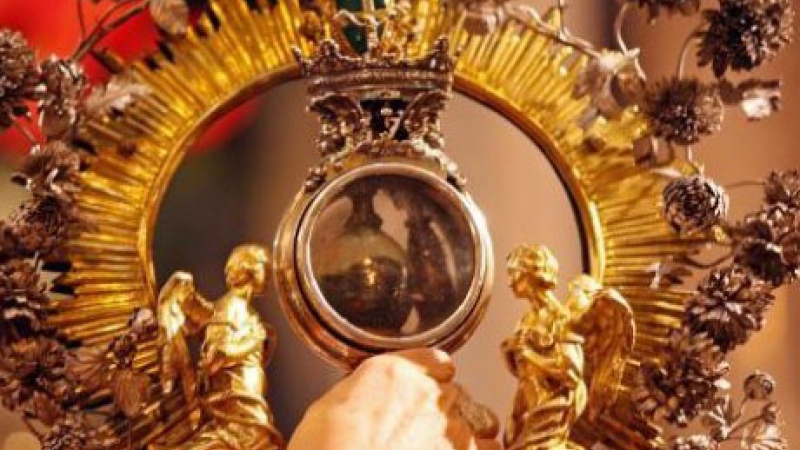
He is the patron saint of Naples. At the church named for him, the dried blood of Saint Januarius (or Gennaro) is supposed to liquefy three times a year:
September 19, the saint’s feast day
December 16
The first Saturday in May
When the miracle fails to occur, it portends “imminent disaster including war, famine or disease,” according to one website. Apparently, the miracle occurred again in September, but I have not been able to find whether the December 16 miracle occurred on schedule.
Januarius was a third century bishop of Benevento, Italy, who was martyred during the persecutions of the Emperor Diocletian.
For a number of years, I have pre-empted the name of Januarius to refer to my practice of using the first month of the year to read only authors I have never read before. My reasoning for this is to constantly broaden my horizons. For example, this year I plan to read several Cuban novels.
One result of my Januarius project is also that I read more women authors, which I had not done so much heretofore.
I will report back to you probably in early February if I have made any finds worth noting. (I probably will.)
I cannot help but think that that the literary reputation of Sir Walter Scott will continue to fade. After all, he can be diabolically difficult to read. His Guy Mannering: or The Astrologer (1815) is written in English, a broad Lowland Scots dialect, thieves cant, with numerous quotes in Latin, French, German, and Dutch.
Just the Scots itself can be challenging to most readers. The following terms were excerpted from the 20+ page glossary: aiblins, awmous, bestad, braw, camsteary, clanjamfray, eilding, fow, fremit, gumphion, niffer, sapperment, unco, and waf. In addition, my edition (Penguin) has some sixty pages of detailed end notes.
And yet I think that Scott is one of the finest novelists of the 19th century. The plot line of the book is a bit ridiculous. And there really isn’t a central character (not even Guy Mannering himself). At different times, the reader is confused whether to follow Mannering, Godfrey Bertram, Meg Merrilies, Vanbeest Brown, Dandy Dinmont (not a dog), or the eccentric lawyer Paulus Pleydell.
But if you are willing to take the trouble of trying to understand Scott, the rewards are great. He wrote so energetically, and his knowledge of Scots law is so impressive, and his language so vivid that the two weeks I spent reading the novel were an unalloyed pleasure from beginning to end. Even his descriptions of the wild landscape around Solway Firth are worthy of note:
Do you see that blackit and broken end of a shealing?—there my kettle boiled for forty years—there I bore twelve buirdly sons and daughters—where are they now?—where are the leaves that were on that auld ash-tree at Martinmas!—the west wind has made it bare—and I’m stripped too.—Do you see that saugh-tree?—it’s but a blackened rotten stump now—I’ve sat under it mony a bonnie summer afternoon, when it hung its gay garlands ower the poppling water.—I’ve sat there, and I’ve held you on my knee, Henry Bertram, and sung ye sangs of the auld barons and their bloody wars—it will ne’er be green again, and Meg Merrilies will never sing sangs mair, be they blithe or sad. But ye’ll no forget her, and ye’ll gar big upthe auld wa’s for her sake?—and let somebody live there that’s, ower gude to fear them of another warld—For if ever the dead came back amang the living. I’ll be seen in this glen mony a night after these crazed banes are in the mould.
Again, Scott is a difficult author, but I think demonstrably a great one.
My apartment is home to my collection of books, five to six thousand volumes in all. In addition to my library, which is dedicated to my collection, I have crowded book-cases in every room of my apartment, including the kitchen and bathroom.
There was a time when I could not visit a bookstore without buying several new or used books. In addition, I purchased books from EBay, Abebooks.Com, and a fair number of other Internet book dealers.
Right now, I am reading with great enjoyment Walter Scott’s Guy Mannering; or, The Astrologer (1815), the second of his Waverley Novels. Forty or fifty years ago, I would think nothing of trying to find the complete works of any author I liked. In fact, at one time I owned a complete hardbound set of the Waverley Novels. Now I only have some twenty selected titles—but in nice editions. In this, I resemble Dominie Sampson in Guy Mannering:
The lawyer afterwards compared his mind to the magazine of a pawnbroker, stowed with goods of every description, but so cumbrously piled together, and in such total disorganisation, that the owner can never lay his hands upon any one article at the moment he has occasion for it.
Guilty as charged! But now that I am approaching my eightieth year, I would like to find a good home for most of my books. It helps—sad to say—that bookstores, in disappearing from the landscape, furnish less of a temptation.
Tomorrow, I will travel downtown to return some library books (and get some new ones). I will be strongly tempted to visit the (appropriately named) Last Bookstore at 5th and Spring Streets and check out their more obscure Sir Walter Scott titles, such as Peveril of the Peak, Count Robert of Paris, Anne of Geierstein, and The Fortunes of Nigel.
But, really, who am I kidding? Will I really read all of Scott’s novels? If I live long enough, I sure would like to try. But why buy the books when I can check them out of the Central Library or download them on my Amazon Kindle. Old habits die v-e-r-y hard.
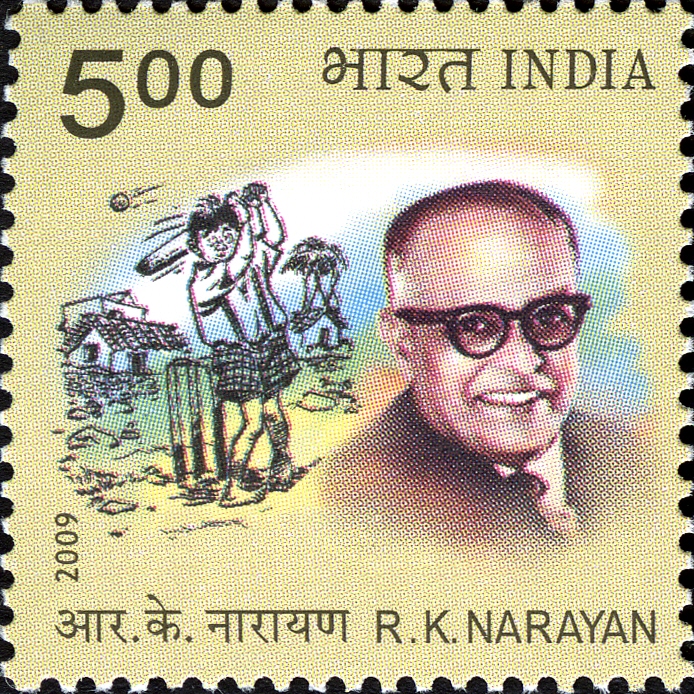
The above stamp was issued to honor the 103rd anniversary of the birth of India’s greatest writer of fiction: Rasipuram Krishnaswami Iyer Narayanaswami, better known as R. K. Narayan. Interestingly, he wrote most of his fiction in English. And it was Graham Greene whose influence led to the publication of his first four books.
I have just finished reading his short-story collection entitled Malgudi Days (1942), in which every one of the 30-odd stories competed with all the others for Best in Show. Over the years, I have also read a number of other titles—all of which I loved—including:
Swami and Friends (1935) which includes the cricket scene shown on the illustrated stamp above
The Bachelor of Arts (1937)
The Financial Expert (1952)
The Guide (1959)
The Vendor of Sweets (1967)
A Tiger for Malgudi (1983)
Under the Banyan Tree and Other Stories (1985)
Narayan’s fiction is mostly set in a mythical South Indian city called Malgudi. Once you start reading his work, it will seem like home to you.
I first started listing the books I read in 1972 and continued, with a six month lacuna around 1992, to the present day. Of one thing I am sure: It was Jorge Luis Borges who pointed the way to G. K. Chesterton. Though what I discovered from reading him is slightly different from what Borges discovered.
First of all, there was in Chesterton’s fiction what I call moral landscape, in which the natural environment in the scene takes place is affected by the feeling conveyed by the narrator. Take, for instance, this paragraph from the first chapter of The Man Who Was Thursday:
This particular evening, if it is remembered for nothing else, will be remembered in that place for its strange sunset. It looked like the end of the world. All the heaven seemed covered with a quite vivid and palpable plumage; you could only say that the sky was full of feathers, and of feathers that almost brushed the face. Across the great part of the dome they were grey, with the strangest tints of violet and mauve and an unnatural pink or pale green; but towards the west the whole grew past description, transparent and passionate, and the last red-hot plumes of it covered up the sun like something too good to be seen. The whole was so close about the earth, as to express nothing but a violent secrecy. The very empyrean seemed to be a secret. It expressed that splendid smallness which is the soul of local patriotism. The very sky seemed small.
If I were designing a cover for a new edition of the book, the scene described in this paragraph is what I would attempt to depict.
Thursday was my first Chesterton. There were lines in the novel that affected me strongly. In the same opening chapter, the poet Gabriel Syme is made to say:
“All the same,” replied Syme patiently, “just at present you only see the tree by the light of the lamp. I wonder when you would ever see the lamp by the light of the tree.”
What went through my mind at this point was, “Wow!” That line is forever emblazoned in my memory as the absolute height of imagination. I went on to read all of Chesterton’s fiction, then moved over to his essays and even his religious works. Curiously, although Chesterton is perhaps most famous for his father Brown stories, I did not read those until relatively recently.
But I have read The Man Who Was Thursday four or five times. As a matter of fact, I should re-read it again soon.
Jorge Luis Borges Story “Tlon, Uqbar, Orbis Tertius”
This is the first of a series of posts about literary works that got ,e started in becoming the person I am today. It all started with a New Yorker article around 1970 which introduced me to Latin American magical realism. I was enthralled, so I hunted up the two Jorge Luis Borges (1899-1986) books it mentioned: Labyrinths and Ficciones.
Borges really got me started on a quest that is still going strong more than half a century later. The first book I read was Labyrinths, and the first story in that collection was “Tlon, Uqbar, Orbis Tertius.” As soon as I read the following, I was on my way:
From the remote depths of the corridor, the mirror spied on us. We discovered (such a discovery is inevitable in the late hours of the night) that mirrors have something monstrous about them. Then [Argentinian writer Adolfo] Bioy Casares recalled that one of the heresiarchs of Uqbar had declared that mirrors and copulation are abominable, because they increase the numbers of men.
It turns out that Bioy Casares was quoting from a strange encyclopedia that the two of them decide to look up, but have difficulty finding, because different editions of the Anglo-American Cyclopedia have different articles.
I now own everything that Borges ever wrote that has been translated into English, and several in the original Spanish. Borges sent me in many directions. The next time, I will talk about how he turned me on to G. K. Chesterton.








 Tarnmoor
You must be logged in to post a comment.