A Cemetery for Halloween

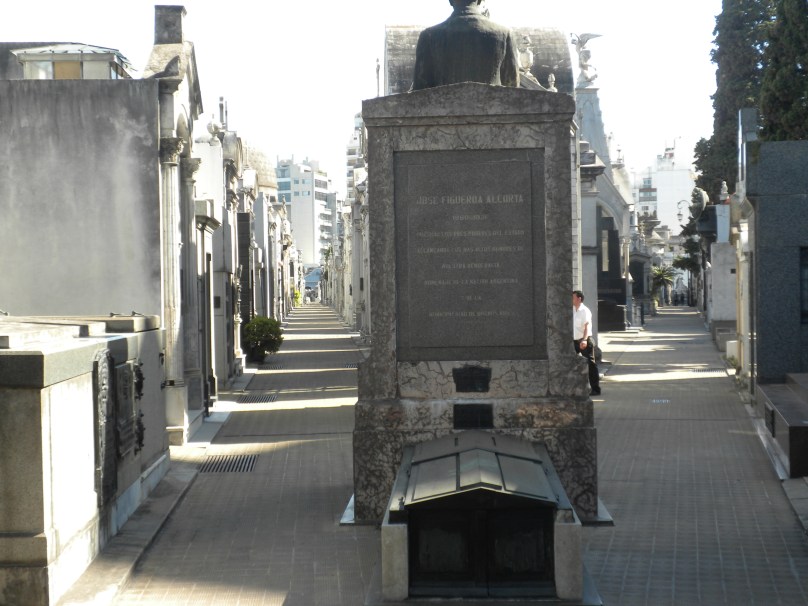
Recoleta Cemetery in Buenos Aires

I have been to some spooky cemeteries, but I think that the spookiest one of all is El Cementario de la Recoleta in Buenos Aires. Curiously, it is also perhaps the city’s main tourist attraction.

Practically everybody who was anybody in Argentina is buried there—with some interesting exceptions. Jorge Luis Borges is interred in Geneva, Switzerland, where he died. Although Evita Perón is buried in Recoleta under her maiden name of Duarte, her husband, former dictator Juan Perón was not allowed in. He is buried on the grounds of his presidential estate at Olivos.

Many of the funerary monuments at Recoleta are spectacular. Some are grim. In a few vaults, one can look through gaps in the gates and see some occupied coffins in bad shape, apparently from families that have died out and not left instruction for their maintenance.

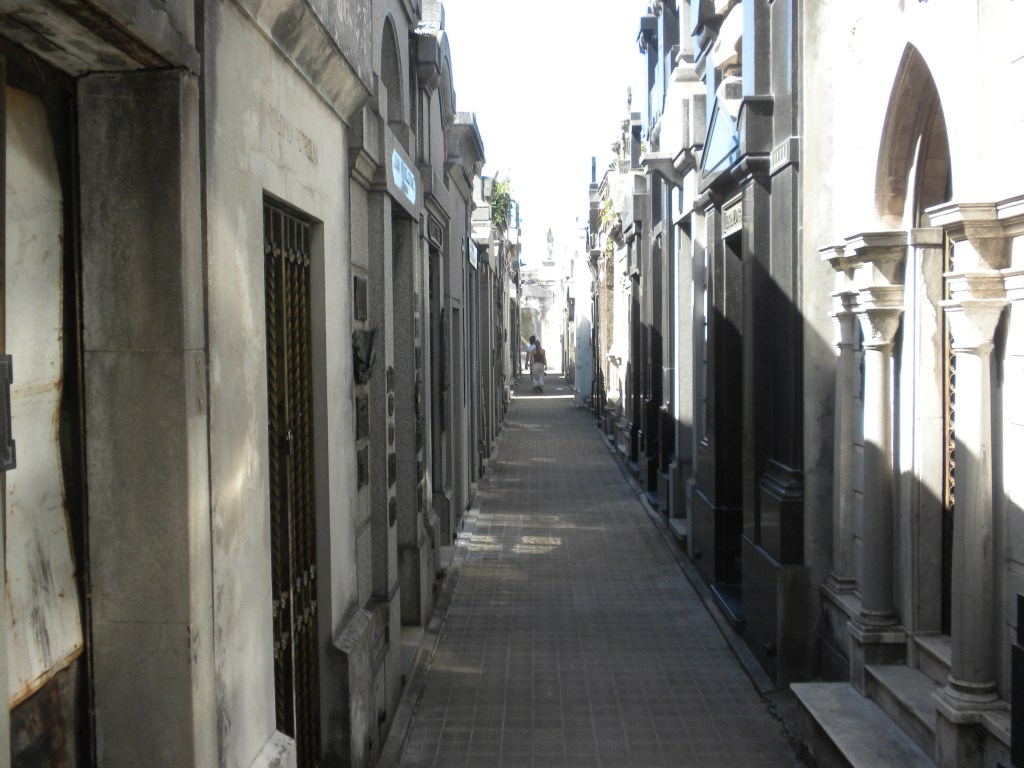
The last time I was in Buenos Aires, I stayed in a hotel that was across Avenida Azcuenaga from the high west wall of the cemetery. It didn’t feel spooky to me at all. It’s only by wandering up and down the rows of funerary monuments that one gets a spooky forechill.

Incident at Retiro

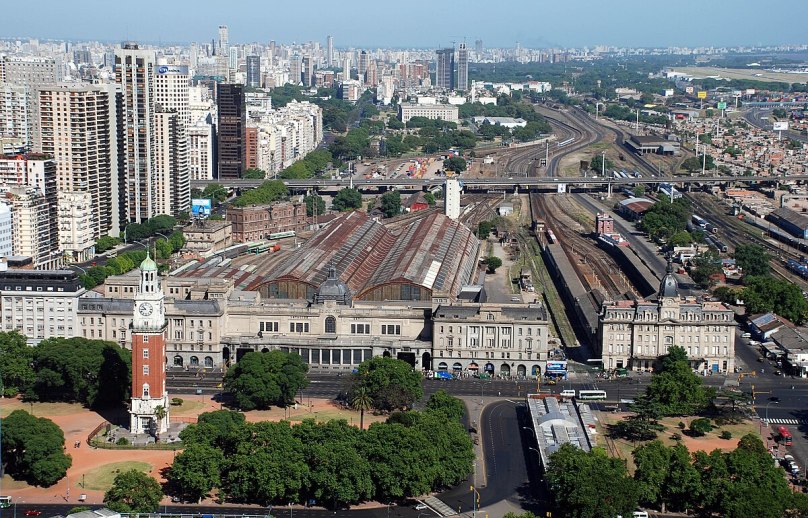
The Retiro Train Station in Buenos Aires

It was November 2015. I had just returned by train from Tigre where I had explored the delta of the Rio Paraná on a boat. That evening, I wanted to take a night bus to Puerto Iguazú to see the famous waterfalls. First I had to get a bus ticket, then take a cab back to my hotel in Recoleta and pick up my luggage, which was being held for me at the desk.

The main Buenos Aires bus station is a couple hundred yards’ walk to the north of the train station, just to the right (not shown) of the train station shown above.

As I walked along the crowded walkway to the bus station, I smelled an odorous mix of steak sauce and mustard that was squirted onto my back by a young couple that was following me. They were exceedingly polite as they applied paper towels to the mess and offered to accompany me to a location on the left where I would be cleaned up.

Cleaned out was more like it. I was familiar with this pickpocket trick. As I was carrying several thousand Argentinean pesos on my person, as well as several hundred dollars cash, I immediately went to my right and hailed one of the numerous cabs that had just dropped someone off at the bus and train stations. I jumped into the cab and asked them to drive me to my hotel in Recoleta.

The cab driver was not happy to be dealing with a rider who made his cab smell weird. Still, he drove me and I gave him a generous tip to clean the steak sauce/mustard smell from the back seat.

I picked up my bags and took another cab—this time directly to Retiro Bus Station, avoiding the walkway between it and the train station. I bought my ticket to Iguazú and got on the bus, still reeking. When, after a good night sleep, I got to my destination, I talked my hotel into laundering my still-smelly clothes.

It was an interesting experience.

“You Are Inside Me Now”

El Jardin Botanico in the Palermo Neighborhood of Buenos Aires

Since I wrote about Buenos Aires being one of my favorite cities yesterday, I thought I would present a sonnet by Jorge Luis Borges, the poet of Buenos Aires, translated by Stephen Kessler from his collection of Borges’s sonnets:

Buenos Aires

Before, I looked for you within your limits
bounded by the sunset and the plain
and i the fenced yards holding an old-time
coolness of jasmine and of cedar shade.
In the memory of Palermo you were there,
in its mythology of a lost past
of cards and daggers and in the golden
bronze weight of the useless door knockers
with their hands and rings. I felt a sense of you
in the Southside patios and in the lengthening
shadows that ever so slowly obscured
their long right angles as the sun went down.
You are inside me now. You are my blurred
fate, all those things death will obliterate.

My Cities: Buenos Aires

Plaza de Mayo with Jacarandas

In my mind, Buenos Aires is forever associated with Jorge Luis Borges. It is my love of the author’s works which led me to Argentina three times: in 2006, 2011, and 2015. God knows, I would welcome a fourth visit. It’s a huge city (17 million population in the metropolitan area); it’s difficult to get around in; but I love it nonetheless.

What does one say to a city whose biggest tourist attraction is a cemetery? Each time, I visited the Recoleta Cemetery and viewed the crypt where Evita Peron is buried. Yet, poor Borges is buried in Geneva, Switzerland.

Funerary Monuments at Recoleta Cemetery

Borges taught me that Buenos Aires is a city of neighborhoods, of which my favorite is Palermo. At Borges 2135 in Palermo is where Jorge Luis spent his boyhood.

Palermo is also home to some of the loveliest parks in the city, including the Botanical Garden and the zoo where he visited the tigers that appeared in so many of his poems and stories.

Palermo’s Jardin Botanico

One thing that impressed me was the large stray cat population of the Jardin Botanico. While I was there, a local resident came and fed them. He then folded up his bag and walked toward the exit.

I think I would probably choose to stay in Palermo the next time I visit.

The Tiger at the Buenos Aires Zoo

The Buenos Aires Zoo that Jorge Luis Borges visited to be inspired by its tigers was closed in 2016, five years after Martine and I visited it. Its former space in Palermo is now occupied by an EcoPark.

Although he became almost totally blind in the 1950s because of an ophthalmic ailment inherited from his father, Borges in his poetry returned again and again to the tigers he heard roaring in the old zoo.

Below is one of my favorites—“The Gold of the Tigers”—translated by Alastair Reid:

The Gold of the Tigers

Up to the moment of the yellow sunset,
how many times will I have cast my eyes on
the sinewy-bodied tiger of Bengal
to-ing and fro-ing on its paced-out path
behind the labyrinthine iron bars,
never suspecting them to be a prison.
Afterwards, other tigers will appear:
the blazing tiger of Blake, burning bright;
and after that will come the other golds—
the amorous gold shower disguising Zeus,
the gold ring which, on every ninth night,
gives light to nine rings more, and these, nine more,
and there is never an end.
All the other overwhelming colors,
in company with the years, kept leaving me,
and now alone remains
the amorphous light, the inextricable shadow
and the gold of the beginning.
O sunsets, O tigers, O wonders
of myth and epic,
O gold more dear to me, gold of your hair
which these hands long to touch.

In this poem, Borges refers to William Blake’s poem “The Tyger”; to the Greek myth of Zeus impregnating Danaë disguised as a shower of gold; and the Norse myth of Draupnir, the self-replicating gold ring. The only color Borges was able to see as his blindness worsened was yellow. Finally, the golden-haired beauty referred to at the end was probably Norah Lange, the Norwegian-Argentinian writer whom Borges loved but who chose to marry rival poet Oliverio Girondo instead.

A Few Days in Uruguay

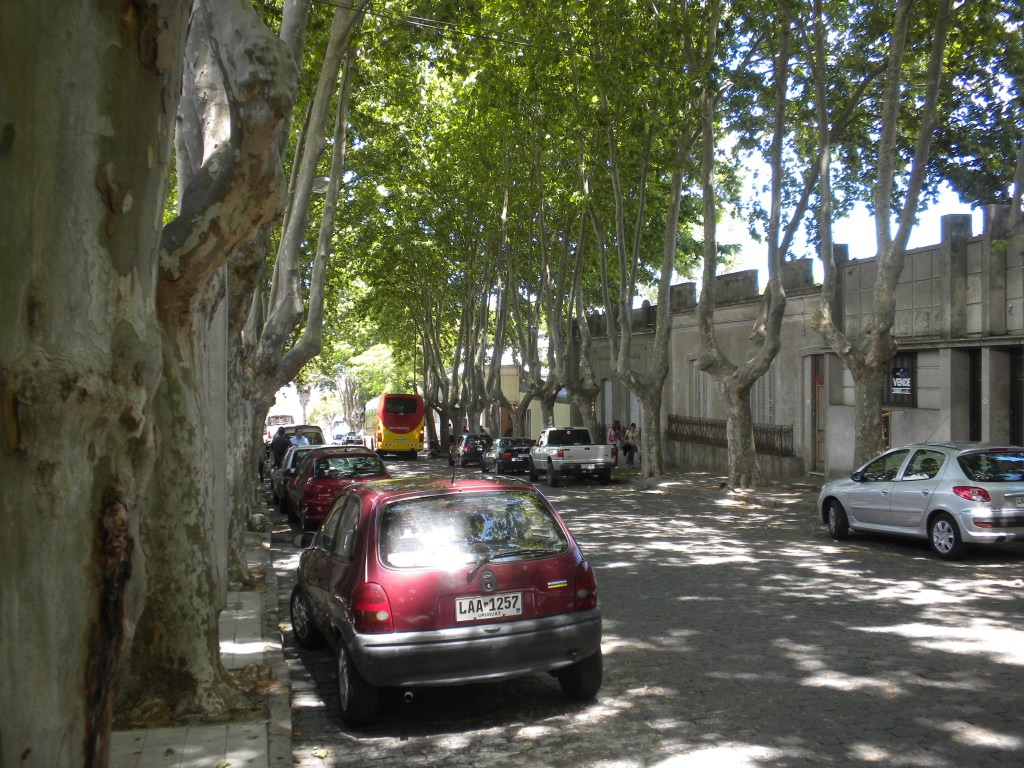
Street Scene in Colonia del Sacramento, Uruguay

In November 2011, Martine and I spent two and a half weeks in Argentina, plus a few days in Colonia del Sacramento, just across the River Plate from Buenos Aires. With a population of three and a half million people, Buenos Aires was at times a bit much for Martine, especially when she had to ride the crowded buses and subways.

So I planned in advance for a mini-vacation from the crowds of Buenos Aires by taking a ferry across the Plate to Colonia del Sacramento in nearby Uruguay. Colonia is, in fact, where Porteños (that’s what the residents of Buenos Aires call themselves) go when the big city is too much for them.

With only 27,000 people, Colonia is a 17th century town founded by Brazil. The streets are mostly all cobblestone, and there are a half dozen small pokey museums that are good for about an hour each.

A Tasty Restaurant Within Sight of the Atlantic

As a getaway, Colonia del Sacramento was a roaring success. We stayed at an old bed & breakfast that was at least three hundred years old. We lazily trod the cobblestones going from sight to sight, and eating some tasty steak dinners. We went back to Buenos Aires for one day before catching a flight to Patagonia, which is an entirely different story.

Limits

Here is one of my favorite poems by the Argentinian Jorge Luis Borges (1899-1986). Above is a view of a street in the San Telmo neighborhood of Buenos Aires.

 
Limits
Of all the streets that blur in to the sunset,
There must be one (which, I am not sure)
That I by now have walked for the last time
Without guessing it, the pawn of that Someone

Who fixes in advance omnipotent laws,
Sets up a secret and unwavering scale
for all the shadows, dreams, and forms
Woven into the texture of this life.

If there is a limit to all things and a measure
And a last time and nothing more and forgetfulness,
Who will tell us to whom in this house
We without knowing it have said farewell?

Through the dawning window night withdraws
And among the stacked books which throw
Irregular shadows on the dim table,
There must be one which I will never read.

There is in the South more than one worn gate,
With its cement urns and planted cactus,
Which is already forbidden to my entry,
Inaccessible, as in a lithograph.

There is a door you have closed forever
And some mirror is expecting you in vain;
To you the crossroads seem wide open,
Yet watching you, four-faced, is a Janus.

There is among all your memories one
Which has now been lost beyond recall.
You will not be seen going down to that fountain
Neither by white sun nor by yellow moon.

You will never recapture what the Persian
Said in his language woven with birds and roses,
When, in the sunset, before the light disperses,
You wish to give words to unforgettable things.

And the steadily flowing Rhone and the lake,
All that vast yesterday over which today I bend?
They will be as lost as Carthage,
Scourged by the Romans with fire and salt.

At dawn I seem to hear the turbulent
Murmur of crowds milling and fading away;
They are all I have been loved by, forgotten by;
Space, time, and Borges now are leaving me.

The Most Expensive Real Estate in Argentina

Recoleta Cemetery in Buenos Aires

When former military dictator of Argentina Juan Perón died in 1974, he couldn’t be buried at Buenos Aires’s exclusive Recoleta Cemetery. It was most galling to his followers that his widow Evita did manage to be buried there with the rest of her family (née Duarte). Eventually, his body was moved to the grounds of his estate in the exclusive barrio of Olivos.

I have visited Recoleta during each of my three trips to Argentina. Why? It is actually the number one tourist destination in Buenos Aires—and it’s free. Just about everyone of note in Argentine history and culture is buried there. Adolfo Bioy Casares the writer is buried there, but the Argentina’s greatest writer, his friend Jorge Luis Borges, is buried in Geneva, Switzerland, where he died in 1986.

One of Many Bronze Commemorative Plaques Marking the Grave of Evita Perón

Among other famous denizens are past presidents such as Agustín Pedro Justo, Bartolomé Mitre, Domingo Faustino Sarmiento, Hipólito Yrigoyen, Julio Argentino Roca, Pedro Eugenio Aramburu, and Raúl Alfonsín. There’s famous boxer Luis Firpo; Isabelle Walewski, a granddaughter of Napoleon Bonaparte; warlord Facundo Quiroga; writer Silvina Ocampo and her sister, publisher Victoria Ocampo; and William Brown, Irish-born founder of the Argentinean Navy (widely known as Almirante Brown).

The Narrow Streets of Argentina’s Notable Dead

In fact, the last time I stayed in Buenos Aires, I stayed at a hotel right across the street from the west wall of the cemetery.

Villa 31

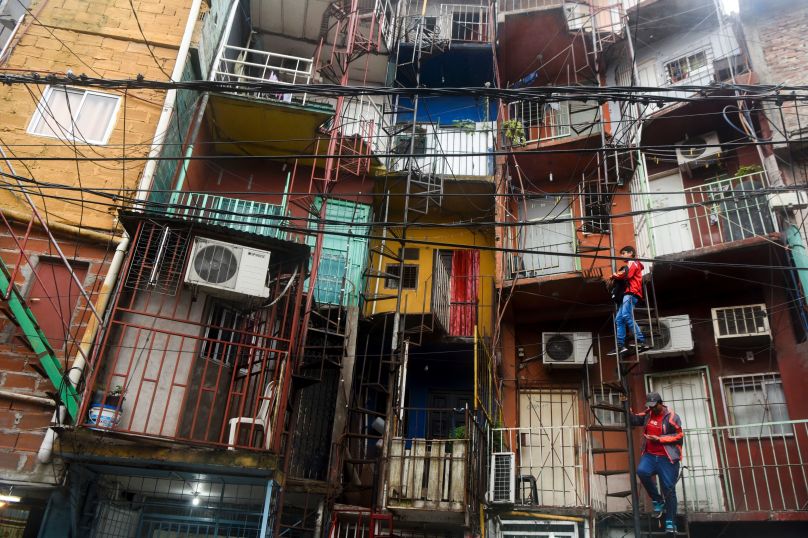
View of Apartments in the Villa 31 Shantytown in Buenos Aires, Argentina, on April 25, 2017

I had a long conversation with my friend Suzanne about the homeless earlier this evening. The increasing poverty displayed by the rising numbers of tent-dwelling homeless bothered both of us, especially as we did not find any easy solution to the situation.

During my travels, I have seen some grinding urban poverty, mostly in Buenos Aires. That was only because the train and bus stations in Retiro border on one of the worst slums in South America, namely Villa 31, one of the Villas Miserias in the Argentine capital. In BA, the ugliest slums tend to be prefaced by the word Villa in their names.

The following YouTube video will give you an idea of the place:

YouTube Video About Villa 31

In 2015, I was at the edge of Villa 31 while walking between the train station and the bus terminal. At the time, I was carrying over $2,000 in Argentinean pesos I had just obtained. A couple in their thirties came up behind me and sprayed me with a combination of steak sauce and mustard. Suddenly, they started wiping the mess with tissues that appeared miraculously in their hands. They tried to get me to go to a restroom where they would help me clean up and strip me of anything of value. But as they were urging me to my left, I suddenly cut right toward a waiting taxi and made my escape. The taxi driver was not happy with a passenger that smelled of steak sauce, but I tipped him well to clean up the upholstery after I left.

I did not visit any of the other famous favelas or shantytowns of South America, but I did get a good look at Villa 31 as my bus sped me toward Puerto Iguazú near the border with Brazil and Paraguay.

The Crowding has Made Villa 31 a Covid-19 Hot Spot

If you have any sort of conscience, you can only feel uncomfortable dealing with so much raw poverty. In the gospels (specifically Matthew 26:11), we are told “The poor you will always have with you.” But we are not told how we can eradicate poverty. Maybe we can’t, but I think it is only right that we be disturbed about it.

“A Last Time and Nothing More”

1920s Building in Today’s Buenos Aires

Buenos Aires is a magical city. I have been there three times; and each time, I loved wandering its streets. Is it because of Argentinian poet Jorge Luis Borges, who loved the place and never grew tired of writing about it in his poems and stories? Or did Buenos Aires, in some strange way, create Borges, who merely returned the favor? The following is one of my favorite poems by Borges.

Limits

Of all the streets that blur in to the sunset,
There must be one (which, I am not sure)
That I by now have walked for the last time
Without guessing it, the pawn of that Someone

Who fixes in advance omnipotent laws,
Sets up a secret and unwavering scale
for all the shadows, dreams, and forms
Woven into the texture of this life.

If there is a limit to all things and a measure
And a last time and nothing more and forgetfulness,
Who will tell us to whom in this house
We without knowing it have said farewell?

Through the dawning window night withdraws
And among the stacked books which throw
Irregular shadows on the dim table,
There must be one which I will never read.

There is in the South more than one worn gate,
With its cement urns and planted cactus,
Which is already forbidden to my entry,
Inaccessible, as in a lithograph.

There is a door you have closed forever
And some mirror is expecting you in vain;
To you the crossroads seem wide open,
Yet watching you, four-faced, is a Janus.

I like the line about a “four-faced” Janus. Perhaps, is Borges connecting two-faced Janus with the four directions that are sacred to the Indians of the Americas?