Cineconline

A Precursor of King Kong?

Over the last ten years, I have spent much of the Labor Day Weekend in Hollywood watching movies at Grauman’s Egyptian Theater as part of the annual Cinecon festival. This year, because of the coronavirus quarantine, the management of Cinecon decided to make the show available online at no charge—except for several please to donate (which I did).

A Well-Crafted Silent Film

The films typically screened for Cinecon are rarities. One doesn’t encounter the classics with which everyone if familiar. In fact, most of the titles are fairly obscure. The four features that were screened online this year are:

  • The Fourth Commandment (Universal 1926), directed by Emory Johnson
  • Without Pity (Italy 1948), directed by Alberto Lattuada and co-written by Federico Fellini
  • Sherlock Holmes’ Fatal Hour (England 1931), directed by Leslie S. Hiscock
  • Lorraine of the Lions (Universal 1925), directed by Edward Sedgwick

A Decade before Basil Rathbone’s Sleuth

I particularly liked Without Pity, an Italian Neo-Realist film with a very advanced subject: The love between a black G.I. and a blonde Italian woman who has lost everything in the war. It was made in 1948 at a time when no American film would be so daring on the subject of interracial love.

Also shown was a two-hour program of rare kinescopes (“Kinecon on Cinecon”) from the earliest days of television including Jan Murray, Bob Hope, George Burns and Gracie Allen, Dean Martin and Jerry Lewis, and Milton Berle.

A 1948 Italian Film About Interracial Love

In addition, there were the usual silent and early sound shorts with such capable but relatively unknown stars as Billy Bevan, Al Jennings (a train robber become Western star), Edward Everett Horton, Lige Connelly, and Andy Clyde.

I did not see all the short films. After all, life must go on. But what I saw only whetted my appetite to see what they have scheduled for next year.


 

Plague Diary 31: At the Library Portals

The Los Angeles Central Library on West 5th Street

The Los Angeles Central Library is an impressive structure. In 1926 the original structure was designed by Bertram Grosvenor Goodhue in a combination ancient Egyptian and Mediterranean Revival style. In 1986, there was an arson fire that destroyed some 400,000 volumes, or 20% of the library’s holdings—as well as causing damage to the structure. Fortunately, the library was rebuilt and restored to much of its original splendor. It was only three years ago that I started going to the library, only after the Expo rail line from Santa Monica to downtown LA was constructed.

Thanks to the coronavirus, however, I cannot go inside the library. But I can put books on hold and make an appointment to pick them up at the 5th Street entrance. This I did, showing up at 11:15 am and calling inside with my cell phone to give my name and library account number, whereupon a librarian came out with the books I ordered in a blue bag, accompanied by a complimentary LA Public Library deck of cards.

Unfortunately, one of the books I had put on hold, Dora Bruder by Patrick Modiano, was in the original French. I put a hold on the French edition by mistake. The book’s name is the same in English and French, so it was an easy mistake to make.

The big problem with going downtown during the plague is twofold:

  • Finding a place to eat
  • Finding a rest room

Thanks to one of the library cops (yes, they have their own police force), I found out that I could go across the street to the City National Plaza (formerly the Atlantic Richfield Plaza), eat at one of the few restaurants still open on the ground floor (Lemonade is pretty good), and get a free token to use the public restroom.


At the Last Bookstore

The Mystery and Sci-Fi Section

Since the beginning of quarantine, I had only been Downtown once. It wasn’t pleasant because I couldn’t find anywhere to eat, and unless I went to Union Station, there were no restrooms around. Today I decided to go again, mainly to return three books to the Central Library. Although they were not technically due until next month, I thought that as I had finished reading them, I might as well take them back.

Also, I put a hold on three more books which I could pick up at the front of the library once I had been e-mailed that they were available. That would be a big plus, even though I still miss sitting down in the literature section for a few hours reading.

Afterwards, I stopped at the Last Bookstore at 5th and Spring Streets. Last time I went, it had been closed due to the coronavirus. Now it was open, but they did one thing that I liked. Before the virus, the place was crawling with young pseudosophisticates who didn’t care about the books, but took hundreds of pictures with their smart phones to document their spavined lifestyles. Now one has to pay five dollars for admission, which is refunded from the price of books purchased.

I can just imagine it now: What? I have to buy books? Reading is so lame compared to the wonders of my smartphone.

It presented no obstacle to me: I bought five paperbacks. They included three Dave Robicheaux mysteries by James Lee Burke, André Gide’s If It Die, and Isaac Bashevis Singer’s Gimpel the Fool.

As soon as I receive notification that my books are being held for me at the Central Library, I’ll make another trip downtown. And I will likely drop in at the Last Bookstore.


Plague Diary 30: Heroes and … Martyrs?

We’re All in This Together, or Are We?

There is a nauseating saccharine imagine coming down to us from corporate America of everyday heroes in the struggle against coronavirus. The word “hero” is being bandied about … a lot! But when you come to think about it, it doesn’t cost much to employ people in hazardous work without making much of an effort to guarantee their safety. You see, if you call them heroes, you open up the possibility that many of them can make the ultimate sacrifice and become martyrs. And we know that martyrs are heroes that can no longer fight back. Very safe from a corporate standpoint.

I have become very suspicious of this type of unanimity from U.S. corporations. But it’s not just an American trait: During the Chernobyl disaster, dozens of Soviet citizens were fighting toxic radioactivity with nothing more protective than brooms and shovels. Nobel Prize winner Svetlana Alexievich wrote a book of interviews with people involved in the disaster. It was entitled Voices from Chernobyl: The Oral History of a Nuclear Disaster. I am not trying to imply that the coronavirus is like a nuclear accident, but it certainly shared a similar awfulness and magnitude.

SNL Takes on Three Mile Island

While on the subject of nuclear accidents, I am reminded of a Saturday Night Live sketch after the Three Mile Island accident in 1979. The title of the skit was “The Pepsi Syndrome.” The reaction of the bigwigs was to send Garrett Morris dressed as a maid with a broom to clean up the radioactivity.

It is in the nature of power to make the innocent pay the price. The whole hero thing is nothing more than soft soap, and during this epidemic, we certainly have had enough of soft soap, haven’t we?


Plague Diary 29: Corona Cooking

The Mafia Cooking Hour

During my months-long quarantine, I have been sustained by five things:

  1. My relationship with Martine
  2. Playing chess with the computer
  3. Reading
  4. Watching movies on TV and my computer
  5. Cooking

That last item deserves some explanation. I have always enjoyed cooking, but I never was able to give it the attention it deserved. When I was working, I cooked good food, but I shied away from recipes that required some sophistication and a lot of time. Now that I am retired and quarantined, I am able to take the time to make some really good meals.

Mostly for Martine’s benefit, I got my hands on a cookbook by a convicted mafioso, Henry Hill, featuring the Italian cooking of the New York/New Jersey area: The Wiseguy Cookbook. Although Martine was born in France, she was mostly raised in Northern New Jersey (in Oceanport). As a child, it was New Jersey Italian food that she loved most. That was before she came out to Los Angeles and fell for Hungarian food.

For myself, I have become more interested in the vegetarian cuisine of India. Fortunately, Youtube has some excellent and very authentic recipes by Indians, Pakistanis, and others featuring Indian cuisine. This week, I made the following:

Manjula presents us here with a recipe for Chick Pea Pulav (aka Chole Biryani). The followed the recipe exactly, except that I added half a chopped onion and some extra hot Indian red chile powder. The only change I would suggest is to use one cup of water rather than a cup and a half. The dish is superb.

Fortunately, there is a nearby Indian foods store in Culver City called Indian Sweets and Spices. In better times, there is a little café on the premises with vegetarian-only curries; but there is also an excellent selection of teas and such hard-to-find items as mango powder, foenugreek leaves, garlic/ginger paste, and asafoetida.

The Disunited States of America

The Fracture Lines Are Becoming More Evident

At some point in the last few decades, it appeared that the people of the United States of America could not agree on much of anything. Does water flow uphill? Is a fetus worth more than an actual human being? Did the Confederacy actually win the Civil War? Did the moon landing really take place? Can we fight the coronavirus by injecting bleach into our veins? Does the Hollywood QAnon child sex ring exist? Is the Earth flat?

All these questions which to me represent the pinnacle of stupidity seem to have large numbers of adherents—people who are angry with Liberals who have ignored them as inhabitants of “Flyover Country,” made fun of their strange religious practices, and insisted that they conform to scientific principles that are somehow unfriendly to them. These people are seriously pissed off, to the extent that they will stridently and repeatedly deny home truths believed by their adversaries.

Will the USA eventually fragment itself into agglomerations of states such as the map shown below?

One of Many Possible Variations

I was discussing the matter with my friend Bill Korn this evening. We both agreed that we were mistaken in thinking that a real existential crisis would bring us together. Well, coronavirus is nothing if not an existential crisis, and we are finding millions of people who are saying, “F—k it! Let’s go back to normal and ride it out!” Them’s brave words, but I would not trade my life for a chance to go to a bar or patiently listen to an unmasked person ranting in my general direction.

Perhaps I am timorous because I am:

  • Diabetic
  • Overweight
  • Asthmatic
  • Blood Type A

That makes me a four-time loser if I get the ’Rona. Thanks, but I’ll watch all you fine folks self-destruct from the sidelines.


Putting Myself Down

I Have Always Underestimated Myself…

When I was young, I was always one of the shortest kids in my class—and one of the sickest. The result was that I habitually underestimated myself. Everyone else looked taller, happier, and more accomplished than me. And that even after I was the valedictorian of my class at Chanel High School in Bedford, Ohio. In fact, it was not until I reached the age of forty that I realized what I had been doing to myself. That was the age at which I was finally able to drive. Before that, I was on a medication (Catapres) that made me fall asleep whenever I got into a moving vehicle.

Within weeks after I got off Catapres, I took driving lessons and passed with flying colors. But then something happened to my picture of other people: The moment I saw drivers who committed moving violations at the rate of once every hundred feet or so, I began to revise my impressions of the rest of the human race.

Politics also stepped in to lower my estimation of my fellow Americans. I first became aware of political conservatism during the 1964 election, when Barry Goldwater was trounced by Lyndon Johnson. Conservatism was to become my bête noire during the following decades, where now I regard most Republicans and Trump followers to be mental defectives. Now that so many of these so many of these Trumpists are advocating a return to normalcy during a dreadful epidemic, I now look at people such as the individuals in the above photograph as suicidal fools who would think nothing of infecting their friends, neighbors, and families with a potentially fatal disease.

Do I have any regrets for being so hard on myself all those years? Not a bit. I think that I am happier than most people and less likely to be played like a marionette out of baseless fears.


A Ghost Town in the Mountains

Martine in Bodie, California, by Old Gas Pumps

During this awful quarantine year (soon to become the awful quarantine decade), I keep thinking back to the places I’ve been. Just to maintain social distancing, most of my favorite destinations in the U.S. and Latin America are severely curtailed. One of my favorite places along U.S. 395 is the ghost town of Bodie, California midway between Mono Lake and the Mono County Seat of Bridgeport.

There is nothing Disneyfied about Bodie. It was abandoned over a period of years, during which people just left their stuff behind them because it was just too difficult to cart away. That includes coffins, hearses, dishes, furniture, and all manner of things.

Horse-Drawn Hearse Left Behind

Unlike many other ghost towns, Bodie is run as a park in which the buildings and mining equipment are in a state of “arrested decay,” in which repairs ae made to prevent roofs and walls from falling in. The exception is for several houses which are kept up for State Park rangers and their families who stay year-round to protect the premises.

The cemetery at Bodie is one of my favorite features of the town. Life in Bodie could be nasty, brutish, and short, as attested by the tombstones.

One Little Girl Who Died Young

Part of the reason for the high mortality rate among the residents were the horrible winters. The altitude of Bodie is 8,375 feet (2,553 meters). It is some twenty-odd miles from the main highway and is susceptible to blizzards and high winds. And that’s besides the usual Old West killers as alcohol, gunfights, and mining accidents.


The Prisoner [of Coronavirus]

The 1960s British Television Series That Epitomizes Our World

On one hand I am imprisoned by the dread ’Rona; on the other, I am liberated by it. I have been binge-watching the 1967 British television series The Prisoner, starring (an co-created by) Patrick McGoohan. Thanks to my being a member of Amazon Prime, I have access to a wealth of movies and television shows streaming at little or no cost to me. So far, I have seen all but the last five episodes of the series, which I have found to be a liberating experience.

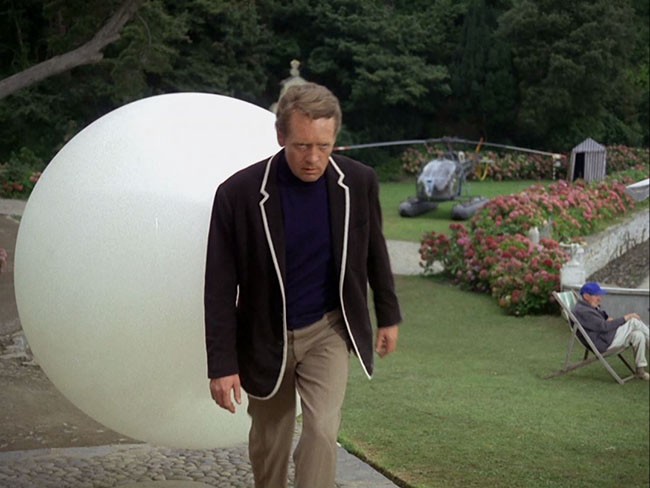
If you are not familiar with The Prisoner, it is about an unnamed spy for British intelligence who resigns suddenly and is carried off to a prison community referred to as “The Village,” in which everyone is known by a number. Our hero is Number 6. The village is headed by by a mysterious Number 1, whom thus far I have not seen, but is managed by a Number 2, who changes from one episode to the next—sometimes even within a single episode. Number 6 wants more than anything else to escape the village.

Number 6 Being Stalked by an “Enforcer Balloon”

One of the strange things about the village is that both the prisoners and the warders look alike, wearing overly cheery British resort wear, including multicolored capes and twirling multicolored umbrellas. It gives the prisoners a kind of manic appearance, as if most of them are enjoying their captivity.

When the series first came out in the U.S., it was too difficult for me to tune in at the same time on days it was broadcast. Now, as prisoner of the coronavirus, I can enjoy the series. (The same goes for Deep Space Nine, which I am binge-watching in parallel.)

The Image of Number 6 Superimposed Over “The Village”

ddly, “The Village” is a real place: Portmeirion in Wales. You can stay there and dine in its restaurant without being answerable to Number 2.


Pining for the Pyramids

Maya King at Mérida Anthropology and History Museum

With the continuing bad news of the continuing ravages of the coronavirus, I begin to wonder whether I will ever again be able to travel. Of the countries that have encountered the virus, the United States has perhaps been the one nation whose people have been most incompetent at surviving. It doesn’t help that our national leadership seems to be intent on running up the totals of people infected and killed by the virus. I become increasingly furious at people who act as if Covid-19 didn’t exist.

My friend Peter tells me of seeing a wedding rehearsal at a park in San Pedro consisting of some two hundred people, none of whom were wearing face masks. Using the plague’s mortality statistics, it is likely that two of the people present will lose their lives, and possibly more will come down with the virus who are friends and family of the attendees.

There appears to be a large population that couldn’t be bothered with protecting themselves from the coronavirus. Either they see themselves as invincible, or they are resentful of politicians who are trying to enforce the quarantine, or they are f—ing stupid.

Admittedly, I don’t like wearing a face mask. When I am driving or walking outside in such a way that I could swing around people I encounter, I don’t wear a mask. Indoors, however, there is a danger that someone could cough or sneeze or even talk in my direction; so I don my mask and grit my teeth.

On my kitchen table is an old Lonely Planet guide to Mexico that I page through every day. I have found dozens of places that look interesting to me, from Baja California to Sonora to the Chihuahua al Pacifico Railroad … and the list goes on and on. My fingers are crossed that the stupidity of my fellow Americans does not turn me into an involuntary shut-in.