Vladimir Ivanovich Leventon

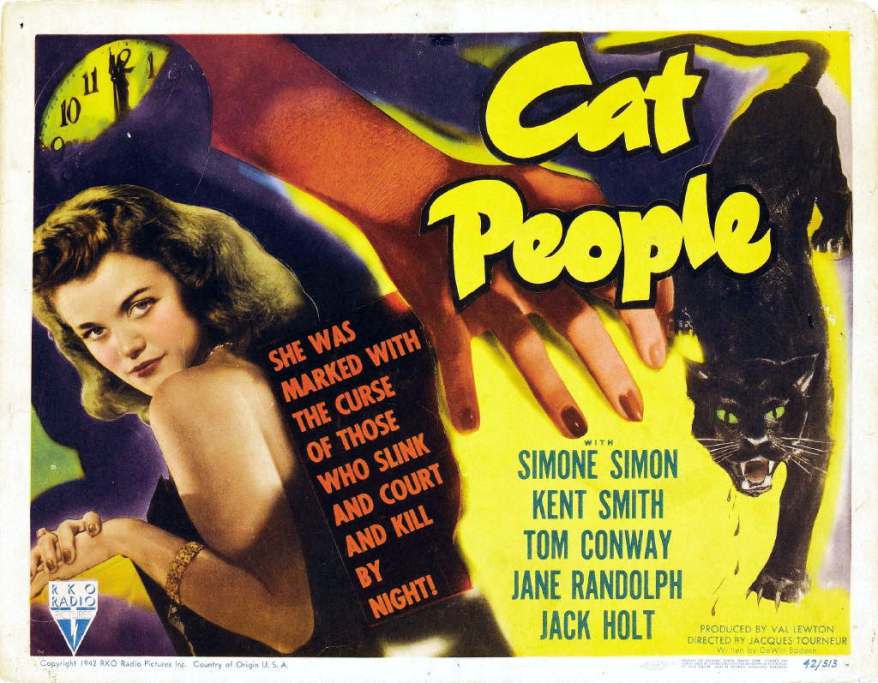
Lobby Card for Val Lewton’s The Cat People (1942)

This is a re-post from October 20, 2022. I have just sat through four films directed by Jacques Tourneur on Turner Classic Movies (TCM), three of them produced by the great Val Lewton. He is the only producer who deserves to be called great. Most of the others are impediments to greater or lesser degrees.

There are horror films, and there are horror films. They can scare you out of your wits, like Curse of the Demon (1957) and Poltergeist (1982), or they can make you understand that the world is both light and dark in equal measure, like Val Lewton’s great films of the 1940s, such as The Cat People (1942).

Val Lewton, born Vladimir Ivanovich Leventon in Yalta, Russia, was interested in making low budget films to compete with Universal Pictures’ highly successful Frankenstein, Dracula, Mummy, and Wolf Man franchises. The title for The Cat People was assigned to Lewton by RKO, and Lewton went to work on a psychological thriller in which there is no overt violence. Perhaps the greatest scene takes place in a swimming pool in which a young woman is swimming all by herself at night. In the shadows, we imagine there is a black panther, but neither the swimmer nor we the viewers are absolutely sure.

Even though Halloween is just about over, I highly recommend all the following Lewton films:

  • The Cat People (1942)
  • I Walked with a Zombie (1943)
  • The Leopard Man (1943)
  • The Seventh Victim (1943)
  • The Ghost Ship (1943)
  • The Curse of the Cat People (1944)
  • The Body Snatcher (1945)
  • Isle of the Dead (1945)
  • Bedlam (1946)

All are great films worthy of being seen multiple times. They are short, thoughtful, extremely moody, and highly successful. Also available is a Turner Classics biopic about Lewton’s career called Shadows in the Dark narrated by Martin Scorsese. Martine and I watched it last night and recommend you see it.

In all of Hollywood’s history, Lewton was probably the only film producer who controlled his products as if he were the director. Even though Lewton directorial protegés Jacques Tourneur, Robert Wise, and Mark Robson went on to have brilliant careers, when one is watching a Lewton film, one recognizes it as a Lewton film.

Preparing for Halloween

British Gothic Novelist Ann Radcliffe (1764-1823)

Usually, I spend much of the month of October each year reading gothic or horror fiction. I have already started reading Ann Radcliffe’s The Italian, or the Confessional of the Black Penitents (1797), after which she quietly stopped writing and spent the last twenty-six years of her life as a private person. I have fond memories of reading her novels The Romance of the Forest (1791) and The Mysteries of Udolpho (1794).

Also, I will inevitably read one of Joyce Carol Oates’s underrated gothic novels or collections of short fiction. Other possibles are Thomas Ligotti and Robert Aickman. And I will certainly re-read some of Edgar Allan Poe’s stories.

In November, I will write a post detailing with gothic/supernatural/horror titles I have read.

Halloween Reading

Monster Brains Logo Created by Tom Cochien

For over a decade, I have tackled one or two works of horror literature during the month of October. In the past, most of these were collections of horror stories in the excellent collections put out by Dover Publications, but I am coming to the end of these; so I am branching out a bit.

This month, I have read two collections: Amelia B. Edwards¹s The Phantom Coach and Other Stories and Thomas Ligotti’s Noctuary. Ms Edwards (1831-1892) was not only an excellent teller of tales, but also a world traveler, journalist, and—to add a touch of the weird—an early Egyptologist of some note. I have downloaded her book A Thousand Miles Up the Nile from Amazon Kindle to read sometime next year.

Thomas Ligotti, on the other hand, is a contemporary, born in 1953. I had previously read two of his collections—Songs of a Dead Dreamer and Grimscribe: His Lives and Works—and found them satisfyingly eldritch in every way. The same could be said of Noctuary, which I loved. In fact yesterday’s post on this blog site was a short short story entitled “One May Be Dreaming” from Noctuary in its entirety. Click on the link to check it out.

And, Happy Halloween!

Poe-Pourri

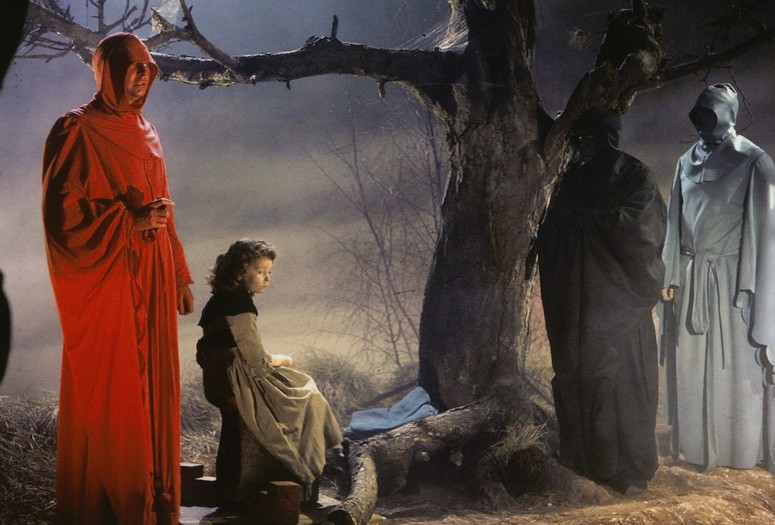
Scene from Roger Corman’s Masque of the Red Death (1964)

One of the most entertaining film series of the 1960s consists of the eight Edgar Allan Poe titles directed by Roger Corman and, for the most part, starring Vincent Price. In order by year, these consist of:

  • The House of Usher (1960)
  • The Pit and the Pendulum (1961)
  • The Premature Burial (1962) starring Ray Milland
  • Tales of Terror (1962)
  • The Raven (1963)
  • The Haunted Palace (1963) actually based on H. P. Lovecraft
  • The Masque of the Red Death (1964)
  • The Tomb of Ligeia (1964)

All the films are very loosely based on Poe originals (except for The Haunted Pa;lace, which is very Poe-like). Last Wednesday, I sat through The Pit and the Pendulum, The Raven, and Masque of the Red Death on Turner Classic Movies’ tribute to Roger Corman, who died earlier this year.

Although some regard him as the ultimate schlockmeister, Corman knew how to make an entertaining film that came in on time and under budget. So what if they were not quite faithful to Poe’s (or Lovecraft’s) originals: They were fun to watch, even if we felt superior to them.

I remember some other likeable Corman classics like Attack of the Crab Monsters (1957), in which the eponymous monsters looked like a crumpled old knapsack, and Creature from the Haunted Sea (1961), in which the creature looked like an overgrown stuffed animal. The first named film is one of Martine’s all-time faves, such that she obtained a signed still from Beverly Garland, the star.

And yet at least two of the titles—The Raven and Masque of the Red Death—are, to my mind, two of the best American films produced in the 1960s.

The Horror Films of Val Lewton

Lobby Card for Val Lewton’s The Cat People

The following is a repost from October 31, 2015. I had just saw The Leopard Man on Turner Classic Movies (TCM) and started thinking (for the nth time) how great Val Lewton was as a producer—probably the only great film producer.

There are horror films, and there are horror films. They can scare you out of your wits, like Curse of the Demon (1957) and Poltergeist (1982), or they can make you understand that the world is both light and dark in equal measure, like Val Lewton’s great films of the 1940s, such as The Cat People (1942).

Val Lewton, born Vladimir Ivanovich Leventon in Yalta, Russia, was interested in making low budget films to compete with Universal Pictures’ highly successful Frankenstein, Dracula, Mummy, and Wolf Man franchises. The title for The Cat People was assigned to Lewton by RKO, and Lewton went to work on a psychological thriller in which there is no overt violence. Perhaps the greatest scene takes place in a swimming pool in which a young woman is swimming all by herself at night. In the shadows, we imagine there is a black panther, but neither the swimmer nor we the viewers are absolutely sure.

Even though Halloween is just about over, I highly recommend all the following Lewton films:

  • The Cat People (1942)
  • I Walked with a Zombie (1943)
  • The Leopard Man (1943)
  • The Seventh Victim (1943)
  • The Ghost Ship (1943)
  • The Curse of the Cat People (1944)
  • The Body Snatcher (1945)
  • Isle of the Dead (1945)
  • Bedlam (1946)

All are great films worthy of being seen multiple times. They are short, thoughtful, extremely moody, and highly successful. Also available is a Turner Classics biopic about Lewton’s career called Shadows in the Dark narrated by Martin Scorsese. Martine and I watched it last night and recommend you see it.

In all of Hollywood’s history, Lewton was probably the only film producer who controlled his products as if he were the director. Even though Lewton directorial protegés Jacques Tourneur, Robert Wise, and Mark Robson went on to have brilliant careers, when one is watching a Lewton film, one recognizes it as a Lewton film.
In Praise of Minor Talents

The Good Doctor Ruffled a Few Feathers, Including Mine

As part of my annual Halloween reading, I just finished the Oxford World’s Classics Tales of Terror from Blackwood’s Magazine. In the early decades of the 19th century, that’s where budding writing talents turned for examples of tales of horror. Among the most devoted readers were Charles Dickens, the Brontë sisters, Nathaniel Hawthorne, Robert Browning, and—most particularly—Edgar Allan Poe.

Of the seventeen stories in the collection, I had only heard of two of them before: Sir Walter Scott and James Hogg, a.k.a. the Ettrick Shepherd. The other writers (who were all new to me) were Patrick Fraser-Tytler, John Wilson,Daniel Keyte Sandford, John Galt, John Howison, William Maginn, Henry Thomson, Catherine Sinclair, Michael Scott, William Mudford, William Godwin the Younger, and Samuel Warren. All of their stories were first class.

Now I understand why Poe wrote him famous essay “How to Write a Blackwood Article.” And why Leigh Hunt wrote in 1819:

A man who does not contribute his quota of grim stories now-a-days seems hardly to be free of the republic of letters. He is bound to wear a death’s head, as part of his insignia. If he does not frighten every body, he is nobody.

Well, I could testify that I was frightened by this collection—by a bunch of “minor” writers who knew what they were doing. The credit for this collection goes to the two co-editors, Robert Morrison and Chris Baldick.

I was particularly entranced by the three selections from a long-running serial in Blackwood’s entitled Passages from the Diary of a Late Physician (appearing from 832-1837) by Samuel Warren (1807-1877).

The Scariest Film Ever Made?

The Eponymous Villain of Curse of the Demon

As of today, I have seen Jacques Tourneur’s excellent The Curse of the Demon at least half a dozen times. (The film, released by Columbia in 1957, is also known as Night of the Demon.)

I regard films involving demonology as potentially the scariest of horror films. After all, there are ways to overcome vampires, Frankenstein monsters, mummies, werewolves, and zombies; but no one can overcome Satan himself. The script is based on a famous short story by M. R. James entitled “Casting the Runes.” You can find a copy of the story by clicking here.

Dr. John Holden (Dana Andrews) is a skeptical investigator sent from the U.S. to England to speak at an international conference on the paranormal, shortly after one of the other speakers dies gruesomely outside his home. It is suspected that Dr. Julian Karswell, a British Satanist, was involved.

Karswell meets Holden in the British Library Reading Room, where he chivalrously reaches down and hands Holden a file he has dropped. Inside that file is a strip of paper with an ancient runish curse that Holden will die at 10 pm several days hence.

As the time approaches, Holden and the niece of the dead investigator try to understand what is happening and to cleverly circumvent it.

Along the way, there are weird sequences when Karswell summons the powers of darkness to scare Holden and convince him that he is a goner.

This is a film worth seeing multiple times. Watch out that you don’t bite your tongue while munching on popcorn during the scarier scenes.

The Halloween 2020 Book List

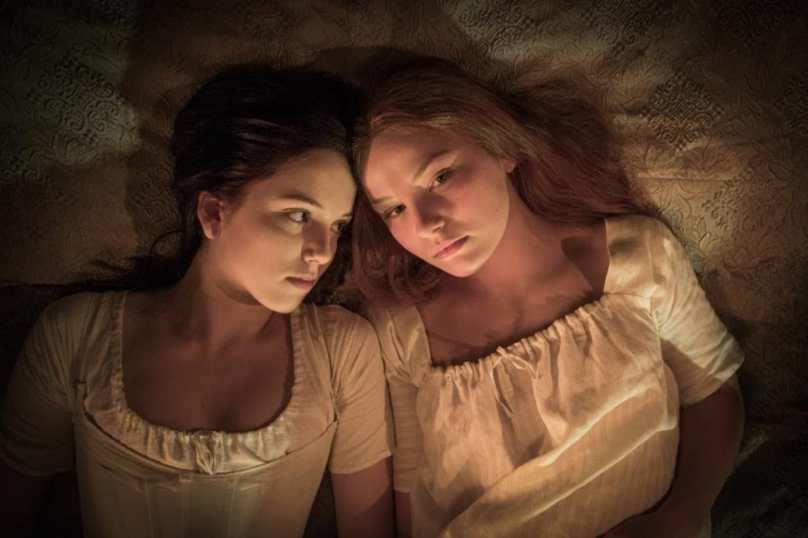
A Canadian Adaptation of LeFanu’s Carmilla (2017)

Every October, I usually read several novels and short stories in the horror genre. I do not care that much for the current stuff, like Stephen King or Dean Koontz. My preference is for the classics, and those tend to be concentrated in the late 19th century.

The books I read this month were:

  • Shirley Jackson’s Dark Tales
  • Joseph Sheridan LeFanu’s In a Glass Darkly, which included the short novels Carmilla and The Room in the Dragon Volant
  • Arthur Machen’s The Great God Pan and Other Horror Stories, a new collection edited by Aaron Worthy

Shirley Jackson is most famous for her short story “The Lottery,” but she also wrote such novels as We Have Always Lived in the Castle and The Haunting of Hill House.

Sheridan LeFanu (1814-1873) was an Irish author who wrote some classic tales of horror, especially Carmilla, a tale of a lesbian vampire who predated Bram Stoker’s Dracula by some twenty years. In 1960, it was made into a film by Roger Vadim entitled Blood and Roses (in France: Et mourir de plaisir). At the time I attended college, it was the most popular film showed by the Dartmouth Film Society.

Welsh Horror Tale Author Arthur Machen

Finally, there was a delightful collection of novellas and tales by Arthur Machen (1863-1947). Most of Machen’s best work was composed up to the late 1920s and included the classic The Great God Pan (1894), which tells of what happened when a young woman who, upon being exposed to the Greek god Pan, created a trail of destruction that spanned several continents.

Plague Diary 17: A Film About the Plague

There Is Only One Film I Know About Quarantining from the Plague

In the early 1940s, a Hollywood movie producer named Val Lewton (his real name was Vladimir Ivanovich Leventon) was responsible for a handful of great horror films in which the effects were more psychological than crude, which placed him pretty much in a one-man category.

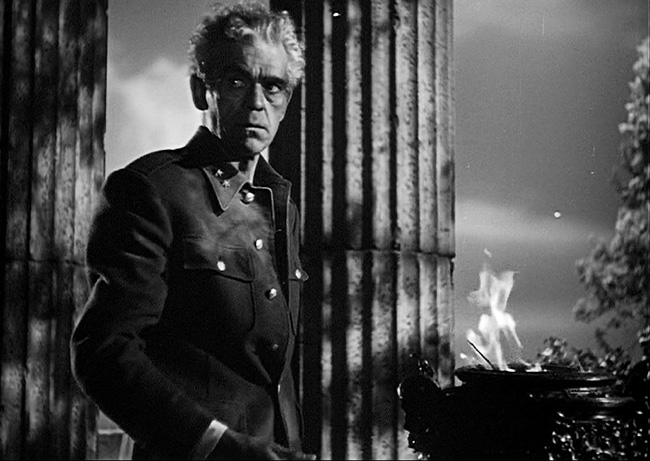
Today, I saw (for the nth time) his film Isle of the Dead (1945), set on a strange Greek island during the First Balkan War (1912-13). Boris Karloff plays the Greek General Nikolas Pherides who, together with an American journalist, rows to an offshore island to visit the grave of his wife. He finds that her grave had been broken into and her body stolen. Worse yet, he lands on the island only to find that one of the guests in the house where he is staying has died of the plague.

Karloff and the other people on the island must quarantine until the wind changes. Once the hot, dry sirocco wind begins to blow, that particular strain of the plague dies off.

Boris Karloff as General Pherides, “The Watchdog”

The psychological element introduced by Lewton is a superstition of a vampire-like creature called a vorvolaka which is promulgated by a Greek peasant woman named Kyra serving in the house. Karloff, who prides himself by his nickname of “The Watchdog,” buys into the possibility of the truth of this superstition, blaming a young serving woman who is enjoying rubicund good health for being a vorvolaka.

The film is a scant 72 minutes long and would be an excellent choice for a Quarantining-at-Home Film Festival, even if it is one lone title. There is also an Elia Kazan film called Panic in the Streets (1950) which involves the plague but has no claustrophobic quarantining.


Ten Short Horrors

Edgar Allan Poe (1809-1849)

Think of this as my Halloween contribution. For the last several years, I have celebrated Halloween not by Trick-or-Treating, not by gorging myself with candy, but by reading collections of horror stories, mostly those published by Dover Publications. I find that the best works of horror fiction are usually not the longest (sorry, Stephen King), but either short stories or novellas.

Here is a list of ten of my favorites, in order of publication:

  • Edgar Allan Poe, “The Masque of the red Death” (1842)
  • J S Le Fanu, “Carmilla” (1871)
  • Robert Louis Stevenson, “The Body Snatcher” (1884)
  • Henry James, “The Turn of the Screw” (1898)
  • Bernard Capes, “An Eddy on the Floor” (1899)
  • W W Jacobs, “The Monkey’s Paw” (1902)
  • Arthur Machen, “The White People” (1904)
  • Algernon Blackwood, “The Willows” (1907)
  • M R James, “Casting the Runes” (1911)
  • H P Lovecraft, “The Colour Out of Space” (1927)

Happy Halloween, and Boo!