

My Own Nationality

A Different Kind of Hungarian

As I get older, I am increasingly unwilling to interact with strangers. Chatting with people I do not know is just something I would rather not do any more. I don’t even like sharing an elevator. The absolute worst is having to interact with American tourists when I am traveling abroad.

And yet I remember helping a group of French tourists in Iceland get guesthouse accommodation in Höfn, Iceland, when they couldn’t find any locals who understood them.

The difference was they didn’t have any expectations of help, whereas many or most American travelers, on the contrary, would. It is at that point that I reply to their question(s) very politely in my off rural Hungarian dialect from the 1930s. I could be telling them in Hungarian to get stuffed, but I actually try to answer them politely in my native language.

There is always the danger that the person accosting me knows the Magyar language. That actually happened to me once in Vancouver’s Chinatown, when the beggar asking for spare change recognized what I was saying and answered me back in Hungarian. I immediately melted and gave him a five dollar bill. He actually invited me for coffee, but I was on my way to a movie screening and didn’t want to be late. Else I would have obliged him.

I am not that way, of course, with my friends and acquaintances. Or even with waiters or cashiers. It’s just that I have a phobia of dealing with demands placed on me by strangers. That even includes the unsmiling visage that I characteristically assume—all to avoid having to deal with the public at large.
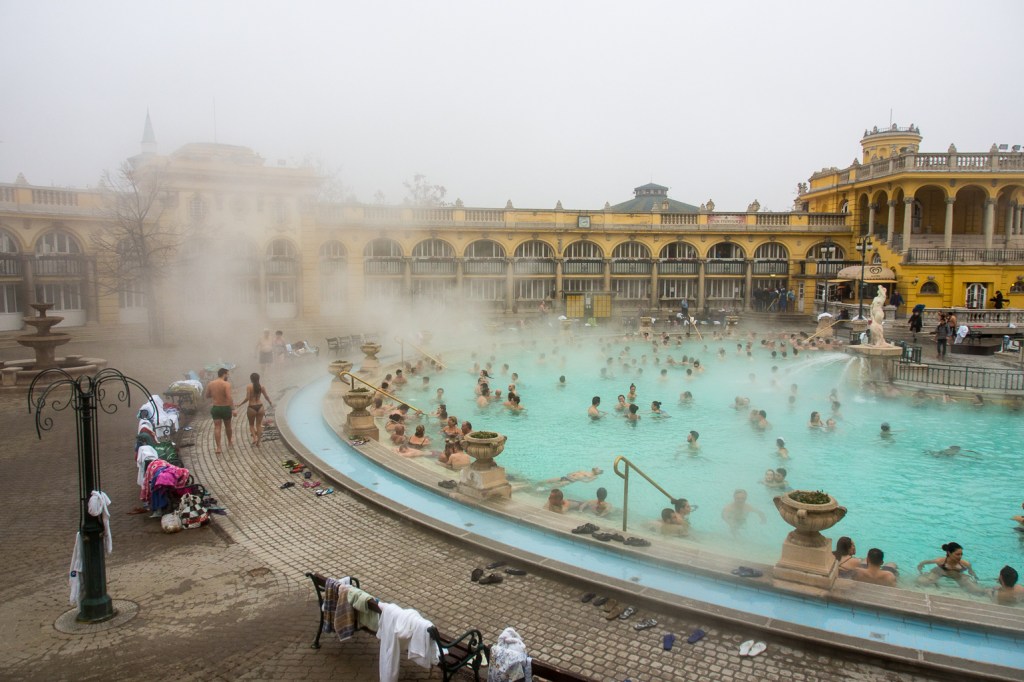
In Hot Water

Széchenyi Baths in Budapest, Hungary

I’ve only been to Hungary once, back in 1977. One of my happiest times alone with my father was the two of us visiting Budapest’s Széchenyi (SAY-chen-yee) baths and chatting for hours in the thermal pools. Of course, an opportunity gained can also be an opportunity lost. During that time, my mother went back to Felcsut in the Fehérmegye countryside, where she was raised as a young girl on a farm by her grandparents. I never did get to see Felcsut.

Although I spent so little time in Hungary, I am proud to say that I still somehow bear inside of me the seed of the Magyar culture and language. When I was a little boy in Cleveland, television was just coming in; so, living in a Hungarian neighborhood, I was blissfully unaware that the English language even existed. Until I showed up for kindergarten classes at Harvey Rice Elementary School.

That set off a whole chain of events, from moving to the suburbs, even though my father always yearned to be back in the old Buckeye Road neighborhood, to my majoring in English at an Ivy League school. But that is another story.

Magyar Blood

Folk Dancers from the Kárpátok Troupe at Grace Hungarian Reformed Church

For the first time since the Covid lockdown began, Martine and I were able to attend a church festival, in this case the Hungarian festival at Grace Hungarian Reformed Church in Reseda. I was raised on Hungarian food, and Martine, although French, prefers Hungarian food to the cuisine of her native land.

So we chowed down on stuffed cabbage and krémes (Hungarian style cheesecake) and watched a program of folk dancing. Plus I had the opportunity of practicing my rusty Hungarian. Although it is my native language, my vocabulary and grammar are atrocious. Yet my pronunciation is still pretty accurate. As I’ve mentioned before, I speak a rural Fehérmegye dialect dating back to the 1930s. This is what we spoke at home in Cleveland.

Still and all, I want to stay close to my Magyar roots as much as possible. I see it as an escape hatch when I get too disgusted with my fellow Americans. I like to stay current with Hungarian literature, even though I have to rely on translations into English, of which there are few.

Below is the announcement for the festival we attended today:

Not a single word is in English, and yet I understood most of it. And what I didn’t understand, I looked up.

Martine and I have been attending this church’s spring festivals for most of the last eleven or twelve years. Great fun!

The Only Language the Devil Respects

Hungarian Poet Borbély Szilárd (1963-2014)

This post is a tribute to my strange native language, Hungarian, which is one of only four non-Indo-European languages in Europe. (The others are Basque, Estonian, and Finnish.) It is also a tribute to one of the great Hungarian poets of our time: Borbély Szilard. Get the pronunciation right: It’s BOHRR-bay SEE-lard.

I have decided to print the following poem first in English translation, and then in the original Magyar language. My intent is to show you what a strange language Hungarian is, so alien from any other language you may know. In his novel Budapest, the Brazilian novelist Chico Buarque writes that Hungarian “is rumoured to be the only tongue in the world the devil respects.”

Computer, Evening

There are certain moments in the evening when
one is too tired to do more.
Just to sit quietly. Not tired enough for sleep,
but not really energetic either. You read a few lines

from Kosztolányi about autumn and the soul, mysterious
way stations, the passing of time. For time is like life
itself: it leaves its imprint on the body alone.
In consciousness, on the soul, or the relational

structures of language. I don’t really know. Someone looks
out from the window, to see the stars growing distant
or whatever else they are doing. And thinks about

this: between the stars and the earth, he lived. Afraid
to sleep. Like a child in the evening, always seeking
a pretext. While the computer’s screen saver swirls.

Now for the original Magyar:

A Számítógép Este

Vannak azok a pillanatok este, amikor
az ember fáradt már bármit csinálni.
Csak ül csendben. Még nem álmos, de
nem is friss. Olvas néhány Kosztolányi

sort lélekről, őszről, titokzatos megállókról,
elmúlódő időről. Mert az idő is olyan, mint
az élet: csupán a testen hagy nyomot.
A tudatban, a lélekben vagy a nyelv

viszonyrendszerébden. Nem is tudom. Valaki
kinéz az ablakon, hogy távol a csillagok
vajon mit is csinálnak. Elgondolkodik azon,

hogy a föld és a csillagok közt élt ő. Fél
elaludni. Mint a gyerek este, kifogást
keres. Amíg táncol a képernyőkímélő.

I don’t expect you to understand a word of the Hungarian. It is one of the most difficult languages in the world to learn. But it was the first language I learned, and it has had a lasting effect on my life. First of all, it is an agglutinative language, like Turkish, Korean, and Swahili. It puts together elements into long words such as viszonyrendszerébden (relational structures of language) and képernyőkímélő (screen saver). Note also the double acute accent in words such as őszről (about autumn). It represents a lengthening of the umlauted vowel sound.

The reference to Kosztolányi is to Hungarian poet and prose writer Dezső Kosztolányi (1885-1936).


Reading Russian Poetry in Translation

I Love Russian Poetry, But I Don’t Know Russian

I get a real feeling of inadequacy every time I read Russian poetry in translation. How can one really appreciate a country’s poetry unless one speaks the language? What Russian I know relates only to, of all things, chess. I used to play international correspondence chess in competition, so I had to understand certain terms such as “position drawn” or “resigns” or the names of the pieces in several languages. That doesn’t help me understand what Marina Tsvetaeva meant in the above illustration. I’ve read Tsvetaeva and several of her countrymen in translation. Most recently, I read Arseny Tarkovsky’s collection I Burned at the Feast.

Again and again, I would run into stanzas that seemed to open vistas for me—only to wonder how the poem read in the original language. Here are a few examples:

A word is only a skin,
a thin film of human lots,
and any line in your poem
can sharpen the knife of your fate.

Or this:

Something was leading us.
Built by miracle, whole cities split—
like mirages before our eyes.
And mint bowed beneath our feet,
and birds hovered above our heads,
and fish nosed against the river’s flow,
and the sky unscrolled above the land…

while behind us, fate followed
like a madman with a razor in his hand.

Russians love the poetry of Pushkin, but I have no idea of what he sounds like in the original Russian. Sometime in the next year, I will read Babette Deutsch’s translation of Eugene Onegin. But is it really any good? Some people say it is, but I am at the mercy of whatever translation I select.


His 455th Birthday

Portrait of William Shakespeare (1564-1616)

Today is the 455th anniversary of the birth of dramatist William Shakespeare. To honor his birthday, I picked up my old Penguin edition of Hamlet and started to re-read it for the nth time. It has been a couple of decades since my last reading. I was shocked to the extent that the Bard’s language had become so familiar to me that I almost regarded it as my own. From Act I alone, I had adopted into my own language such expressions as:

Before my God, I might not this believe
Without the sensible and true avouch
Of mine own eyes. (I,i,56-58)

A little more than kin, and less than kind! (I,ii,65)

’A was a ma, take him for all in all,
I shall not look upon his like again. (I,ii,187-188)

In the dead waste and middle of the night. II,ii,198)

I do not set my life at a pin’s fee (I,iv,65)

Something is rotten in the state of Denmark. (I,iv,90)

There are more things in heaven and earth, Horatio,
Than are dreamt of in your philosophy. (I,v,166-167)

The time is out of joint. O cursèd spite
That ever was I born to set it right! (I,v,188-189)

If these short quotes are familiar to you, it is because they have become a part of our language. Shakespeare actually changed the way we think about things. Within the next day or so, I want to write about how Hamlet changed forever the straightforward revenge tragedy that was such a part of Elizabethan and Jacobean dramaturgy.


Serendipity: My Hovercraft Is Full of Eells

The Eells in Question Was the Reverend Myron Eells

In preparation for a projected trip along the Inside Passage to Alaska, I am reading Jonathan Raban’s Passage to Juneau: A Sea and Its Meanings (New York: Pantheon Books, 1999). The book is full of delightful historical anecdotes about Captain Vancouver and other early explorers and settlers. Some got along well with the Indians: Others didn’t. One in the latter category was the Reverend Myron Eells, known for his “garrulous moralism.” More than fifty years after he passed on, he was still remembered by old people who, as children, been on canoes with him. In 1934, William M. Elmendorf interviewed a Skokomish elder who spoke of Eells as “that awful man.” The elder went on to say:

People didn’t like him very well. He was collecting Klallam words from some Klallam Indians who were visiting here one time. I had to translate for him. So he would ask them for words like father, mother, house, dog, and so on. And those people didn’t think much of Eells, so they would give him all sorts of dirty, nasty words, and he would write them down in a book. Then he would try to use some of these words. thinking he was talking Indian, and people would just about bust trying to keep from laughing.

If you have any interest in primitive languages, it would help first to see whether one is on the same wavelength as one’s interviewees. (Oh, and my apologies to Monty Python’s Flying Circus!)

The Unrhymeables

Everyone Knows You Can’t Rhyme Anything with Orange ...

Everyone Knows You Can’t Rhyme Anything with Orange …

… but did you know that there are three major colors for which you can’t find rhymes? They are:

  1. orange
  2. purple
  3. silver

According to the Futility Closet website, there are four other common words which have no rhymes.  They are: chimney, depth, pint, and month.

There are probably at least a dozen other words which are less common which also are not part of the traditional poet’s lexicon.


It’s OK To Be a Fool!

When in Doubt, Use All Means To Communicate—Even If It Makes You Look Like a Fool

When in Doubt, Use All Means To Communicate—Even If It Makes You Look Like a Fool

I never took Spanish in school, so most of my knowledge of the language comes from an old Berlits Latin American Spanish phrase book. I’m pretty good at getting a place to stay, and even better at ordering a meal. What I cannot do is engage in a conversation. I will try gamely, but my Rule #1 is never ever get flustered.

Once you get flustered, the person who is talking to you will think that you are being a rude dickhead for no earthly reason. It is far better to look stupid and try patiently with your limited repertoire, including hand gestures and even written notes.

At the bus station in Cuenca, I tried hard to buy a ticket for a ride to Alausi. Although the signs on the booth indicated that Patria buses stopped there, the lady refused to sell me a ticket there. Instead she went into a long explanation which I didn’t understand. Finally, I bought a ticket instead to Riobamba, which was a major stop on the line, albeit past Alausi. I figured I could get off the bus near enough to Alausi to get there by other means—at worst walking a kilometer or two down the hill. (I knew that the buses would not stop in Alausi itself, as it was in a valley below the Pan-American Highway.)

In the end, not only did I have no trouble getting off at the Alausi bus station on the Pan-American Highway (a place called La Estación), but the conductor called a cab for me.

I think what the woman’s long explanation at the Cuenca terminal was all about was that the bus did not go into the town of Cuenca, a fact which I already knew. Although I was out about fifty cents by buying a ticket to Riobamba, everybody was a winner in this transaction.