Where There Are No Rivers

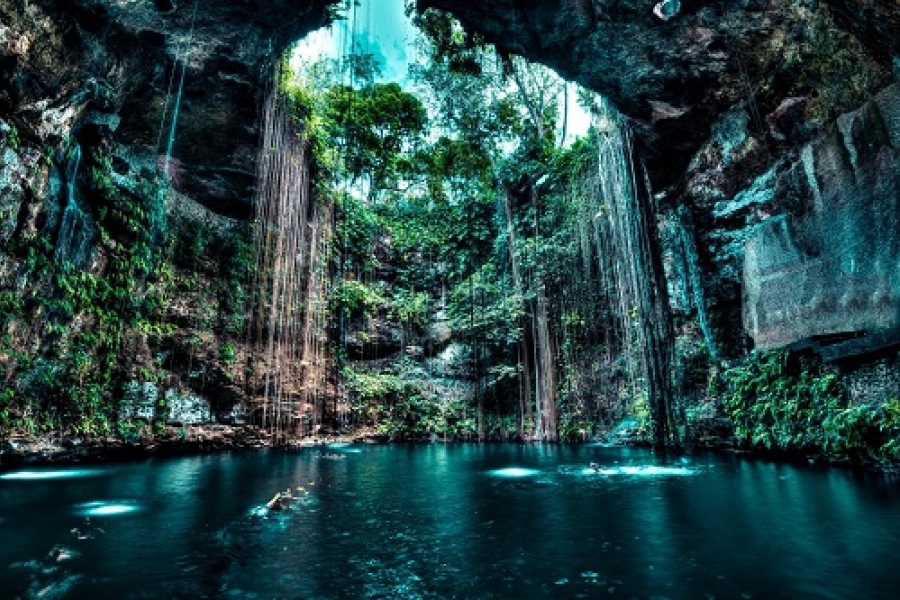
Cenote at Chichen Itza in Yucatán

Even Los Angeles has a river. Never mind that its banks are mostly of concrete and that it runs dry most of the year. There are some parts of the world in which rain sometimes falls in great profusion, but where there are no rivers to be seen. The operative phrase here is “to be seen.”

The Yucatán Peninsula in Mexico, which I plan to visit next winter, is a solid block of limestone into which the rainfall seeps. There is quite a bit of water in Yucatán, but almost all of it is below sea level. Thanks to the giant meteor which caused the Cretaceous Extinction some 66 million years ago, numerous holes were punched through the surface of the limestone causing waterholes (usually referred to as cenotes). Many of these cenotes are interconnected through extensive subterranean caves.

Many of these cenotes make for excellent swimming holes in the subtropical climate of the peninsula, and they are a steady source of water for drinking and washing to the local population.

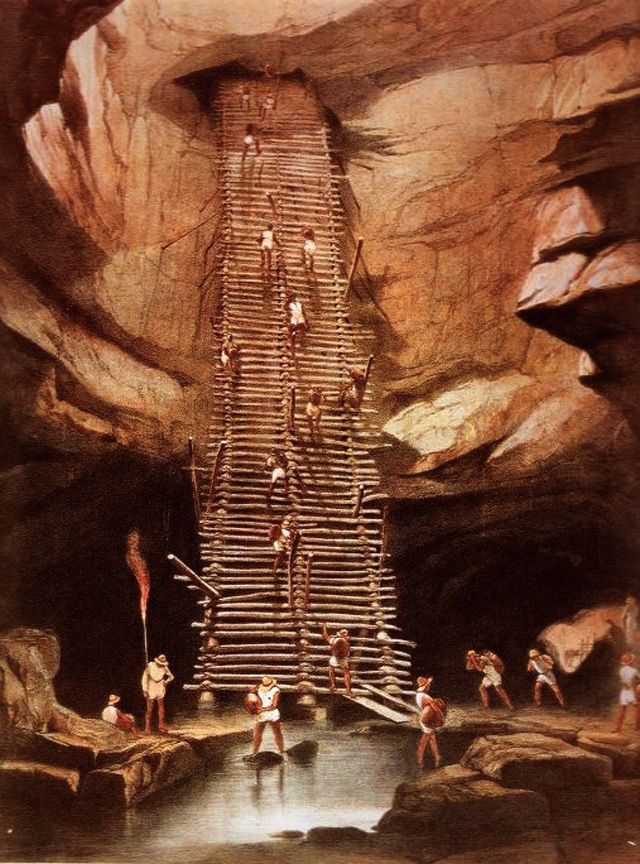
Where matters get more complicated is in the region known as the Puuc Hills, which rise several hundred feet above sea level, yet which sustained a large Maya population in ancient times. During rainy season, water is collected in stone cisterns called chultunes. During the dry season, these sources tend to dry up, and the local Maya must go hundreds of feet down to get at the subterranean rivers and wells. There is a famous illustration by Frederick Catherwood (around 1840) that shows the descent of hundreds of feet at the well in Bolonchen (see below). Shown here is only a portion of the descent to the wells, which continue for several hundred feet from the base of the stairs.

The Log Stairway at the Wells of Bolonchen (Representing Just Part of the Journey to Get Water)

Many place names in Yucatán contain the particle chen, which means well. In addition to Bolonchen, there is Chichen Itza, which, translated, means “The Mouth of the Well of the Itzaés.” A quick glance at a detailed map of this part of Mexico will turn up hundreds of other examples.


Serendipity: Daguerrotypes

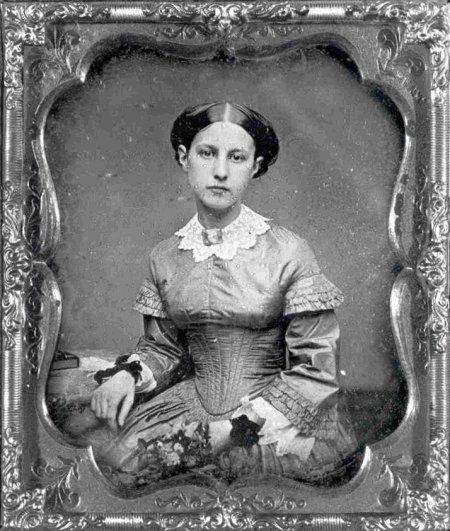
A Daguerrotype Portrait

John Lloyd Stephens and Frederick Catherwood were not known as photographers, yet I was greatly interested by Stephens’s description of offering to create daguerrotype portraits of some of the female inhabitants of the City of Mérida in Yucatán on their second trip to Mexico around 1840. The following excerpt is from Volume I of Incidents of Travel in Yucatan.

The ceremonies of the reception over, we made immediate preparations to begin. Much form and circumstance were necessary in settling preliminaries; and as we were in no hurry to get rid of our subjects, we had more formalities than usual to go through with.

Our first subject was the lady of the poetical name. It was necessary to hold a consultation upon her costume, whether the colours were pretty and such as would be brought out well or not; whether a scarf around the neck was advisable; whether the hair was well arranged, the rose becoming, and in the best position; then to change it, and consider the effect of the change, and to say and do many other things which may suggest themselves to the reader’s imagination, and all which gave rise to many profound remarks in regard to artistical effect, and occupied much time.

The lady being arrayed to the best advantage, it was necessary to seat her with reference to a right adjustment of light and shade; to examine carefully the falling of the light upon her face; then to consult whether it was better to take a front or a side view; to look at the face carefully in both positions; and, finally, it was necessary to secure the head in the right position; that it should be neither too high nor too low; too much on one side nor on the other; and as this required great nicety, it was sometimes actually indispensable to turn the beautiful little head with our own hands, which, however, was a very innocent way of turning a young lady’s head.

Next it was necessary to get the young lady into focus—that is, to get her into the box, which, in short; means, to get a reflection of her face on the glass in the camera obscura at that one particular point of view which presented it better than any other; and when this was obtained, the miniatured likeness of the object was so faithfully reflected, that, as artists carried away by enthusiasm, we were obliged to call in the papas and mammas, who pronounced it beautiful—to which dictum we were in courtesy obliged to respond.

The plate was now cleaned, put into the box, and the light shut off. Now came a trying time for the young lady. She must neither open her lips nor roll her eyes for one minute and thirty seconds by the watch. This eternity at length ended, and the plate was taken out.

So far our course had been before the wind. Every new formality had but increased our importance in the eyes of our fair visiters [sic] and their respectable companions. Mr. Catherwood retired to the adjoining room to put the plate in the mercury bath, while we, not knowing what the result might be, a little fearful, and neither wishing to rob another of the honour he might be justly entitled to, not to be dragged down by another’s failure, thought best to have it distinctly understood that Mr. Catherwood was the maestro, and that we were merely amateurs. At the same time, on Mr. Catherwood’s account, I took occasion to suggest that the process was so complicated, and its success depended upon such a variety of minute circumstances, it seemed really wonderful that it ever turned out well. The plate might not be good, or not well cleaned; or the chemicals might not be of the best; or the plate might be left too long in the iodine box, or taken out too soon; or left too long in the bromine box, or taken out too soon; or a ray of light might strike it on putting it into the camera or in taking it out; or it might be left too long in the camera or taken out too soon; or too long in the mercury bath or taken out too soon; and even though all these processes were right and regular, there might be some other fault of omission or commission which we were not aware of; besides which, climate and atmosphere had great influence, and might render all of no avail. These little suggestions we considered necessary to prevent too great a disappointment in case of failure; and perhaps our fair visiters were somewhat surprised at our audacity in undertaking at all such a doubtful experiment, and using them as instruments. The result, however, was enough to induce us never again to adopt prudential measures, for the young lady’s image was stamped upon the plate, and made a picture which enchanted her and satisfied the critical judgment of her friends and admirers.

Our experiments upon the other ladies were equally successful, and the morning glided away in this pleasant occupation.

“Wind, Water, Stone”

A Poem for a Very Windy Day

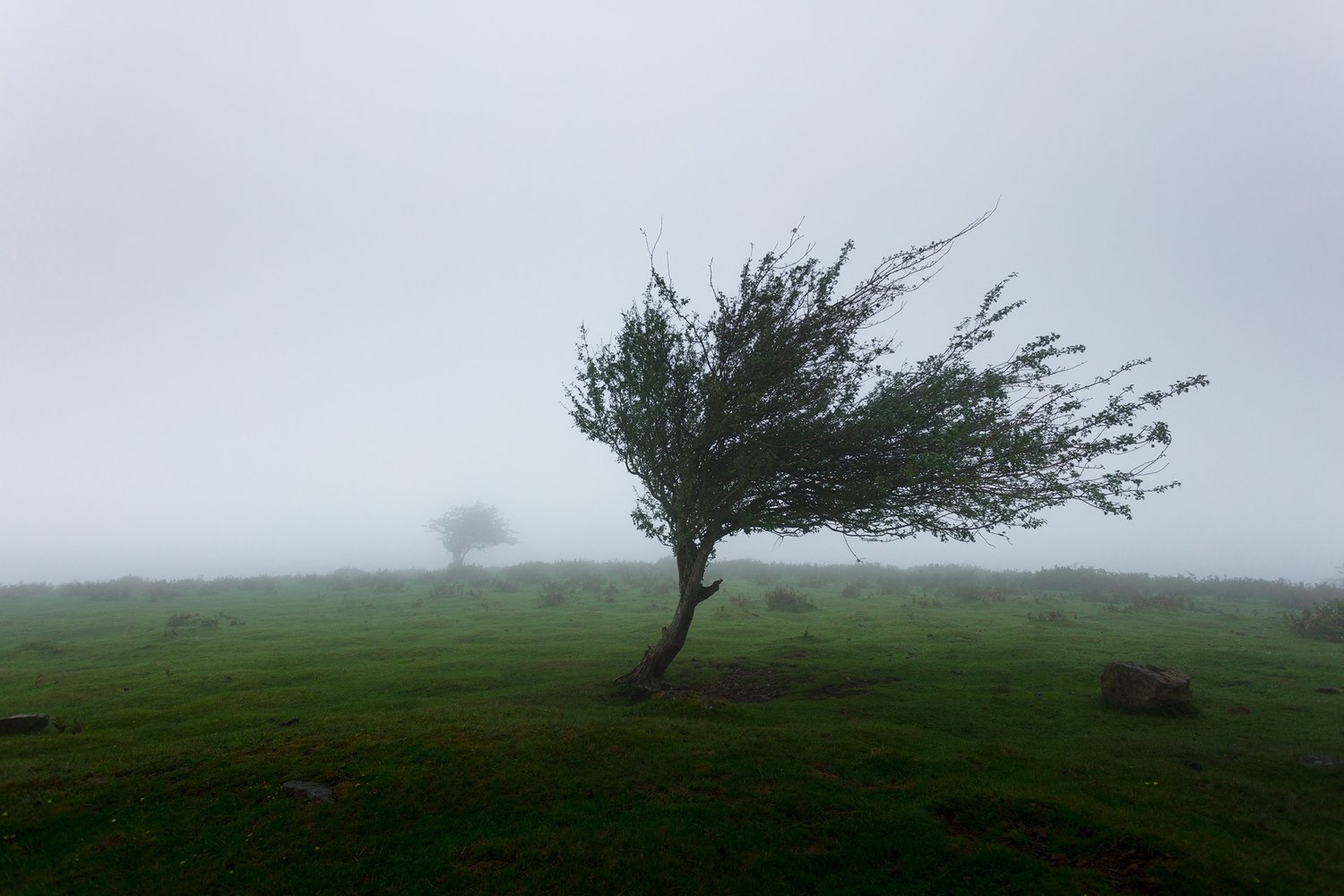
As the lights are going out in parts of Los Angeles because of high winds, I am reminded of a poem by the Mexican Nobel-prize-winning poet Octavio Paz (1914-1998) entitled “Wind, Water, Stone.”

Wind, Water, Stone
By Octavio Paz
Translated by Eliot Weinberger

for Roger Caillois

Water hollows stone,
wind scatters water,
stone stops the wind.
Water, wind, stone.

Wind carves stone,
stone’s a cup of water,
water escapes and is wind.
Stone, wind, water.

Wind sings in its whirling,
water murmurs going by,
unmoving stone keeps still.
Wind, water, stone.

Each is another and no other:
crossing and vanishing
through their empty names:
water, stone, wind.

The poem makes me think of the game of Paper, Stone, and Scissors. I love the final stanza which brings the three elements together into a satisfying whole.

Unfinished Business with the Maya

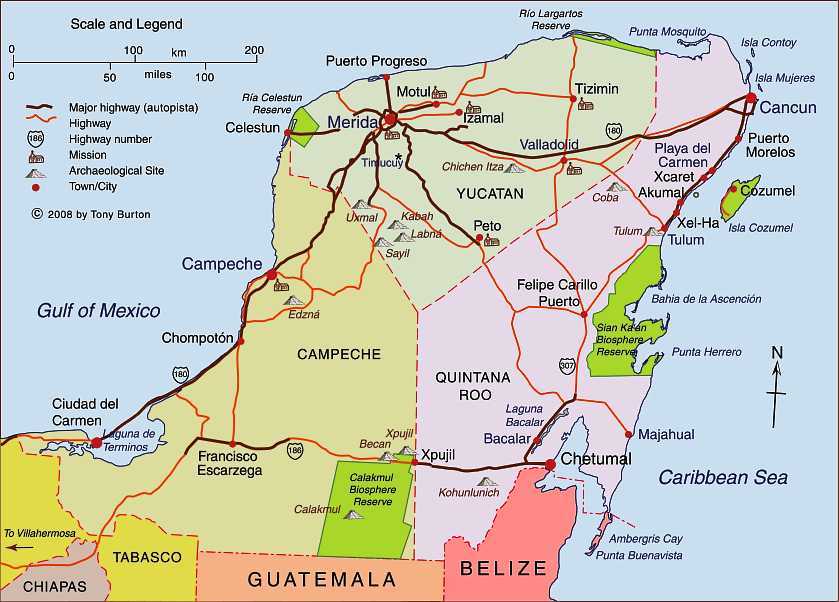
The Three States on the Yucatán Peninsula

I have not been to the Maya parts of Mexico since 1992, when I traveled to the Yucatán Peninsula with Martine and several co-workers at Urban Decision Systems. Now I am thinking of going again. My January trip to Guatemala only whet my appetite for more.

On past trips, I have seen the ruins at Chichén Itzá, Uxmal, Dzibilchaltun, Acanceh, Mayapan, Palenque, Tulum, Kabah, Labna, Sayil, and Xlapak. I would not mind seeing Chichén, Uxmal, and Palenque again, and perhaps even spending a little time at Valladolid and Izamal, which I have not seen. New destinations would include several Maya ruins in the State of Campeche, most notably Calakmul and Edzná, and Bonampak and Yaxchilán in the State Of Chiapas. The latter two can be seen on a tour from Palenque.

The most problematical destination is Calakmul, which may possibly have been the largest Maya city at one time—perhaps even bigger than Tikal in Guatemala. The problem is that the southeastern edge of the State of Campeche has not yet been sufficiently developed for tourism by the Mexican government. I can possibly get a tour from either the city of Campeche or of Chetumal in Quintana Roo.

Maya Structures at Calakmul

There is also the possibility of Cobá in Quintana Roo. I might visit it if I have to go to Chetumal to set up a tour for Calakmul. Otherwise, I would be reluctant to run into the passenger ship mobs that dock at Cancun and the Maya Riviera.

Two cities I would love to re-visit are Mérida in Yucatán and Campeche in the state of the same name. Both are delightful places that positively reek of contemporary Maya culture, with hints of the Mexican mestizo culture and—oddly—an admixture of Lebanese and Syrian, due to the merchant classes that set up there in the 19th Century.


A Nostalgia for Evil Empires?

Ruins at Mayapan in Yucatán

You can see the prejudice even in the naming of the archeological periods of Maya civilization. There is Preclassic, Classic, and Postclassic. The Classic Period ended around AD 800, while the English were struggling with Viking invaders, and while Charlemagne ruled in France. The Classic period was when most of  the big pyramids and temples were built—some 700 years before Cortés and the Spanish decided to muscle in on the action.

When we travel in Yucatán or the jungles of Petén, what we marvel at are the Classic ruins of places like Tikal, Copan, Calakmul, Uxmal, and Chichen Itza. In our simple way of admiring the wrong things. The Classic period was great for the divine kings who wasted their subjects in massive construction projects and endless wars.

After the Classic period, the Maya actually improved their lot: In place of pharaonic dictates to abject slaves and massive tragedies when one of their divine kings bit the dust, the new emphasis was on trade and multiple sources of power. Of course, there were no more huge pyramids, but the Maya could spend more time on agriculture, trade, and a slightly less domineering religion.

When the Grijalvas and Alvarados began attacking the Maya, the Maya resisted. The Aztecs lasted only a couple of years under the onslaught of the Conquistadores, whereas the Maya held out until 1697, some 175 years after the Aztecs fell. Today, there are about a million speakers of Nahuatl, which was the language of the Aztecs. The Maya today number about six million in Mexico, Belize, Guatemala, Honduras, and El Salvador—and they speak some 28 dialects of the Mayan language! While the Aztecs went down in flames, the Maya survived in greater strength despite multiple attempts to curtail their numbers and their power.


Pre-Columbian Writing

Detail from the Dresden Codex

At the time the Spanish landed in he New World, there was only one Pre-Columbian culture that had a written alphabet, and that was the Maya. Now I have heard that in earlier centuries, the Zapotecs and Mixtecs of Northern Mexico had a written alphabet, but stopped using it after a certain point. Curiously, the Aztecs and Inca did not have their own alphabet, however advanced they may have been in other respects.

Right now, the only instances we have of writing in Mayan are glyphs at various Maya ruins and four surviving codices that escaped the religious zeal of the Spanish missionaries in destroying what they perceived to be heretical. And since the subject matter related to Maya religion, it was heretical insofar as Christianity was concerned.

The most famous destroyer of Mayan codices was Diego de Landa, the Franciscan Bishop of Yucatán in the 16th century. In a famed book burning conducted in 1562, de Landa had 27 codices burned at Mani. He described the Maya as being disconsolate at the destruction of so much of their culture at one time. Curiously, it was the same de Landa who wrote the Relación de Las Cosas de Yucatán, which preserved an astonishing amount of the culture and language, such that it is still studied by Maya scholars. It is still available in a Dover Publications paperback.

Do you see the dots and dashes in the above detail from the Dresden Codex just above the four seated figures? They are, in order, the numbers 16, 4, 9, 13, zero (yes, the Maya had discovered zero), 5, 12, 2, and 1. As you can probably surmise from this, the dashes represented the number five or a multiple of fives; and a dot, a one or multiple of ones up to four. It was a vigesimal system, meaning to the base 20 rather than base 10 like ours. Very likely, the numbers in the illustration represent a “long count” calendar date fixing a particular event in time. You can read more about Maya mathematics here.

The other interesting thing about the Mayan alphabet is that some symbols were hieroglyphic and stood for an entire word and others phonetic, standing for syllables. This confused scholars for years.

At the time I started visiting the Maya world, only the calendrical symbols had been decoded (mostly thanks to the selfsame good/bad Diego de Landa). In the last forty years, we have discovered that the Maya have a history. We have learned names of rulers and translated descriptions of events commemorated by Maya rulers.


O Brave New World!

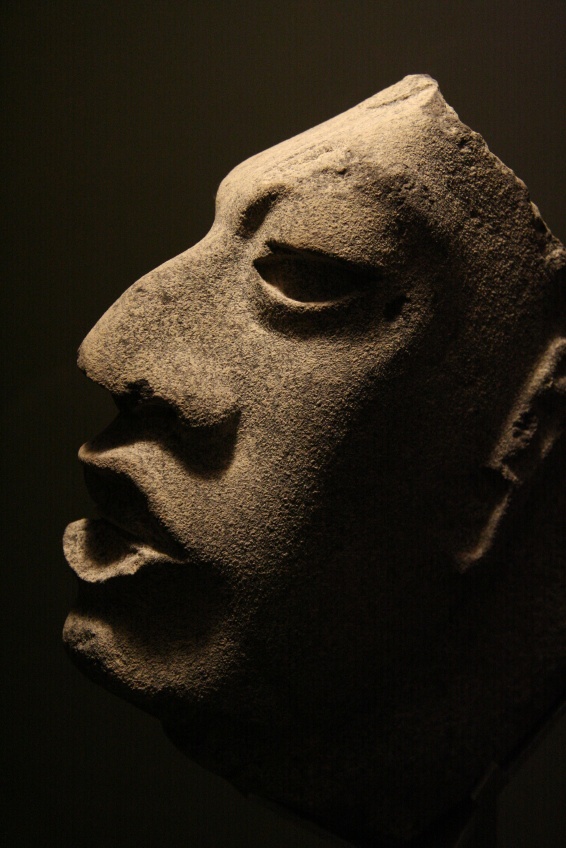
Maya Nose on Pre-Columbian Figure

The world opened up for me when I was thirty years old. It was the first time I even thought of breaking loose from my mother and father and exploring the world. For my first trip, I chose Yucatán in November 1975. And it was magical. First there was that cab ride to the Hotel Mérida past snack bars that were open to the street. It was my first experience of the tropics (other than Florida), and in the dark I saw men and women drinking beer and sodas. I was able to peer into houses and saw families watching television.

Once I checked in to my hotel, I stood at my sixth-floor window looking down onto Calle 60 and looking at passers-by walking on the sidewalk below. Suddenly one stopped and looked straight up at me. How did he know to do that? I stayed up until the wee hours of the morning, staring at an optician’s office across the way called Optica Rejón.

I was entranced by the zócalo and the 16th-century structures surrounding it. I had my boots polished every day. There was endless people-watching, all those Maya with their distinctive noses.

How many goodly creatures are there here!
How beauteous mankind is! O brave new world,
That has such people in ’t!


Around mid-afternoon, I hung out at the main entrance of the University (also on Calle 60, just a couple blocks from my hotel). So many beautiful young women that looked so different from the ones back home! Young Maya women are astonishingly good looking.

Can you wonder that, feeling the way I did about travel, that it would become a major feature of my life. Even though, in the next two years, I would travel to Europe, there was something about Latin American that lured me—and still does.

Why I’m Stuck on the Maya

Maya Girls

My first real trip outside the borders of the United States was to Yucatán in November 1975. I was so entranced with what I saw that I kept coming back to Maya Mexico for years, until 1992. During that time, I also wanted to go to Guatemala, but a civil war between the Maya and the Ladinos (Mestizos) was raging until 1996; and Guatemala was on the State Department’s “Level 4: Do Not Travel” list until just recently. Even now, the State Department as the whole country classified under a blanket “Level 3: Reconsider travel to Guatemala due to crime” warning.

Why is it that I am so fascinated by the Maya that I would risk flouting President Trumpf’s State Department?

For one thing, the Maya are incredible survivors. The Aztecs were ground down by Cortez within two years. In Peru, it took forty years before resistance was smashed by Pizarro and his successors. And the Maya? That took a full 180 years before the last Maya kingdom (at Tayasal in Guatemala) was leveled.

Today, there are 1.5 million speakers of Nahuatl, the language of the Aztecs. There are some 6 million speakers of the 26-odd Mayan languages and dialects. Of course, the Incan Quechua language has even more speakers: some 8.5 to 11 million speakers in several South American countries.

In recent years, there have been several disturbances in the Maya area:

  • In Mexico, there was a Maya war against the Ladinos in Yucatán that lasted from 1847 to 1901 and a Zapatista revolt in Chiapas that flared briefly in 1994.
  • In Guatemala, there was a violent civil war against the Ladinos from 1960 to 1996. It is estimated that tens of thousands of Maya were massacred by the army.
  • In El Salvador, there was a civil war from 1979 to 1981. (Only some of the indigenous peoples involved in that one were Maya.)

The Maya are still there, occupying large parts of Mexico (Yucatán, Chiapas, Tabasco, Campeche, and Quintana Roo); Belize; Guatemala; and parts of Honduras and El Salvador. It is no small achievement for them to have survived so much persecution for upwards of 500 years.

That is what interests me.


Portrait of a Sucker

Scene in the Crafts Market, Otavalo, Ecuador

There is nothing quite like the crafts market of a Latin American city like Chichicastenano, Guatemala; Otavalo, Ecuador; or Cusco, Peru. One wonders down narrow ways awash with color and aglitter with native ingenuity. There are times when I felt bad for not buying far more handicrafts than I could reasonably be expected to carry—especially the textiles. What I do buy is usually small enough to fit into the single bag with which I travel.

I remember the first time I felt this way. I was in San Cristóbal de las Casas in Chiapas, Mexico. It was December 1979, and I was fascinated by the Highland Maya textiles. It was then that a little Chamula girl, no older than eight or nine, sold me a little doll in native costume that she had made herself (or so she said). As she was describing it in her Highland Mayan dialect of which I knew not a single word, and stroking it as if it were something rare and magical, my heart melted and I bought the doll. I still have it on one of my bookshelves, resting against the Latin American literature section.

At some point, I’ll take a picture of it so that you can all see what I sucker I am. I suppose it is better than being heartless.

The Joys of Pre-Columbian Art

Moche Portrait Vessels at Lima’s Museo Larco

Not everyone is an aficionado of primitive art—particularly the Pre-Columbian art of the Americas. Children are not taught in schools about the early civilizations of the Americas. On the contrary, I suspect most kids think that, since the ancient civilizations fell so quickly to the conquistadores,  they didn’t have anything to offer to us.

Even one of my literary heroes, Aldous Huxley, came a cropper in his 1934 travel classic, Beyond the Mexique Bay: “Frankly, try how I may, I cannot very much like primitive people. They make me feel uncomfortable. ‘La bêtise n’est pas mon fort.’”

I strongly suspect that among Europeans of some eighty years ago, that was a common opinion. After all, the Olmecs, Maya, Aztecs, Moche, and Inca do not in any way resemble the ancient Greeks and Romans—except that the Inca, like the Romans, were also great road-builders. They didn’t have much of a literature that has survived the Spanish conquest, except perhaps for the Maya Popol Vuh of the 16th century. As for philosophy, drama, novels, poetry… you can pretty much forget about it.

There was a period of tens of thousands of years during which the peoples of the Americas were isolated from any possible contact with European civilization. In consequence, they developed along different lines. Again and again in his book on Guatemala and Mexico, Huxley shows himself to be unwilling to consider that the Maya are very different. Not inferior, just different.

The Moche figures in the above photograph are all highly individualized. They remind me of the terra-cotta Chinese warriors discovered in Xian: Each of the 8,000 soldiers was different from all the others.

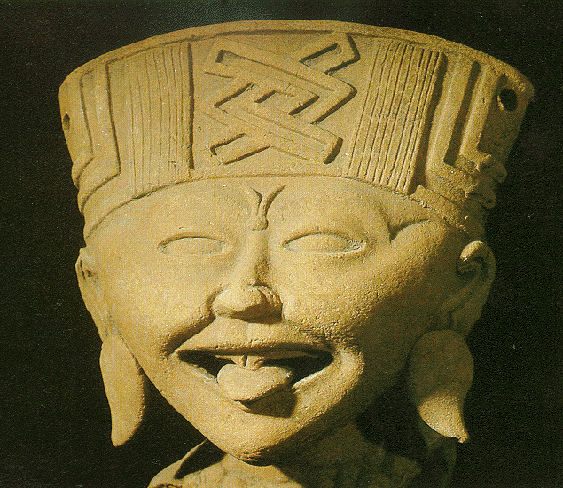
Totonac Figure from Mexico

Take the Totonac figure from the State of Veracruz in Mexico. This is a typical subject for Totonac art. Do we know what it means? The sloping forehead (does it show a deliberately deformed skull such as many Maya subjects?), the humorous expression: It is as if the distant past were laughing at us. And, in a way, it is. Many Pre-Columbian figures of animals from Mexico are downright hilarious. I don’t remember that type of humor from Greece or Rome, and certainly nothing similar from the Christian era.

Look at the Diego Rivera mural below, depicting a scene from El Tajin, the ancient ceremonial center of the Totonacs:

Scene from Diego Rivera Mural of El Tajin, Ancient Totonac Center

Let’s face it. We don’t quite understand what is going on here. We probably never will. I myself have been to El Tajin and saw Totonac youths rotating around elevated poles as voladores. Was there any convincing explanation of what was going on here? No, of course not. What intrigues me about this period is that the subjects are incredibly fascinating, but it is all a great mystery. Like life in general.