The Peru of a Hundred Years Ago Through Peruvian Eyes
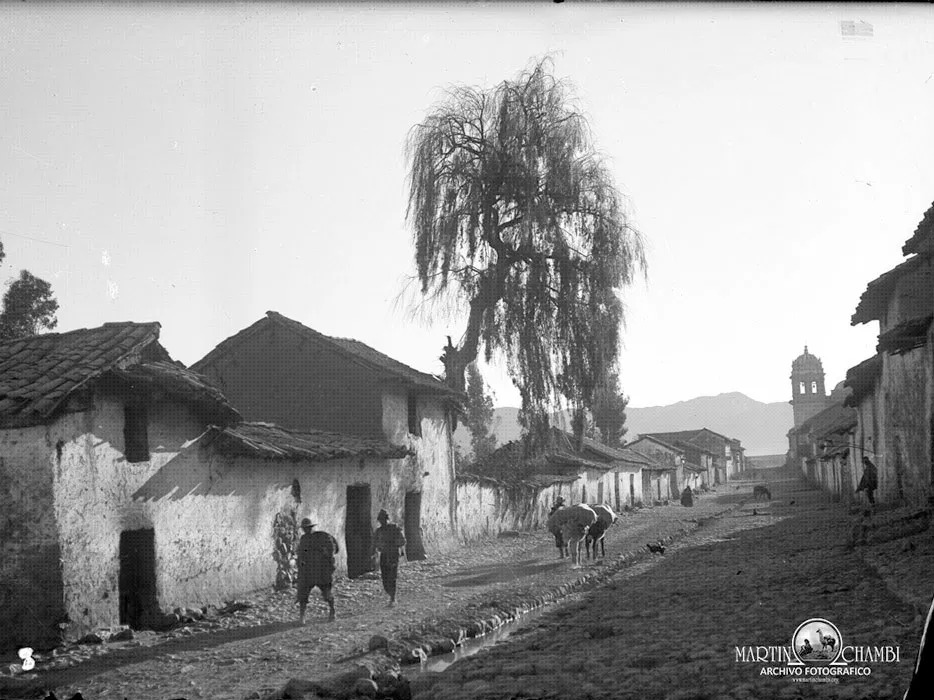
Martín Chambi Jiménez (1891-1973) was a Peruvian photographer who was active until a 1950 earthquake destroyed much of his beloved Cuzco. In his studio, he took pictures like the above musical group with their traditional instruments. But he also traveled around, photographing the altiplano of Peru, the city of Cuzco, and such sites as the ruins of Machu Picchu.
Cuzco Street Scene
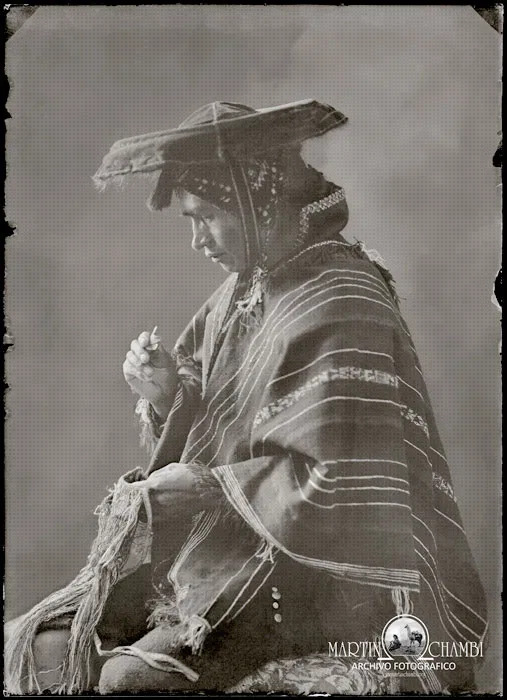
In 1979, the Museum of Modern Art in New York displayed an exhibition of Chambi’s photographs, which traveled to other cities and inspired other shows displaying his work. Chambi was a native-born speaker of Quechua, the language of the Incas, and he saw the people and the landscape as only a native could see them.
Quechuan Woman Chewing Coca Leaves
Below is one of the many images he shot at the ruins of Machu Picchu.
Machu Picchu As It Was 100 Years Ago
Photographers like Chambi are a rare link to the past in faraway places that were not in the mainstream of Western European Civilization.
I must think I’m going to live forever.Trapped in my apartment during the quarantine, I am thinking more and more about returning to Peru and including the altiplano of Bolivia. Here I am at age 76, thinking of a strenuous trip at high altitude to one of the most fascinating (albeit difficult) places on Earth.
In 2014, I spent some time on the western shore of Lake Titicaca, on the Peru side. I even took a tour on a launch to Isla Taquile and one of the Uros Isles, but as the boat left the dock, I discovered that I was beginning to suffer the effects of food poisoning. The former afternoon at Sillustani, I ate something in a farmer’s house that violently disagreed with me. What is more, I was hours away from a toilet. Under the circumstances, I was not able to appreciate the beauties of Lake Titicaca, and in fact I took no pictures that day.
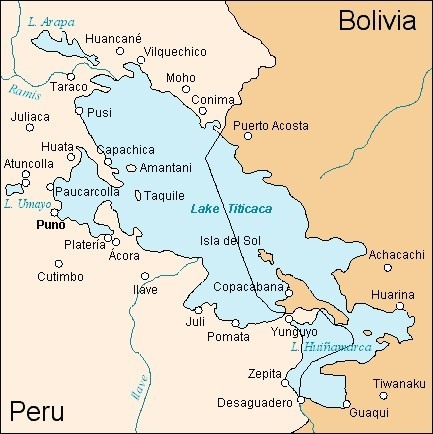
Map of Lake Titicaca, Showing the Location of Tiwanaku at Lower Right
Just as I returned to Tierra Del Fuego after breaking my shoulder there in 2006, I plan on returning to the Peruvian side of the lake, and adding some parts of Bolivia to the mix. I find myself suddenly interested in the Aymara-speaking peoples of the Andes.
A funny thing happened to me in Puno during my last visit. It was a bitterly cold morning, as it frequently is at that altitude (12,000 feet or 3,700 meters). I had neglected to bring a scarf with me, and I badly needed one. Enter a poor Aymara woman laden down with hand-knitted handicrafts. I walked up to her and brought a beautiful scarf at a reasonable price. Apparently, I made that woman’s day. She broke into a big smile and was almost prepared to welcome me into her family.
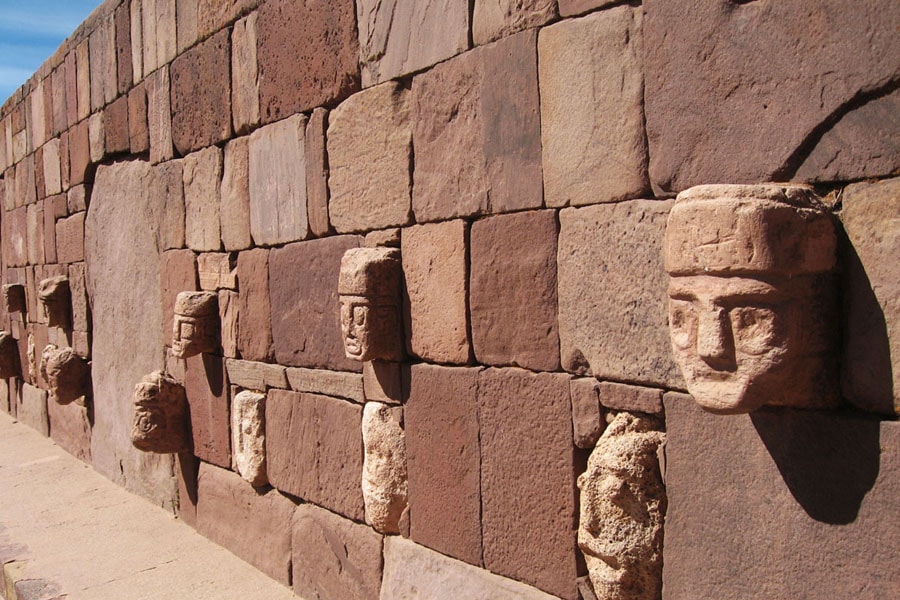
Over a thousand years ago, there was an Aymara empire centered at Tiwanaku in modern-day Bolivia. It lasted until AD 1100 when a massive and persistent drought led to a drop in the level of Lake Titicaca, leaving the Aymara fields high and dry. Hundreds of years later, the Inca took over; but their empire was short-lived once the Spanish conquistadores began to move in.
Walls of the Kalasaya Complex at Tiwanaku
Since the eco-catastrophe that destroyed the Aymara empire a thousand years ago, the Aymara have become a scattered people indulging in subsistence agriculture and the herding of llamas and alpacas.
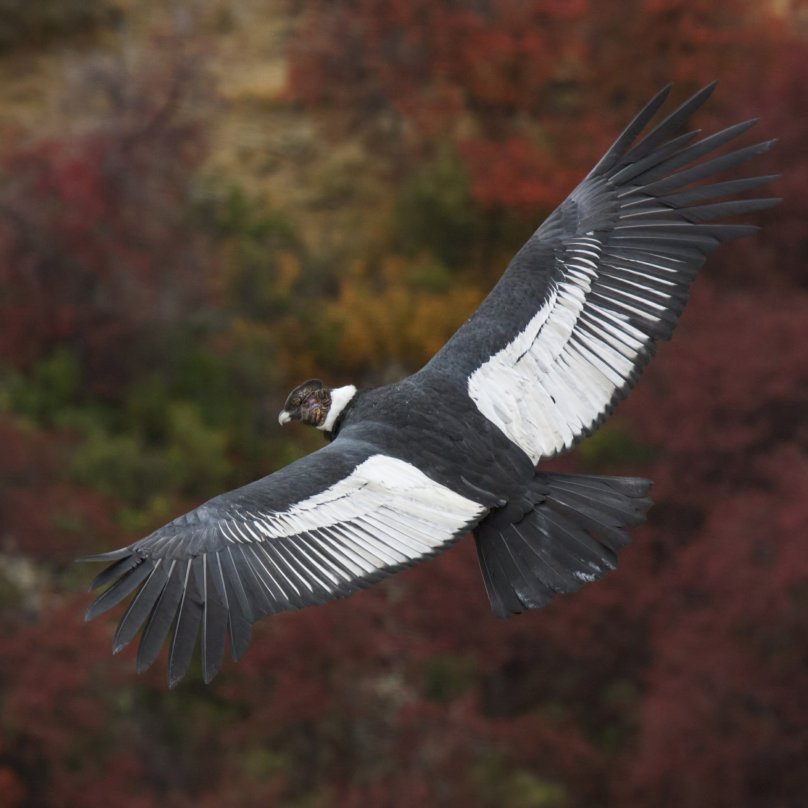
They’re Not the Prettiest Birds, But They Are HUGE!
Along the south rim of Peru’s Colca Canyon, midway between Chivay and Cabanaconde is a place called Cruz del Cóndor. We stopped there late one morning waiting for the thermals that bring that condors up from the canyon below. I had a hard time focusing on the birds when they were against a dark background, so I was not able to take the above picture. Below is the best of the ones I shot, up against a blue sky:
Condor at Colca Canyon
To be a good wildlife photographer, you have to be patient … and you have to have the right equipment. Unfortunately, I have only a digital rangefinder camera, and I wasn’t able to stay put and wait for the right shot to happen. So it didn’t.
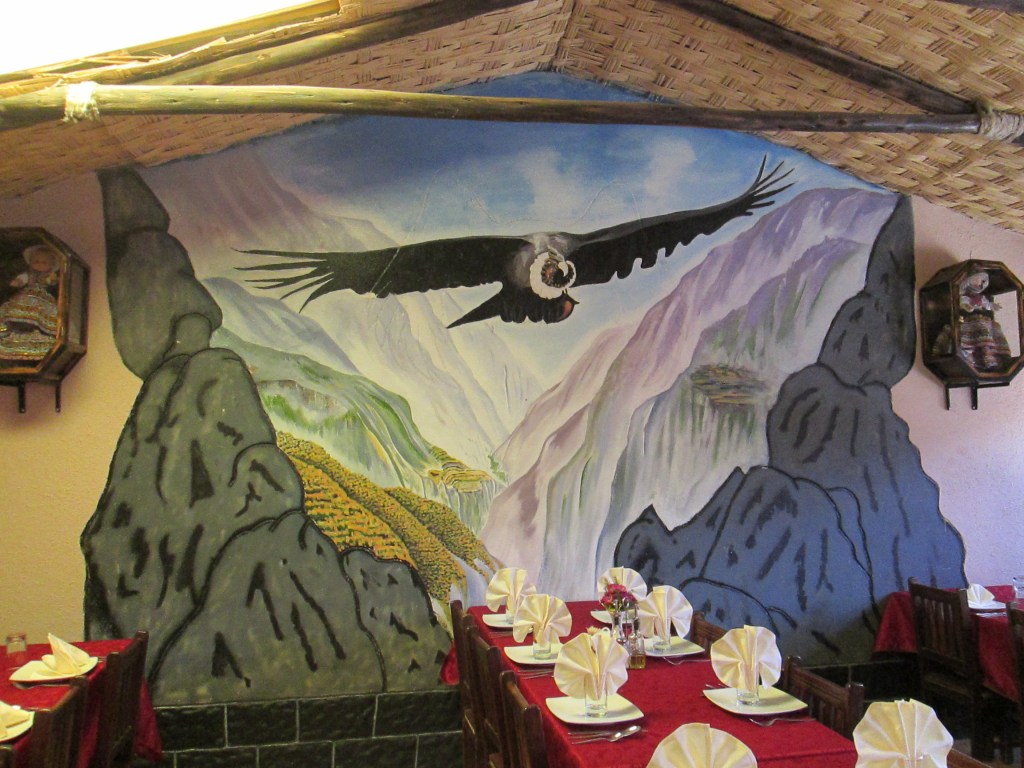
Condor on the Dining Room Wall in Chivay
Here’s one condor I was able to photograph—at the restaurant where we ate lunch after viewing the condors. Then it was on to the high point of the trip—Patopampas at 15,000 feet (4,600 meters)—enroute to Puno and Lake Titicaca.
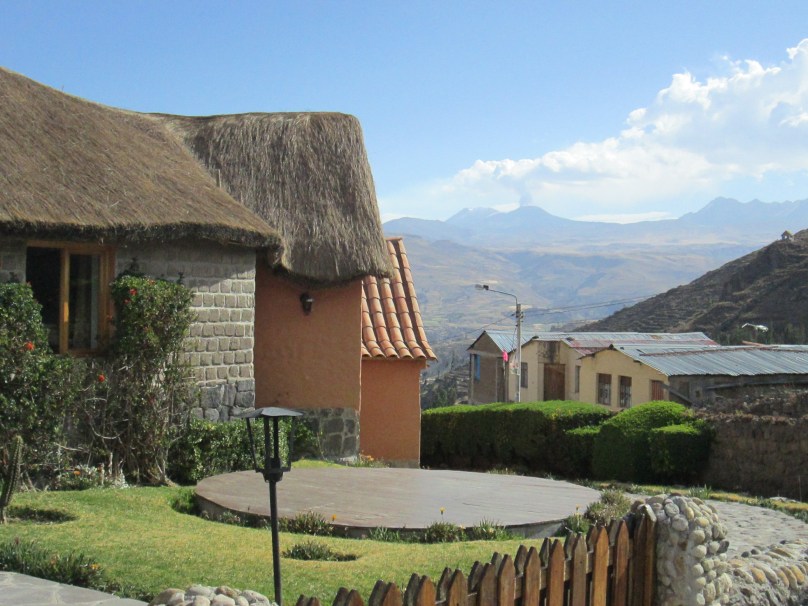
Coporaque, Peru with Volcán Sabancaya Erupting in Background
On my kitchen table, I have two guides to Peru which I consult from time to time. Even at my advanced age, I am thinking of going there once the coronavirus is but a dim memory (should that time ever come). I see in my mind a tour I took from Arequipa to the Colca Canyon area back in 2014.
We were in the Andes at between 12,000 and 15,000 feet (3,600-4,600 meters) altitude. I was chewing coca leaves with an alkaloid to keep me from suffering the effects of soroche, or altitude sickness. With meals, I would drink a tea of maté de coca, which had the same effect. Man was not made to live at that kind of elevation without some assistance. Please note that the difference between coca leaves and cocaine is like the difference between Lipton’s Tea and Bath Salts. At that level, it is simply not a narcotic.
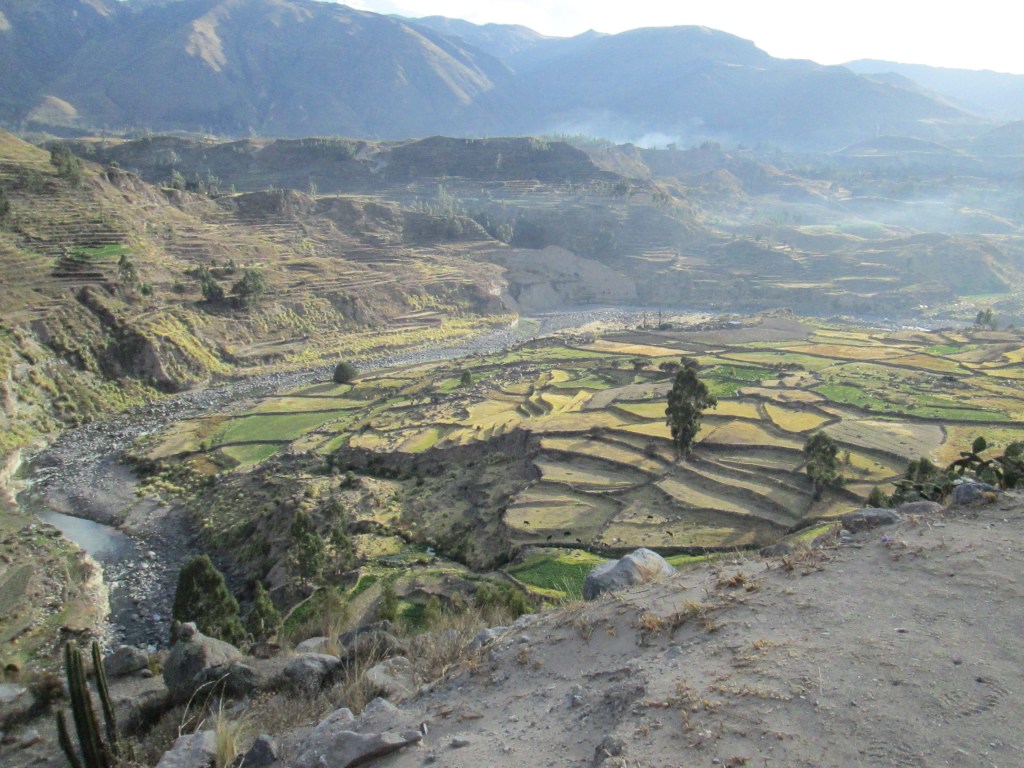
Colca Canyon with Farming Terraces Created by the Inca
As it works its way down to the sea, Colca Canyon becomes even deeper than the Grand Canyon. At its deepest point, it is 10,730 feet (3,270 meters) deep. And the whole canyon is only 43 miles (70 km) long. (Just north is an even deeper canyon: Cotahuasi Canyon at 11,004 feet or 3,354 meters deep.)
There is a place west of Coporaque called Cruz del Cóndor where you can see giant Andean condors rising on thermals from far below. At a wingspread approaching 9 feet (3 meters), it is one of the most incredible things I have ever seen. Later this week, I’ll show you some pictures I took there.
A Fiesta in Chivay, Largest Town Around Colca Canyon
The Colca Canyon area is inhabited by the Cabana and Collagua peoples. It is only about three hours from Arequipa along a high, desolate, and unbelievably picturesque route.
I spent only a single night in Colca, and I would like to remedy that. There are scheduled intercity buses that go from Arequipa to Chivay along the same route I took, and I can probably find a tour guide in Chivay. He might not speak English, but my Spanish is tolerable—if the person I’m talking to is patient.
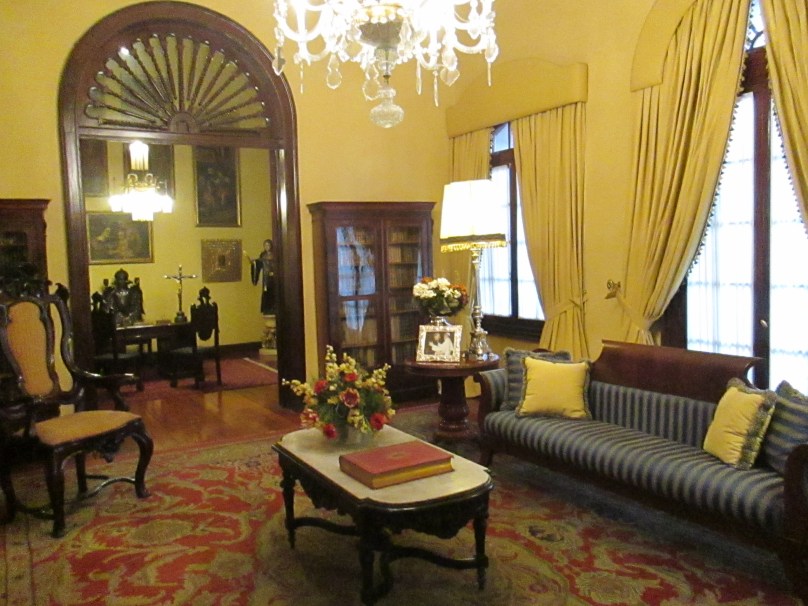
Interior of the Palace of the Archbishop, Lima, Peru
What shocked me more than anything during my 2014 visit to Peru was that the archeology of Spanish Catholicism in Peru was fully as interesting as the archeology of the Incas and other pre-Columbian peoples. The pictures here all come from my visit to the Palace of the Archbishop next to the Cathedral in Lima on November 9, 2014. I was guided through the Palace by a very cute young Peruvian nun who kept addressing me as “Gentleman.”
As I visited the Palace and the various churches and convents, I thought to myself that the Christian religion in Peru had passed its peak. What remained was partially syncretic, but in any case visually stunning.
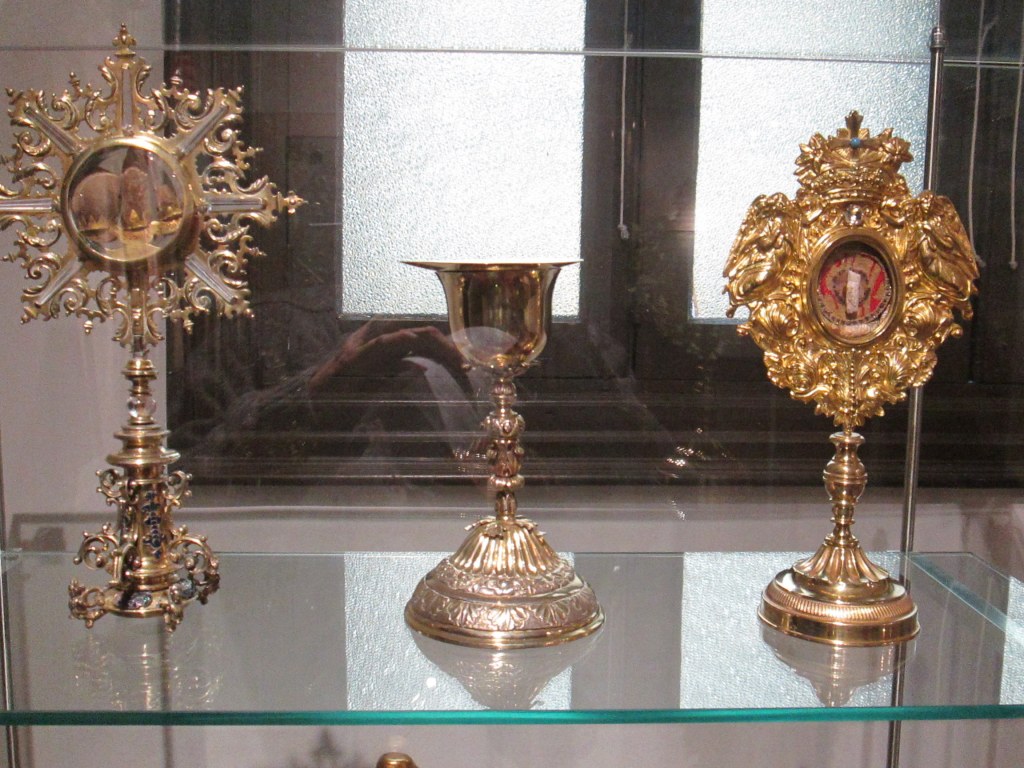
Chalice Flanked by Two Monstrances
I have often thought that it was not the King of Spain who benefited from the wealth of gold and silver transshipped from South America, as much as Holy Mother the Church. The churches and monasteries in the historic center of Lima are glistening with gold, silver, and precious stones. At the Monastery of Santo Domingo are the remains of three 17th century Limeño saints: Rose of Lima, Martín de Porres, and Juan Macías—all of whom were affiliated with the Dominican Order.
Brought up as a Roman Catholic, I found myself spending a lot more time in the churches than at the Inca ruins. They were usually beautiful and peaceful, even if I wound up attending Mass a number of times. In fact, I felt myself more a Catholic in Peru than I do in Los Angeles.
Statue of the Blessed Virgin
Whatever their original colors, it seems as if the paintings and statues of Christ, the Virgin, and the saints are predominantly reddish brown. This is particularly true of the Cusco School of Painting which predominated at the time. At some point soon, I will repeat a past post on the iconography of archangels shown in Peruvian paintings of the Cusco School.
Still on lockdown from the quarantine, I am dreaming of a vacation that includes Peru, the northern tip of Chile, and the Altiplano region of Bolivia. I may be too old for this trip (at age 76), but I continue to collect information. In terms of transportation, it involves a round trip flight from Los Angeles to Lima, Peru.
There are three legs to this trip.
First I head south in two or three stages to Tacna, Peru, which is on the border with Chile and its Atacama Desert, and over the border to Arica. The stages might include Paracas, Huacachina, and (most definitely) Arequipa.
From Arica, I head northeast to the Bolivian border, possibly stopping at Putre and the Parque Nacional Lauca. From this point until the end of the trip, I am at high altitude, from twelve to fifteen thousand feet (between 3600 and 4600 meters). I will be subject to soroche, or altitude sickness. I will have to use coca leaves and an alkaloid to keep me from becoming seriously ill.
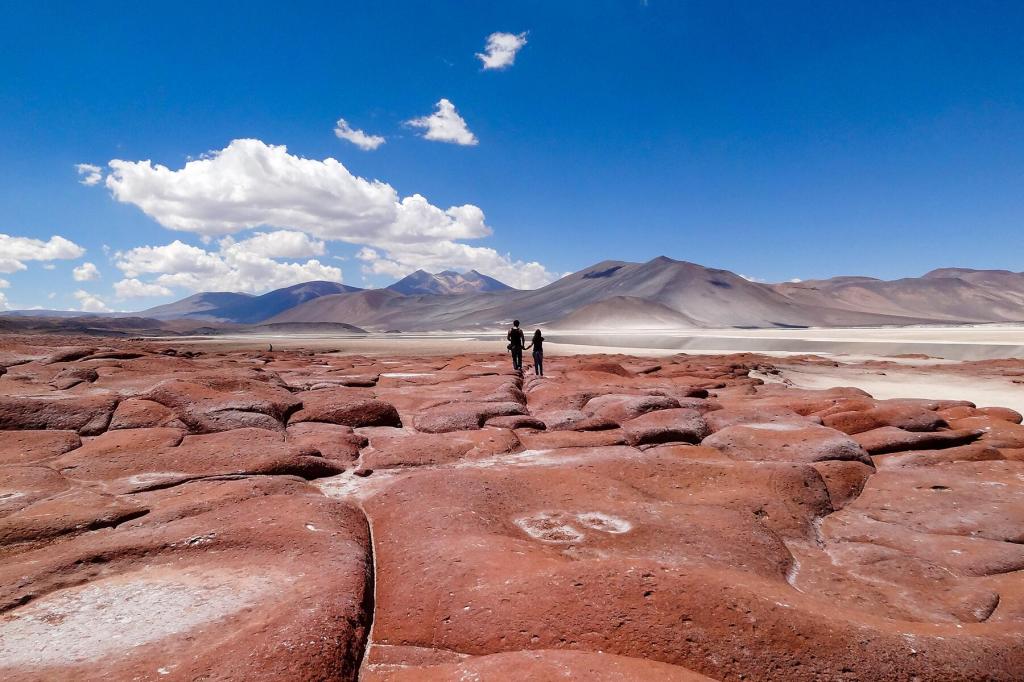
Chile’s Atacama Desert, Which Receives No Rain To Speak Of
From Arica to La Paz, Bolivia is only seven hours by bus, continuing on my northeasterly direction.
I will recover from my bus ride for a few days in La Paz, possibly seeing the ruins at Tiwanaku. Then I head northwest to Copacabana, where I will be on the shores of Lake Titicaca. I will spend a night on the Isla del Sol, and take a bus to Puno in Peru. From Puno, I will take either a bus or train to Cusco, where I will see several local Inca ruins (though not necessarily Macchu Pichu, which I saw in 2015). From Cusco, I fly to Lima and eventually back to Los Angeles.
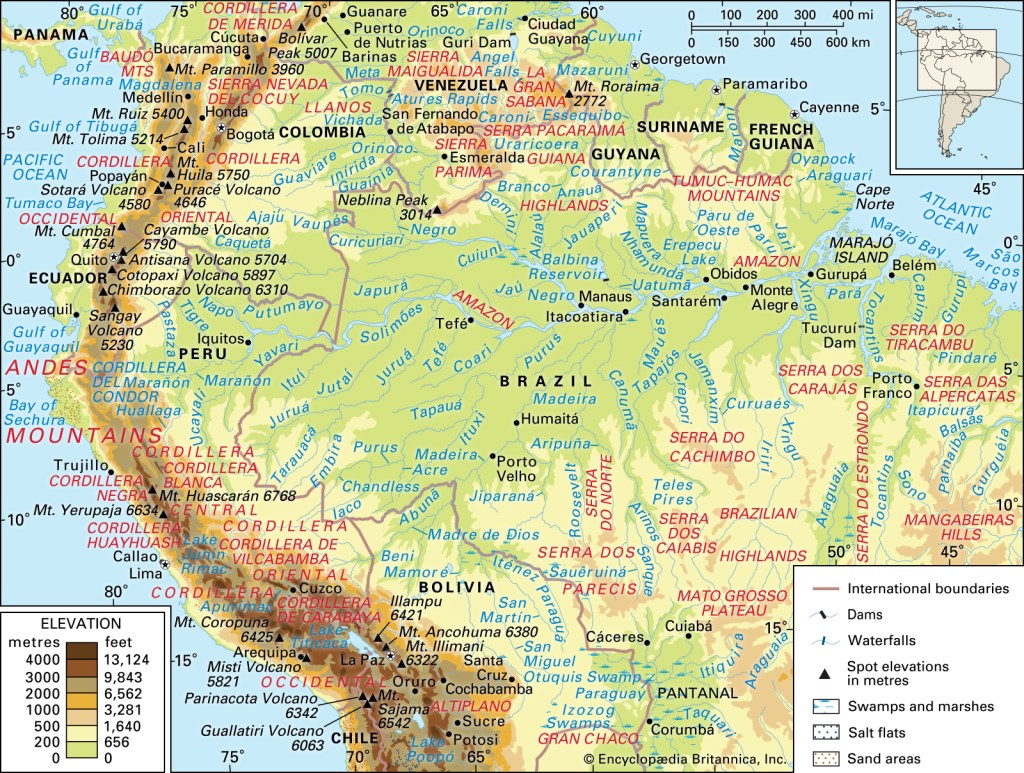
The Whole Trip Is in the Extreme Southwest of This Map
What interests me in this area are, in addition to the mountains and deserts, the cultures of the mountain peoples living in the area. Originally, I was very interested in the Inca, but then I realized that they were not as advanced as I had thought. One exception: Their stonework is amazing. Also, this is the area from which the Spanish conquistadores extracted most of their wealth, leaving behind some incredible churches full of gold, silver, and incredible paintings.
If it turns out I am too old for this trip, I will reluctantly skip Bolivia and continue to head southward in Chile until I reach Santiago.
Surprisingly, the most magical places I visited in Peru were not the world-famous Inca ruins at Machu Picchu or other places, but rather the Spanish churches and convents. After all, the Inca had no writing, so while their ruins showed an incredible knowledge of masonry that could withstand severe earthquakes, there was little that aroused my imagination.
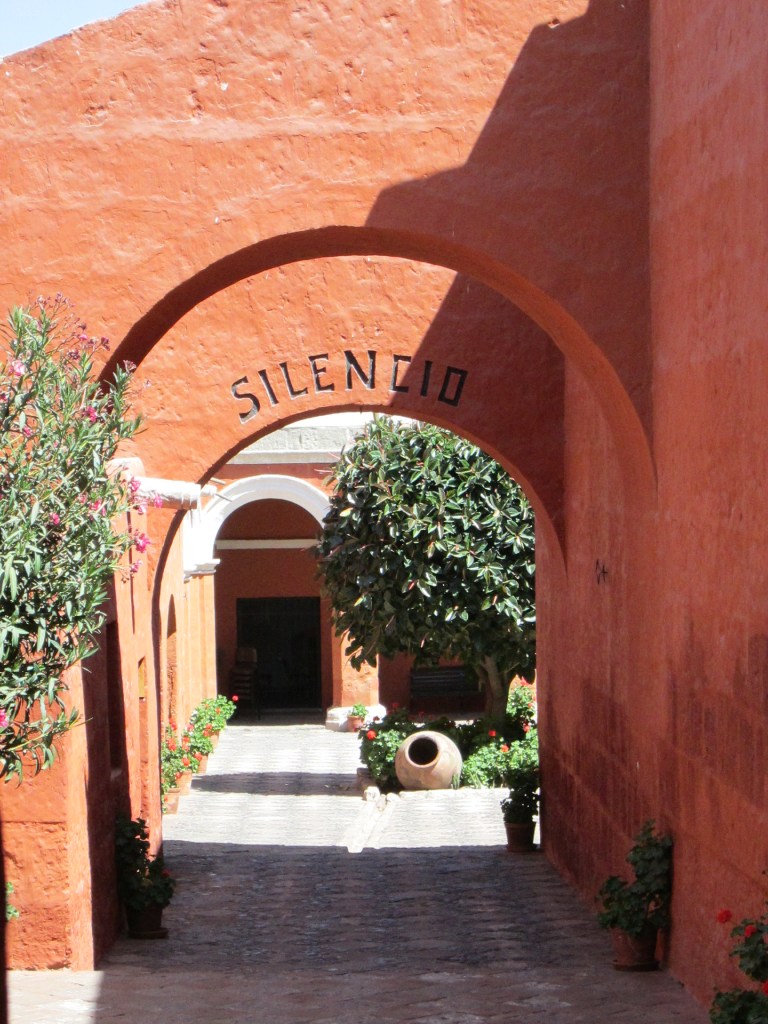
A place that did, however, was the giant convent of Santa Catalina in Arequipa. It occupied something like a whole square mile that was walled off from the city that surrounded it and had a warren of narrow pedestrian walkways.
It Was, After All, a Convent
I spent an entire day, from morning to late afternoon, wandering around the grounds of Santa Catalina, with its monastic cells, courtyards, kitchens, chapels, and even a strange room where the faces of nuns who had died were painted on canvases and displayed.
At Times, It Was Almost Like Modern Art
As Christianity begins its slow fade in the Western World, I begin to look upon religious monuments of the past as being every bit as interesting as that of ancient civilizations. In Peru, I loved visiting the old churches, convents, and museums of ecclesiastic art. I must have attended a dozen masses, just because they took place while I visited.
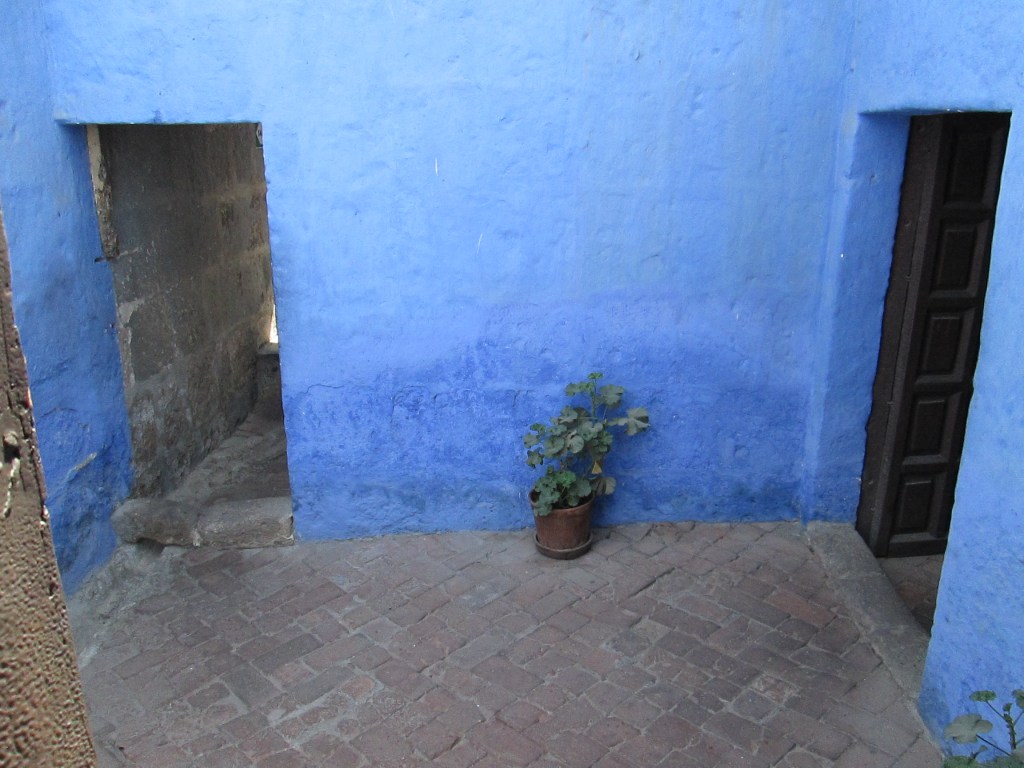
The Walls Were All Either Blue or Dark Orange
I took dozens of photos which I could have shown here, because Santa Catalina mesmerized me. If you should happen to go to Peru, you will probably wind up in Cusco and Machu Picchu, but for your health, it is better to go first to a place where you will not be so afflicted by the dread soroche (altitude sickness). Arequipa, at 7,660 feet (2,335 meters) is a good place to prepare yourself.
Nun’s Cell at Santa Catalina Convent in Arequipa, Peru
There is nothing I have ever seen quite like Santa Catalina Convent in Arequipa, Peru. It occupies virtually a square mile with numerous chapels, nuns’ cells, narrow winding streets. One could easily spend a whole day here, as I did. It reminds me of one of Wordsworth’s sonnets:
“Nuns Fret Not at Their Convent’s Narrow Room”
Nuns fret not at their convent’s narrow room;
And hermits are contented with their cells;
And students with their pensive citadels;
Maids at the wheel, the weaver at his loom,
Sit blithe and happy; bees that soar for bloom,
High as the Peak of Furness-fells,
Will murmur by the hour in foxglove bells;
In truth the prison, unto which we doom
Ourselves, no prison is; and hence for me,
In sundry moods, ’twas pastime to be bound
Within the sonnet’s scanty plot of ground;
Pleased if some Souls (for such there needs must be)
Who have felt the weight of too much liberty,
Should find brief solace there, as I have found.
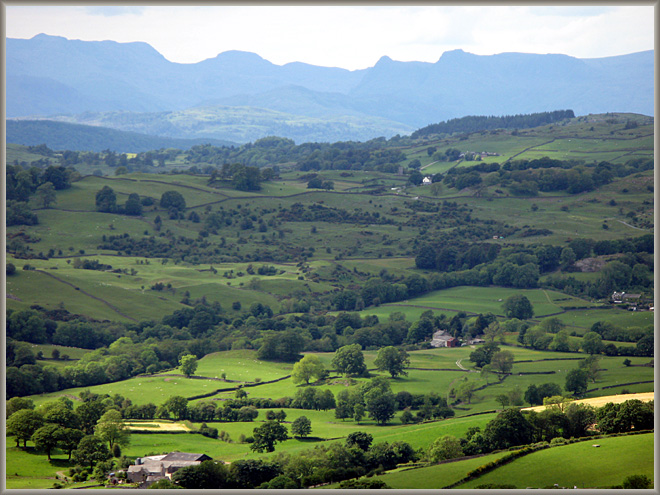
Furness Fells in Lancashire, England
I love what Wordsworth does here, comparing the sonnet’s “scanty plot of ground” with the constricted quarters of a nun, hermit, scholar, or weaver. If I remember, tomorrow I will show some pictures I took at Santa Catalina in Peru, a place that impressed me even more than Machu Picchu.
Basilica and Convent of Nuestra Señora de la Merced in Lima, Peru
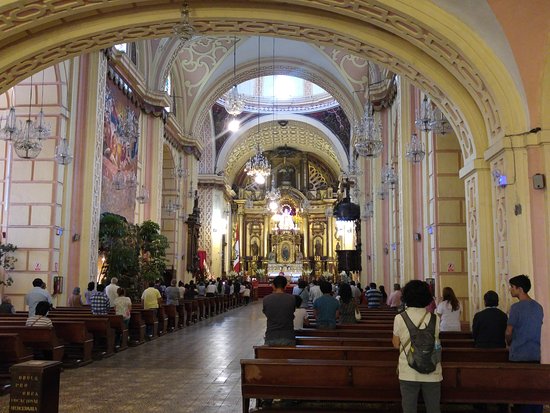
In the historic center of Lima, Peru, on the Jirón de la Union, sits one of the oldest churches in South America. When I visited Peru five years ago, I would have the taxi driver let me off at the south end of the Jirón so that I could pass by the elaborate Churrigueresque façade of La Merced and wander in. When I dropped in at these old churches I frequently found myself attending Holy Mass as I was gaping at the gorgeous decorations. I always stayed to the end, out of respect for the religious orders which built such splendid edifices to worship God.
I do believe that the Spanish kings only got a fraction of the gold that was mined in the New World, and that the lion’s share went to the Church and is visibly on display.
Interior of La Merced
As I have said on other occasions, I visited Peru because of the Incas, but what really caught my eye were the old Catholic churches, some dating back almost 500 years. La Merced was built around 1535 by the Mercedarians, short for the Royal, Celestial, and Military Order of Our Lady of Mercy and the Redemption of Captives. In fact, if I were to visit Peru again—as I hope to—I would skip Machu Picchu and spend more time viewing the Catholic churches and their related ecclesiastical art.
It was not until I visited Peru five years ago that I realized that the Inca were not the only game in town. In fact, I found the old Catholic churches with their ornate ornamentation was equally interesting. After all, the Inca had no written language and left no books until the Spanish taught them how to write. And yet the Catholic church in Peru was incredibly powerful. A visit to the great old churches of Lima led me to think that the Church in Peru was the recipient of as much gold and silver as the King of Spain.
In the south of Peru was San Luis Potosí, where there was an entire mountain of silver called to this day the Cerro Rico, the “Rich Hill.” The silver was sent to Lima, from where it was transshipped to Panama, where the conquistadores marched it across the isthmus to Colón, where it was loaded onto Spanish treasure ships and sent to Spain.
Altar at Lima’s Cathedral
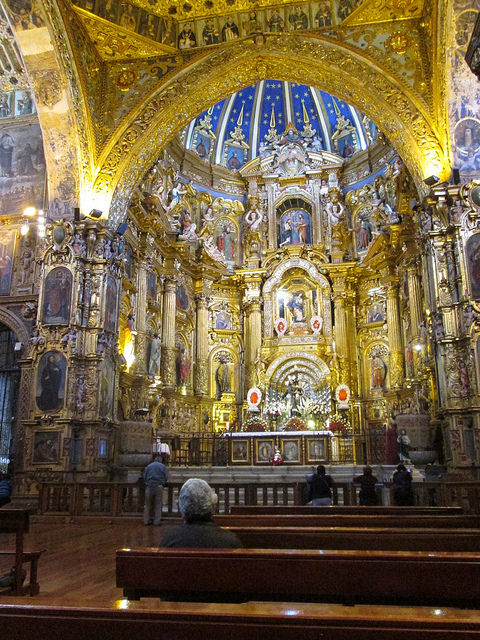
Of course, much of these Peruvian riches never made it to Spain, thanks to the ravages of pirates and storms at sea. Whatever was given to the church, however, went into the churches of Lima and the rest of the Hispano-America. I cannot count the number of times I would walk into a church and be struck by all the gold used in the altars and in gilding the statues and frames of the paintings on display. Look, for instance, at the picture below of the Company of Jesus Church in Quito, Ecuador:
The Main Altar of the Company of Jesus (Jesuit) Church in Quito, Ecuador
It was nice to see the Inca ruins, but the remnants of a once-triumphal Catholicism were far more impressive. Granted that the Inca were perhaps the world’s greatest stonemasons, but the Spanish civilization is far richer.













 Tarnmoor
You must be logged in to post a comment.