Archangels of the Andes

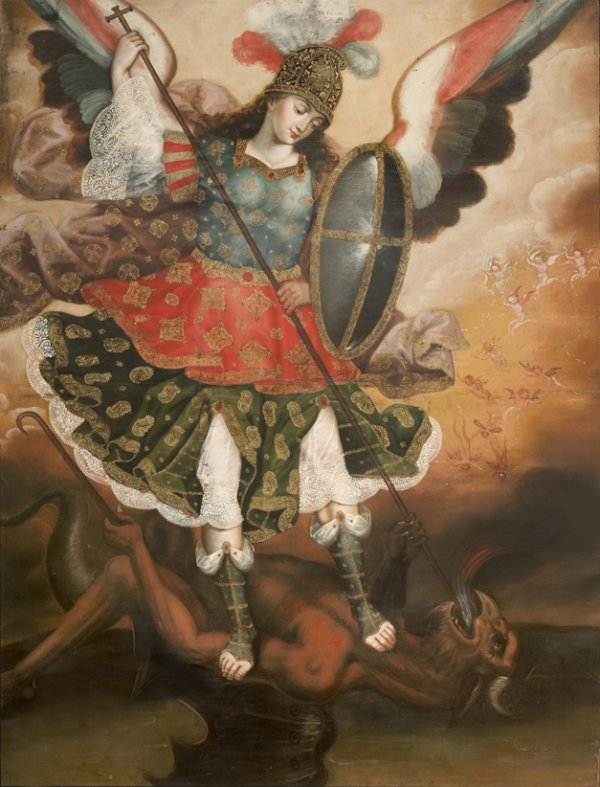
The Archangel Michael Vanquishing Satan

The Archangel Michael Vanquishing Satan

They are young, elegant, and handsome. Their wings are bi-colored, like the wings of mature condors. Yet they are all powerful and conquer their enemies with surpassing ease. They are the archangels depicted in paintings of the Cusco School of Art.

One has to imagine what it was like to be an Inca facing a compact phalanx of Spanish conquistadores mounted on horseback. At Cajamarca, many thousands were slaughtered by Pizarro and his hundred or so men. They barely even used their muskets, which were pretty useless in hand-to-hand combat in any case. No, it was Spanish steel and the strangeness of seeing warriors on horseback. Were they a single creature, man and horse? The Incas tried to kill the horses and display their corpses, thinking that now they would win with ease.

It was not to be so. The Incas were ultimately conquered, even though it took the better part of a century to complete the conquest. To the defeated, it didn’t look as if their gods were of much help to them. There must be something to this Christianity!

You can see it in the native painters’ depiction of angels, such as the one above. Michael defeats the demon without breaking a sweat or staining his doublet. He might just as easily be crocheting a doily or cleaning his nails. All throughout Peru, I saw hundreds of these archangels in the churches and archiepiscopal palaces, all with the same characteristics. The artists are usually indigenous Quechuans who painted multiple images of the same religious figures for distribution to churches all around the country.

When the Incans saw these angels, did they think of how easily they themselves were bested by the Spanish?


Ollantay

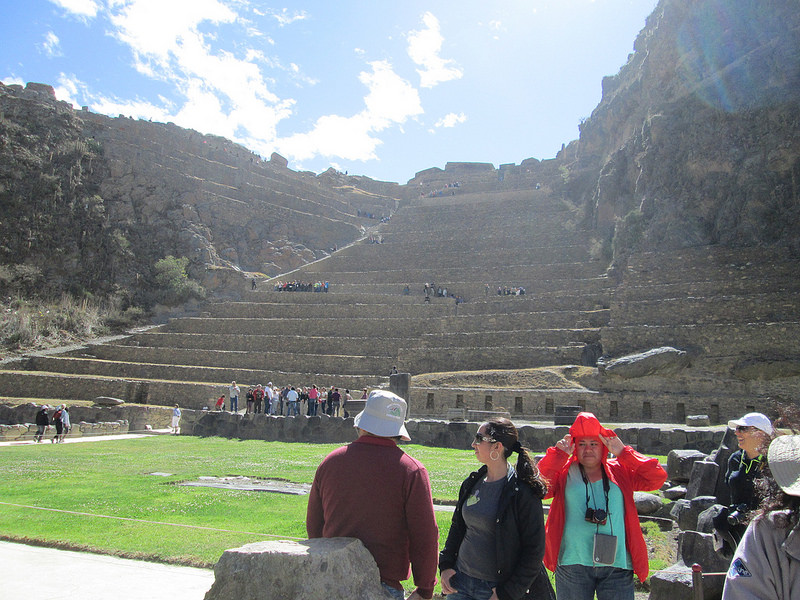
Inca Ruins at Ollantaytambo

Inca Ruins at Ollantaytambo

Built into a hillside, the ruins at Ollantaytambo was the site of the last Inca victory over the Spanish. Manco Inca defeated a force captained by Hernando (brother of Francisco) Pizarro by diverting the Urubamba River and flooding the battlefield. The thrill of victory didn’t last long, because Manco Inca withdrew his forces to Vilcabamba in the jungle of Espiritu Pampa, where it was lost until rediscovered in the 20th Century.

Most tourists don’t spend much time visiting the Incan sites in the Sacred Valley, preferring instead to either take the train to Machu Picchu or hike the 35 km of the Inca Trail without further delay. (When people asked if I was taking the Inca Trail, I always answered by saying that I was taking the Inca Train.)

Other than Machu Picchu and the sites immediately around Cusco, the main tourist destinations in the valley are Pisac and Ollantaytambo. Pisac is known for its Sunday crafts market and “Ollantay,” as the starting point for most of the trains to Machu Picchu. The ruins at Ollantay are extensive, including temples, terraces for farming, and granaries several hundred feet up in the Andes.

At the ruins, I hired a guide named William who did a good job of explaining, albeit in broken English, the features of the site. In fact, I liked him so much, I hired him for an all-day tour of Moray, Maras, the Salineras, and Chinchero the next day. That trip (about which more later) proved to be one of the highlights of my trip to Peru.

Who Was More Civilized?

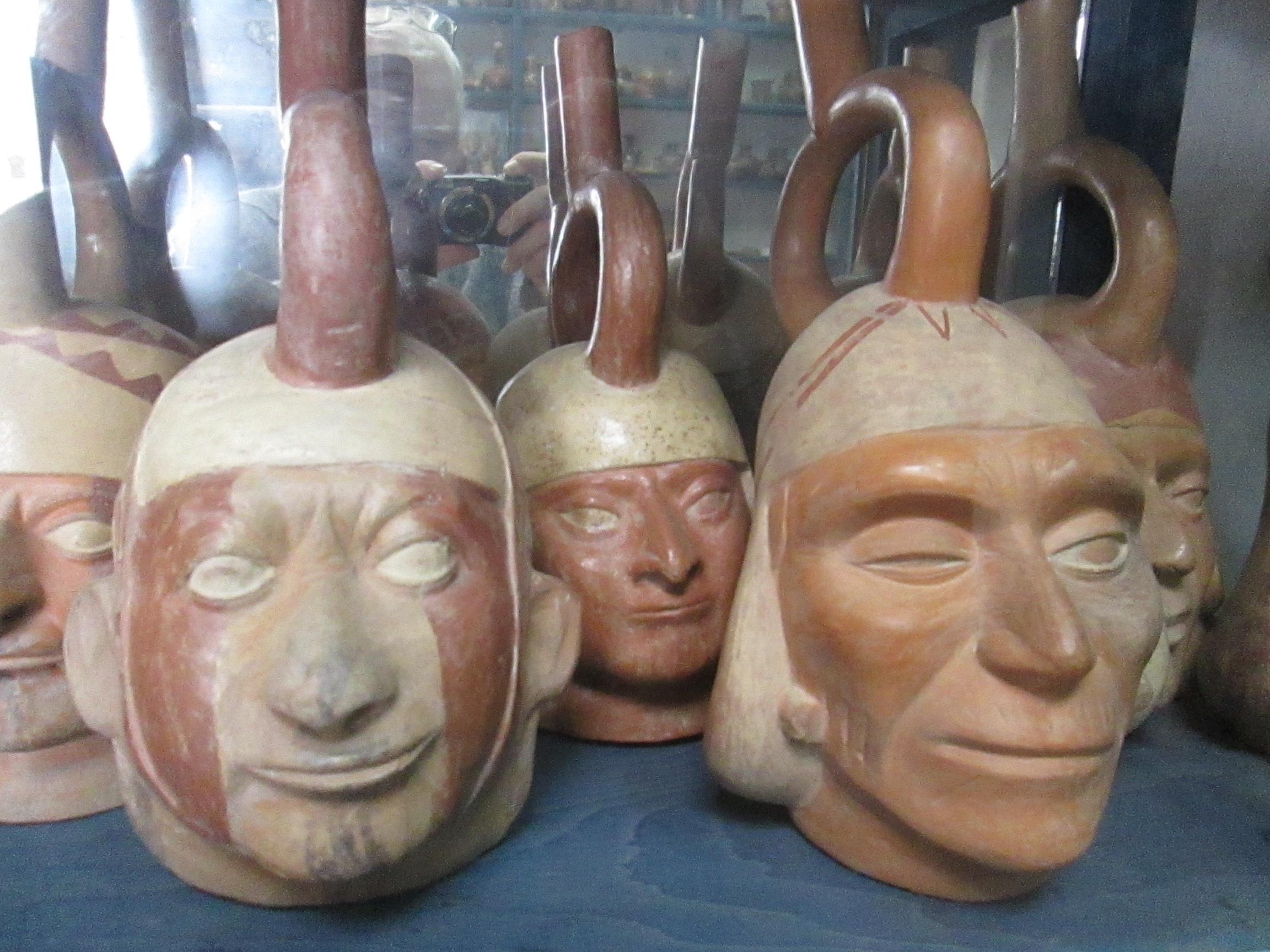
Moche Ceramics at Lima’s Museo Larco

Moche Ceramics at Lima’s Museo Larco

Who really was more highly civilized—the Incas or some of the peoples who preceded them? While it is unquestionable that the Incas were the greatest stonemasons and road builders, they could not hold a candle to the Moche in their artwork. Look at the faces above: They are remarkably individualized, especially the one to the right.

If you should find yourself in Lima, I would highly recommend a visit to the Museo Larco in Pueblo Libre. Dedicated primarily to Moche ceramics and metal-working, it is a phenomenal collection, originally put together by Rafael Larco Hoyle in Northern Peru. It is a delightful place to spend several hours, especially if one eats at the museum’s excellent restaurant. (Try the tiraditos.) After visiting the Museo Larco, you could follow the painted blue line on the sidewalk for some twenty minutes or so and end up at the Museo Nacional de Arqueología Antropología e Historia del Perú, with its excellent exhibition on the Paracas Culture.

The Incas were, in their time, an up-and-coming military power that conquered most of Peru, Bolivia, Ecuador, and parts of Chile. In the process they supplanted many talented peoples who were set to working raising crops and building roads and structures. Gone forever were the brilliant ceramics. Fortunately, enough was left to leave a brilliant picture of a culture that flourished from 100 to 800 AD, centuries before the Inca rose to power.


Volcano Land

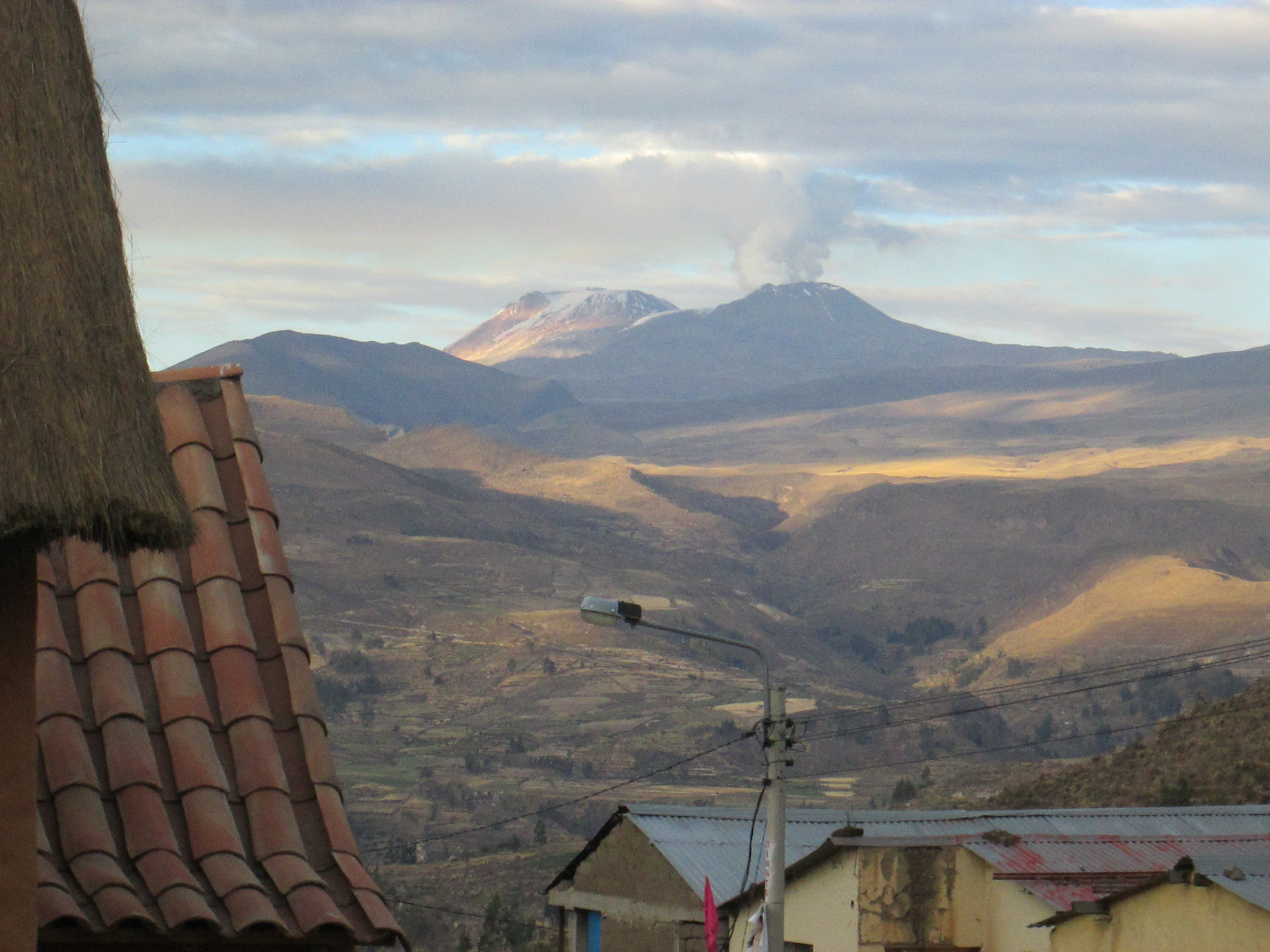
Mount Sabancaya Erupting

Mount Sabancaya Erupting—Seen from Coporaque

The State of Arequipa is full of active volcanoes. Two of them in particular—Sabancaya and Ubinas—have been in eruption for weeks, if not months.

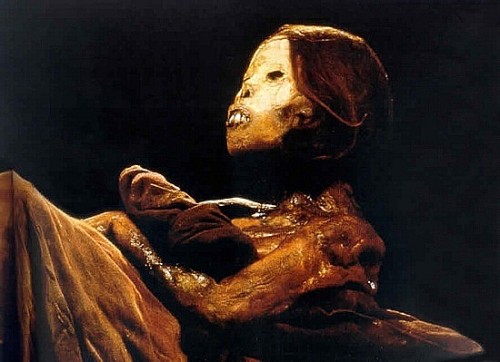
In fact, before the Spanish ever made it to Peru, an eruption of Sabancaya triggered the sacrifice of an Inca maiden (named by archaeologists as Juanita) on neighboring Nevada Ampato to satisfy the angry earth gods. A 12-year-old girl of good family, “Juanita” was marched up Ampato with an escort of priests, given some chicha to drink to calm her nerves, and clubbed to death. It was only in 1995 that Johan Reinhard discovered her remains and brought her body down to Arequipa, where it is on display in the city’s Museo Santuarios Andinos, where I saw it.

The Remains of the Inca Maiden Called “Juanita”

The Remains of the Inca Maiden Called “Juanita”

When I stayed in Arequipa, I awoke every morning to see the city ringed by the volcanoes Chachani, El Misti, and Pikchu-Pikchu. Going north to Colca Canyon, I saw perhaps a score of other volcanic peaks. This is a volatile section of the Pacific Ring of Fire, where the Nazca Plate is slipping under the South American Plate and making the Andes rise and providing pathways for the fires under the earth to rise to the top on occasion.


Don’t Let Machu Beat You!

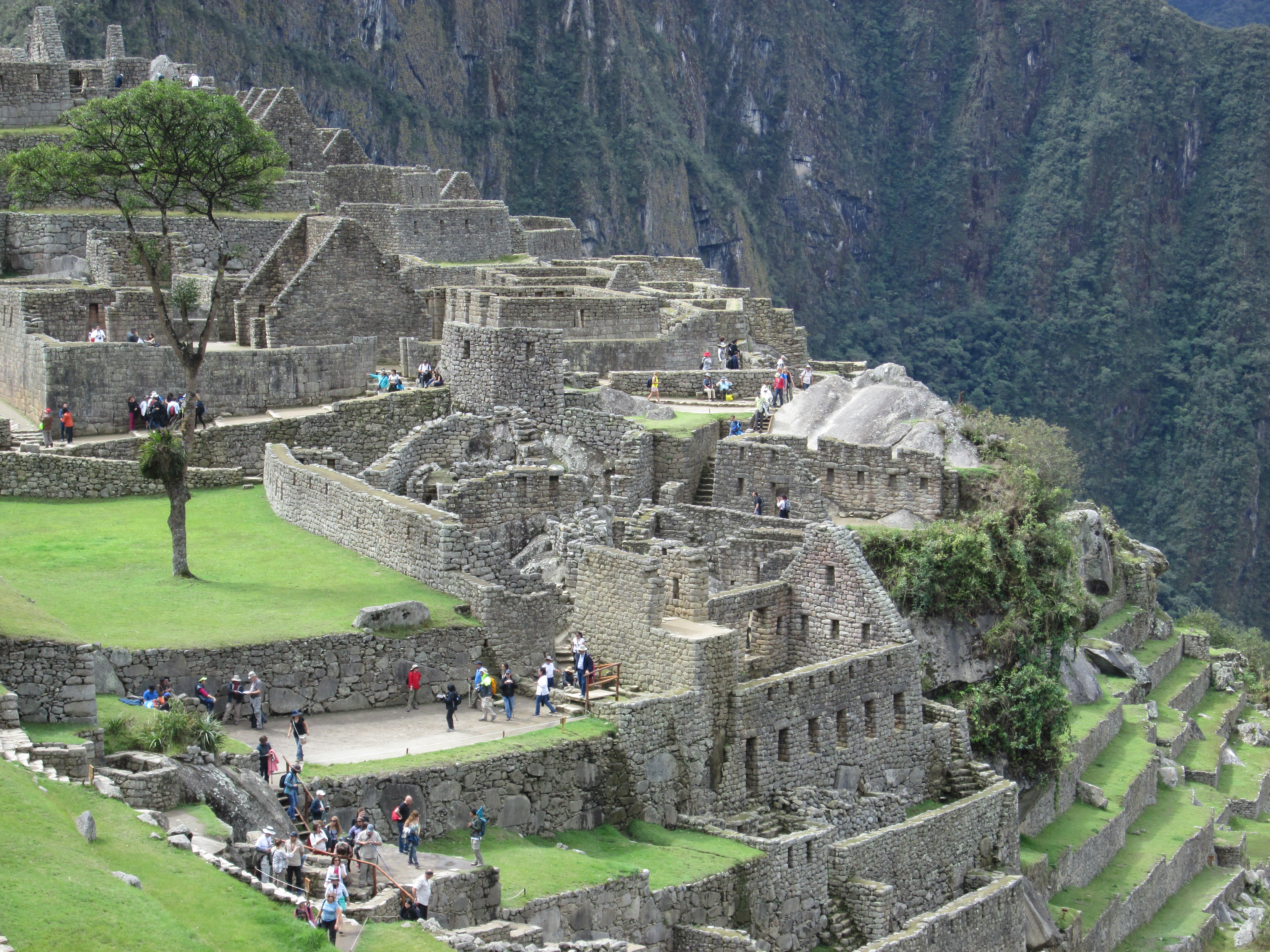
At the Ruins of Machu Picchu

At the Ruins of Machu Picchu

Yes, the ruins at Machu Picchu are probably the premier tourist attraction in all of South America, followed by Iguazu Falls between Argentina and Brazil.

There were only two problems with my visit there on September 25:

  1. It was raining
  2. I could only see apart of the ruins because I was terrible of the irregular stone steps (without guard rails) that connected the different levels, of which there were many. Also, because of the rain, they were slippery.

See the picture below for a view of some of the steps.

Irregular Stone Steps at Machu Picchu

Irregular Stone Steps at Machu Picchu

I could see myself taking a step the wrong way and tumbling down a couple thousand feet into the Valley of the Urubamba. So excuse me if I was petrified for much of the three hours I spent at the ruins.

In a way, I anticipated the possibility that Machu Picchu was not going to be the be-all and end-all of my trip: There was so much else going on, not only with regard to the ancient Incas, but to the numerous indigenous cultures (Quechua, Aymara, and Collagua, among others) and the spectacular churches—about which more anon. I made the reservation for the ruins in June, not knowing what the weather would be like.

Did I like Machu Picchu? For sure! It was in a phenomenal setting, with spectacular views along two ranges of the Andes. Was it the highlight of my vacation? By no means. In the weeks to come, you will understand why.


Support Your Local Chifa

My Local Chinese Restaurant in Miraflores

My Local Chinese Restaurant, the Chifa Jin in Miraflores

I got back from Peru on Tuesday night—as usual in the middle of a blistering heat wave. Finally, I have enough energy to take up with my blog again, even though it’s hot enough to melt prestressed concrete outside.

Although Peruvian food is, by and large, excellent, I was surprised to see so many Chinese restaurants all over the country. In Peru, they are called chifas. Why are there so many of them? As I wrote in my blog entitled The Guano Economy, many Chinese are descended from the coolies brought over from mainland China in the 1800s to mine bird droppings from the islands off the coast of Peru.

It’s a far cry from guano to won ton soup and fried rice (called chaufa in Peru), and there are interesting differences for what passes for Chinese fare in the United States, but the quality runs from the acceptable to the delicious. The best I had was my fun with pork at the Wa Lok restaurant in Miraflores on Angamos Oeste. I liked Peruvian won ton soup better than American, because although the won tons are not wrapped around any meat, there are usually big pieces of pork and chicken along with the lasagna-like noodles.

I ate Chinese in Lima, Puno, and Machu Picchu Pueblo. In every case, the food was inexpensive and well prepared. It was nice to have a familiar backup to the usually omnipresent Peruvian cuisine.


Beating Soroche

I made it to Puno several days ago for what was to be the high point of my trip. Of course, I am referring to the altitude of 12,500 feet. Tomorrow I venture out on Lake Titicaca to see the Uros Islands (floating agglomerations of reeds anchored to the lake on which people live) and Isla Taquile. Since today was rainy, I expect the water to be rough, so I purchased some dramamine at the local InkaPharma just to be on the safe side.

If you have been following my posts about Peru, you know that I was fearing the ill effects of soroche, acute mountain sickness. Although I am still occasionally short of breath and have to wake up two or three times during the night, these are considered normal reactions. I took a two-pronged approach:

  1. I had my doctor prescribe Diamox (generic: acetazolamide). I take one tablet a day, and that does tend to account for several of my night trips to the bathroom.
  2. I take coca leaves in two forms, both of tea and, when the symptons worsen, I chew the leves directly. It helps to have a high carb diet to go with this.

It’s nice to be able to plan for this sort of thing. In the lobby of Puno’s Casa Andina Classico Tikinari Hotel, I get a big kick out of the whey-faced travelers staggering in with their giant rolling suitcases only to hear they will be picked up at 7 am tomorrow for several tours for which they are totally unprepared and likely to beg off from because their head aches, they are dizzy and nauseous, and in general remorseful for ever having signed up for their trip.

On Saturday, I board the Andean Explorer, a famous train that crosses the altiplano from Puno to Cuzco. That’s where you’ll hear from me next.

Under Three Volcanoes

I have made it to Arequipa, which is surrounded by three volcanoes, El Misti, Chachani, and Pichu Pichu. We are at approximately six or seven thousand feet. During the days, the weather is sunny and warm with cool evenings.

Yesterday I visited one of the greatest tourist sites I can remember: the gigantic Convento de Santa Catalina. It is so large as to be almost a city within itself. Here several hundred Dominican nuns lived and died, never leaving the convent grounds. A locuturio was provided to communicate with members of their families, consisting of a series of benches in front of grills. For most of the nuns, they had to have a chaperon to make sure that nothing inappropriate was being communicated (this did not, however, apply to senior nuns).

The grounds had several cloisters and “apartments” for the nuns and their servants, consisting of a spartan bedroom with pryer alcove, servant’s quarters, and a kitchen.

In Arequipa, it was expected that the eldest daughter would marry, and that the second (and subsequent?) daughters become nuns. Consequently, many of the nuns were from good families. Indigent nuns, of which there were several, themselves became servants to other nuns.

Tomorrow I hit high altitude for the first time. I will cross the Pass at Patapampa (15,000 feet) and sleep in Coporaque by Cañon de Colca (10,000 feet). The day after, I travel by bus to Puno (12,500 feet). I have already begin taking Diamox—and I have been mainlining mate de coca to allow my system to tolerate the onset of soroche.

On Foot in Lima

I finally made it to Lima, where I am staying at the Antigua Miraflores Hotel. Because no one sleeps well on a long flight—regardless of what they may claim—I am a bit groggy. All the more so as I have just made the acquaintance of the Peruvian national drink, the Pisco Sour, a brandy and egg white cocktail that is as smooth as a baby’s bum.

Today was dedicated to cleaning up loose ends. I got lost several times, and I covered approximately ten miles on foot, but I did manage to

  • Locate the South American Explorers, which had moved a mile from its old 135 Piura adress.
  • Obtain my train ticket for the Andean Explorer route between Puno and Cusco
  • Buy some prescription meds over the counter that my pharmacy muffed back in Los Angeles

Tomorrow, I visit the Museo Larco and the National Museum of Anthropology, which should pretty much take up the whole day.


On to Peru

I’m Flying to Lima Tonight

I’m Flying to Lima Tonight

The time has finally come: Tonight I board a LAN Chile jetliner to fly me nonstop to Lima. I should be at Jorge Chavez International Airport at 10:55 tomorrow morning Peru time, which is the same as U.S. Central time. (Countries so near to the equator don’t need to have Daylight Savings Time, as the times for sunrise and sunset do not change as much as they do in the temperate and polar zones.)

L.A. is doing its best to push me out of town. We have more Mexican monsoon weather with high temperatures and high humidity. Curiously, although I will be only a few degrees south of the Equator, the icy Humboldt Current keeps coastal Peru cool and cloudy for eight months of the year, from March through November. I can’t wait to see what type of tropical hell I will be returning to in L.A. on September 30. Once a couple years ago, Martine and I landed from a Canadian vacation to a temperature of 113 degrees Fahrenheit (45 degrees Celsius).

Chances are I will be posting little or nothing over the next three weeks, or if I do, there won’t be accompanying photos until October.

To keep in touch with Martine, I have a fully charged Mobal international cellphone that will charge me $1.95/minute for calls to the U.S. I could get cheaper rates by other means, but I don’t want to be buying cellphones and special memory cards in a country where I do not speak the lingo well enough to be make good decisions. Mobal picks the local telephone company for me—the one with the most bars in the city I’m in—probably Movistar [sic] or Clarin in Peru.

Have a good September!