Red Hat

Entrance to Louisiana’s State Penitentiary at Angola

Located in West Feliciana Parish is Louisiana’s fearful Angola State Penitentiary. And within that penitentiary, by far the worst place to be incarcerated was the Red Hat Cell Block, which also contained the state’s electric chair, known as “Gruesome Gertie,” which was used for 87 executions between 1956 and 1991.

The Red Hat Cell Block was named after the red painted straw hats the inmates wore when working on the prison farm. It contained thirty cells that were 3 × 6 feet (0.91 meters × 1.8 meters), with a single window near the ceiling that was 1 foot square (0.3 meters square). Inmates slept on an iron bunk without any mattress. Temperatures frequently soared to slow oven levels; and the cells were infested with rats and other vermin. There was no toilet: prisoners had to eliminate in a bucket that was emptied each morning.

Naturally, most of the inmates of the cell block were non-whites. And, needless to say, even prisoners on death row in Angola had it better.

Entrance to the Red Hat Cell Block

Why am I describing such a terrible place? It is because I am becoming increasingly of the role that racism has played in the history of our country—a history which many Americans are trying to whitewash.

It goes all the way back to the Constitution of the United States. In an article by Steven Mintz entitled “Historical Context: The Constitution and Slavery,” it states:

The word “slave” does not appear in the Constitution. The framers consciously avoided the word, recognizing that it would sully the document. Nevertheless, slavery received important protections in the Constitution. The notorious three-fifths clause—which counted three-fifths of a state’s slave population in apportioning representation—gave the South extra representation in the House of Representatives and extra votes in the Electoral College. Thomas Jefferson would have lost the election of 1800 if not for the Three-fifths Compromise. The Constitution also prohibited Congress from outlawing the Atlantic slave trade for twenty years. A fugitive slave clause required the return of runaway slaves to their owners. The Constitution gave the federal government the power to put down domestic rebellions, including slave insurrections.

Lest we pat ourselves on the back for not being Southerners, I have seen enough in Cleveland and Los Angeles in my time to feel a deep sense of shame. How many decades, how many centuries must pass before the blot of slavery and racism are wiped out?

“Accidental to the Truth”

The Flag of Venezuela

I have just finished reading V. S. Naipaul’s A Way in the World. No one can describe the sometimes barely visible gradations that make up racism and colonialism. At one point, his character Francisco Miranda—a fictional precursor to Simón Bolívar, José de San Martín, and the other liberators of South America from Spanish rule—discusses the difficulties inherent in unifying the newly freed peoples of Venezuela:

“In all your years of writing about Venezuela and South America, you simplified it, General. You talked about Incas and white people. You talked about people worthy of Plato’s republic. You always left out two of the colours. You left out the black and you left out the mulatto. Was that because you were far away?”

“No. I did it because it was easier for me intellectually. Most of my ideas about liberty came to me from conversation and reading when I was abroad. So the country I created in my mind became more and more like the countries I read about. There were no Negroes in Tom Paine or Rousseau. And when I tried to be like them I found it hard to fit in the Negroes. Of course, I knew they existed. But I thought of the m as accidental to the truth I was getting at. I felt when I came to write that I had to leave them out. Because of the way I have lived, always in other people’s countries, I have always been able to hold two or more different ideas in my head about the same thing. Two ideas about my country, two or three or four ideas about myself. I have paid a heavy price for this.”

As I read these lines, I suddenly thought about why Spain lost South America. The Spanish monarchy sent out mostly men, accompanied by very few Spanish women. Many of these men married native women, or black women, or mulattoes. Consequently, the thought arouse back on the Iberian peninsula that these Spaniards who “went native” probably did not have the best interests of the Spanish monarchy at heart. Consequently, they were almost never promoted to positions of authority. The rebels who defeated the Spanish armies were mostly these men, referred to as Creoles, who were not quite Spanish.

Waiting for the Bus at Bundy & Exposition

When I go downtown to the Central Library, I travel by bus and train to avoid paying the usual exorbitant parking rates (upwards of $30 in some places). This afternoon, when I got off the train to transfer to the Santa Monica #14 bus, I ran into a hard-core racist. It was ugly and disgusting.

He was sitting on the bus bench next to mine talking to himself. He obviously hated Asians, so he was enumerating the many things about Asians that teed him off. When three cute Mexican high school girls walked by talking in Spanish, he switched topics and complained that they were speaking Spanish in his United States.

This character was probably in his late twenties, with a skateboard and a cart full of clothing and other miscellaneous items. He didn’t appear to be homeless: He was relatively well dressed, and he boarded the #16 bus headed to Brentwood, which is a high rent district to the north.

At one point, he looked to me for confirmation of his racist patter. He received the shock of his life when the old white man at his right answered him in Hungarian, inviting him in the Magyar language to be sodomized by a horse. His response? “Another effing furriner!”

Twelve Silents

Scene from Josef Von Sternberg’s The Salvation Hunters

As promised, here are an even dozen great American silent films. Left out are the great comedians—Chaplin, Keaton, and Lloyd—mostly because people are pretty familiar with them. Below are films that are mostly dramatic, including one drama that Chaplin directed, but did not star in. The films are arranged by year of release:

  • D. W. Griffith’s Broken Blossoms (1919), probably my favorite among his films
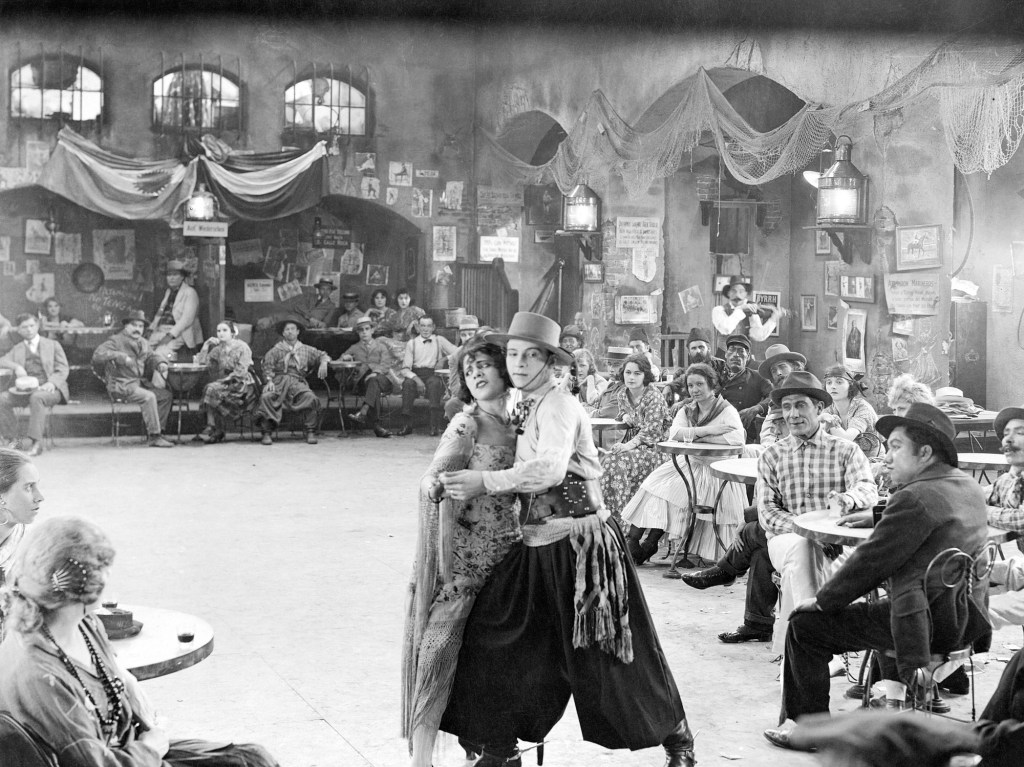
  • Rex Ingram’s The Four Horsemen of the Apocalypse (1921), starring Rudolph Valentino
  • Maurice Tourneur’s Lorna Doone (1922), a real diamond in the rough
  • Charlie Chaplin’s A Woman of Paris (1923), his tribute to the lovely Edna Purviance
  • Victor Sjöström’s He Who Gets Slapped (1924), starring Lon Chaney Senior, based on a Leonid Andreyev play
  • Josef Von Sternberg’s The Salvation Hunters (1925), the director’s first American film
  • Ernst Lubitsch’s Lady Windermere’s Fan (1925), based on the Oscar Wilde play
  • Raoul Walsh’s What Price Glory? (1926), with profanity for proficient lip-readers
  • F. W. Murnau’s Sunrise (1927), a real masterpiece
  • Paul Leni’s The Man Who Laughs (1928), based on a Victor Hugo novel
  • Victor Sjöström’s The Wind (1928), with Lillian Gish going mad on the prairies of 19th century America
  • Erich Von Stroheim’s Queen Kelly (1928), produced by Joseph P. Kennedy and starring Gloria Swanson

Rudolph Valentino Dancing the Tango in Four Horsemen of the Apocalypse

I think it is worth the effort to see these films if you’re interested in silent films of the period. If you’re not, they very well might make you interested.

NOTE: The 1920s were pretty racist, so I would advise you to remember that our great-grandparents did not hold the same political views that we do.

America First?

Dragging Our Flag Down Into the Mire

Sometimes, I think the United States was destroyed by our victory in the Second World War. It seemed that we found ourselves alone at the top of the heap even as we were surrounded by countries in ruins. That’s when the hubris set in. We were free to make mistakes, lots of mistakes, while trumpeting our prowess.

In an article for The New York Review of Books for November 19, 2020, Pankaj Mishra wrote:

In Radical Hope: Ethics in the Face of Cultural Devastation (2006), Jonathan Lear writes of the intellectual trauma of the Crow Indians. Forced to move in the mid-nineteenth century from a nomadic to a settled existence, they catastrophically lost not only their immemorial world but also “the conceptual resources” to understand their past and present. The problem for a Crow Indian, Lear writes, wasn’t just that “my way of life has come to an end.” It was that “I no longer have the concepts with which to understand myself or the world…. I have no idea what is going on.”

It is no exaggeration to say that many in the Anglo-American intelligentsia today resemble the Crow Indians, after being successively blindsided by far-right insurgencies, an uncontainable pandemic, and political revolts by disenfranchised minorities. For nearly three decades after the the end of the cold war, mainstream politicians, journalists, and business people in Britain and the US repeatedly broadcast their conviction that the world was being knit together peaceably by their guidelines for capitalism, democracy, and technology. The United States itself appeared to have entered, with Barack Obama’s election, a “post-racial age,” and Americans seemed set, as President Obama wrote in Wired a month for Donald Trump’s election, to “race for new frontiers” and ”inspire the world.”

Well, that didn’t happen. We had Trump for four years, and suddenly it appeared that we were headed for the dissolution of everything we held dear, while dumbasses from Red States crawled out of their caves and began to shake the foundations of our democracy.

It’s not over yet by a long shot. The one sentence I remember from my high school civics textbook is, “Eternal vigilance is the price of liberty.” So we had best wake up.

Rewriting History

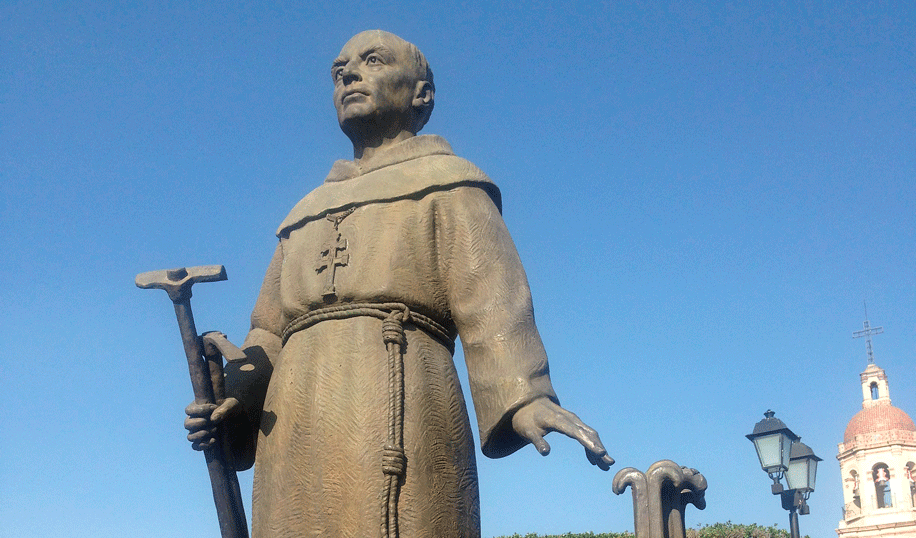
Still Standing Statue of Saint Junipero Serra

I have written before about attempts by mostly leftist protestors to rewrite history by attacking monuments commemorating Confederate generals, Christopher Columbus, and now Father Junipero Serra, recently declared a saint by Pope Francis. I get very uncomfortable by anyone attempting to mess with the past. People believed and behaved differently in the past, and, yes, they were frequently racist. In fact, before a certain point in the Twentieth Century, everyone was a racist. That included my Mother and Father, whose memory I revere.

The current attempts to punish past racists remind me of a scene from Luis Buñuel’s film The Milky Way (La Voie Lactée), my favorite among his films. In one scene, the religious pilgrims view the exhumation of the body of an archbishop who, because it was discovered he had been a heretic, is to have his body burned. I sincerely doubt that the heretical bishop was discommoded in any way by the firing of his remains; and I doubt that the religious zealots viewing the exhumation and fire received any benefit therefrom. I feel the same way about the renaming of Fort Bragg, the pulling down of statues of Robert E. Lee and Junipero Serra.

Over the years, Martine and I have visited several of the California missions founded by Father Serra. We found them to be places of peace. We know for a fact that many of these missions included barracks for Spanish troops. If there were any depredations against native aborigines, they were conducted by soldiers and not Franciscan priests and monks. Were any of these Franciscans racists? Of course, they were Spanish—and that racism was endemic during that historical era.

Father Junipero Serra, Recently Sainted

Perhaps we should burn all our history books, after first admitting that all previous generations were tainted. Instead of rewriting history, perhaps we should burn all the books and create a mythical Edenic portrait of people who lived in the past and condoned slavery while admitting that all men were created equal. Maybe we should burn the people who who are toppling the statues. It makes me disgusted that I have liberal leanings!


The Last Refuge of the Scoundrel

American Flag Pin

Thanks to the current occupant of the White House, I am feeling less patriotic than ever. I have come to associate the ubiquitous flag pins that Republican politicians wear with the excesses of the Trump administration. As Dr. Samuel Johnson noted, “Patriotism is the last refuge of the scoundrel.” I don’t believe that for members of the older generation who have fought for our country, but for younger people, especially politicians, who use it to identify themselves as racists, white nationalists, saboteurs, and looters—in a word, Republicans. It is a symbol the course of being degraded beyond all recognition.

I am feeling out of touch with American voters. Can I trust them to actually love their country and send the Trump administration down to ignominious defeat? Not entirely, especially in certain parts of the country where politics is a form of resentment and regional hatred, especially against voters who live in large cities. It is the politics of Hooterville versus the politics of New York and California. (Though even New York and California have isolated pockets of atavistic tendencies.)

It has gotten to the point that I feel alienated from American politics, both Republicans and Democrats. (I now vote No Party Preference.) I don’t even classify myself as being Caucasian any more. As a Hungarian-American, I am Finno-Ugric, or “Other Race.” (Most of my rage is directed at White voters.)

I hope that this is only a phase I am going through until the politics of the United States returns to normal—that is, if it ever does.

Of Ideological Purity

Nuclear Power Plant Cooling Tower

One of the reasons the Democrats have such a hard time winning the hearts and minds of voters for the presidency is that they hamstring themselves with an insistence on ideological purity—even where it doesn’t matter. Take the issue of nuclear power, for instance. We know from Three Mile Island, Chernobyl, and Fukushima that nuclear power can be deadly. So instead of improving the safety of nuclear power, many U.S. politicians have decided that all nuclear power is potentially deadly.

In a rush to legitimize the LGBTQRSTUV &c &c population, we have created a minefield on the subject of gender identity. And even more, with the #MeToo movement, while attempting to eliminate sexual harassment from the social sphere and workplace, we have created another minefield—one that has ensnared such relative innocents as Joe Biden and Al Franken.

To What Extent Is This Serious Sexual Harassment?

Granted that Biden’s and Franken’s touchie-feelie incidents are in poor taste, to what extent have they they done anything more than remind us that sometimes people can behave inappropriately while not at the same time criminally. Do such acts merit political banishment for all time?

Now we are finding that—if ever one went around in blackface for any reason and irrespective of time period—they are racist. Again, I just think such persons were being merely inappropriate.

Consider that our current president is one of the most inappropriate human beings on the planet. And he has gleefully admitted to behaving boorishly on issues relating to sex, race, religion, and just about any other issue about which people are insensitive. So why are Democrats doing Trump’s work for him, by banishing politicians for venial sins while the major malefactor laughs up his sleeve?


Real Genius

Hank Williams (1923-1953)

Where is the real artistic genius of America to be found? Sad to say, it’s not literature. It’s not painting or sculpture. Near as I can say, what the United States will be most remembered for is music—not only jazz, blues, soul, bluegrass, rockabilly, zydeco, gospel, country & western, but much of rock & roll as well. Names like Elvis Presley, Hank Williams, Miles Davis, Muddy Waters, John Coltrane, and a host of others will answer the question: What has America produced that will stand the test of time?

As a self-proclaimed intellectual, I am aware that such a title cuts no mustard in the U S of A. Far from it. It’s almost a term of opprobrium.

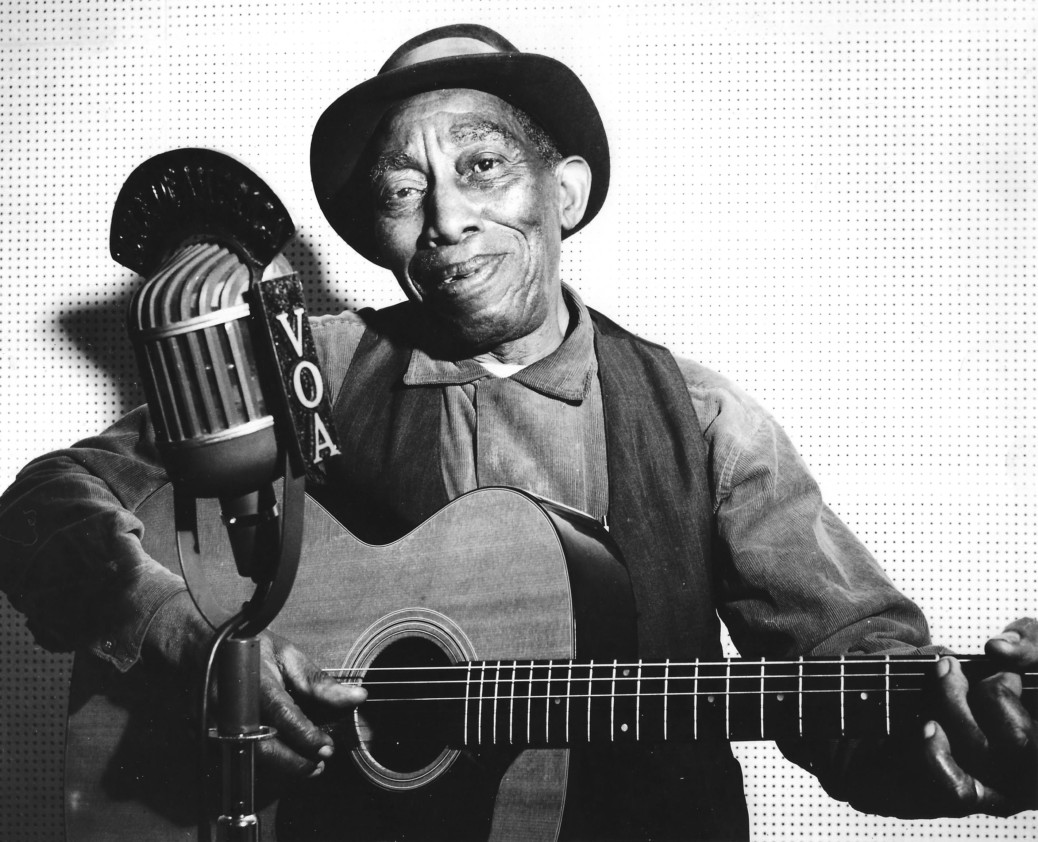
Mississippi John Hurt (1892-1966)—A Favorite of Mine

Curiously, in such a racist country as ours, it’s the only place that comfortably cuts through the racial divide.Black artists copied from the whites, though not nearly as much as white artists copied from African-Americans.

Of course, there is no Nobel Prize for music. It registers in the heart—and, typically American, at the Box Office.

On the Bus

The MTA Santa Monica Blvd, #704 Express

Since I am now on a fixed income, I avoid expensive parking lot charges. For some of the places I hang out, I take the bus: It only costs 35¢ a ride rather than, say, the $25.00 or more it would cost to park downtown or $10.00 it would cost at the Fairfax Farmers Market. Today, I had to endure the abusive chatter of a Tourette’s Syndrome bum who was serially abusing all the passengers on the bus. Fortunately, he disembarked in Beverly Hills, where—no doubt—he started abusing the tourists who congregate there.

The Many Aspects of Tourette’s Syndrome, On the Surface and Below

I have found that Los Angeles has a fair number of angry African-American homeless persons who are angry and verbally abusive. Several months ago, on the same bus line, a bum started shouting at me. Angrily, in Hungarian, I told him I hoped he would be f*cked in the ass by a horse. Not hearing me right, he thought I was using the N-word at him, which is something I would never do. That ended with the police being called by the driver and the bum being evicted from the bus.

This time, I saw this bum approaching from a hundred feet away, enraged at the world and various unspecified rednecks. I knew he was going to be trouble. Fortunately, this particular bozo did not pick on me in particular; so I was able to maintain a neutral pose.

When I read the papers about the growing number of homeless in Los Angeles, I rarely see anything about mental illness and drug abuse. And yet those are the dominant characteristics of most homeless. It is not shelters they want (that would impinge on their freedom, such as it is), but either mental healthcare or drug treatment—that is, if they would submit to treatment at all.