The Stamp Collector

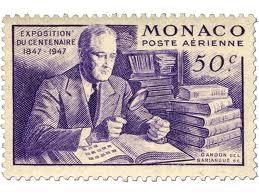
Franklin Delano Roosevelt as a Stamp Collector

Franklin Delano Roosevelt as a Stamp Collector

Until around the age of thirty or so, I was a stamp collector, specializing in the United States, France, and Vatican City. Then I gave up on the hobby around the time several million other collectors did, probably because we’re all more distracted now with all the new electronic media. Although I sold the cream of my 19th century U.S. collection on eBay, I still have most of my albums. Looking back on my collecting days, I realize that the hobby actually contributed a great deal to my development.

From a relatively early age, I learned how to recognize foreign countries by how they identified themselves, not how we identified them. As I Hungarian, I knew that Hungarian stamps said Magyarország, not Hungary. Many countries, such as those in the Arabian Peninsula, Greece, Eastern Europe and the USSR, East Asia, and Armenia did not use the Roman alphabet, so I had to identify them using other means. (Of course, back then, we did not have the Internet to help us.) Just to give an idea of the complexity of identifying stamps by country, here are a few examples:

Bohmen und Mahren: Czechoslovakia under German Nazi occupation
ΕΔΔΑΣ: Greece
Hejaz and Nejd: The two sheikdoms that later made up Saudi Arabia
Island: Yes, an island, but more properly, Iceland
K.U.K: Bosnia and Herzegovina under the Austro-Hungarian Empire
Lietuva: Lithuania

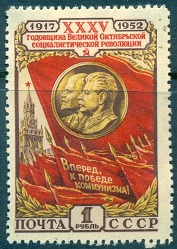
The stamp illustrated below, for example, is from the USSR. But note that Russia was not the only country employing the Cyrillic alphabet: There was also Bulgaria, Serbia, the Ukraine, and other Eastern European stamp-issuing countries.
USSR Stamp Scott #1644

USSR Stamp Scott #1644

Also I learned about the currencies of those countries, such as Hungary’s own fillers, forints, and pengös. The above Russian stamp has a denomination of 1 ruble. Until recently, stamps of all countries adhered to a Universal Postal Union treaty that specified that the stamp bear a denomination in their local currency. Now, with the U.S. Postal Service’s “Forever” stamps, that convention is apparently no longer in force.

In addition, as a collector we had to be aware of fine printing details, such as those that characterized the issues of the American, Continental, and National Bank Note Companies in the 1870s in our own United States. These included secret marks, varieties in the number and spacing of perforations, paper and watermark variations. It was difficult but fun to find a more valuable Bank Note issue that had been wrongly classified by a seller or fellow collector.

No, I do not regret my stamp collecting days.

“Forward! Still Forward!”

French Poster for The Man in the Iron Mask (1998)

French Poster for The Man in the Iron Mask (1998)

The movies have it all wrong. After he wrote the original novel in the series, The Three Musketeers (1844), Alexandre Dumas Père decided he was more interested in his guardsman heroes after they’ve begun to enter middle and old age. The movies like to treat The Man in the Iron Mask (1847), the last book in the series, as if it were still full of youthful hijinks and derring-do. There is no doubt a bit of that present, but in this last book Athos, Porthos, Aramis, and d’Artagnan enter a world that is far different and more threatening than the world of Richelieu and Louis XIII.

Louis XIV, the sun-king, starts out as being not altogether sympathetic, nor is Jean-Baptiste Colbert, his fast-rising minister. This prompts two of the Musketeers to replace him with his little-known twin brother Philippe, who is being held in the Bastille. When Nicolas Fouquet, the Superintent of Finances, is told, he immediately restores the monarch and gives Aramis and Porthos a four-hour head start to safety.

Neither d’Artagnan nor Porthos are in on the plot, though both are somewhat on the outs with the young monarch. The former is sent to apprehend his old friends, and that’s when their world begins to unravel. Porthos dies in the attack on Belle-Île, while Aramis manages to escape. Shortly after, both Athos and his son Raoul die of grief. Here we see into d’Artagnan’s mind at their funeral:

The captain [d’Artagnan] watched the departure of the horses, horsemen, and carriage; then crossing his arms upon his swelling chest, “When will it be my turn to depart?” said he, in an agitated voice, “What is there left for man after youth, after love, after glory, after friendship, after strength, after riches? That rock, under which sleeps Porthos, who possessed all I have named; this moss, under which repose Athos and Raoul [de Bragelonne], who possessed still much more!”

He hesitated a moment with a dull eye; then, drawing himself up, “Forward! still forward!” said he. “When it shall be time, God will tell me, as he has told others.”

The Musketeers have become a relic in a world they now cease to comprehend. Entropy has reared its ugly head, and the period of eternal youth and joy has come to an end. Curiously, Dumas was still a fairly young man when he and his collaborator Auguste Maquet wrote this sequel.

Life in the France of the 1840s was no picnic, as we can tell from reading the novels of Honoré de Balzac written about the period. In debt, disliked by Napoleon III, and subject to the tyranny of changing fashions, Dumas frequently found himself in debt.

Coincidentally, Dumas was one of two great nineteenth century authors of African ancestry. (The other was also called Alexander: Pushkin in Russia.) Once when twitted about his ancestry, Dumas had the perfect comeback: “My father was a mulatto, my grandfather was a negro, and my great-grandfather a monkey. You see, Sir, that my family starts where yours ends.”

Free Fall

Jumper from World Trade Center on 9/11

Man Falling from World Trade Center on 9/11

Today is the twelfth anniversary of the World Trade Center bombing on 9/11. It occurred exactly one week after I returned from Iceland in 2001. I was on American Airlines Flight 11, the one that crashed into the North Tower of the WTC, seven days before the debacle. For some reason, I turned on the news and saw the whole thing happen—something that I almost never did, and certainly never do any more.

The above image of the man falling from one of the towers has been one of my strongest memories of the event. Two years later, in 2003, Tom Junod wrote an article for Esquire about the picture, in which he wrote:

In the picture, he departs from this earth like an arrow. Although he has not chosen his fate, he appears to have, in his last instants of life, embraced it. If he were not falling, he might very well be flying. He appears relaxed, hurtling through the air. He appears comfortable in the grip of unimaginable motion. He does not appear intimidated by gravity’s divine suction or by what awaits him. His arms are by his side, only slightly outriggered. His left leg is bent at the knee, almost casually. His white shirt, or jacket, or frock, is billowing free of his black pants. His black high-tops are still on his feet. In all the other pictures, the people who did what he did—who jumped—appear to be struggling against horrific discrepancies of scale. They are made puny by the backdrop of the towers, which loom like colossi, and then by the event itself. Some of them are shirtless; their shoes fly off as they flail and fall; they look confused, as though trying to swim down the side of a mountain. The man in the picture, by contrast, is perfectly vertical, and so is in accord with the lines of the buildings behind him. He splits them, bisects them: Everything to the left of him in the picture is the North Tower; everything to the right, the South. Though oblivious to the geometric balance he has achieved, he is the essential element in the creation of a new flag, a banner composed entirely of steel bars shining in the sun.

In the article, Junod attempts to establish the identity of the jumper. The article is well worth reading.

I see 9/11 as a giant punctuation mark for the new millennium. There was before, and now there is after. We seem to be more involved in the Middle East and its hatreds, its fundamentalisms, its generations-long vengeance than we ever wanted to be.


Fragments of Eternity

Joseph Cornell’s Hotel Eden

Joseph Cornell’s Hotel Eden

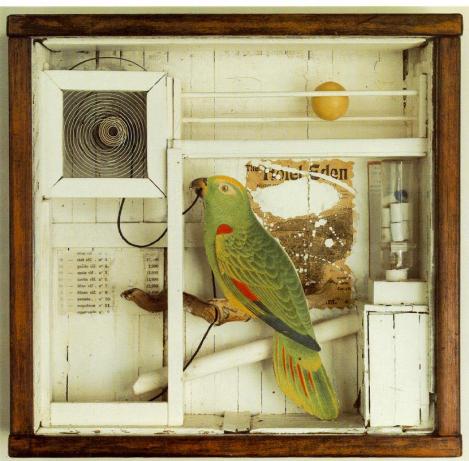
Sometimes even a fragment can set one’s mind a-roving. Today while eating lunch at the Attari Persian Sandwich Shop in Westwood, I started reading an article about the poetry of Charles Simic in the July 11, 2003 issue of The New York Review of Books. Because I was almost finished with my iced tea, I stopped reading the article and got up to make room for other diners. Before I folded up the issue, I saw an intriguing comparison between the poems of Emily Dickinson and the bricolage art of Joseph Cornell (1903-1972). Now who was this Joseph Cornell? I got back to the office and looked at several samples of his work, two of which I include here. I also read a poem by Emily Dickinson entitled “A Bird Came Down,” which I present below in its entirety:

A bird came down the walk:
He did not know I saw;
He bit an angle-worm in halves
And ate the fellow, raw.

And then he drank a dew
From a convenient grass,
And then hopped sidewise to the wall
To let a beetle pass.

He glanced with rapid eyes
That hurried all abroad,—
They looked like frightened beads, I thought;
He stirred his velvet head

Like one in danger; cautious,
I offered him a crumb,
And he unrolled his feathers
And rowed him softer home

Than oars divide the ocean,
Too silver for a seam,
Or butterflies, off banks of noon,
Leap, splashless, as they swim.

Everything is fairly clear until we come to the last two stanzas. At this point, Dickinson compares the bird’s wings to oars and butterflies, whose movement suggests to her a resemblance to swimming in the air. Now, let me ask you this: Did the bird accept the proffered crumb or not? Did the bird suddenly take to flight and suddenly remind the poet of butterflies diving, as it were, into the air?

You may notice: I do not present answers, merely questions. I am not such a tyrant as to wish to impose my interpretation (which, in any case, I have not yet arrived at and probably never will) on you. To me, poetry that is great suggests a multiplicity of questions, and no dogmatic answers. Poetry leads you to strange places and makes you see strange relationships. But, if it’s great poetry, it leaves the answers up to you. So, too, does the following box by Joseph Cornell:

Joseph Cornell’s Medici Boy

Joseph Cornell’s Medici Boy

What is it with that thing in the lower center that looks like a small fan? And what about those photos and drawings along the sides of the main image and the blocks at the bottom? Then there are those numbers that look like something taken off an oversized railroad schedule.

Eventually I’ll read the article about Charles Simic’s poetry. Perhaps tomorrow. In the meantime, certain fragments have made me see things that set my mind reeling. Even if my conclusions are different from those of the reviewer, I will have taken an interesting little journey.

The Poets and the Horse Collar

A Horse Collar

A Horse Collar

Cottle, in his life of Coleridge, relates the following amusing incident:–’I led my horse to the stable, where a sad perplexity arose. I removed the harness without difficulty; but, after many strenuous attempts, I could not remove the collar. In despair, I called for assistance, when Mr. Wordsworth brought his ingenuity into exercise; but, after several unsuccessful efforts, he relinquished the achievement as a thing altogether impracticable. Mr. Coleridge now tried his hand, but showed no more skill than his predecessor; for, after twisting the poor horse’s neck almost to strangulation, and the great danger of his eyes, he gave up the useless task, pronouncing that the horse’s head must have grown since the collar was put on; for he said,“it was a downright impossibility for such a huge os frontis to pass through so narrow an aperture.” Just at this instant, a servant-girl came near, and understanding the cause of our consternation, “Ha! master,” said she, “you don’t go about the work in the right way: you should do like this,” when, turning the collar upside down, she slipped it off in a moment, to our great humiliation and wonderment, each satisfied afresh that there were heights of knowledge in the world to which we had not yet attained.—William Evans Burton, The Cyclopædia of Wit and Humor, 1898

A Polish Poet Learns Latin

Zbigniew Herbert

Zbigniew Herbert

In my interest in Latin and my admittedly mediocre progress in that sphere there lay an element I might call personal. In the apartment building across the road from us there lived a young person, whose full shape, auburn hair, and dimples stirred my senses and gave me vertigo. She was the daughter of a Latin professor—not from our gymnasium, it is true, but known to us as the author of the book of adapted texts over which we labored; he also published articles in the monthly Philomat, to which Grzesio obliged us to subscribe through him. I used to sit on the balcony with my Auerbach & Dąbrowski Latin grammar and pretend that reading this exceptionally dull tome put me in ecstasy.

It was in fact an act of despair. If the object of my passionate feelings appeared on the balcony, it was not for my sake. She sometimes brushed me with a distracted look, as one glances at clouds moving across the sky. She was waiting for an older colleague of mine from the lyceum, a tall youth with a wavy blond crop, undeniably handsome (he was the standard-bearer of our school and wearing a sash and white gloves at celebrations he really did present well)—but I knew he could never make her happy. Every day around five in the afternoon she would leave the house with my mortal enemy and disappear around the corner into a little street shaded by chestnut trees, where (my feverish imagination told me) terrible things happened: he would take her arm (against the severest injunctions of the middle school rules) and perhaps press a fiery kiss on her silken glove. A storm of contradictory feelings in my tormented heart:

Odi et amo. Quare id faciam, fortasse requiris.
Nescio, sed fieri sentio et excrucior.

What did I think to achieve, holding my Auerbach & Dąbrowski Latin grammar on the balcony so that its cover would be visible from afar? I thought that one day her father—the classical philologist—would notice me and shout across to me: “I have been observing you for a while now, my boy. Your modesty and industry, your love for the Roman tongue are a warranty that you are a proper candidate for my daughter’s husband. I therefore grant you her hand.” And from then on things would proceed as in a fairy tale.

They didn’t. On the other hand, I learned many examples of the use of the more complicated grammatical forms by heart and was able to shine in class, even winning a cordial look from Grzesio.

We labored in the sweat of our brows. The time to reap drew near: the next year we were to proceed to the poetry of Catullus and Horace. But then the barbarians invaded.—Zbigniew Herbert, “A Latin Lesson,” Collected Prose

NOTE: Translated, the above Latin quote reads:

“I hate and I love. Why do I do it, perchance you might ask?
I don’t know, but I feel it happening to me and I’m burning up.”

The lines are from Catullus.

Right Wing Poster Boy Goes Bad

It Didn’t Take Long for Him to Show His True Stripes

It Didn’t Take Long for Him to Show His True Stripes

George Zimmerman has gone over to the Dark Side. Actually, I am of the opinion he was never far from it. His behavior since being acquitted in the “Stand Your Ground” murder of Trayvon Martin shows him to have been guilty—just like O. J. Simpson’s armed robbery in Las Vegas put the skids on any sympathy he may have gotten from his 1990s murder trial.

In the news today is word that the right wing poster boy is in custody after threatening his estranged wife with a gun. Shellie Zimmerman claims that her Georgie Boy was verbally abusive. And the misuse of guns appears to be a chronic problem with him.

I remember an ad that used to run on L.A. television stations years ago for a law enforcement school in which the first benefit listed was that graduates could “arrest offenders.” Or, in other words, carry a gun and feel a surge of power. Perhaps it is people like Zimmerman who should, at all costs, be kept away from firearms.

This is probably not the last we’ll hear of the Floridian neighborhood watch guy with the itchy trigger finger.

Living in the Past?

Not Altogether a Bad Thing

Not Altogether a Bad Thing

My brother and I usually talk on the phone on Sunday mornings, usually while I’m on my weekend hike. (That wasn’t the case today, however, because of the heat.) I hadn’t called him first because I was watching the DVD version of Ken Burns’s multi-part documentary The Civil War (1990), specifically the episode relating to Gettysburg, Vicksburg, and Chickamauga. Dan was curious to know why I was watching it. I replied that, frequently, during the hottest part of the summer, I would read a lot about the Civil War and watch DVDs on the subject. For instance, last month I watched Ted Turner’s production of Gettysburg (1993) with Tom Berenger, Martin Sheen, and Jeff Daniels.

“Boy, you really like living in the past, don’t you?” was Dan’s response.

“Absolutely,” I replied. “There’s little to like about what’s happening right now. After all, we’re getting ready to go to war again in the Middle East.”

Strictly speaking, I don’t live in the past. Although my tastes in music might be mostly 18th and 19th century, I am very partial to Jazz, the Blues, and folk music. I am more aware of what’s happening than people who rely on television news. Perhaps I do read the papers, getting the Los Angeles Times home-delivered seven days a week; but I get most of my news updates from the Internet, from the websites of CNN, MSNBC, and the BBC. Occasionally, I also check out Al Jazeera.

I am quite aware that many people who live in the past do so out of fear of the present. I have no particular fear of the present. If I like the history and literature of the past, it is partly to understand the present. Take a look at the illustration above, for instance: We are still fighting the American Civil War a hundred and fifty years later. The  Confederate States of America have found a way to bollix up the Senate by requiring that all measures pass with at least a 60-40 vote in order to avoid a filibuster. Do we have majority rule in the Senate? Not really. We’re sill hung up on States’ Rights, and talk of Secession is still in the air. We may no longer have literal slavery; but racism is rife and the villains have shifted from the rich plantation owners to the rich CEOs, the so-called One Percent.

No, if I spend time in the past, it is with an eye to the present. I urge all of you to read Herodotus, Thucydides, Livy, Tacitus, Philippe de Commynes, Gibbon, Parkman, Prescott—and, yes, the Civil War historians—for a unique perspective on the present.

Little Princesses

Possibly the Wrong Paradigm

Possibly the Wrong Paradigm

Today, Martine and I spent the afternoon at the L.A. Greek Fest near downtown. Because the temperature was well into the Nineties, we spent most of our time in the school gym, which was air-conditioned and supplied with large tables. Around the edges of the room were merchants selling various gift items, including tiaras and shiny accessories to make little girls’ dresses resemble the costumes of fairy princesses. One even resembled an Egyptian headdress with a snake like the crown we imagine Cleopatra as sporting. Several little girls were prancing around the room with the sense of entitlement that a princess costume bestows on its wearers.

Really, what is a princess if not a girl who is entitled from birth? What does one do to become a princess? Simple: One is born to royal parents. And when a little girl grows up thinking she is a princess, what are her chances of happiness in a world in which a sense of entitlement will only carry one so far? Really, what is a true-life princess born into except the dynastic pursuit of a [preferably] male heir? In Westwood, near the UCLA campus, there are legions of little princesses who are now in their twenties. In lieu of fairy wands, they carry smart phones , but they still dress fancifully in other ways. Not a pretty sight.

And then I wonder: Am I carrying this too far? After all, little boys are drawn to violent fantasies of battle which are carried forward into the teen years with video games. Even I played cops and robbers and [shudder] cowboys and Indians. But what I really loved more than anything else were my plastic bricks. I would not only use my toy soldiers for going into battle: I actually created little cities for them, with more officers’ titles to go around than I had toy soldiers. Then, too, there was my Lionel O-Gauge electric train, which I played with for over a decade. Again, as with my toy soldiers, I made up series of towns connected by the railroad, complete with schedules. I remember that was a great deal of fun, and constructive, too, in the long run, because it gave play to my imagination.

But thank God I never wanted to be a little princess. Maybe a prince… I had dreams of being visited by people from Hungary who declared I was to be the new monarch of the ex-Communist satellite. That would have been dicey, because my father and my uncle were identical twins.

If Only This Were True!

Hilarious!

Hilarious!

ST. PETERSBURG (The Borowitz Report)—Hopes for a positive G20 summit crumbled today as President Obama blurted to Russia’s Vladimir Putin at a joint press appearance, “Everyone here thinks you’re a jackass.”

The press corps appeared stunned by the uncharacteristic outburst from Mr. Obama, who then unleashed a ten-minute tirade at the stone-faced Russian President.

“Look, I’m not just talking about Snowden and Syria,” Mr. Obama said. “What about Pussy Riot? What about your anti-gay laws? Total jackass moves, my friend.”

As Mr. Putin narrowed his eyes in frosty silence, Mr. Obama seemed to warm to his topic.

“If you think I’m the only one who feels this way, you’re kidding yourself,” Mr. Obama said, jabbing his finger in the direction of the Russian President’s face. “Ask Angela Merkel. Ask David Cameron. Ask the Turkish guy. Every last one of them thinks you’re a dick.”

Shortly after Mr. Obama’s volcanic performance, Mr. Putin released a terse official statement, reading, “I should be afraid of this skinny man? I wrestle bears.”

After one day of meetings, the G20 nations voted unanimously on a resolution that said maybe everyone should just go home.—The Borowitz Report