Before the Incas

Yes, There Were Great Civilizations Before the Incas

Yes, There Were Great Civilizations Before the Incas—Witness This Moche Pot

We tend to think that the only advanced Pre-Columbian Civilizations were the latest. For Mexico and Central America, that would mean the Aztecs and Mayas; for Peru, the Incas.

As one who has traveled to Mexico many times to see archaeological sites, I can vouch for the fact that, long before the Aztecs left their mythical homeland of Aztlán, there were other civilizations in Mexico that they replaced, but which they did not necessarily improve upon. The peoples who built Teotihuacan north of Mexico City did it around a hundred years before the Christian era. Then there were the Toltecs, the Totonacs, the Olmecs, and the Huastecs. I have seen remains from these and other Meso-American civilizations over a thirty-year period.

The Mayans are slightly different: They were less a centralized political entity than a people who have been around for thousands of years and lived through both empires and more localized city states and leagues of city states. The last Mayans were conquered by the Spanish at Tayasal in 1697, representing a much thornier military target for the conquistadores than the Aztecs.

The Moche Civilization of Peru

The Moche Civilization of Peru (100-800 AD)

Like the Aztecs, the Incas were fairly late on the scene, first coming to notice around 1438 and being conquered (but not decisively) by Francisco Pizarro a hundred years later. In many ways they were not as advanced as the Aztecs and Mayans inasmuch as they did not have writing—though they appear to have been able to use a writing system of colored knotted cords called quipus for inventories and other business purposes. (In this regard, they were like the ancient Greeks who used Linear A in a similiar way.)

What the Incas had going for them were primarily two things:

  1. They built a great paved road system covering some 25,000 miles. (But since these roads included steps at times, they could be navigated by sure-footed llamas, but not by the Spaniards’ horses).
  2. They were great builders who, in a major earthquake zone, erected structures that are still standing.

Prior to the Incas, there were numerous Peruvian civilizations who bettered the Incas in many respects. The Moches or Mochica of the north were just one example: Their pottery is far more artistic (see above photo) than anything the Inca were able to create. Then, there were the Wari, the Nazca, the Chavin, Tiwanaku, Chincha, Chanka, and Chimu.

My upcoming trip to Peru will include some visits to non-Inca ruins, such as Huaca Pucllana of the indigenous Lima culture and Pachacamac of the Ichma people. If it weren’t for the fact that I’ve never been to Peru before—and I don’t know whether I can go again—I will concentrate mostly on the Inca sites of the Sacred Valley between Cusco and Machu Picchu.


Art Without a Human Context

Not a Fan of Non-Representational Art

I’m Not a Fan of Non-Representational Art

There are people who like abstract art, and then there are people like me. I could go through a large museum of modern art in a quarter of an hour or less, stopping only for a handful of paintings that catch my eye. Admittedly, one finds masses of brilliant colors, bold designs, but nothing that relates to human experience. I have always been amazed that so many works of abstract art are so large, involving so many square feet of canvas and paint, yet  elicit so little response from me. How often does one find works of non-representational art that are small? Their very hugeness is part of their impact. I could spend half an hour looking at a small Renoir or Cézanne, yet pass by a room full of gigantic daubs with barely a shrug.

Some of my friends think there is something wrong with my taste in art. They urge me to visit Los Angeles’s Museum of Contemporary Art (MOCA), but I hesitate to devote my time and money to something that does not engage my intellect.

I have looked through some of my earlier posts about art, particularly those relating to Marcel Proust’s In Search of Lost Time. One is about Vermeer’s “A View of Delft”; another takes as its subject Pieter de Hooch’s “The Mother”; and yet another, Sandro Botticelli’s “The Trials of Moses.” Marcel Proust and I have this in common: paintings that send one on a tangent are infinitely preferred to those which only inspire a grunt accompanied by the exclamation “Meh!”

It is no surprise that banks and corporate headquarters tend to like large works of abstract art. They want people to think they are forward looking, at the leading edge. One looks at them as adjuncts of power rather than as works that can inspire even a modicum of thought. But, perhaps, power without thoughtfulness is what they are aiming at.


I Seem To Have Become Hispanic

I Didn’t Know One Could Change One’s Ethnicity

I Didn’t Know One Could Change One’s Ethnicity

For some reason, I seem to have spooked the marketing algorithms behind some web sites: Now I find myself getting ads in Spanish. Could it be because of all the Google searches I have done regarding my upcoming vacation in Peru? In any case, I am amused by the whole thing—provided I do not have to fear getting nabbed by the migra and deported to Tijuana.

I guess this is the way I look to the marketers:

Which One Do I Resemble Most?

Which One Do I Resemble Most?

The painting above is John Sonsini’s “Christian and Francisco” (2013), which hangs in the Autry National Center in Los Angeles’s Griffith Park, which Martine and I visited yesterday.

In the meantime, I hope to improve my colloquial Spanish so that I can be worthy of my new identity.


Their Hearts Are in the Highlands

Highland Lass with Lore Master

Highland Lass with Lore Master

One of the premier attractions at last week’s Old Fort MacArthur Days was my visit to the encampment of Clan Mac Colin. One of the reasons is that, although many of the performers cooked their own food, the Clan’s food looked the most scrumptious. When I asked some questions to the young lady in the photo above, she referred me to the clan’s Lore Master, who set me straight.

Clan Mac Colin attempts to reproduce a Scottish Highland (and Irish) way of life dating back to the Sixteenth Century, mostly centered around Glenderry, around East Loch Ewe, the Isle of Ewe, and the Gruinard Peninsula in what is now County Ross and Cromarty. I suspect some of the geography might be made up, but the way of life represented attempts to be as authentic as possible. If you are interested in delving into some of the details, you could hardly do better than scanning through the Basic Guide (which loads as an Adobe Acrobat PDF file). Also check out their Tribal Lore website, which is more succinct.

Although I have not an iota of Celtic blood in my veins, if I wanted to escape the cares of a stupid workaday life, I should think that Clan Mac Colin would exercise a powerful lure.

While going to Old Fort MacArthur Days is like walking through history, joining Clan Mac Colin is like living history. I would worship Saint Maolrubha with my fellow clan members. As the Tribal Lore site says, the good saint “continued the work of Saint Columba in Wester Ross and, retiring from that abby, established a cell on the isle of Maree in Loch Maree, the sight of his holy well. He is also the patron saint of the insane, being drug behind a boat around his island three times widdershins and drinking from this well is reputed to be a cure.”

Well, why not?


When the U.S. Downed a Commercial Jet

Not One of Our Great Moments in Military History

Not One of Our Great Moments in Military History

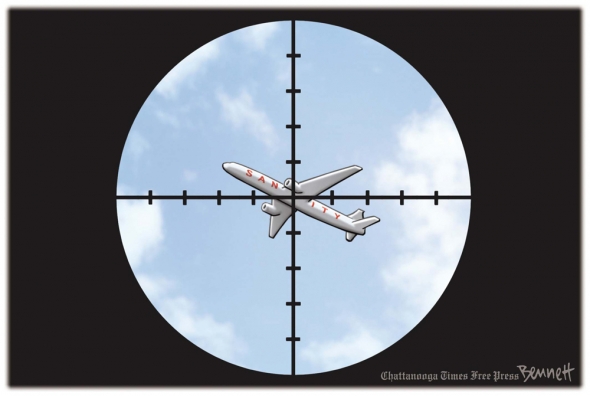
The date was July 3, 1988. The United States Navy was engaged in the Persian Gulf protecting oil shipping lanes. Around that time, there had been several hostile engagements with both the Iraqi and Iranian forces. Shipping through the Straits of Hormuz had to cross into territory claimed as Iranian waters in order to avoid running aground.

The USS Vincennes, a guided missile cruiser patrolling the Straits, picked up a signal from an aircraft that it misidentified as coming from an F-14 Tomcat, of which there were several in Iran’s air force. It let fly an SM-2MR surface-to-air missile. Instead of an F-14 Tomcat, the missile brought down an Airbus 300B2-200 flying a commercial flight as Iran Air 655 between Bandar Abbas, Iran and Dubai. On board were 290 persons, including 66 children and 16 crew. All persons on board died.

Did the United States apologize to Iran? According to Wikipedia:

In 1996, the United States and Iran reached “an agreement in full and final settlement of all disputes, differences, claims, counterclaims” relating to the incident at the International Court of Justice. As part of the settlement, the United States did not admit legal liability but agreed to pay US $61.8 million ($92.9 million today), amounting to $213,103.45 ($320,446 today) per passenger, in compensation to the families of the Iranian victims.

Iran Stamp Commemorating the Incident

Iran Stamp Commemorating the Incident

Although flight numbers are usually retired after a prominent airline disaster, Iran Air still has a flight 655. I guess they want to keep the villainy of the Great Satan fresh in their minds.

As to the Malaysian Airliner Flight MH17 shot down over Eastern Ukraine, I highly recommend that you read Patrick Smith’s posting on the subject in his Ask the Pilot blog in preference to listening to the mainstream media pundits bloviating about unsupportable conspiracy theories.


Red Sunset Mother

It All Goes Back to Aesop

It All Goes Back to Aesop

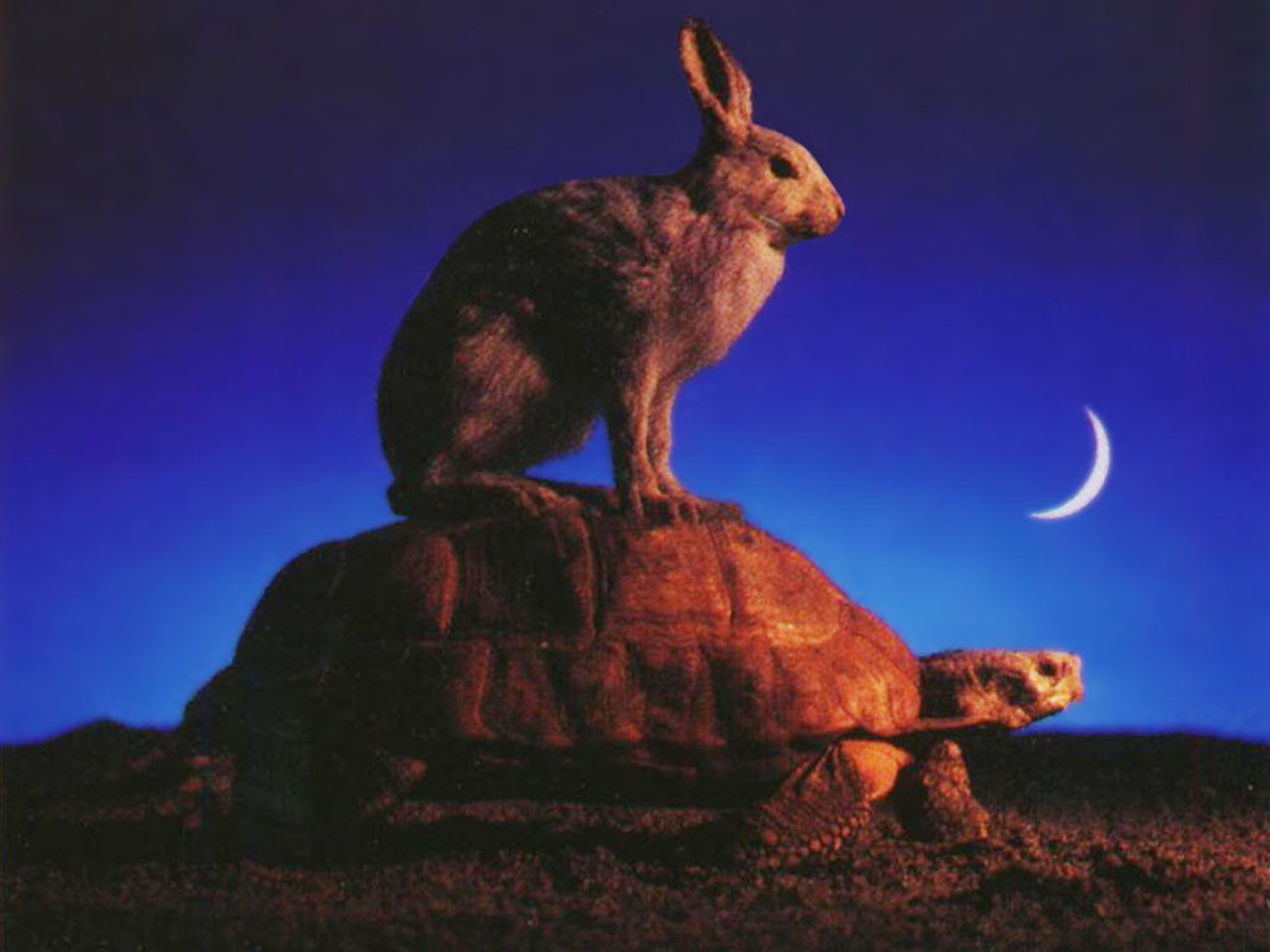
The three words of the title of this post were separately suppressed by Myanmar’s ruling junta: “red” because of its association with Communism; “sunset” because General Ne Win’s name meant “sunrise”; and “mother” because that was the nickname of Burmese dissident Aung San Suu Kyi.

That brings back to mind another draconian instance of censorship. In Costa-Gavras’s film (1969), the rightist Greek colonels in charge forbid the use of the letter Z (Zeta) in the Greek alphabet because of the protestors’ use of the Greek phrase “Ζει,” meaning “He lives.” The pronoun refers to the democratic politician Grigoris Lambrakis, who was assassinated in 1963.

What does one do when the powers that be forbid the use of certain words? Russian and Eastern European writers under Communist rule came up with the solution: use other words in their place. This is referred to as the use of Aesopian, or Aesopic, language. Just as the ancient Greek teller of fables used stories to mask political realities, writers would use metaphorical language to stand in for the proscribed language. In an article entitled “The Rhetoric of Subversion: Strategies of ‘Aesopian Language’ in Romanian Literary Criticism Under Late Communism,” Andrei Terian describes the procedure used:

Since organized dissent was absent, the ‘resistance through culture’ represented in Romania the main form of assertion of the writers’ independence from the Communist regime. Civically, it materialized through the refusal to enroll in the party’s propaganda machine, while artistically, it took place through the defense of the priority of the ‘aesthetic’ criterion in the production and reception of literary works, which generated a literature relatively autonomous from the political sphere. Nevertheless, from the perspective of maximalist ethics, the ‘resistance through culture’ is a deeply duplicitous phenomenon, which fits perfectly in the Ketman paradigm described by Czeslaw Milosz. In the Polish writer’s opinion, ‘Ketman means self-realization against something’ (The Captive Mind ….), which, in the case of totalitarian societies, is translated in a profound divergence between an individual’s private thoughts and their public expression.

I thought Milosz expressed it better in The Captive Mind—a book I urge everyone to read—but I can’t quote it because, alas, I can’t lay my hand on it at the moment.

Terian is a bit abstruse, so let me think of an example. Let us say that the Tea Party rules America as a rightist junta and bans the use of the word “abortion.” A hated Liberal writer can use another term, such as “ablution” in such a way that a censor would let it pass, despite the fact that its meaning would be clear from its context, as in “they were able to limit the size of their family with the discreet use of ablution.” Writers can and did develop an entire language of such circumlocutions under the noses of the Communist censors.

Even words as basic as “red,” “sunset,” and “mother” can find Aesopian equivalents, such as, perhaps, “rubicund,” “gloaming,” or “progenitrix” respectively—though a poet can play with the concept much as Viking poets used kennings such as “wave’s steed” for “ship” or “Freyja’s tears” for “gold.” And the Viking’s did this not because of censorship, but to help the meter of their compositions.

Iraq in Tres Partes Divisa Est

ISIS Executing Prisoners

ISIS Executing Prisoners

The following post was written on Yahoo360 back in March 2006. Even with the U.S. forces having been withdrawn, the basic situation has not changed much:

Looking beyond the daily news, the explosions, the body bags, and the turmoil in both Baghdad and Washington, what is likely to happen to Iraq in the years to come? I think that Iraq’s future is closely tied to Iraq’s recent past, starting when it was part of the Ottoman Empire until the end of World War I. As Constantinople had made the wrong choice of allies in the war—namely Germany and Austria—the British and French parlayed after the war to decide how the land would be divvied up.

Many of the Foreign Office clerks in London had only an Old Testament background in the history of the area. So they proceeded to create new countries based on maps printed in old Bibles and distant recollections of empires long faded into dust. There was also a debt that had to be paid: Hussein ibn Ali, Sharif of Mecca, had provided critical aid to the British in their war against the Turks (you may know him as Omar Sharif from the film version of Lawrence of Arabia), and the British promised to make his three sons kings. To accomplish this, they created three countries—Syria, Transjordan, and Iraq—for Hussein’s sons to rule. Syria was placed under French administration; and Transjordan and Iraq, under British.

The tale of how this happened is contained in a book that should be required reading for everyone interested in the subject: David Fromkin’s A Peace to End All Peace: The Fall of the Ottoman Empire and the Creation of the Modern Middle East, which is available from Amazon.Com. You may be interested to know that one of the prime movers behind this remapping of the Middle East was none other than the young Winston Churchill.

Iraq’s monarchy didn’t last very long, but its borders are more or less the same as stipulated by the Sykes-Picot Agreement of 1916 and several subsequent treaties. Ignored by the Foreign Office clerks was the fact that the Iraq they created was split along major cultural fault lines: (1) the north was Kurdish; (2) the area around Baghdad extending west to Jordan was largely classical Sunni Arab with an intermingling of Shi’ites; and (3) the South, centered around Basra, was almost exclusively Shi’ite.

Why don’t we just break Iraq into three countries? (1) The Turks would go ballistic if the Kurds had their own state and destabilized the Kurdish regions of Turkey; (2) There would be wholesale genocide between Sunnis and Shi’ites in the center; and (3) A Shi’ite state in the south would eventually fall under the sway of Iran, even though the Iranians speak a different language.

What can we do? I think we should declare our adventure in Iraq to be a stunning victory and bring our troops home. They have no role to play in a civil war except as targets in a shooting match between all parties concerned.

I wouldn’t change a word of what I wrote back then. I still think that Iraq will be subdivided into two or three states, one of which will be an independent Kurdistan. As for the Sunnis and the Shi’ites, only Allah knows what will happen.

Serendipity: Master of Five Willows

Master of Five Willows

Master of Five Willows

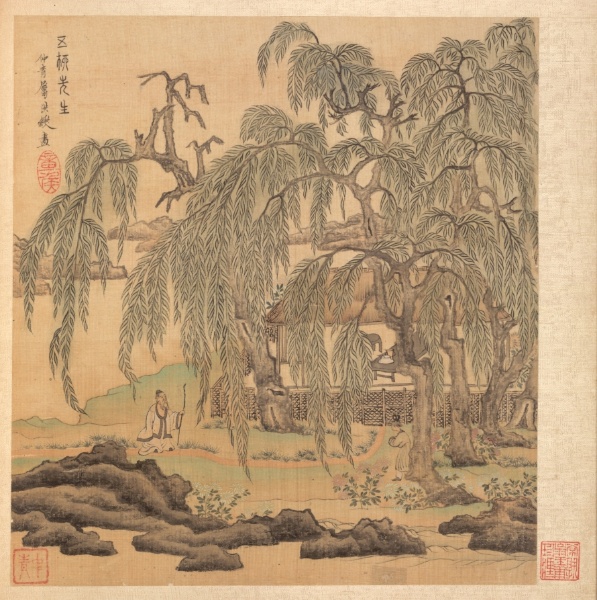
From Tau Ch’ien (365-427) comes this memorable portrait:

No one knows where he came from. His given and literary names are also a mystery. But we know there were five willows growing beside his house, which is why he used this name. At peace in idleness, rarely speaking, he had no longing for fame or fortune. He loved to read books, and yet never puzzled over their profound insights. But whenever he came upon some realization, he was so pleased that he forgot to eat.

He was a wine-lover by nature, but he couldn’t afford it very often. Everyone knew this, so when they had wine, they’d call him over. And when he drank, it was always bottoms-up. He’d be drunk in no time; then he’d go back home, alone and with no regrets over where things are going.

In the loneliness of his meager wall, there was little shelter from wind and sun. His short coat was patched and sewn. And made from gourd and split bamboo, his cup and bowl were empty as often as Yen Hui’s. But he kept writing poems to amuse himself, and they show something of who he was. He went on like this, forgetting all gain and loss, until he came naturally to his end.

In appraisal we say: Ch’ien Lou said Don’t make yourself miserable agonizing over impoverished obscurity, and don’t wear yourself out scrambling for money and honor. Doesn’t that describe this kind of man perfectly? He’d just get merrily drunk and write poems to cheer himself up. He must have lived in the most enlightened and ancient of times. If it wasn’t Emperor Wu-huai’s reign, surely it was Ko-t’ien’s.

The Missing Link, Going Forward

Man May Prevail, But With What “Modifications”?

Man May Prevail, But With What “Modifications”?

I am always amused about talk of a “missing link” between what was recognizably ape and what is recognizably human. But once we have Homo sapiens down, what about changes to our species that may be as significant—if not more significant—to those which we have traditionally associated with the concept of a missing link?

Today, I had lunch at a local Thai restaurant. In the next booth sat a woman who was part of a larger party that had not yet all met up. No sooner did she get seated than she had a long painful conversation with another member of the party which was supposedly looking for the restaurant but had trouble finding it. At no point did she get the name of the restaurant correct (she kept calling it simply “Thai Café”) and never thought to supply the exact street address. All her instructions were with regard to the identities of nearby retail establishments. If her friend was several blocks away, he would have no more luck finding the “Thai Café” than the stores in its immediate vicinity.

The thought suddenly hit me that the smart phone has introduced new ways of thinking. No longer is any sort of advance preparation required for anything. One can simply make a phone call and use relational markers to home a friend in to the desired location employing fuzzy logic of a sort.

Man has developed increasingly sophisticated tools for tens of thousands of years, but for the first time we are approaching the point where we are using tools to change ourselves and our very thought processes. It is possible, for example, that the smart phone may be as significant for the human race as Gutenberg’s invention of moveable type. If we ever improve robots to the point that we can communicate with them, that may be even more significant. In both cases, man is delegating his own brain powers to a device that parses, stores, and possibly communicates commands.

What do you suppose the effect of that will be on the human brain? Perhaps it will begin to atrophy. Once one has a truly smart phone, one does not have to think for oneself any more.

I’m not sure I would like that development, or should I say retrogression?

The Ghost in the Machine

Lou Lopez, Coordinator of Old Fort MacArthur Days

Lou Lopez, Coordinator of Old Fort MacArthur Days

Everyone liked making fun of him, but he ran a tight ship at Old Fort MacArthur Days. Lou Lopez had been in charge of the event since 2000, and Martine and I were expecting to see him again yesterday behind the microphone trying to keep the straggling event together.

Only, we did not see him this time. Apparently, last month, he—such a lover of history—had himself passed into history on the morning of June 18.

I did not know him personally, and he certainly did not know Martine or me. He was one of those little guys that people joked about, but always with a feeling of affection and grudging respect.

It became evident yesterday at the parade of military units, always a feature at these events. It always began with the ancient Roman legions and ended with units from the Korean and Vietnamese conflicts. The public address system was haunted. It was used to conveying Lou Lopez’s voice over the air, but didn’t quite acknowledge his replacement.

In the meantime, Lou, in his traditional garb of the U.S. forces in Cuba, was off somewhere charging up San Juan Hill with Teddy Roosevelt.