The Royal Society for Putting Things on Top of Other Things

Alberta Branch

Alberta Branch

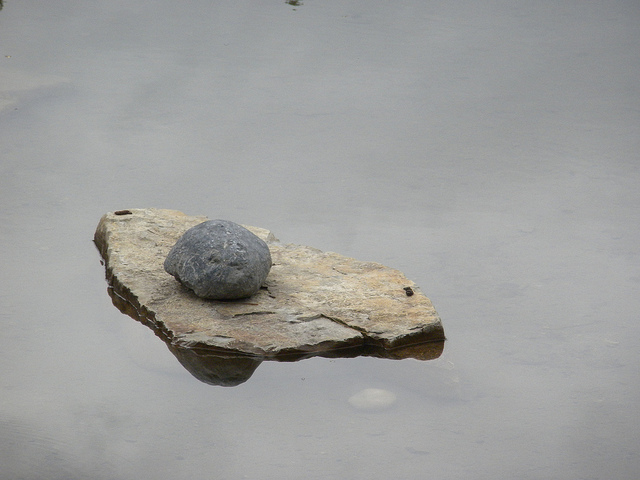
One of my favorite Monty Python sketches was about the Royal Society for Putting Things on Top of Other Things, chaired by the late lamented Graham Chapman. (To see the sketch, click here.) Above, we see the local Alberta branch’s work at Johnson Lake, just northeast of Banff Townsite.

The question I ask myself is the following: Is there any way that round rock could have gotten onto the flat rock on its own? If so, how so? And is there any way of measuring exactly when it happened? And if the above is a natural formation, would that not altogether vitiate the work of the Society for Putting Things on Top of Other Things? These are all hard questions which either must be addressed, or entirely scouted.


Tarnmoor’s ABCs: Xul Solar

Surreal Cities ...

Surreal Cities …

All the blog posts in this series are based on Czeslaw Milosz’s book Milosz’s ABC’s. There, in the form of a brief and alphabetically-ordered personal encyclopedia, was the story of the life of a Nobel Prize winning poet, of the people, places, and things that meant the most to him.

My own ABCs consist of places I have loved (Iceland, Patagonia, Quebec, Scotland), things I feared (Earthquakes), writers I have admired (Chesterton, Balzac, Proust, Borges, and Shakespeare); locales associated with my past life (Cleveland, Dartmouth College, and UCLA), people who have influenced me (John F. Kennedy), foods I love (Olives and Tea), and things I love to do (Automobiles and Books). This blog entry is my own humble attempt to imitate a writer whom I have read on and off for thirty years without having sated my curiosity. Consequently, over the next couple of weeks (there are now only two letters left in the alphabet: Y and Z), you will see a number of postings under the heading “Tarnmoor’s ABCs” that will attempt to do for my life what Milosz accomplished for his. To see my other entries under this category, hit the tag below marked “ABCs”. Today is X for—no, not X-Ray—but Xul Solar.

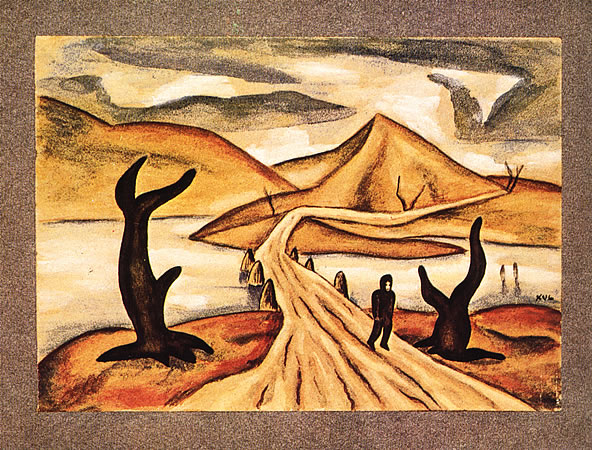
I generally do not like modern art, but I have a strange affinity for many surreal artists like Salvador Dalí, Giorgio di Chirico, and Xul Solar.

In March of last year, I already wrote a post about the Latvian-Argentinean painter, whose real name is Oscar Agustín Alejandro Schulz Solari, but since that “X” is a difficult letter to account for in any alphabetical scheme such as this one, and because I plan to visit his museum in Buenos Aires in November, I decided to write more about his work, which is filled with strange cities and desolate landscapes populated with strolling characters of a vaguely human appearance.

“Paisaje Bunti”

“Paisaje Bunti”

As I wrote in my previous post, it was Jorge Luis Borges who turned me on to his work. As he wrote on one occasion, “His paintings are documents of the unearthly world, of the metaphysical world in which the gods take the forms of imagination, dreams. Passionate architecture, happy colors, many circumstantial details, labyrinths, homunculi and angels unforgettably define this delicate and monumental art.” Soon after he wrote those words, Borges lost his eyesight and was unable to enjoy any paintings, save what visual fragments remained in his memory.

Below is Xul Solar’s take on a cathedral:

“Cathedral”

“Cathedral”

My hotel in Buenos Aires will be within walking distance of the Xul Solar Museum, which is situated at Laprida 1212, a short walk down Pueyrredón from Recoleta. You can visit the museum’s website and view a nice selection of his paintings done over some fifty years. Never mind that the text is in Spanish.


The Ytinerary: Buenos Aires

Starting at the Beginning ...

Starting at the Beginning …

This is the start of a new series of posts, all connected with my vacation plans and daydreams. The Ytinerary—combining the words “Why” and “Itinerary”—takes each step of my November trip and answers the question, “Why are you going there?”

Let’s start with Buenos Aires. My plane lands at Ezeiza, officially known as Ministro Pistarini International Airport, one of the largest in South America. Fortunately, there are a lot better reasons than mere convenience to spend time on the shores of the Plate. B.A. is a target-rich environment, full of museums, parks, and historical buildings. It has been described as very like a European city, partly because the majority of its inhabitants are of European descent, mostly Italian and Spanish. (The original natives of the Pampas were wiped out by General Julio Argentino Roca’s “Conquest of the Desert” in the 1870s.)

I have been to B.A. twice before, in 2006 and 2011. The first time, I stayed at the Posada del Sol (above) on Hipólito Yrigoyen, not far from the Plaza de Mayo and the Casa Rosada, the nation’s capitol. The second time was at the Chez Lulu in Palermo. This time, I plan to stay in Recoleta, between the two.

This time, I hope to see the city from the eyes of its greatest writer, Jorge Luis Borges. His widow runs a Borges Cultural Centre at Viamonte and San Martín. I also plan to see the Museo Xul Solar, dedicated to a surrealist painter whose work Borges loved (and about whom I will write later this week). Also, I will walk the streets of Palermo, where the poet was born long before the area became gentrified and when it was full of knife-fighters and trucho players.

I will visit some of the old cafés for which the city is famous, such as the Café Tortoni, Il Preferido, El Sanjuanino, and Los Violetas, which are well into their second century, and where Borges and his friends used to hang out. The food is great and the service exquisite.

Also, I will renew my acquaintance with TEGOBA, the English Speaking Group of Buenos Aires, which meets on Fridays for dinner at the FAME Fast Food Restaurant on Cabildo near the Congreso de Tucumán Subte stop (below).

My Friends at TEGOBA: Marta Viajero and Gonzalo Luchinetti

My Friends at TEGOBA: Marta Viajero and Gonzalo Luchinetti

As you can see, I could easily spend all three weeks of my vacation in Buenos Aires. It’s one of those cities which is endlessly fascinating.


Down to Yellow Alert

Yes! It Looks Like Calbuco Won’t Interfere with My Trip

Yes! It Looks Like Calbuco Won’t Interfere with My Trip

I have been watching Sernageomin’s Reporta de Actividad Volcánica (RAV) on a daily basis. I have seen the warnings go from a Red Alert and a 20 km danger zone to an Orange Alert and finally a Yellow Alert. Even if Calbuco doesn’t emit so much as a puff of smoke in the next six months, the Servicio Nacional de Geología y Minería will likely not lower the alert to Green if only because the three eruptions of April 22, 24, and 30 were so spectacular as to keep the agency on its toes.

On May 9, I printed a vastly different chart showing the danger zone, the lava paths to the surrounding lakes, and the direction of wind-borne volcanic ash. My planned bus journey from Lago de Todos los Santos to Puerto Varas would have been blocked at several points by flowing lava; and both Ensenada and Petrohué had been evacuated.

As you can see from the most recent RAV chart for Calbuco (above), only parts of the Rio Frio and Rio Caliente are in any danger of pyroclastic flows; and ash is no longer coming from the caldera.

Chile is a somewhat tricky country to visit: It is not only one of the most active countries in the world due to its volcanic activity, but also due to devastating earthquakes. On May 22, 1960, Valdivia had a quake that tipped the Richter scale at 9.5. What with its associated tsunami, is is considered one of the strongest tremors in history.

So why do I want to go there? Certainly not to walk innocently into a disaster. Mountainous country is beautiful, but the taller the mountains, especially near the edge of a tectonic plate, the more Biblical are the disasters. You pay for beauty.


Totally Out of Whack

None of These Bozos Will Make It to the White House

None of These Bozos Will Make It to the White House

There are currently so many GOP candidates for the Presidency that they could not fit into any vehicle smaller than the trailer of an eighteen-wheeler. Frankly, I don’t think I can name them all from memory. All I know about them is that they tend to say a lot of stupid things, which the echo chamber of the press magnifies until it seems that there is only one political party: The Tea Party.

As for Democratic front-runner Hillary Clinton, no one really likes her. I don’t like her. Martine despises her. She is probably more competent to run our country than any of the Klown Kar Republicans. But she knows that everything she says will be drowned out by cries of Benghazi! E-mail! Foundation money! Why, I wouldn’t even be surprised if Faux News reveals that she had a torrid affair with Monica Lewinsky, and they probably have the dress to prove it!

Our political process has become so toxic that the only reason I vote is that I know that, if I didn’t, some Evangelical Jesus child molester will win. Gone is any Roman sense of duty. I will trudge down to the polling precinct by myself, thinking dark thoughts, while crowded church buses full of rednecks vote en masse.

In the Jungles of This Earth

Orchid in L.A. Arboretum Greenhouse

Orchid in L.A. Arboretum Greenhouse

In various posts I have made to this blog, I have expressed some distaste about visiting the tropics. In November, I will make a two-day exception by visiting Iguazu Falls at the junction of Argentina, Brazil, and Paraguay. Since I share with Martine an abhorrence of mosquitoes and the diseases they pass on to humans, I will wear insect repellent and avoid going out at dusk, when they are most active. I shall also ask my physician—who herself has visited the falls—whether I should also take chloroquine, which I could buy over the counter in Buenos Aires.

My curiosity has been piqued by all the great waterfalls I saw In iceland, especially at Dynjandi and Gullfoss, in 2013. For someone living in an extreme drought zone like California, the thought of all that water is intriguing.

I shall take an overnight bus from Retiro bus station in B.A. to Puerto Iguazu and fly back to B.A. after two days.

Despite my reluctance to pick up some tropical disease, I will probably take one or two of the jungle trails around the falls (just not at dusk) to see all the rich plant and animal life. Tourists at the falls are assailed by troops of coatimundi (see below). They are cute little buggers, but extremely voracious and aggressive.

Cute But Dangerous

Cute But Dangerous


After my broken shoulder, all I need are some nasty coatimundi bites, possibly rabid.


Juice Wondering …

Are They Really As Healthy As People Think?

Are They Really As Healthy As People Think?

Omigosh, that photo caption is almost pure clickbait! The point I am trying to make is that fruit juices are one of those categories of foods that are almost universally thought to be good for you.

Except for one thing: They concentrate their one ingredient which is not so good for you, namely sugar, and throw out the fiber that your body needs far more. This goes back to that mantra of “quick energy” that used to be claimed for most sugary beverages going back to the 1960s.

To the youth of America, fiber is not only boring but decided unsexy. It seems to be associated exclusively with the old people’s bowel movements. Actually more important is that the fiber keeps the pancreas from being bombarded by an excess of sugar. According to Harvard’s T.H. Chan School of Public Health, they act to form complex carbohydrates:

These carbohydrates have more complex chemical structures, with three or more sugars linked together (known as oligosaccharides and polysaccharides).  Many complex carbohydrate foods contain fiber, vitamins and minerals, and they take longer to digest – which means they have less of an immediate impact on blood sugar, causing it to rise more slowly.

At a time when a whole generation seems to be headed into the maws of Type II Diabetes, it’s probably a good idea to minimize the impact of sugar on one’s diet—regardless of the promise of “quick energy.” So drink water, coffee, or tea instead.


Tarnmoor’s ABCs: William Shakespeare

The Famous Droeshout Portrait of the Bard

The Famous Droeshout Portrait of the Bard

All the blog posts in this series are based on Czeslaw Milosz’s book Milosz’s ABC’s. There, in the form of a brief and alphabetically-ordered personal encyclopedia, was the story of the life of a Nobel Prize winning poet, of the people, places, and things that meant the most to him.

My own ABCs consist of places I have loved (Iceland, Patagonia, Quebec, Scotland), things I feared (Earthquakes), writers I have admired (Chesterton, Balzac, Proust, and Borges); locales associated with my past life (Cleveland, Dartmouth College, and UCLA), people who have influenced me (John F. Kennedy), foods I love (Olives and Tea), and things I love to do (Automobiles and Books). This blog entry is my own humble attempt to imitate a writer whom I have read on and off for thirty years without having sated my curiosity. Consequently, over the weeks to come (there are only three letters left in the alphabet: X, Y, and Z), you will see a number of postings under the heading “Tarnmoor’s ABCs” that will attempt to do for my life what Milosz accomplished for his. To see my other entries under this category, hit the tag below marked “ABCs”. Today is W for William Shakespeare.

On one hand, it is pretty easy to make fun of the Immortal Bard. The following is from Jonathan Miller’s On Further Reflection: 60 Years of Writing:

Take this my hand, and you fair Essex this
And with this bond we’ll cry anon
And shout Jack Cock o’London to the foe.

Or: “Is it botched up then, Master Puke?” Or: “Now is steel ’twixt gut and bladder interposed.”

If one is not in the habit of reading difficult or old works, tackling Shakespeare can be a chore. His rich, even overripe, use of language goes against everything we have been taught about written communication. And yet, and yet, there are many complex thoughts and emotions that have never been better expressed before or since.

Over the last six months, I have been reading the “tetralogy” of Henry VI Parts 1, 2, and 3, followed by Richard III. Not too many people venture to read Henry VI, but from them come some great thoughts, such as this from Part 2, scene 3:

What stronger breast-plate than a heart untainted!
Thrice is he arm’d, that hath his quarrel just;
And he but naked, though lock’d up in steel,
Whose conscience with injustice is corrupted.

Also from Henry VI comes such phrases as “main chance,” “let’s kill all the lawyers,” “I owe him little duty and less love,” “O, tiger’s heart, wrapped in a woman’s hide!,” and “hasty marriage seldom proveth well.”

And yet these are all in a minor key when you compare them to the four great tragedies—Hamlet, Macbeth, King Lear, and Othello—which will shake the world of whoever reads, hears, or sees the plays. Take this from the wretched Lear in Act IV:

Ay, every inch a king:
When I do stare, see how the subject quakes.
I pardon that man’s life. — What was thy cause? —
Adultery? —
Thou shalt not die: die for adultery! No:
The wren goes to’t, and the small gilded fly
Does lecher in my sight.
Let copulation thrive; for Gloster’s bastard son
Was kinder to his father than my daughters
Got ’tween the lawful sheets.
To’t, luxury, pell-mell! for I lack soldiers. —
Behold yond simpering dame,
Whose face between her forks presages snow;
That minces virtue, and does shake the head
To hear of pleasure’s name; —
The fitchew nor the soiled horse goes to’t
With a more riotous appetite
Down from the waist they are centaurs,
Though women all above.
But to the girdle do the gods inherit,
Beneath is all the fiend’s; there’s hell, there’s darkness,
There is the sulphurous pit; burning, scalding, stench, consumption! — fie, fie, fie! pah, pah! Give me an ounce of civet, good apothecary, to sweeten my imagination: there’s money for thee.

I will continue reading the history plays, and then I’ll tackle the tragedies and comedies again. Shakespeare just gets deeper as you continue reading. One is never done with him.


Attacked by One of Their Own

James Laughlin Visits Burma

James Laughlin Visits Burma

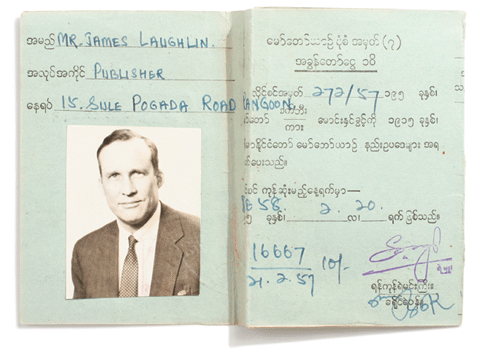
Every once in a million years, someone from the hated 1% not makes a positive contribution to the culture but also attacks his fellow millionaires. James Laughlin (1914-1997) was not only a poet of some repute, but also the founder and publisher of the New Directions paperbacks that are to be found all over my library, including my favorite volume of stories by Jorge Luis Borges:

One of My All-Time Faves

One of My All-Time Faves

Interestingly, James Laughlin was from the Laughlins of Jones & Laughlin Steel Company, founded in 1852 and one of the giants of American manufacturing.

Imagine what his family thought of the following poem attacking corporate executives for their intransigence in a remarkably modern way:

Confidential Report

The president of the
corporation was of the

opinion that the best
thing to do was just

to let the old ship
sink as pleasantly &

easily as possible be-
cause it was plain as

day you couldn’t op-
erate at a profit as

long as that man was
in the white house &

now he was there for
good you might just

as well fold yr hands
and shut yr face and

let the old boat take
water till she sank.

Now it is quite obvious that the president of whom Laughlin was talking was Franklin D. Roosevelt, though I can see the same thing being said about Obama, Carter, or even Clinton.


A Club for Kids

Every Boy’s Sweetheart:  Annette Funicello

Every Boy’s Sweetheart: Annette Funicello

On October 3, 1955, I walked over a mile to Warrensville at the corner of Northfield Road and Van Aken to see a movie; but I was more interested in what was going to be on T.V. when I got home. Although I ran at what for me at the age of ten was top speed, I only missed a few minutes of “The Mickey Mouse Club.” I did not make that mistake in days to come: there were kids like me, cartoons, special guests, and various other little daily features.

And there was that ultimate sexpot of the 1950s.No, not Marilyn. The shorter one: Annette Funicello. In darkened living rooms all around the country, little boys were sighing as their hearts went pit-a-pat.

Disney really made it happen for me. That same year, he was going to open a theme park in Anaheim called Disneyland. It was to be an unattainable place of dreams.

Unattainable, at least, until the tail end of 1966, when I came out to Southern California to go to graduate school in film at UCLA. Our old neighbors from Cleveland, the Gurals, took me to a ball game in Anaheim to see the Cleveland Indians lose to the (then) California Angels, after which we went to … DISNEYLAND!

I am not one of those people who are too old and too sophisticated for Disneyland. Granted, the greasy kid stuff at Fantasyland is de trop for me, but I still love New Orleans Square and, nowadays, Toontown. I have yet to visit the Calfornia Adventure theme park next door, but I will eventually.