Serendipity: A Snark-y Response

The Snark at the Dock

The Snark at the Dock

The following comes from the Foreword of Jack London’s The Cruise of the Snark:

Our friends cannot understand why we make this voyage.  They shudder, and moan, and raise their hands.  No amount of explanation can make them comprehend that we are moving along the line of least resistance; that it is easier for us to go down to the sea in a small ship than to remain on dry land, just as it is easier for them to remain on dry land than to go down to the sea in the small ship.  This state of mind comes of an undue prominence of the ego.  They cannot get away from themselves.  They cannot come out of themselves long enough to see that their line of least resistance is not necessarily everybody else’s line of least resistance.  They make of their own bundle of desires, likes, and dislikes a yardstick wherewith to measure the desires, likes, and dislikes of all creatures.  This is unfair.  I tell them so.  But they cannot get away from their own miserable egos long enough to hear me.  They think I am crazy.  In return, I am sympathetic.  It is a state of mind familiar to me.  We are all prone to think there is something wrong with the mental processes of the man who disagrees with us.

The ultimate word is I LIKE.  It lies beneath philosophy, and is twined about the heart of life.  When philosophy has maundered ponderously for a month, telling the individual what he must do, the individual says, in an instant, “I LIKE,” and does something else, and philosophy goes glimmering.  It is I LIKE that makes the drunkard drink and the martyr wear a hair shirt; that makes one man a reveller and another man an anchorite; that makes one man pursue fame, another gold, another love, and another God.  Philosophy is very often a man’s way of explaining his own I LIKE.

The Man With The Shredded Ear


Speaking of Raymond Chandler

Speaking of Raymond Chandler

While I was scanning the Futility Closet website (it’s on my link list to the left), I found the following alternative titles that Raymond Chandler had listed for possible future works:

The Man with the Shredded Ear
All Guns Are Loaded
The Man Who Loved the Rain
The Corpse Came in Person
The Porter Rose at Dawn
We All Liked Al
Too Late for Smiling
They Only Murdered Him Once
The Diary of a Loud Check Suit
Stop Screaming — It’s Me
Return from Ruin
Between Two Liars
The Lady with the Truck
They Still Come Honest
My Best to the Bride
Law Is Where You Buy It
Deceased When Last Seen
The Black-Eyed Blonde

In addition, there was this delightful little excerpt:

In a 1954 letter to Hamish Hamilton, he invented a “neglected author” named Aaron Klopstein who “committed suicide at the age of 33 in Greenwich Village by shooting himself with an Amazonian blow gun, having published two novels entitled Once More the Cicatrice and The Sea Gull Has No Friends, two volumes of poetry, The Hydraulic Face Lift and Cat Hairs in the Custard, one book of short stories called Twenty Inches of Monkey, and a book of critical essays entitled Shakespeare in Baby Talk.”

How does one shoot oneself with an Amazonian blow gun? I thought those were fairly long. Maybe he got his own toes, or set up some sort of fancy ricochet.


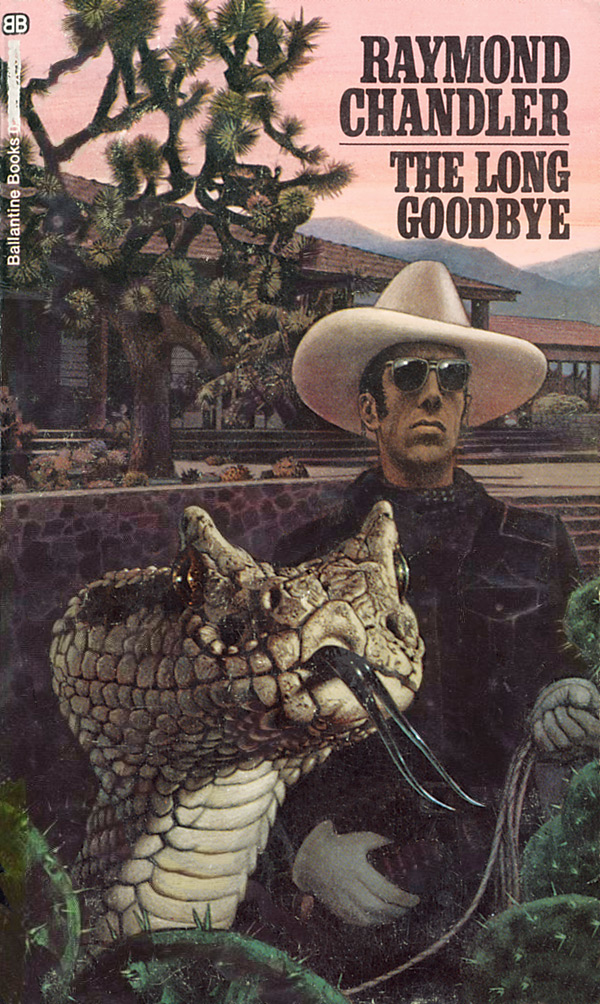
The Long Goodbye


The First Time I Read This Edition

The First Time I Read This Edition

The following is based on my review of Raymond Chandler’s The Long Goodbye for Goodreads.Com:

I had read The Long Goodbye many years ago, and liked it. In the meantime, I have aged—not exactly like a fine wine, but aged nonetheless—and found myself loving Raymond Chandler’s penultimate work. I might even go so far as to say it is his masterpiece, though back then I liked The Big Sleep and Farewell My Lovely more.

This time I detected the raggedness. Chandler’s wife, Cissy, was dying and he felt more vulnerable. This is no tight Agatha Christie thriller than runs like a Swiss clockwork. Not by a long shot. It’s about a nasty, persistent evil that, once you poke it with a stick, keeps coming back to snare you and hurt you. Somehow, Chandler’s detective Marlowe walks the straight and narrow path and comes out alive at the end:

I was as hollow and empty as the spaces between the stars. When I got home I mixed a stiff one and stood by the open window in the living room and sipped it and listened to the groundswell of the traffic on Laurel Canyon Boulevard and looked at the glare of the big angry city hanging over the shoulder of the hills through which the boulevard had been cut. Far off the banshee wail of police or fire sirens rose and fell, never for very long completely silent. Twenty-four hours a day somebody is running, somebody else is trying to catch him. Out there in the night of a thousand crimes people were dying, being maimed, cut by flying glass, crushed against steering wheels or under heavy tires. People were being beaten, robbed, strangled, rape, and murdered. People were hungry, sick, bored, desperate with loneliness or remorse or fear, angry, cruel, feverish, shaken by sobs. A city no worse than others, a city rich and vigorous and full of pride, a city lost and beaten and full of emptiness.

A French Edition of The Long Goodbye

A French Edition of The Long Goodbye

And mind you, this is just the background in which a series of murders and/or suicides take place that call Marlowe’s actions into question and put him in personal peril, such as the time four toughs waylay him in his own house. They included the following:

A man was sitting across the room with his legs crossed and a gun resting sideways on his thigh. He looked rangy and tough and his skin had that dried-out look of people who live in sun-bleached climates. He was wearing a dark brown gabardine-type windbreaker and the zipper was open almost to his waist. He was looking at me and neither his eyes nor the gun moved. He was as calm as an adobe wall in the moonlight.

That last short sentence inspired writer Walter Mosley to begin writing his own series of detective novels featuring Easy Rawlins.

I feel I have not rendered justice to this great novel—probably because it is still working its way through my bloodstream and opening channels in my body that I did not know existed.

“Iron In The Blood Of The People”

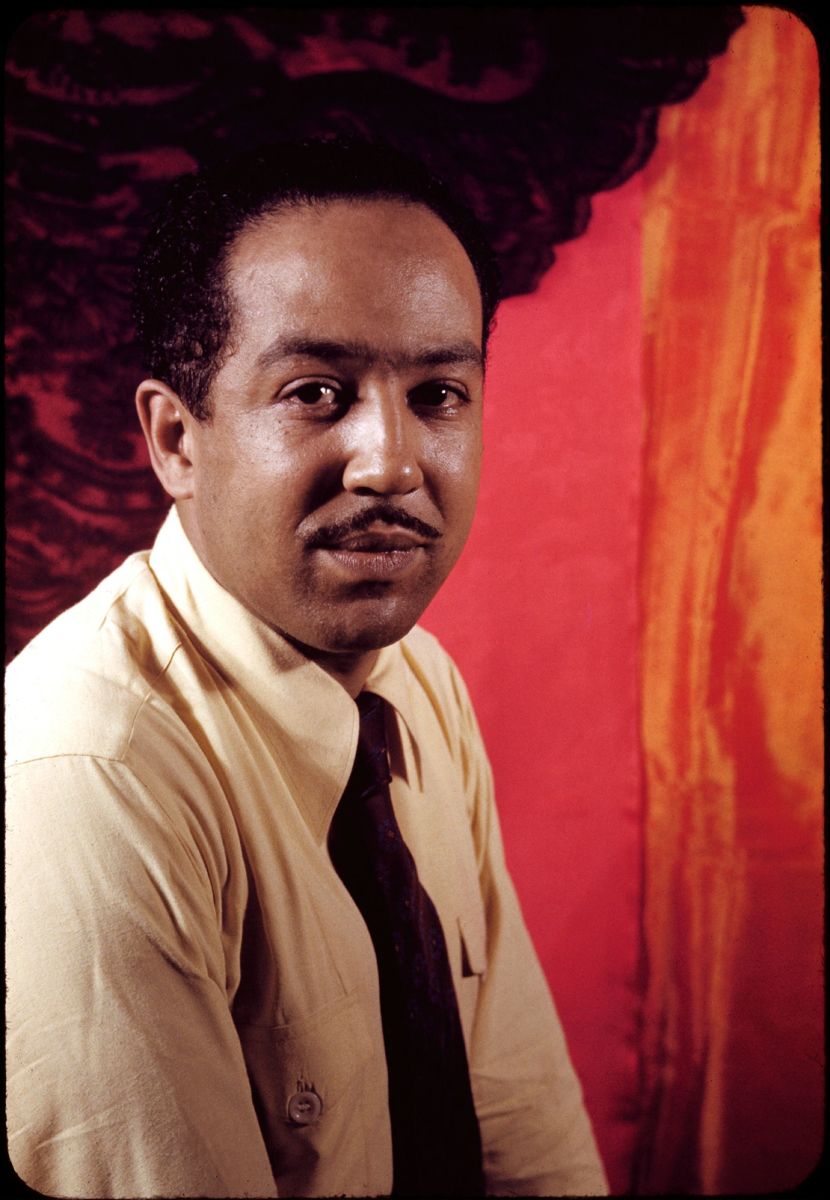
Poet Langston Hughes (1902-1967)

Poet Langston Hughes (1902-1967)

I like this poem by Langston Hughes, which is entitled “Kids Who Die.” Unfortunately, it’s as relevant today as when it was first written.

Kids Who Die

This is for the kids who die,
Black and white,
For kids will die certainly.
The old and rich will live on awhile,
As always,
Eating blood and gold,
Letting kids die.

Kids will die in the swamps of Mississippi
Organizing sharecroppers
Kids will die in the streets of Chicago
Organizing workers
Kids will die in the orange groves of California
Telling others to get together
Whites and Filipinos,
Negroes and Mexicans,
All kinds of kids will die
Who don’t believe in lies, and bribes, and contentment
And a lousy peace.

Of course, the wise and the learned
Who pen editorials in the papers,
And the gentlemen with Dr. in front of their names
White and black,
Who make surveys and write books
Will live on weaving words to smother the kids who die,
And the sleazy courts,
And the bribe-reaching police,
And the blood-loving generals,
And the money-loving preachers
Will all raise their hands against the kids who die,
Beating them with laws and clubs and bayonets and bullets
To frighten the people—
For the kids who die are like iron in the blood of the people—
And the old and rich don’t want the people
To taste the iron of the kids who die,
Don’t want the people to get wise to their own power,
To believe an Angelo Herndon, or even get together.  \1

Listen, kids who die—
Maybe, now, there will be no monument for you
Except in our hearts
Maybe your bodies’ll be lost in a swamp
Or a prison grave, or the potter’s field,
Or the rivers where you’re drowned like Leibknecht \2
But the day will come—
You are sure yourselves that it is coming—
When the marching feet of the masses
Will raise for you a living monument of love,
And joy, and laughter,
And black hands and white hands clasped as one,
And a song that reaches the sky—
The song of the life triumphant
Through the kids who die.

\1 – Angelo Herndon was an African-American labor organizer arrested in Atlanta for insurrection for attempting to organize industrial workers in 1932.

\2 – Liebknecht – Karl Leibknecht was a German socialist who was murdered by paramilitary forces for his role in the failed Spartacist Uprising of 1919.

A City That Is Set On A Hill

Homeless Man on the Street

Homeless Man on the Street

It all started in the 1980s, during the Presidency of Saint Ronald Reagan. Almost overnight, the homeless began appearing in the streets. Over the last thirty years, their numbers have increased to the point that I cannot step out for lunch without getting at least three solicitations for spare change. When I drive home on Ohio Avenue, the bridge under the I-405 is full of tents and cardboard “forts” covered with tarpaulins.

In Matthew 5:14, Christ says, “You are the light of the world. A city that is set on a hill cannot be hidden.” Reagan and other Republicans have been fond of seeing the United States in this light. Sometimes I wonder what foreign tourists think when they see raggedy men and women sprawled on the sidewalks and living under bridges. In my travels, I did not see such sights, not even in supposedly Third World countries such as Peru, Uruguay, Argentina, and Chile.

For whatever reason, our “city that is set on a hill” has become a festering garbage dump. Even in rural America, crystal meth, opiates, and alcohol have stranded untold thousands wandering the streets in search of a meal or a place to crash. Across the street from where I live, people appearing to be homeless have their own cigarettes and cell phones and are, I suspect, dealing in drugs—especially when they make an appearance at their “corner” only intermittently.

As much as I want to help them, I know that my best bet is to help the Salvation Army and the local rescue missions. They can weed out the clearly unworthy more readily than I can. But what of the mentally ill? It seems that they form more than half of the local homeless population. I get this feeling of hopelessness whenever I think of them.

“The Longing for Impossible Things”

Ernie Kovacs and Edie Adams

Ernie Kovacs and Edie Adams

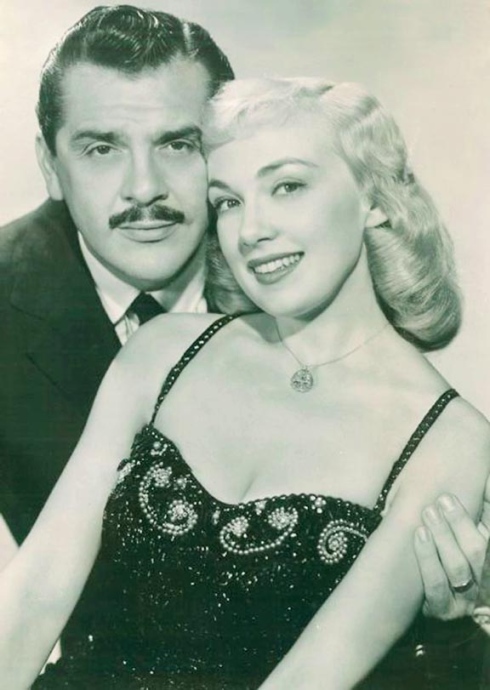
One of the most poignant things about watching old movies and television programs is that, quite suddenly, the veil of years disintegrates, sometimes leaving an image of inexpressible beauty. That happens when I see films with Louise Brooks, Mabel Normand, Marilyn Monroe, and now Edie Adams.

Sunday was a rare wet day in Los Angeles, so Martine and I spent it at the Paley Center for Media in Beverly Hills. While Martine watched some of her old faves, for three hours I watched nothing but the old Ernie Kovacs show. While she was married to Ernie, until he died in a spectacular car crash in West Los Angeles on my 17th birthday, she was in her late twenties and drop-dead gorgeous. The above picture doesn’t do her justice. In the earlier shows on the Dumont and NBC networks, she was cute and obviously in love with her tall Hungarian madman.

Although she had a long and distinguished career in showbiz after the accident, she is buried at Forest Lawn Hollywood Hills next to her late husband.

As a child, I remember watching Ernie because, well, we were Hungarians; and Ernie was our hero. I recall Edie as being lovely. Years later, she still is in those old kinescopes.

As Portuguese writer and poet Fernando Pessoa wrote, “The feelings that hurt most, the emotions that sting most, are those that are absurd—The longing for impossible things, precisely because they are impossible; nostalgia for what never was; the desire for what could have been; regret over not being someone else; dissatisfaction with the world’s existence. All these half-tones of the soul’s consciousness create in us a painful landscape, an eternal sunset of what we are.”

Saint LaVoy, Martyr

Robert “LaVoy” Finicum, When He Walked Among Men

Robert “LaVoy” Finicum, When He Walked Among Men

It is the ultimate goal of all armed U.S. militia members to die in a blaze of glory. Or, anyway, to die. They know they can’t win, that most Americans regard them as dildos. Now that Robert Finicum was shot while grabbing for his loaded pistol, he is being touted as a patriot, hero, and—dare I say it?—martyr. He is forever frozen in time now that he has had his moment.

He can never go back to his eleven children in Colorado City, Arizona.

Wait a minute! Colorado City, Arizona. Isn’t that the isolated town in Northwestern Arizona that is run by the FLDS, the Fundamentalist Church of Latter Day Saints? Isn’t that the town ruled by Warren Jeffs, its patriarch, now serving time in prison for child sexual assault?

Is the late LaVoy a polygamist? Eleven children, but how many wives? How was that association missed by the national press?


On The Other Hand

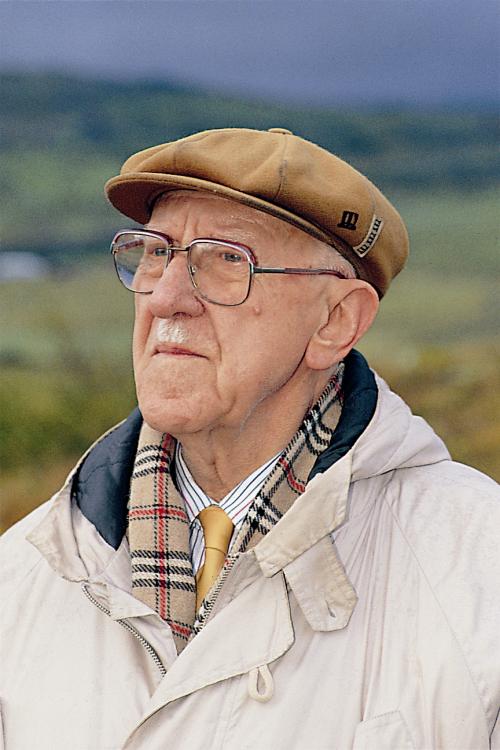
Icelandic Author Halldór Laxness (1902-1998)

Icelandic Author Halldór Laxness (1902-1998)

In yesterday’s blog post, “[Not] The Nobel Prize for Literature,” I blasted the Swedish Academy for awarding prizes to a lot of mediocre writers who have not stood the test of time. As with all annual awards in the arts—and I include the Oscars and the Pulitzer Prizes in this as well—there are a goodly number of clinkers, but there are also some real finds.

Probably the one Nobelist whose work I have discovered and grew to love, perhaps the greatest is Halldór Laxness, Iceland’s sole laureate in literature. In the last few years, I’ve read mot of his work that is available in English translation, including such masterworks as Independent People, Iceland’s Bell, The Atom Station, and World Light.

Although no one I know has ever read any Laxness, I regard him as a giant of world literature. In 2013, I even visited his house in Mosfellsbaer (see below).

Gljúfrasteinn, Home of Halldór Laxness

Gljúfrasteinn, Home of Halldór Laxness

Other Nobelist authors whose work is little known today, but whose work I love,are Knut Hamsun of Norway, Ivan Bunin of Russia, François Mauriac of France, Ivo Andrić  of Yugoslavia, and Miguel Ángel Asturias of Guatemala.

Sometimes, the awards like the Nobels are useful, when they are not tainted by politics. It is said that Jorge Luis Borges of Argentina lost his chance at the prize when he accepted an honor from Chilean dictator Augusto Pinochet. At that point, one leftist member of the Swedish Academy essentially said, “Over my dead body!”

[Not] The Nobel Prize for Literature

Yet Another Great Writer Who Never Received a Nobel

Yet Another Great Writer Who Never Received a Nobel

I don’t have too much good to say about the Swedish Academy, which decides who will receive the Nobel Prize for Literature. If you look at the list of its recipients, it would not take too much effort to produce a list of as great as or even greater literary figures who have not received the laureate. Let me take a stab at it:

  • Kobo Abe (Japan), Woman in the Dunes
  • Chinua Achebe (Nigeria), Things Fall Apart
  • Ryunosuke Akutagawa (Japan), Rashomon
  • Jorge Amado (Brazil), Gabriela: Clove and Cinnamon
  • W. H. Auden (UK), Poetry
  • Georges Bernanos (France), Mouchette
  • Jorge Luis Borges (Argentina), Ficciones
  • Joseph Conrad (UK/Poland), Nostromo
  • Richard Flanagan (Australia), The Narrow Road to the Deep North
  • Graham Greene (UK), The Heart of the Matter
  • Vassili Grossman (Russia), Life and Fate
  • Henry James (US/UK), The Ambassadors
  • James Joyce (Ireland), Ulysses
  • Yashar Kemal (Turkey), Memed, My Hawk
  • Gyula Krúdy (Hungary), The Red Post Coach
  • Stanislaw Lem (Poland), Solaris
  • Osip Mandelstam (Russia), Poetry
  • Vladimir Nabokov (US/Russia), Lolita
  • Fernando Pessoa (Portugal), The Book of Disquiet
  • Marcel Proust (France), In Search of Lost Time
  • Arkady and Boris Strugatsky (Russia), Roadside Picnic
  • Italo Svevo (Slovenia), Confessions of Zeno
  • Leo Tolstoy (Russia), Novels and Stories
  • Mark Twain (US), Novels and Stories
  • Evelyn Waugh (UK), Brideshead Revisited
  • Virginia Woolf (UK), Mrs Dalloway

As you can see, I have not overloaded the list with the names of American authors, in the interests of being fair. If I wanted to, I can add names like Philip Roth, Ursula K. Le Guin, Joyce Carol Oates, Philip K. Dick, Cormac McCarthy, James Baldwin, Ralph Ellison, and a few others.

These can replace such figures as the following, whose reputations have not kept up with the times: Bjornsterne Bjornson, José Echegaray, Giosue Carducci, Rudolf Christoph Eucken, Paul von Heyse, Verner von Heidenstam, Karl Adolph Gjellerup, Henrik Pontopiddan, Carl Spitteler, Jacinto Benavente, Grazia Deledda, Erik Axel Karlfeldt, Pearl S. Buck, Frans Eemil Sillanpaa [SIC], Johannes Vilhelm Jensen, Earl Russell, and a few dozen others—mostly Scandinavian nonentities which at one time were highly thought of by a couple dozen mouldy Swedish academics. (Please forgive me for being lax about the diacritical marks in the above names.)


The Three Houses of the Poet

Isla Negra Where Neruda and His Wife Are Buried

Isla Negra Where Neruda and His Wife Are Buried

I haven’t written about South America lately, so I decided to return to it. If my visit to Chile seems haphazard and unplanned (Puerto Varas to Valparaíso to Santiago), it is because my sightseeing goals were, to say the least, abstruse. Remember, I probably wouldn’t have gone to Argentina if it weren’t for my readings of such writers as Jorge Luis Borges, Adolfo Bioy Casares, Juan José Saer, and César Aira. My favorite Chilean writer is the poet Pablo Neruda. So I went to Chile to visit his three houses.

It’s not really abstruse, I guess, because Neruda was not only a great poet; he was also a great domestic architect and designer. He had some money to work with because he was not only a poet, but served various diplomatic posts, particularly in Mexico.

The first house I visited was at Isla Negra, about an hour south of Valparaíso. It was my favorite of the three, located as it is on a nice stretch of beach. Also it was not trashed by Pinochet’s fascist supporters after Salvador Allende fell, like La Chascona in Santiago was. Isla Negra seems to go on forever, with quirky bars, dining rooms, nautical and railroad themes, and fascinating collectibles.

La Sebastiana in Valparaíso

La Sebastiana in Valparaíso

High on a hill, on Avenida Alemania, with a sweeping view of Valparaíso’s bay, is the towering La Sebastiana. Like Isla Negra, it still has all the original furnishings, with the poet’s quirky love of nautical themes. On the day I went, the house was full of French tourists.

Santiago’s La Chascona

Santiago’s La Chascona

Finally, in the city’s ritzy Bellavista area is La Chascona, which means “messy hair.” The reference is to wife Matilde Urrutia’s hair. This house is tucked against a hill and does not have any sweeping views the way the other two houses do. Although the original furnishings were trashed in 1973 by fascisti supporting dictator General Augusto Pinochet, Matilde managed to salvage many of her late husband’s original decorations, such that one scarcely notices the damage that had been done.