French Noir? Obscurité Française?

Still from Jean-Pierre Melville’s Le Samouraï (1967)

It sounds a bit odd to talk about French noir literature and films, mainly because noir is a French word. Perhaps I should be talking about Obscurité Française. This afternoon, I watched a work of that master of French noir, Jean-Pierre Melville. His film Le Samouraï is a masterpiece, both in its spare visual style and its typical noir attributes. Alain Delon as Jef Costello, the hit man, is a pleasure to watch, as is François Périer, the police superintendent, who goes all out to arrest Jef based on his belief that his alibi would not hold up.

Melville has made other excellent noir films as well, including Bob le Flambeur (1956) and Le Doulos (1963). But Le Samouraï is his best by far.

In addition to noir films, the French are no strangers to noir fiction. Yesterday, I read Three to Kill (1976) by the late Jean-Patrick Manchette (1942-1995), who also wrote Fatale (1977) and Ivory Pearl (1996), the latter of which was unfinished. I am also interested in reading works by Boris Vian (1920-1959), author of I Spit On Your Graves (1946).

The United States has an embarrassment of riches in the genre, starting with Raymond Chandler and Dashiell Hammett, and continuing with David Goodis, Cornell Woolrich, James M. Cain, Mickey Spillane, Charles Willeford, Jim Thompson, Dorothy B. Hughes, Kenneth Fearing, W. R. Burnett, and a host of others. They are one of the joys of recent American literature which I have been taking advantage of during this long, hot summer.
 

The Deserts of This Earth

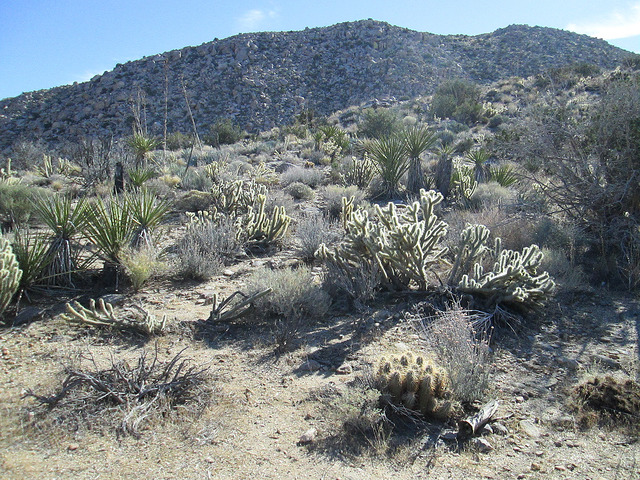
Hillside with Cholla Cactus in the Anza-Borrego Desert

California has a number of distinct desert zones, ranging from Death Valley in Inyo County to the Mohave Desert around I-15 and I-40 along the route to Las Vegas and Northern Arizona to the Anza-Borrego Desert east of San Diego. My friend Bill also tells me about the Carrizo Plain National Monument, which also seems to be a desert, one which I have not yet visited. And undoubtedly there are several I am not taking into account.

One thing they all have in common: Don’t go there in the summer if you don’t want to die of discomfort and have your car stranded on some obscure untraveled highway. In the winter, on the other hand, the desert is lovely and beguiling. Do you see those cholla cactuses in the center of the above photo? When the sun shines through their barbed needles, they look positively huggable. But don’t even try! If you brush against cholla spines, they will stick to your skin and your clothing, and you will have the devil’s own time disposing of them.

During the spring, you are likely to see that every inch of the rough desert surface seems to be covered with tiny wildflowers. The efflorescence lasts only a few weeks, and you have to time your visit carefully and call locals to see if it’s happened yet. And it generally happens only after a wet rainy season. We haven’t had many of those lately.

Because California is on the ring of fire, you can occasionally find natural hot springs in which you can bathe. There is one such in Anza-Borrego on County Road S-2 south of Scissors Crossing. To get there, one passes by the old Butterfield Stage Route; and you can even stop at one of the Butterfield Stage stations which has been restored to its 19th century glory.

When it’s too cold to go the beach, consider the desert.


La Politique des Auteurs

Cahiers du Cinema: The French Film Journal That Started It All

I find now that yesterday’s post took a lot for granted. One can’t just float a concept like the auteur theory and expect to be understood. When I first got into films at Dartmouth College, I was influenced by a French monthly called Cahiers du Cinema, and by the work of an American film critic writing for the Village Voice named Andrew Sarris, who tried to translate the French critics’ ideas into the American idiom. For Film Culture magazine (Winter 1962/1963), he wrote a long article entitled “Notes on the Auteur Theory in 1962.” I photocopied his article and kept it with me for years, until he turned it into a book in 1968 entitled The American Cinema: Directors and Directions 1929-1968.

The whole issue of the auteur theory is simple: If the cinema is an art form, then who is the artist in the cinema? Is it the producer? No, he’s mostly just a money man. Is it the film studio? Again, their major concern is money. Is it the writer, the actors, the director of photography, the editor? No times four. They just do what they’re told to do. The auteur theory elevated the director to the role of the artist. When the director is a studio hack, the result can be entertaining, but is rarely great. Yesterday, I wrote:

Why did I not go to the movies this year? Simply put, I remain an auteurist; and there were few films this year made by the directors whose work I follow. I am not interested in the films of William Seiter, Norman Panama, Archie Mayo, George Archainbaud, Alan Crosland, Alfred L. Werker, and any number of studio hacks who never signed their names to a great film. They were for the most part competent film makers whose work was light and entertaining; but I was after bigger game.

Now thye French considered Jerry Lewis to be an auteur, a true film artist. His films after he parted with Dean Martin are usually directed by him in a consistent and very competent way. You may not think that Jerry Lewis is a film artist, but he fits the idea the French have of the immature American male—like it or not.

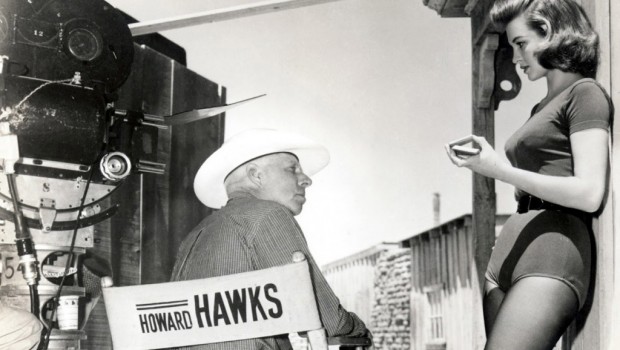
Director Howard Hawks with Angie Dickinson on the Set of Rio Bravo (1958)

So who are the great film auteurs? There are almost as many lists as there are film critics. I remembered long discussions with my fellow film freaks in the late 1960s as to who was great and who wasn’t: I called the activity “trading bubble gum cards.”

Here is Andrew Sarris’s auteur pantheon:

  • Charles Chaplin
  • Robert Flaherty (he wouldn’t make my list)
  • John Ford
  • D. W. Griffith
  • Howard Hawks
  • Alfred Hitchcock
  • Buster Keaton (though he didn’t sign his name as director)
  • Fritz Lang
  • Ernst Lubitsch
  • F. W. Murnau
  • Max Ophüls
  • Jean Renoir
  • Josef von Sternberg
  • Orson Welles

A few of the names are predominantly European directors who also made several films in America (like Murnau, Ophüls, and Renoir).

Everything Changes

Try to Get Your Kids Interested in This!

This year for the first time in many years I have not attended the films at Cinecon. I did, however, go with Martine to the memorabilia dealers’ rooms. In the past, when my friend Norman Witty was alive, Martine enjoyed acting as his assistant; and she made a number of friendships with the other dealers. So while she chatted with her old friends and acquaintances, I found a comfortable chair and read a book. Also I devoted some time to thinking about what was happening to the dealers and members of Cinecon.

In short, they were getting older and passing on. I saw few people under the age of sixty at the dealers’ tables.

Why did I not go to the movies this year? Simply put, I remain an auteurist; and there were few films this year made by the directors whose work I follow. I am not interested in the films of William Seiter, Norman Panama, Archie Mayo, George Archainbaud, Alan Crosland, Alfred L. Werker, and any number of studio hacks who never signed their names to a great film. They were for the most part competent film makers whose work was light and entertaining; but I was after bigger game.

Then I thought,“Wait a sec! How many auteurists are around these days?” The answer is: damned few, and fewer every year. Instead people go to see superhero films intended for very young males, starring powerful guys and gals who like to wear their Underoos over their street clothes. Then there are the numerous independent productions, about the problems of young people who are altogether too full of themselves. What do I care about Hipster man with his man-bun and immaculately trimmed beard and all his digital toys?

Many of my posts have not been kind to the younger generation—mostly because the things they value are nothing to me, and the things I value, nothing to them. For how long will Cinecon be around to commemorate films of the 1920s and 1930s? I mean, people, we are talking about films that are not even in color!

After my generation leaves the scene, many whole worlds will disappear as if in a puff of cosmic dust.


The New Yorker Gets Him Right

That Has Been My Viewpoint Ever Since He Got on That Escalator

If we ever get through this presidency in one piece, we will look back on the cover art of The New Yorker as representative of the way that thinking, feeling people reacted to our 45th President. (As to how his supporters feel, I could care less.) I have been reading the magazine on and off for over half a century. In the end, what I remember most are the covers. There are a few stories that I will always remember, such as the issue that contained the whole of Truman Capote’s In Cold Blood.

I will always remember Election Night 2016 as the worst night of my life. I was in Quito, Ecuador, watching the results coming in on CNN. As the night went on, I was feeling sicker and sicker. The next day, I was to fly back to the U.S., which I suspected was about to be changed forever—for the worse!

He Never Did Clear the Swamp, Did He?

He always presented himself as smart, handsome, and rich. It has become grotesquely apparent that he is dim, ugly, and corrupt. As to his handsomeness, there is this cover:

Yeah, Well, the Emperor Has No Clothes


A Different Jesus

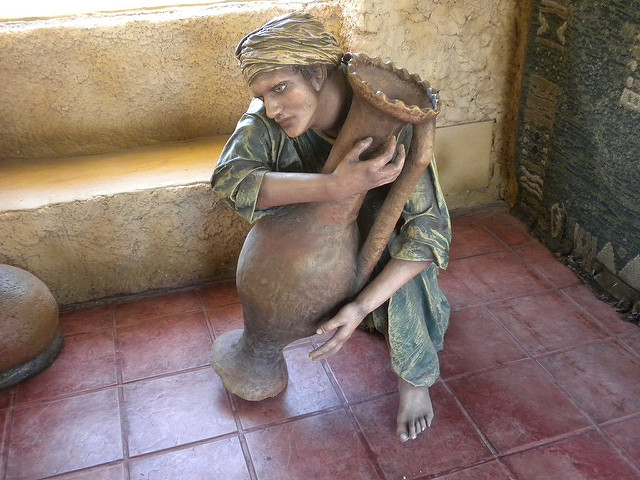
The Crowning With Thorns at Buenos Aires’s Tierra Santa

This country is so Protestant, so Evangelical, that it is positively refreshing to visit a Biblical theme park that is oriented toward Catholicism. The Tierra Santa Theme Park in Buenos Aires does not get many American or European tourists. Its website is in Spanish only.

The park is set along the south bank of the River Plate, just west of the Aeroparque Jorge Newberry. You can see animatronic figures of the Creation, of the Last Supper, and other events from the life of Christ. There are a few references to the Old Testament, but not many. If you get hungry, you can dine on pita bread with hummus and other foods that are reminiscent of the time and place.

The Wedding at Cana: “There is no more wine.”

It’s probably better to go there via taxi, but both times I went, I took the Belgrano Train Line to the Estación Scalabrini Ortiz, only a few minutes from the Retiro railroad terminal. It involves taking a nice walk along the River Plate and looking across the muddy waters at Uruguay. There is generally a cool breeze along the river, which makes the 20-minute walk from the station bearable.

Frankly, one of the things I like about South America is that it is unabashedly Catholic. To be sure, the Evangelicals are making inroads; but I can more easily ignore them than I can in the United States. My pictures of Latin America include a lot of churches, because I visit a lot of churches. They look like churches. In Los Angeles, the Cathedral of Our Lady of the Angels looks more like a warehouse than a church. It was built by former Cardinal Roger Mahony: Therefore, it is often referred to as the Taj Mahony.


Serendipity: At El-Kharga

The Oasis of El Kharga in Egypt

I am currently reading Jan Morris’s Contact! (2009), which is a whole book full of serendipity type encounters which travel writer Jan Morris (formerly James Morris when she was a male) had all around the world. This is only the first of what will probably prove to be more postings along this line.

El Kharga is one of the five isolated oases which lie well to the west of the Nile in the Egyptian desert, and it always has been a place of exile. Nestorius was banished there, and Athanasius too, it is said. In our time political prisoners are immured in a detention camp at the oasis, and I once encountered some of them. They were patients in the local hospital, lying on straw palliasses on the floor of a bare ward. A murderous lot they looked, all the more sinister because bandages and plasters covered their eyes and supported their limbs—one and all were enemies of the state, and their interrogations had not been easy. I talked to them warily of this and that, the conditions of their detention and their hopes of release, and they told me that every morning they were given a lecture of indoctrination by a representative of the regime. Something in their eyes, though, told me they were far from brainwashed, and now and then a particularly savage old dissident lying in a corner intervened with a caustic witticism, delivered in the most cultured of English accents and with the bite of an incisive mind. Thus Nestorius might have spoken, I thought, during his exile at El Kharga.


The Cemetery Cats

Homeless Cat at Recoleta Cemetery in Buenos Aires

One of the biggest tourist draws in Buenos Aires is Recoleta Cemetery, surrounded on all sides by a high-toned urban neighborhood. Tourists go mainly to see where Evita Perón is buried (she’s buried there under her maiden name, Eva Duarte, in the Duarte family crypt. In addition to Evita, virtually everyone who was anyone was at Recoleta, including a number of former presidents, as well as numerous generals and admirals. Not buried at Recoleta is Juan Perón, who was refused admission there, buried at Chacarita Cemetery off to the south, and then, after the body was vandalized, moved to a special crypt at the Museo Histórico Quinta 17 de Octubre in the suburb of San Vicente.

Not quite so well known is that Recoleta Cemetery is full of cats. It is one of several public places in B.A. that is infested with felines, including a botanical garden in nearby Palermo. The kind-hearted Argentinians typically feed these cats, so they are not quite 100% feral. They are a bit wild, however, though they recognize their benefactors. I thought the cats wandering the concrete walkways of the Recoleta were a nice touch.


Don’t Go Here in August

Ruins of the Bank Building in Rhyolite, Nevada

In January 2008, Martine and I spent a few days in Death Valley. It is a totally fascinating place, surrounded by ghost towns (such as Rhyolite, above) and mining shafts. The fascination wears off somewhat if you should try to visit in the summer, as the rangers tell us that German tourists tend to do. When the thermometer hits 130° Fahrenheit (54° Celsius), tourism is secondary to survival. Crawling up the mountain pass of the Panamint Range, your car will pass several water tanks to replenish the fluid in your radiator. Should you not pay attention to your radiator temperature, you had best just pull over and crawl under your car with several gallons of water, preferably cool—at least to start with.

Death Valley was the site of my first ever camping trip, back in 1979. We made it to Furnace Creek campground after midnight. Too weary to pitch our tents, we just lay our sleeping bags over groundcloths and dropped off, only to be awakened by early by a overactive flock of birds that landed in the campground or circled above our heads. The desert was starkly beautiful, and I fell in love with it from the start.

Ubehebe Crater in the Northern Part of Death Valley

I got an altogether different picture of the desert around 1995. Martine was working at the Twentynine Palms Marine Combat Center as a civilian employee. I would visit her several times during the summer, when it was REALLY, REALLY hot. I had to use an oven mitt to open my car door, lest my hand merge with the handle. I don’t know how Martine stuck it out there as long as she did. Eventually, she quit and moved in with me.

Now my brother lives in the desert, in Palm Desert, to be exact. Of course, he has air conditioning and a swimming pool to take some of the sting out of the climate. But I will likely not visit him until the temperature cools.


The Totems of the Cowichan

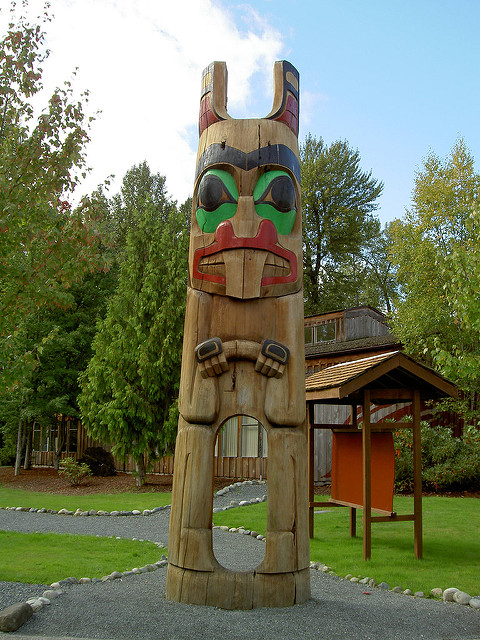
Totem Pole at Cowichan Center, Duncan B.C.

The first vacation I took with a digital camera was to Seattle, Victoria and Tofino (both on Vancouver Island), and the city of Vancouver. One of the highlights of that trip was a visit to Duncan on Victoria Island, roughly midway between Victoria and Nanaimo. The city bills itself as “The City of Totems,” mostly because of the large number of totem poles created by the Cowichan First Nation. At he time (2004), there was a very active visitor center with a restaurant containing Cowichan delicacies and even a program of native dancing.

On that particular vacation, I was traveling alone. Five years later, I repeated my itinerary from 2004. One of the biggest disappointments was the Cowichan visitor center in Duncan. Over a period of five years, neglect had set in. Many of the buildings, including the restaurant, were closed. It seems as if the center were re-positioning itself as a conference site for hire. I guess the economics of using the center as a tourist destination in 2009 were a bit prohibitive. I can only hope they make a comeback: On my first visit, I really liked the place.

Another Cowichan Totem Pole at Duncan

The German-American anthropologist Franz Boas was an expert on the early art of the tribes of the Northwest. His book Primitive Art (1927) attempts to explain how the totem poles functioned in the cultures of the various tribes. It’s a difficult read, but like many difficult reads, eminent worthwhile.